If you want to reduce indoor dust without cleaning daily, attack it at three points: stop it entering the house, capture what is already floating in the air, and cover the surfaces that collect it. Set up the first two and your weekly routine gets short enough to keep up with.
Most of the dust you see is not new. It is old dust that got lifted back into the air when someone walked through, vacuumed or opened the curtains, and then settled somewhere else within a couple of hours.
Here is the order I would follow, and roughly how long each stage takes.
Table of Contents
- What You Need
- How to Reduce Indoor Dust Without Cleaning Daily: Step-by-Step
- Step 1: Find the dust buildup hotspots
- Step 2: Reduce dust at the source
- Step 3: Filter the air continuously
- Step 4: Use the right cleaning tools when needed
- Step 5: Automate small maintenance tasks
- Step 6: Maintain the dust-control setup
- Common Mistakes
- Frequently Asked Questions
- How do I stop my room from getting dusty all the time?
- Do air purifiers really get rid of dust?
- What is the simple trick to eliminate dust?
- How to reduce indoor dust naturally?
- How often should filters and cleaning happen?
- Does this work in a small apartment with pets?
- Conclusion: Start With the Biggest Dust Traps
What You Need
None of this is mandatory, and buying everything at once is a waste. Work down the list and add a piece only when the previous one is already working.
- An entryway mat plus a door mat combo. Anything that traps grit before it reaches the hallway floor. Coir or outdoor-rated rubber mats hold more than thin indoor carpet.
- A vacuum with a sealed HEPA filter. A standard vacuum with a paper bag lets fine dust escape back into the room through the exhaust. A sealed bag or canister plus HEPA keeps it in the machine.
- A damp microfiber cloth and a dry one. Two cloths, one damp for wiping, one dry for the final pass. Washable, cheap, and the single biggest upgrade over a feather duster.
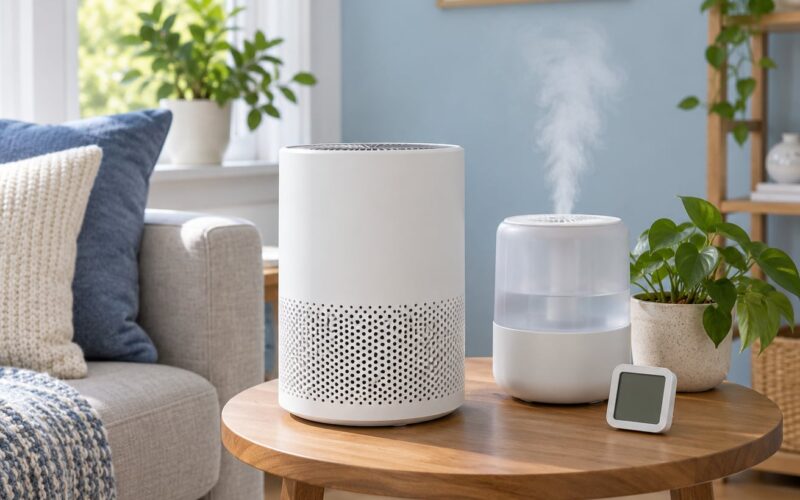
- An air purifier with a replaceable HEPA filter. Size it to the room, not to the largest room in your home. Check that replacement filters are sold for your exact model before you buy.
- A hygrometer. A ten-dollar indoor thermometer with a humidity readout tells you where your relative humidity actually sits. Most people guess, and most guess wrong.
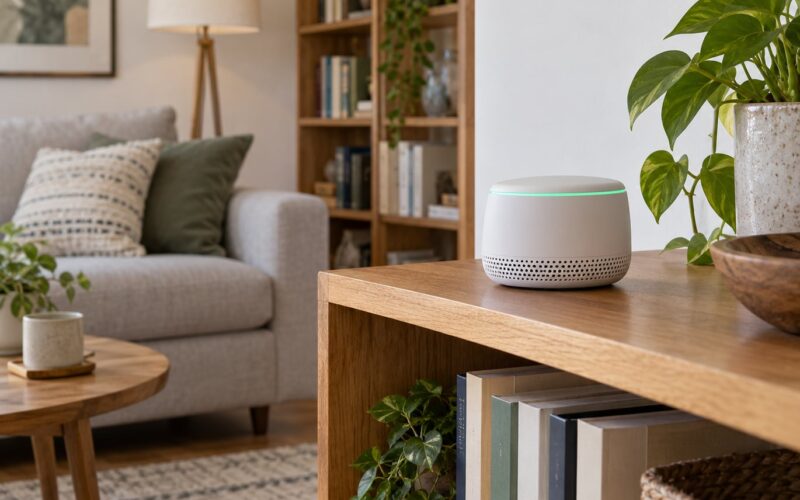
- A smart plug and an air quality sensor (optional). Both are useful if you already run a smart home. Neither is required to see results.
- A robot vacuum (optional). Worth it only if you already have hard floors or low-pile carpet. It handles the daily floor layer so your hands stay free for the surfaces a robot cannot reach.
How to Reduce Indoor Dust Without Cleaning Daily: Step-by-Step
Step 1: Find the dust buildup hotspots
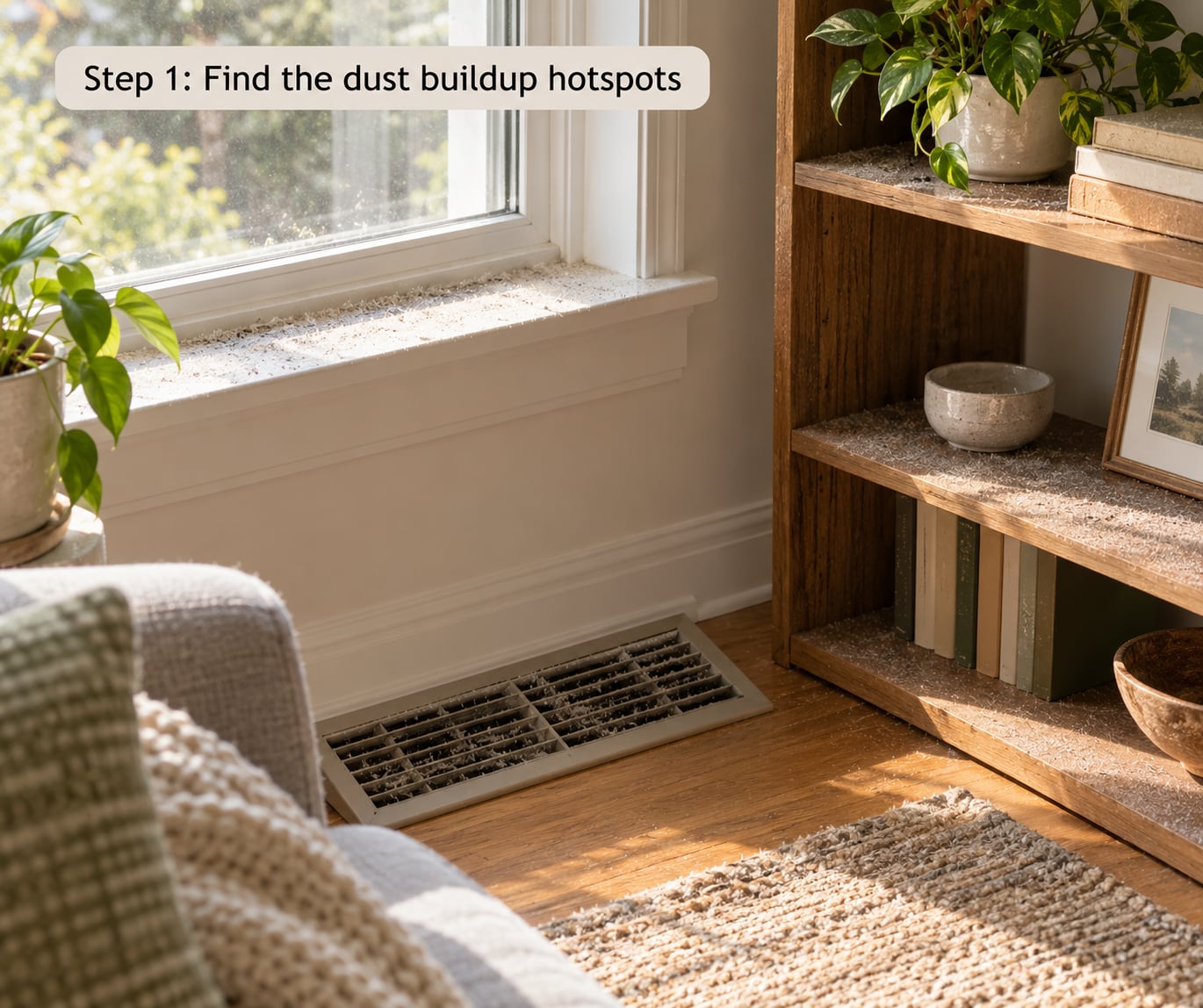
Start by looking, not by cleaning. Go through each room and note where dust is thickest, because that tells you where your real source is.
Check windowsills and the glass, the horizontal blades of any ceiling fan, the lip of each return vent, and the top edge of baseboards. Look behind and under furniture rather than on it, and check the tops of electronics, speakers and TV stands.
In the bedroom, look at the headboard, the top of the wardrobe and the slats of the bed frame. Bedding is a bigger source than most people expect, and it is a source every single night.
You will notice a pattern. Dust heaviest near an entry door means tracked-in dirt. Dust heaviest in one corner near a vent or a window seal means a filtration problem. An even thin layer everywhere means fabric surfaces shedding.
Step 2: Reduce dust at the source
Source control is the part that stops the daily cycle, and it costs nothing.
Shoes off at the door is the highest-return habit for almost every household. Put the mat where people actually walk in, not where the door swings, because that is where the grit drops anyway. Outdoor shoes on a rack, never on carpet.
Wash bedding weekly on a hot cycle and use washable mattress and pillow covers. Dust mites feed on skin flakes in warm bedding, and heat is what kills them, so cold-only washing does much less than it sounds like it should.
Pet dander is the other big indoor source, and no filter fully compensates for it. Keep the coat groomed, wash pet bedding often, and give the pet its own sleeping spot that is not the upholstered sofa.
Cooking smoke and candle soot settle directly onto horizontal surfaces. A range hood vented outside, and no candles in the room where you are trying to keep surfaces clean, both remove a surprising amount of the film you have been wiping away.
Finally, keep windows shut and use recirculation during high pollen or outdoor pollution days. Opening the windows on a dry, windy afternoon refills the house in an hour.
Step 3: Filter the air continuously
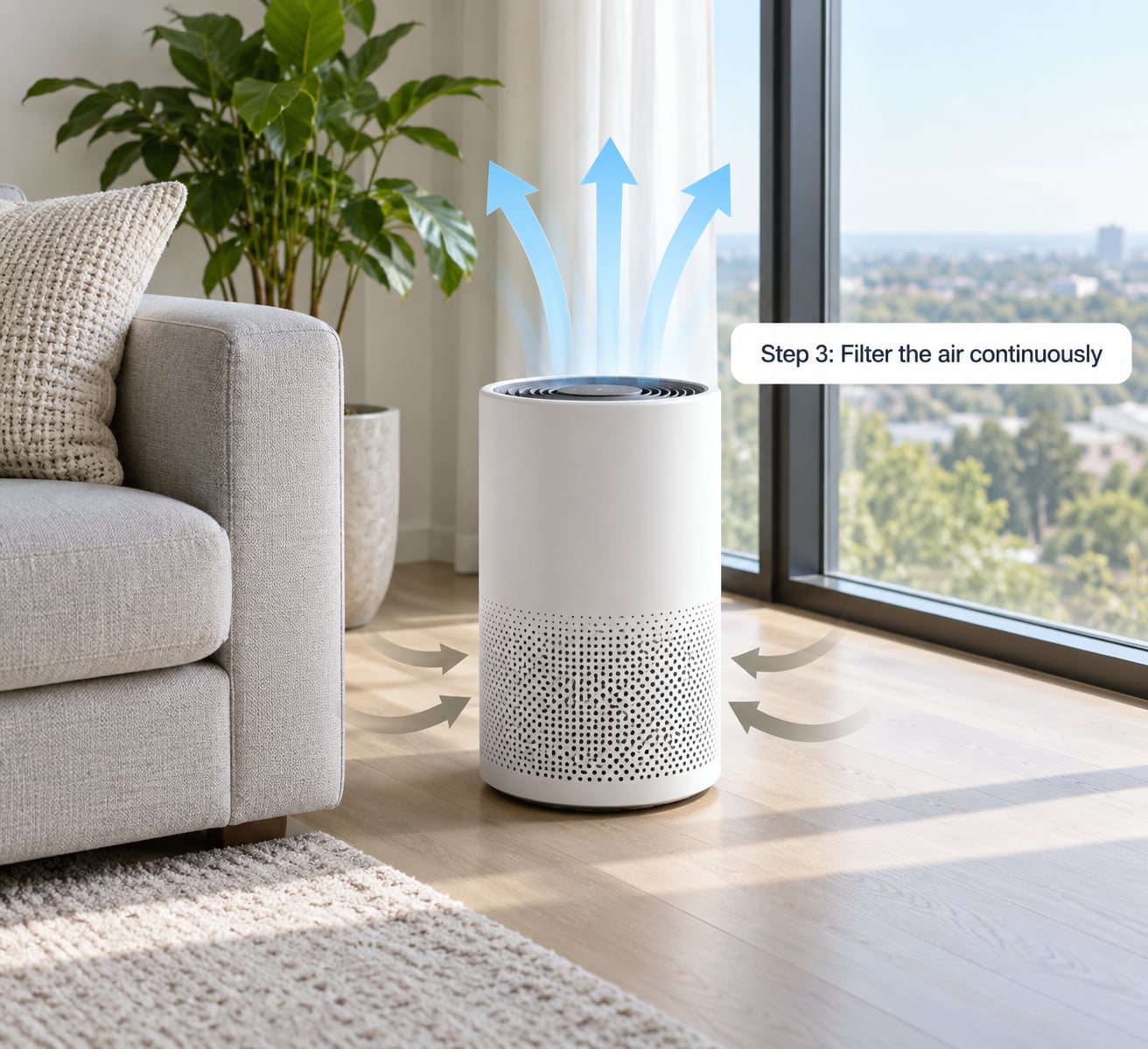
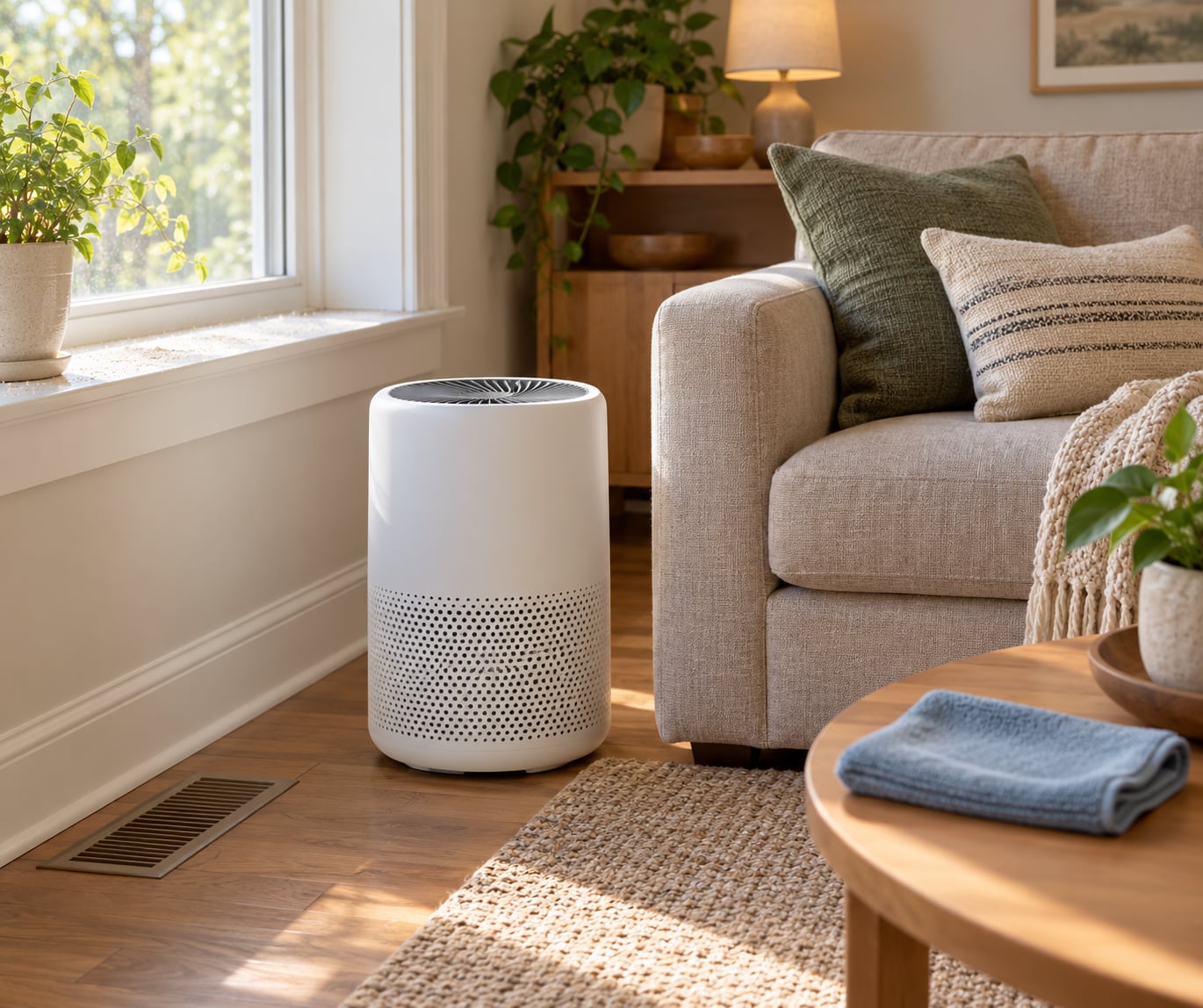
A purifier is not a vacuum. It captures the fine dust still floating in the air so it never lands on a surface, which is exactly the dust you cannot reach with a cloth.
Size it by CADR, the clean air delivery rate. A unit rated too small for the room leaves a lot of dust suspended and gives you the frustration of owning an expensive fan. Leave at least a foot of clearance on every side, and never push it against a wall or into a corner where intake is restricted.
Run it on low or auto continuously rather than blasting it when you walk in. Continuous low-speed filtration keeps the airborne load down so less ever settles, while high speeds mostly just move the dust around the room.
If your purifier has an auto mode driven by a particle sensor, that is the easiest good default. It idles when the air is clean and steps up when dust or cooking raises the count, so you do not have to think about it.
Change the HVAC filter too. A dirty furnace filter becomes a mesh that catches debris and then slowly re-releases it every time the fan kicks on. Check it at the start and middle of each heating season, and again when the central fan runs for cooling.
Step 4: Use the right cleaning tools when needed
With source control and filtration in place, you only need to touch surfaces once a week. The tool choice decides whether that one pass removes dust or just moves it to the next room.
A feather duster is the worst option available. It moves dust around and pushes a fine fraction into the air where it resettles somewhere you will find later. Damp microfiber traps particles on the cloth instead.
Wipe with a lightly damp microfiber cloth, then follow with a dry one on the same pass. Wring it out properly so it is damp rather than wet, and work from the far side of the room toward the door so you do not walk over clean surfaces.
For shelves and knick-knacks, a long-handled duster knocks down the loose layer first, then you wipe. That two-stage approach is faster than trying to capture everything with the cloth alone.
For floors, a sealed HEPA vacuum with a beater head or a brush roller removes what a broom only pushes around. Vacuum slowly, overlapping each pass, and empty the canister or bag outdoors or in the garage rather than in the hallway.
For electronics and screens, dust with a dry soft cloth while the device is off and unplugged, and never spray anything directly onto a display.
Step 5: Automate small maintenance tasks
Automation is where the time savings actually come from, and it works best on the tasks nobody notices are missing.
Schedule the robot vacuum to run while the house is empty, ideally at night, so nobody is stepping on a freshly cleaned floor. On hard floors this alone removes the daily layer that would otherwise resuspend and resettle.
Put the purifier on a smart plug with a schedule, or leave it on auto, so it runs every day without anyone flipping a switch. This is the easiest habit to adopt and the easiest to abandon, and a plug removes the reason to abandon it.
Pair a purifier with an air quality sensor if your ecosystem supports it, so the fan speeds up when particulate counts climb rather than when you guess. Cooking on the hob is a good trigger test.
Use calendar reminders for the monthly jobs: bedding hot wash, filter check, washable cover washing. A recurring reminder costs nothing and is far more reliable than memory.
Automate the fan, the purifier and the robot. Do not try to automate wiping shelves, because no machine handles that well yet and a half-hearted attempt usually means the shelf is done badly.
Step 6: Maintain the dust-control setup
If you are trying to reduce indoor dust without cleaning daily, this monthly pass is what keeps the earlier work in place. It should take about half an hour.
- Weekly: vacuum or run the robot, wipe flat surfaces with damp microfiber, wash bedding on a hot cycle.
- Monthly: wash microfiber cloths and entryway mats, check the hygrometer reading, clean washer lint filter if you have one, wipe the tops of vents and ceiling fan blades.
- Every quarter: replace the HVAC filter if it is a disposable type, empty the vacuum, check the purifier’s filter indicator and airflow path.
- Seasonally: clean or replace the furnace filter, check window seals, and clean upholstery and throw rugs.
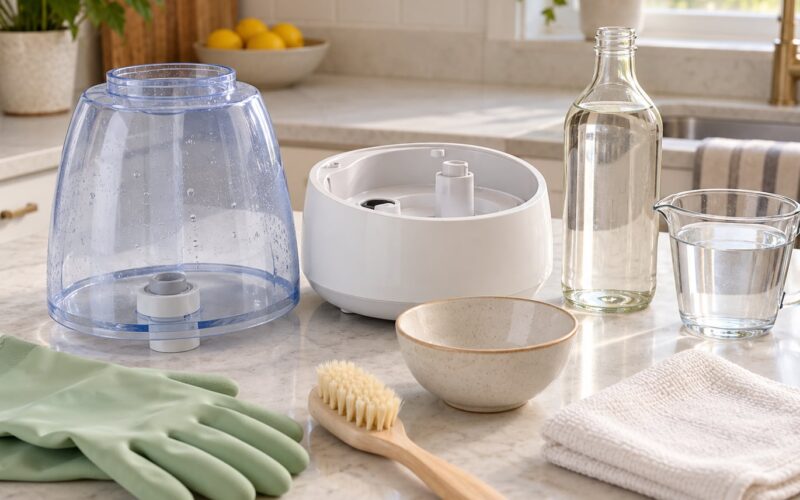
If the humidifier runs in winter, empty and dry it weekly. A damp reservoir grows biofilm, and a musty smell sends people looking for a leak that does not exist.
To check whether any of this worked, hold a flashlight sideways in a dark room with the beam visible. Note how much drift you see, then look again two weeks later. Or put a dark sheet of paper on a shelf and see how fast it greys up. Both cost nothing.
Common Mistakes
Dry dusting with a feather duster. This is the big one. The duster spreads dust into the air and most of it lands again within a few hours. Damp microfiber, followed by a dry pass, keeps the dust on the cloth.
Pushing the purifier against a wall or into a corner. Blocked intake cuts the airflow, and a purifier with restricted airflow filters almost nothing. Give it clear space on all sides and run it on low all day.
Forgetting the HVAC filter. A loaded filter stops filtering and starts shedding. Mark the filter housing with the install date so you stop relying on memory.
Keeping far more fabric than you need. Upholstered furniture, drapes, wool blankets and stacked textiles are the largest dust generators in a room. If you can swap one for a hard surface, that swap beats any purifier.
Expecting one device to solve it. A purifier captures airborne dust but does nothing about grit tracked in on shoes or dust already sitting on a shelf. The air side and the surface side are separate problems.
Leaving windows open on dry, windy or high-pollen days. You are refilling the room you just cleaned. Keep windows shut and the system on recirculate when the outdoor air is worst.
Over-decorating open shelves. Every horizontal surface is a collector. Closed or glass-doored storage cuts the number of surfaces you have to wipe, which is a bigger win than any cloth.
Frequently Asked Questions
How do I stop my room from getting dusty all the time?
Find the source before you buy anything. Dust heaviest near the door means tracked-in grit, so add an entryway mat and a shoes-off rule. Dust heaviest by a vent or window seal means a filtration problem, so replace the HVAC filter and run a purifier on low continuously. An even layer everywhere points at fabrics, so wash bedding weekly and cut down on soft furnishings. Judge the fix over two weeks with the flashlight-beam test before changing anything else.
Do air purifiers really get rid of dust?
They remove the airborne fraction, which is the fraction you cannot reach with a cloth, but they do nothing for dust already settled on shelves or grit tracked in on shoes. A purifier with a sealed HEPA filter running continuously on low keeps the airborne load down so less ever lands. Size it to the room using its CADR rating, leave clearance on every side, and expect to change the filter every few months.
What is the simple trick to eliminate dust?
Dampen the cloth. Most people dust dry with a feather duster, which pushes particles into the air where they resettle within hours. A lightly damp microfiber cloth traps dust on the fabric, and one dry pass over the top picks up the streaks. Combined with shoes off at the door and washing bedding weekly on a hot cycle, that is the smallest change set that produces the largest visible drop.
How to reduce indoor dust naturally?
Use habits rather than gadgets: an entryway mat and shoes-off rule at the door, shoes stored off carpet, washing bedding and pet bedding weekly on a hot cycle, washable mattress and pillow covers, hard surfaces instead of more upholstery, and relative humidity held between 30 and 50 percent. Keep windows shut on dry, windy or high-pollen days and run the HVAC on recirculate so outdoor particles are not pulled in.
How often should filters and cleaning happen?
A steady weekly rhythm works better than a big clean followed by a lapse. Vacuum or run the robot weekly, wipe flat surfaces with damp microfiber, and wash bedding weekly on hot. Check the HVAC filter monthly and replace it quarterly, or sooner if it looks grey. Check the purifier filter indicator monthly and replace on the manufacturer’s schedule. Run the monthly maintenance pass as a single half-hour block.
Does this work in a small apartment with pets?
Yes, and pets make the source-control steps matter more. Keep the animal off upholstered furniture and off the bed, wash pet bedding weekly on hot, and vacuum the pet’s sleeping area with a sealed HEPA vacuum twice a week where hair collects. In a small space a single well-sized purifier covers the room better than two small ones, and sealed storage cuts the number of surfaces you have to wipe.
Conclusion: Start With the Biggest Dust Traps
Work down this list in order, and stop when the shelves stay clean for a week. Shoes off at the door, then a purifier sized to the room running on low with a clean HVAC filter, then damp microfiber instead of a feather duster, then sealed storage to shrink the number of surfaces. Automate the robot, the fan and the reminders so none of it depends on you remembering.
You will still wipe things occasionally. The difference is that it stops coming back the same day.