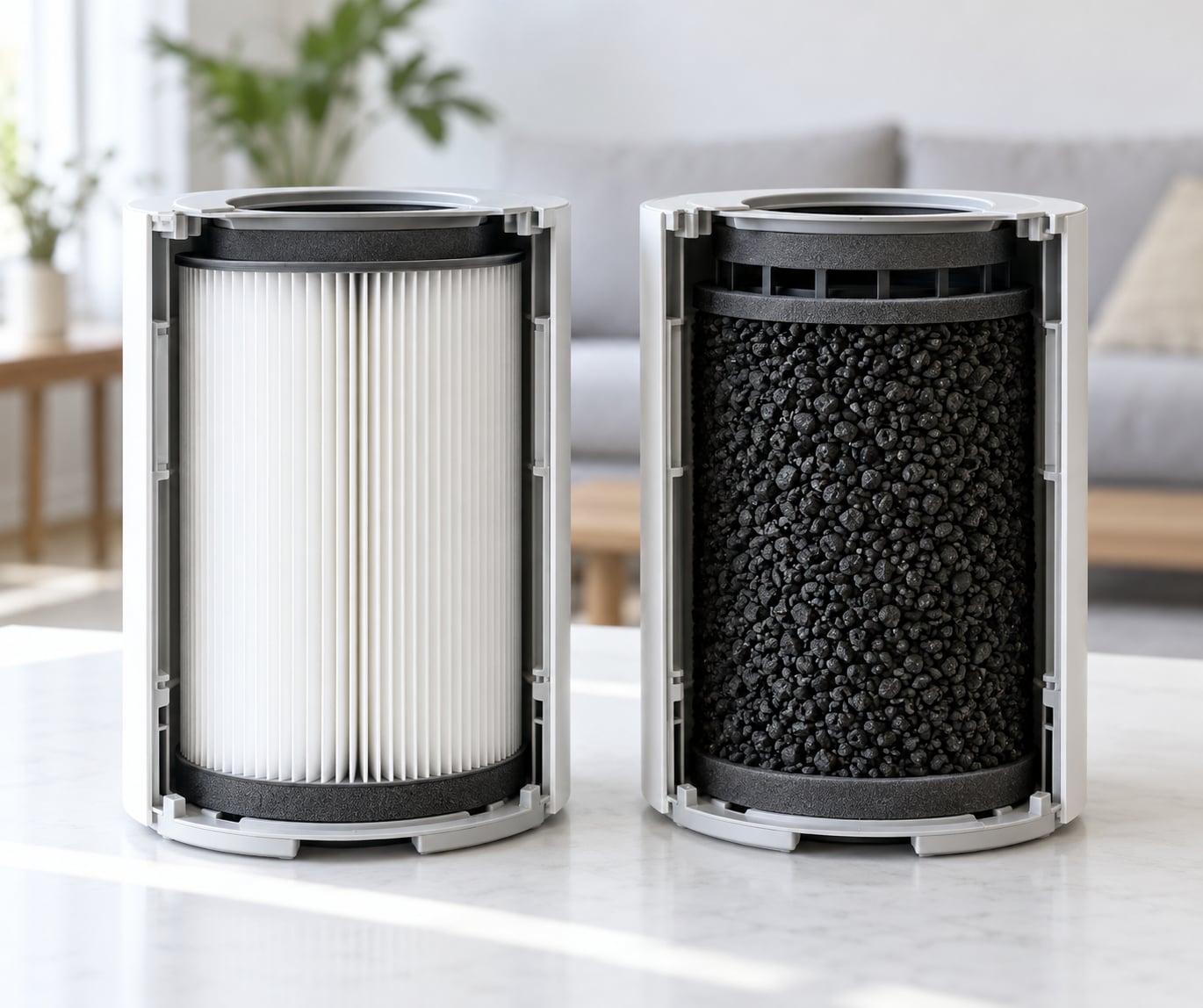
Short answer: choose HEPA if your problem is particles, choose activated carbon if your problem is odors and gases, and choose a unit that has both if your air is a mix of the two. A HEPA filter is a dense fiber mesh that physically traps airborne particles down to 0.3 microns; an activated carbon filter is a porous carbon bed that adsorbs gas molecules onto its surface. They do completely different jobs, which is why the hepa vs activated carbon air filters question comes up so often.
Most households carry a load of both. Pollen, dust, and pet dander need particle filtration, while cooking smells, cigarette smoke, and off-gassing from new furniture need media designed for gases. Below is how each one actually works, what it misses, and how to decide which stage your room needs.
Table of Contents
- HEPA vs Activated Carbon Air Filters at a Glance
- How HEPA and Activated Carbon Filters Work
- HEPA vs activated carbon: what each filter captures
- Which Filter Removes Particles Better?
- Which Filter Controls Odors and Gases Better?
- HEPA vs Activated Carbon Filters: Noise, Cost, and Maintenance
- Do You Need Both Types of Filter?
- Which Should You Choose?
- Frequently Asked Questions
- Can activated carbon replace HEPA in an air purifier?
- Are HEPA and activated carbon filters the same?
- Is a HEPA and carbon combination filter better than HEPA alone?
- Do air purifiers remove cooking odors, smoke, or carbon monoxide?
- How often should HEPA and activated carbon filters be replaced?
- Conclusion
HEPA vs Activated Carbon Air Filters at a Glance
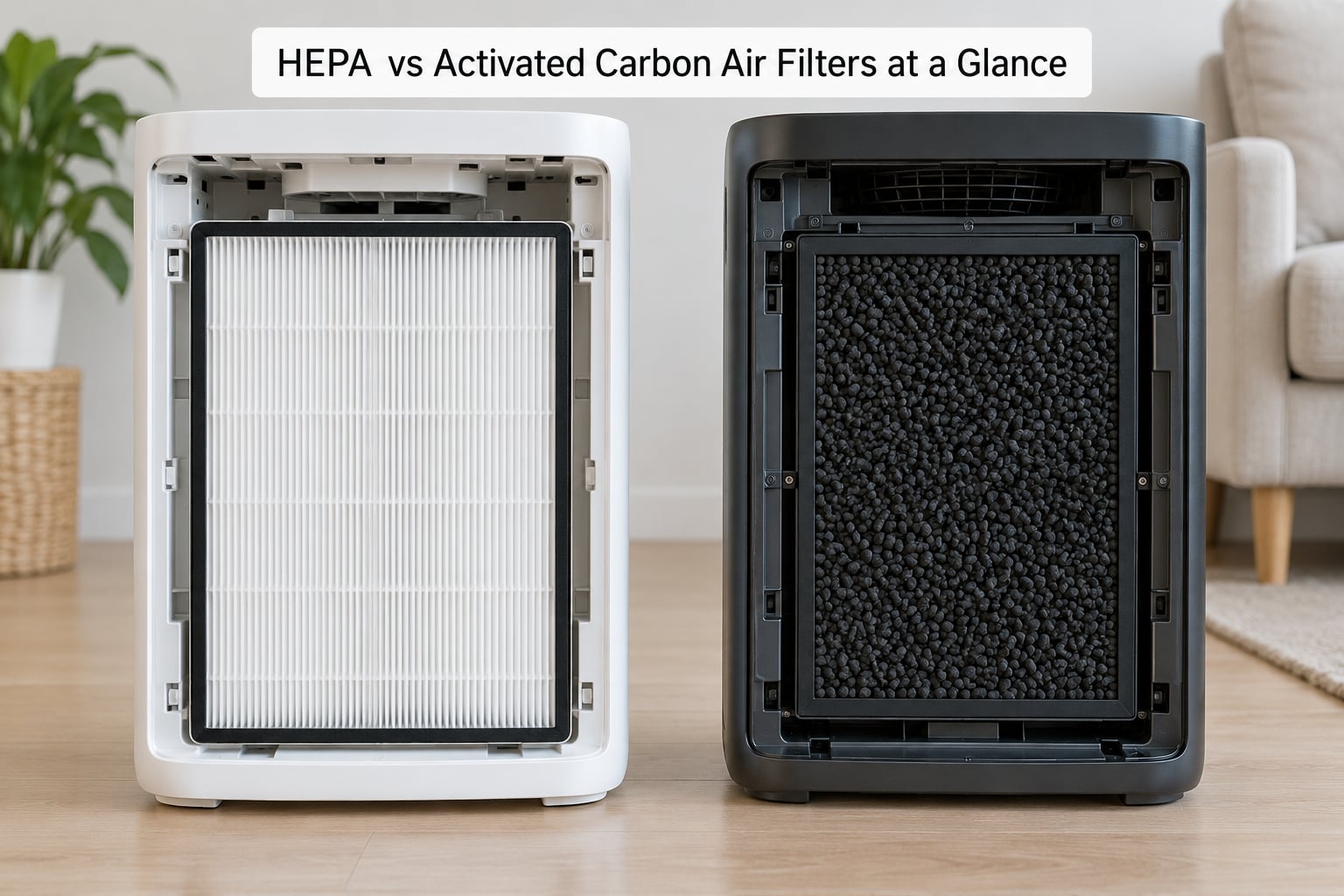
| Criterion | HEPA filter | Activated carbon filter |
|---|---|---|
| Main function | Captures solid airborne particles mechanically | Traps gas molecules on the surface of porous carbon |
| How it works | Interception, impaction and diffusion through a tangled fiber mat | Adsorption onto an enormous internal pore surface |
| Captures | Dust, pollen, mold spores, pet dander, fine particulate | Cooking odors, smoke odor, VOCs, formaldehyde, chemical fumes |
| Stated efficiency | 99.97% of particles at 0.3 microns when properly sealed | No single percentage; depends on carbon weight, bed depth and contact time |
| Misses | Gases, odors, VOCs, carbon monoxide | Particles such as pollen, dust and dander |
| Pressure drop | Moderate to high, especially when loaded | Moderate; increases as the bed fills up |
| Replacement interval | Typically 6 to 12 months in a home | Typically 3 to 12 months depending on odor load |
| Best suited to | Allergy and asthma rooms, nurseries, dust-heavy spaces | Kitchens, smoker homes, new construction, pets, garages and workshops |
One row deserves a closer look: neither filter handles carbon monoxide, and neither one kills bacteria or viruses. A HEPA captures a virus particle and holds it, which lowers the count in the air, but it does not neutralize it. Odor and gas coverage comes only from carbon.
How HEPA and Activated Carbon Filters Work
A HEPA filter is a mechanical sieve made from fiberglass or synthetic polymer fibers arranged in a random web with deep pleats for surface area. Air is pulled through that web, and particles are captured by three mechanisms at once.
Interception catches anything following a straight line into a fiber. Impaction catches heavier particles carried by the airstream, which inertia drives into a fiber wall. Diffusion is the sleeper: the smallest particles bounce around randomly from gas molecules and eventually touch a fiber. That last effect is why 0.3 microns is the hardest size to catch, and why it is the size efficiency is measured at.
True HEPA is rated at 99.97% removal of 0.3-micron particles. Since a real room is full of larger particles, that figure understates what a well-sealed HEPA actually does day to day. What it does not do is change the gas composition of the air.
HEPA vs activated carbon: what each filter captures
Carbon works chemically rather than mechanically, and the term people mix up is adsorption. The gas molecule sticks to the surface of a carbon pore instead of dissolving into it. Think of a wet sponge for water versus a magnet for iron filings: one soaks material up into its bulk, the other holds it on its surface.
That distinction matters because adsorption has a limit. Every pore has a finite capacity, and once it is full the bed stops working. A household example: a jar of baking soda freshens a fridge for weeks because its surface is largely unused. Press that same soda flat into a thin sheet and it is spent in days.
Pollutant by pollutant, the split is clean. HEPA takes dust, pollen, mold spores, pet dander, hair fragments and construction dust. Carbon takes frying odor, cigarette and vape odor, paint and solvent fumes, and volatile organic compounds released by pressed-wood furniture and new flooring. Neither one covers the other’s gap.
Which Filter Removes Particles Better?
HEPA wins this category outright, and no amount of carbon will substitute. Forum discussion in r/AirPurifiers is consistent on this point: carbon does nothing for pollen, dander or dust mite debris, and owners of units with both stages keep the HEPA running all the time while the carbon sits idle in particle-only homes.
Efficiency on paper is only half the story. The other half is whether the air ever reaches the media. Three things decide that in a real room: how big the unit is for the space, whether the fan runs fast enough, and whether the filter is sealed so air cannot slip around the edges.
- Size it to the room. Divide room volume by 60 to get the clean air delivery rate in cubic feet per minute needed for roughly four air changes an hour.
- Read the CADR, not the room-size claim. A published figure for smoke, dust and pollen is a real number; a coverage estimate for a mansion is marketing.
- Count air changes per hour. Multiply CADR by 60 and divide by room volume. Under three changes an hour is low for anyone sensitive to particles.
- Check the pre-filter. Hair and lint that gets past it will mat the HEPA surface and raise pressure fast, which is a fan-noise problem before it is a filtration problem.
Watch for four marketing traps. HEPA-type and HEPA-like wording means the manufacturer has not tested to the standard. A missing CADR figure means the coverage number is invented. A room-size claim built on low fan speed is an estimate, not a rating. And a VOC claim on a unit with no carbon stage describes a filter that cannot deliver it.
Which Filter Controls Odors and Gases Better?
Only carbon does this job, and this is where hepa vs activated carbon air filters stops being a fair fight. The carbon attaches gas molecules to its pore surface, so molecules that pass through the media thousands of times eventually get held. That makes contact time a real design variable rather than a detail.
Three numbers decide whether a carbon stage is serious. Carbon weight is the first and the most revealing; r/AirPurifiers buyers consistently chase the heaviest load they can find because thin sheets saturate fast and give a false sense of protection. Bed depth is the second, since a shallow bed means air crosses it too quickly to adsorb much. Contact time is the third, and it is what makes a slow fan setting weaker at gases than the same unit at high speed.
Formaldehyde deserves special handling. It comes from pressed-wood products, adhesives and resin finishes, and plain activated carbon is not very good at it. Media treated with potassium permanganate, often described as impregnated or chemisorption carbon, reacts with formaldehyde rather than just holding it. NIOSH identifies formaldehyde as a known human carcinogen, and EPA guidance on indoor air treats source control and ventilation as the first line of defense, not filtration alone.
Two limits to keep in mind. Odor reduction is not instant and rarely complete; a home that smells strongly of smoke usually needs several weeks of continuous running plus a change in habits. And purifier VOC sensors drift over months, so the number on the display is a rough indicator rather than a measurement. Use it to notice change, not to trust a reading.
A purifier does not remove carbon monoxide. That gas comes from combustion appliances, and no filter on a market should ever be presented as protection against it. Keep a working carbon monoxide detector near any fuel-burning heater, fireplace or stove.
HEPA vs Activated Carbon Filters: Noise, Cost, and Maintenance
Both media resist airflow, and both get worse as they load up. That resistance forces the fan to spin harder, and a hard-spinning fan is the main noise complaint owners have. Running a purifier on sleep mode at night is quieter but lowers air changes and shortens contact time, so gas removal suffers more than particle removal does.
Replacement timing is where the two filters diverge most. A HEPA in a typical home runs about 6 to 12 months. A carbon bed runs 3 to 12 months, and heavy odor loads shorten it fast. What replaces it matters just as much as when: a carbon cartridge can account for a large share of what the machine cost you in the first year, which is why long-term owners say filter cost rather than purchase price decides whether a purifier feels worth it.
Saturation signs are subtle, and confusing a full carbon bed with too small a carbon bed is the most common complaint I see. Watch for these:
- Odors that return within days after a fresh filter went in, meaning the original bed was too light for the room.
- A smell that fades only while the fan runs and comes back as soon as it stops, meaning the bed is saturated rather than the room cleaned.
- Visible dust or grey shading on a carbon sheet that was marketed as protection.
- Rising fan noise with no change in speed setting, pointing to a loaded HEPA rather than a carbon problem.
Forum users often ask whether they can simply leave the carbon filter out to save money. On a particle-only problem, the machine still runs fine without it. In a shared wall situation with a neighbor who smokes, skipping carbon reintroduces the odor problem you paid to solve, and the smell will settle back into your soft furnishings within weeks.
Do You Need Both Types of Filter?
Usually, yes, and the format matters more than the label. Three-in-one units stack a pre-filter, a carbon layer and a HEPA layer in one cartridge. Separate-stage purifiers give each stage its own slot, which lets you change carbon on its own schedule and keeps a saturated gas filter from being thrown away with a dirty particle filter.
A carbon-coated pre-filter is not the same thing. Those thin sheets are useful for protecting the fan and catching hair, and they are fine for light grease smell. Against a heavy cooking odor or smoke they saturate in weeks and start to smell worse than the air they were meant to clean.
There are cases where carbon adds little. A sealed bedroom with no cooking, no pets and no new furniture needs almost none, and a modest carbon layer is enough. A smoker’s home needs more carbon than most boxes contain. And for wildfire smoke drifting indoors, the smoke has a particle fraction that HEPA removes well alongside a gas fraction that only carbon touches, which is the clearest case for both stages running together.
Which Should You Choose?
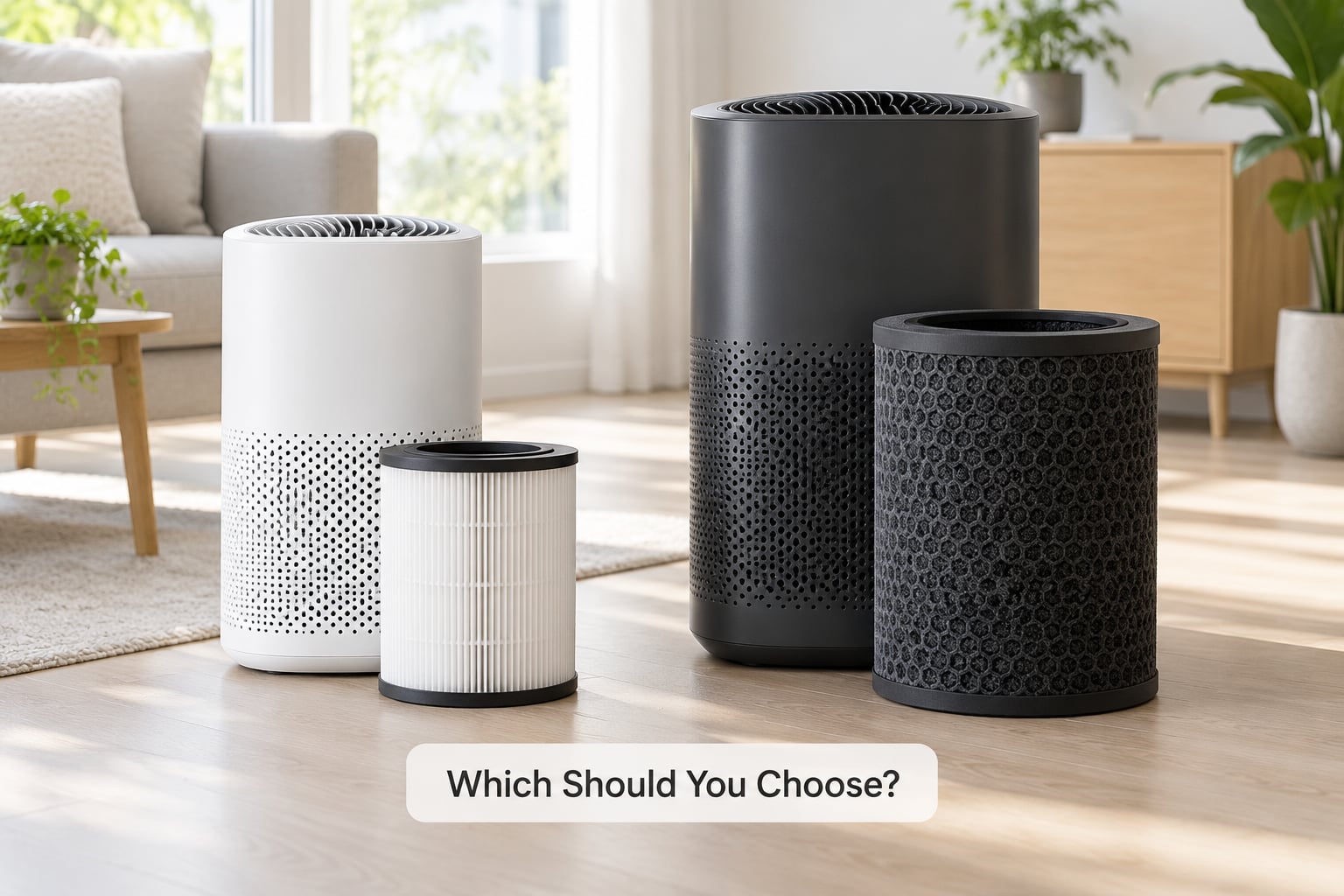
Start by naming the pollutant. That single step eliminates most wrong purchases, because the two filters fail in opposite directions and buying the wrong one leaves the actual problem untouched.
- Seasonal allergies, asthma, or a dust-heavy home: HEPA leads. Prioritize a published CADR and a sealed true HEPA stage; a light carbon layer is fine for kitchen smells that drift in.
- Pet owners: both stages. HEPA for dander, and a carbon weight you would call substantial rather than thin.
- Cooks and households with smoke or vape vapor: carbon leads, with enough mass and depth that contact time stays long at the speed you will actually run.
- New furniture, flooring, or paint: carbon with formaldehyde-treated media, paired with ventilation. No filter replaces airing out a room.
- Renters: a single filter cartridge is easier to move than a multi-stage tower, and confirm replacement cartridges are sold separately for the exact model before you commit.
- Budget shoppers: a compact HEPA unit for particles, run on high in the room and low elsewhere, beats an oversized carbon-only machine for most apartments.
Before buying, check four things on the box or spec sheet: the carbon weight stated in pounds or grams, the CADR for smoke, dust and pollen, the exact wording of the HEPA claim, and whether replacement filters are sold on their own. Vague wording such as HEPA-type or a carbon listed only as a pre-filter coating are the two clearest signs you are about to pay for a label rather than media.
Frequently Asked Questions
Can activated carbon replace HEPA in an air purifier?
No. Activated carbon adsorbs gas molecules onto the pore surfaces of the carbon bed, and it does almost nothing with solid particles. Pollen, dust, dust mite debris and pet dander pass straight through a carbon layer. For particle problems such as allergies or asthma, a true HEPA stage is required, and no amount of carbon replaces it.
Are HEPA and activated carbon filters the same?
They are different media doing different jobs. A HEPA filter is a dense fiber mesh that captures particles by interception, impaction and diffusion, and true HEPA is rated at 99.97 percent removal of 0.3-micron particles. Activated carbon is a porous bed that adsorbs gas molecules onto its pore surfaces, handling odors and VOCs that pass through a HEPA untouched.
Is a HEPA and carbon combination filter better than HEPA alone?
It is better when your air contains both particles and gases, such as a home with pets, cooking or smoke. HEPA alone leaves odors and volatile organic compounds in place, which is often the complaint people describe as a filter that does not work. In a sealed bedroom with no odor sources, the added carbon stage buys you very little.
Do air purifiers remove cooking odors, smoke, or carbon monoxide?
Cooking odors and smoke odor are handled by activated carbon, which adsorbs the gas molecules, while the particle half of smoke is captured by HEPA. Carbon monoxide is different: it comes from combustion appliances, and no air purifier filter removes it. Keep a working carbon monoxide detector near any fuel-burning heater, fireplace or stove.
How often should HEPA and activated carbon filters be replaced?
In a typical home a HEPA filter lasts about 6 to 12 months, and activated carbon runs about 3 to 12 months depending on how heavy the odor load is. Signs of a spent carbon bed include odors returning within days of a fresh filter and a smell that fades only while the fan is running. Clean or wash the pre-filter on its own schedule, usually monthly.
Conclusion
HEPA vs activated carbon air filters is not a contest with one winner: HEPA handles particles, activated carbon handles gases and odors, and indoor air usually contains both. Name the problem in your specific room first, then check the purifier’s room-size rating against the actual CADR figures and confirm that certified replacement filters for that exact model are sold separately.
Finally, treat the purifier as one tool rather than the whole fix. Ventilating to clear outgassing, running a hood over the stove and sealing off-gassing sources do more for indoor air than any filter, and a filter will only ever be as good as the source control behind it.