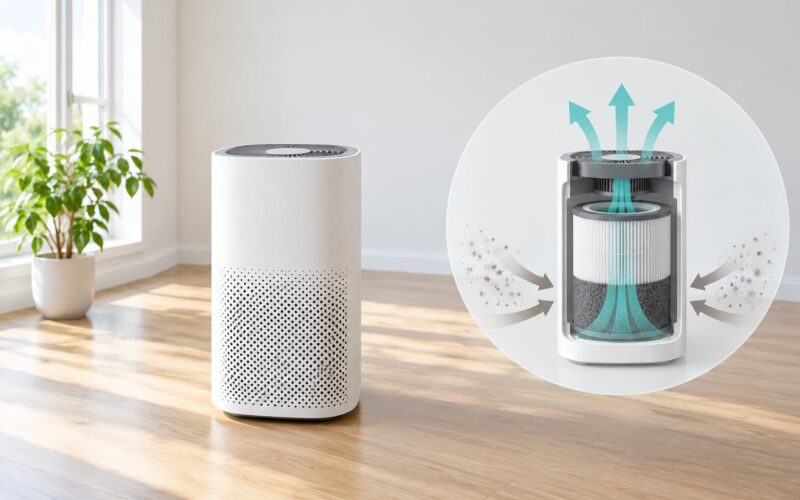
Most people find out their air purifier filter is due the same way: the unit gets louder, the room starts smelling like the last meal again, and a light on the front blinks. It is not complicated, but the honest answer depends on which layer you are talking about, because a pre-filter and an activated carbon filter wear out on completely different clocks than a HEPA filter does.
Table of Contents
- How Often Should You Change an Air Purifier Filter?
- Replacement Intervals by Air Purifier Filter Type
- How often should you change an air purifier filter, by layer
- What Signs Mean the Filter Needs Changing?
- How to Change an Air Purifier Filter Safely
- Should You Clean the Filter or Replace It?
- How Can You Make an Air Purifier Filter Last Longer?
- Frequently Asked Questions
- How often should I replace a HEPA filter in an air purifier?
- Can I wash a HEPA filter instead of replacing it?
- How do I know when my air purifier filter is dirty?
- Does an air purifier filter need to be replaced if the purifier still works?
- How often should I change the activated carbon filter?
- What happens if you use an air purifier without a filter?
- Conclusion
How Often Should You Change an Air Purifier Filter?
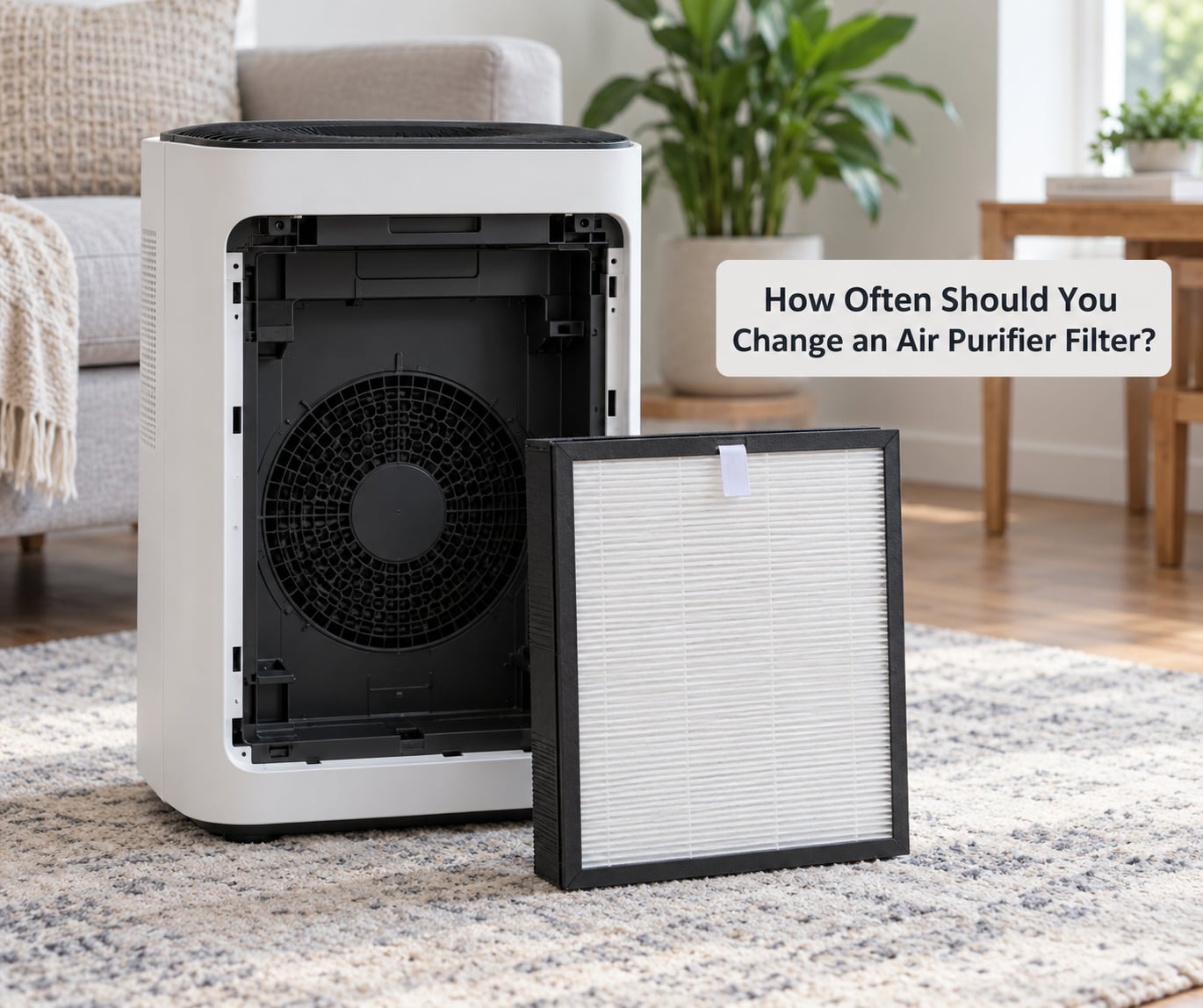
Replace a HEPA filter every 6 to 12 months, an activated carbon filter every 3 to 6 months, and clean a washable pre-filter every 2 to 4 weeks. Replace sooner if you have pets, run the unit around the clock, or live through smoke or high-pollen seasons.
That is the starting point, not a deadline. Six variables decide where your own schedule actually falls.
- Filter type. Particle filters load up; carbon filters saturate. They do not wear out at the same rate.
- Runtime. A unit running 16 hours a day accumulates filter hours twice as fast as one running 8 hours a day.
- The pollution load. Wildfire smoke, construction dust, candle burning and frying all push more material into the media.
- Pets. One shedding dog loads a filter faster than anything else in a normal home.
- Filter design. A thicker, deeper media bed holds more before it clogs. Some premium cartridges are rated in years rather than months.
- The manufacturer’s guidance. Your manual is the baseline. Treat it as a starting point you adjust with evidence from your own home.
The last point deserves emphasis. Manuals describe a home running a purifier a few hours a day in ordinary air. Almost nobody’s actual home matches that picture, which is why owner reports frequently beat the printed schedule.
Best Buy verified buyers, for instance, report HEPA filters lasting one to three years in carpeted, low-dust homes against three to six months in dusty or smoky ones. Same filter, same brand, wildly different schedules.
Replacement Intervals by Air Purifier Filter Type
Here is what each layer does and how long it holds up under normal residential use.
| Filter type | What it captures | Typical interval | What shortens it |
|---|---|---|---|
| Washable pre-filter | Hair, lint, large dust, pet dander | Clean every 2 to 4 weeks; replace if your model uses a disposable one every 1 to 3 months | Pets, carpet, renovation dust |
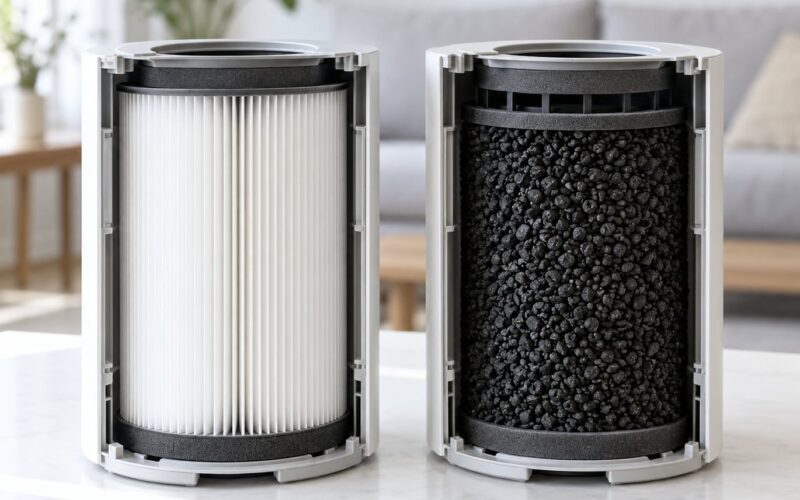
| HEPA particle filter | Fine particles down to 0.3 microns at 99.97% efficiency | 6 to 12 months; 12 to 36 months on deeper media cartridges | Smoke events, high pollen, continuous runtime, unit oversized for the room |
| Activated carbon | Odors, VOCs, cooking gases, smoke | 3 to 6 months | Cooking, candles, paint, indoor smokers |
| Electrostatic / ionizer plate | Charged particles that are then captured downstream | Clean monthly; follow the manual if it is washable | Dust loading on the charging plate |
| Combination cartridge | All of the above in one sealed unit | Follow the cartridge rating, usually 6 to 12 months | Whatever loads your pre-filter first |
How often should you change an air purifier filter, by layer
Each layer fails in its own way, and knowing the mechanism tells you what you are looking at.
A pre-filter fails by surface loading. Dust and hair sit on the open mesh like a net catching debris. It blocks airflow but the fibers underneath stay clean, which is why the front of a filter can look grimy while the back looks fine.
A HEPA filter fails by fiber loading. Particles pack into the dense fiber matrix, the pressure drop across the media rises, and the fan has to push harder to move the same air. Matting and fiber damage are cumulative and not reversible, which is the whole reason washing a HEPA filter does not work.
An activated carbon filter fails by adsorption saturation. It holds gases and VOCs on the surface of the sorbent until there is no room left. Saturation is the dangerous one: a full carbon bed can release compounds it already trapped back into the room, so a purifier with an old carbon filter may be reintroducing the smell you bought it to remove.
Two ratings explain why brands disagree on intervals. CADR, clean air delivery rate, measures how much clean air a unit pushes out at full speed, and a high CADR clears a room faster, so more of the air reaches the filter. CCM, cumulate clean mass, measures how much total particle mass a filter can hold before its pressure drop rises too far. A unit with high CADR and high CCM is efficient and easy on its filter. A unit with high CADR and low CCM chews through cartridges.
What Signs Mean the Filter Needs Changing?
Six signs show up before any scheduled date. Each tells you something, and each has a limit to what it proves.
- Less airflow than it used to deliver. You can hear it: the fan sounds strained at a setting that used to be quiet. This proves the media is loaded. It does not tell you which layer, so open the unit and check in order.
- Odors come back while the unit runs. That is the classic sign of a saturated carbon filter, not a failed HEPA filter. Odor does not prove your particle filtration is gone.
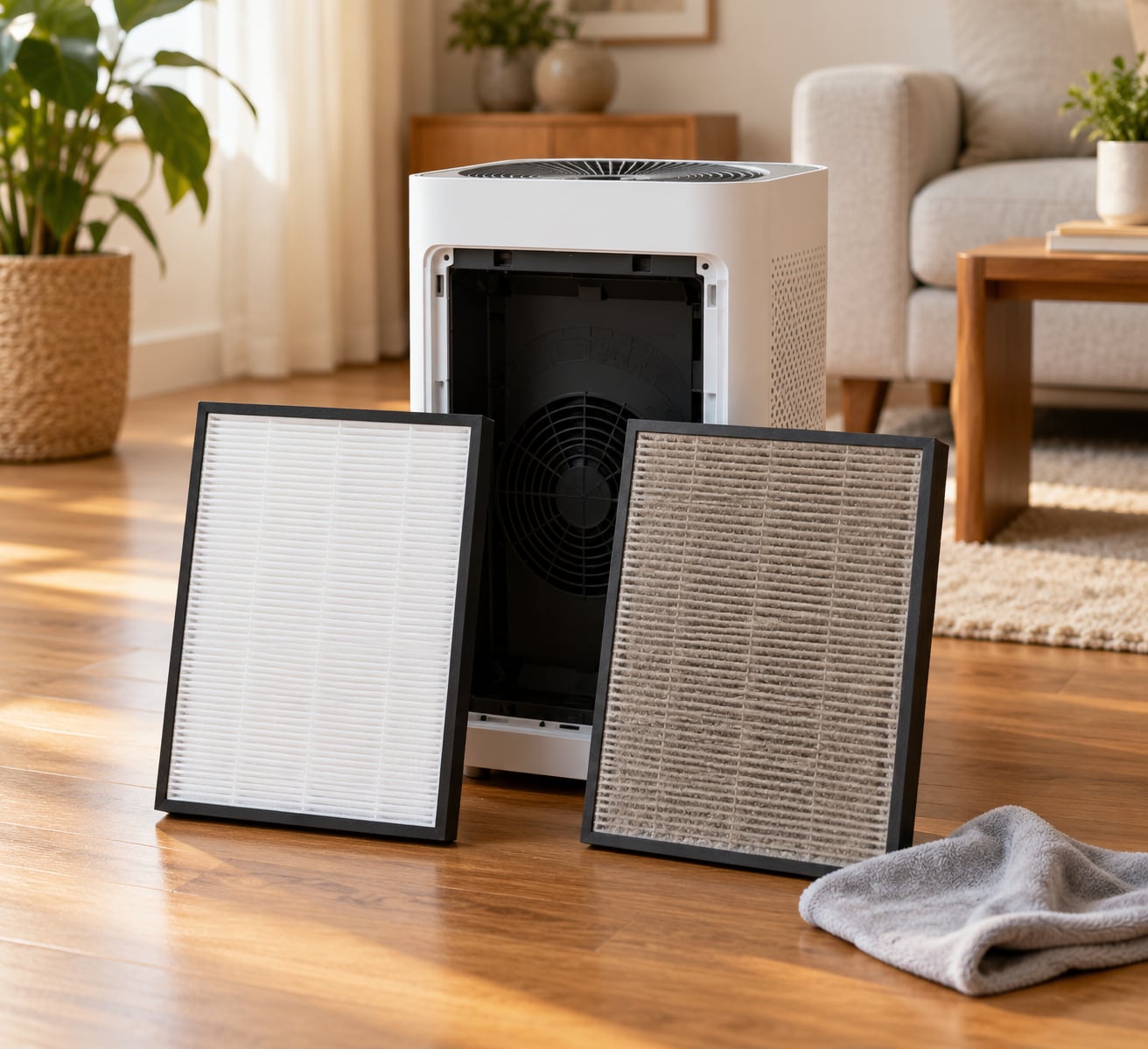
- Visible dust, grey matting or caked debris. Owners report peeling 3 to 4 mm of caked dust off a filter after a full year despite cleaning attempts. If a disposable pre-filter looks like that, it has done its job.
- Unusual fan noise. A new rattle or rising whine on start-up often means airflow restriction. It can also be a loose panel, so listen for a change rather than assuming.
- Allergy or asthma symptoms in the room that were not there before. This is a real signal but a blunt one. Check the filter first, then talk to a doctor if breathing symptoms persist.
- Higher energy use for the same setting. A loaded filter makes the fan work harder against more resistance. Small, but measurable on a unit running continuously.
Now the part that frustrates owners most: the filter life indicator. These lights usually count runtime hours and fan speed, not the condition of the media. On several popular models the algorithm has no flow sensor at all, so the percentage is a countdown, not a measurement.
Levoit Core 400S owners on r/AirPurifiers and r/AirQuality describe the app warning at 10% filter life while a separate air quality monitor still reads clean air in the same room. On the other end, Dyson owners report the app estimate running well past a fixed five-month assumption.
Same general hardware, opposite failure modes in the software. Use the light as a prompt to look at the filter, not as the thing that decides.
How to Change an Air Purifier Filter Safely
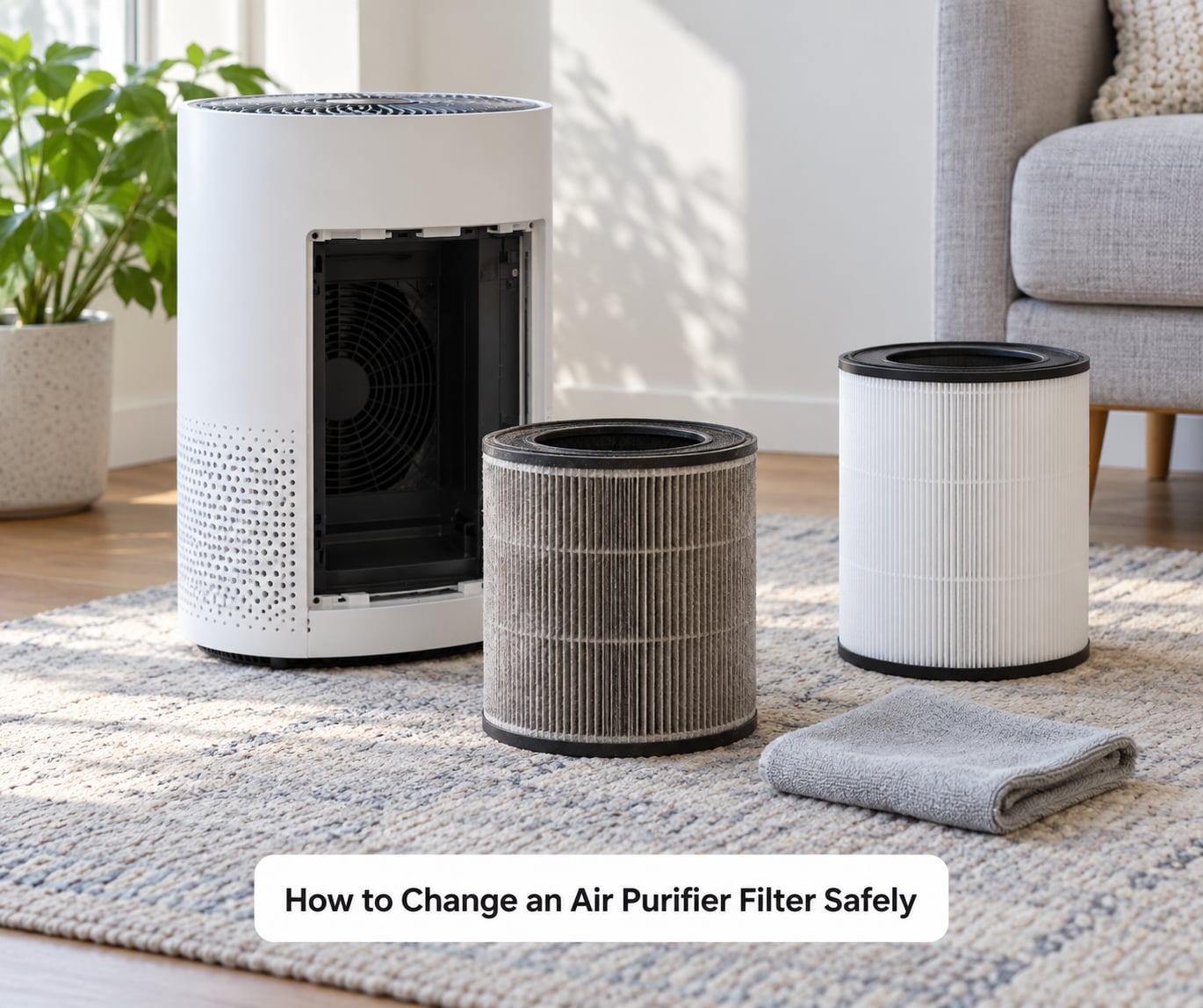
Swapping a filter takes about five minutes. Most of that is reading the arrows.
- Unplug the unit. Do not just switch it off at the panel. Pull the plug and let the fan spin down before you touch the compartment.
- Find the manual or the model number. Filters are model-specific. Using a cartridge from a different series can leave gaps in the airflow path.
- Mark the airflow direction. Filters are one-way. Note the arrow printed on the frame or printed on the housing before you pull it out.
- Remove the old filter. Some units slide the cartridge out from the front, some lift it from the top, some twist it open from the back. Take a photo of the orientation while it is still seated.
- Inspect the empty compartment. Check for dust on the fan, on sensor ports and on the intake grille. A dirty sensor is a common reason a purifier misreads air quality and runs too little or too much.
- Vacuum the compartment gently. Do not push a vacuum nozzle into the fan or let grit fall onto the impeller blades.
- Install the new filter in the same orientation. Arrow toward the fan, every time. Seats slightly proud of the housing can cause vibration and rattling.
- Reset the filter life counter. Most units use a button held for a few seconds, often on the rear panel. The manual lists the exact sequence, and it varies by model.
- Power up and test. Run the unit on high for a minute. A brief dusty smell on first run is normal. Rattling or a big drop in airflow means something is not seated.
Should You Clean the Filter or Replace It?
This is the question that costs people money in both directions, so it is worth being precise about which filters tolerate cleaning.
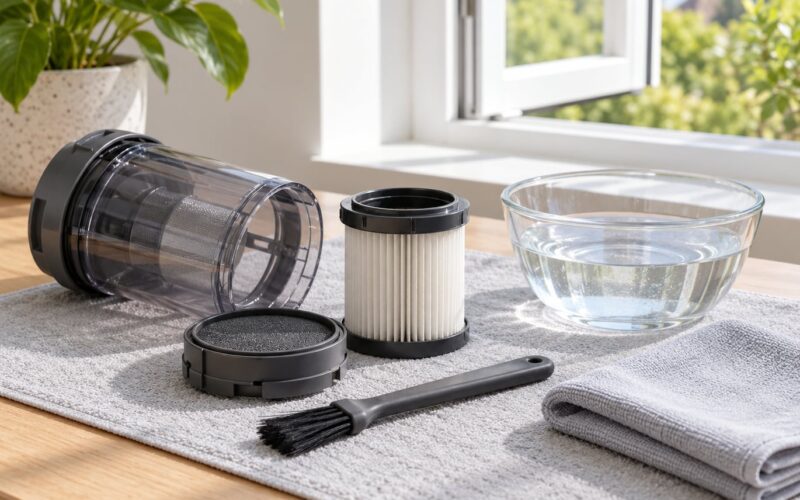
Washable pre-filters are meant to be washed. Rinse them under cool water without detergent, let them drip, then lay them flat or prop them upright until completely dry. A filter put back damp will smell within days and can grow microbial growth, so give it a full day in a warm room if you can.
Electrostatic plates can usually be cleaned gently. Only where the manual says so, and with a dry or barely damp soft cloth. Water and detergent can wash off the charge and the plate stops doing anything.
HEPA filters and activated carbon must be replaced. Water collapses the fiber matrix, and the damage is invisible to you and permanent. The filter still fits, still looks fine, and quietly removes far less than it should. Vacuuming a HEPA filter is the same mistake in a smaller way: you shave a few surface fibres off without restoring the media.
Worth knowing: on some brands the pre-filter and carbon layer are the same physical mesh. Cleaning it once a month keeps the particle stage from loading early, which on its own often buys a few more months on the cartridge behind it.
If a pre-filter is a disposable type and cleaning it would take the frame apart, replace it. The savings from washing something you should throw away are not worth the disassembly.
How Can You Make an Air Purifier Filter Last Longer?
Nobody needs to buy filters more often than the filter requires. A few habits stretch the interval noticeably.
Clean the pre-filter on schedule. This is the highest-value habit by a distance. A dirty pre-filter chokes airflow, forces the fan harder and pulls more material past the layers behind it, so it shortens the life of the expensive cartridge you actually care about.
Give the unit clearance. Leave the recommended gap on every side. Pressed into a corner or against a curtain, a purifier starves for air and works harder for the same result.
Size the purifier to the room, not to the price. A small unit in a large room has to run continuously to keep up, which means continuous loading. Matching the CADR to the room size is the single biggest lever on filter life you control.
Use a lower fan speed at night. Air changes more slowly when nobody is cooking or moving around. A mid setting in a bedroom usually does the same practical work at a fraction of the fan hours.
Control the source first. Cooking with a lid on, running a range hood, and ventilating during paint or candle use cuts the load before air ever reaches the filter.
Buy the correct part. Thin aftermarket media with a loose fit reduces airflow and lowers capture, so you change it twice as often and get less filtration.
During wildfire smoke, expect a shorter life. Run the unit on high, close up windows and doors, and be ready to replace the filter sooner rather than pretending the schedule holds. In a smoke event, an oversized temporary pre-filter ahead of the cartridge is a reasonable stopgap.
Frequently Asked Questions
How often should I replace a HEPA filter in an air purifier?
Replace a HEPA filter every 6 to 12 months in a typical home. Go sooner if you have pets, run the purifier around the clock, or live through wildfire smoke or heavy pollen. Deeper media cartridges from premium brands are often rated at 12 to 36 months. Judge the actual condition too, because a loaded filter drops airflow long before it looks obviously dirty.
Can I wash a HEPA filter instead of replacing it?
No. Water collapses the fiber matrix, and the filter keeps its shape and fit while quietly losing a large share of its capture efficiency. A washed HEPA filter usually looks fine, which is why the damage goes unnoticed. Washable pre-filters and some electrostatic plates are the parts designed for cleaning, and only those. Check your manual to be certain.
How do I know when my air purifier filter is dirty?
Listen for a change first. A fan that sounds strained at a familiar setting means airflow resistance has increased. Then look: grey matting, visible dust or a caked pre-filter all point to loading. Odors returning while the unit runs indicate a saturated carbon layer specifically. Filter life lights count runtime hours, not condition, so treat them as a reminder to inspect rather than the deciding factor.
Does an air purifier filter need to be replaced if the purifier still works?
It still works, but less well than the specification suggests. A loaded filter cuts clean air delivery, makes the fan run harder and increases noise, and a saturated carbon layer can release previously trapped odors and compounds back into the room. Running past the interval also puts avoidable strain on the motor. Replace on condition rather than waiting for the unit to sound broken.
How often should I change the activated carbon filter?
Every 3 to 6 months under normal use. Replace sooner if you cook a lot, burn candles or oil the stove, or have anyone in the home who smokes. The giveaway is odor breakthrough, meaning smells start to reappear even while the purifier is running on high. A saturated carbon filter can re-emit compounds it already absorbed, so letting it run long past due can make a room smell worse than doing nothing.
What happens if you use an air purifier without a filter?
The fan runs and air moves, but almost nothing gets removed. Most purifiers run with the fan off when the compartment is empty or a filter is missing, and some simply circulate dirty air. An empty unit also draws unfiltered air past the motor, where dust collects and adds heat. Never run it filterless as a temporary solution, and never defeat the filter interlock to do so.
Conclusion
Start with two things: read the interval printed on the filter itself, and find your model’s manual so you know which layers are washable and how to reset the counter.
From there, treat 6 to 12 months for HEPA, 3 to 6 months for carbon, and a pre-filter cleaned every 2 to 4 weeks as your baseline rather than a schedule carved in stone. Then adjust it with evidence from your own rooms, because filter life follows load and the filter life light only knows the clock.