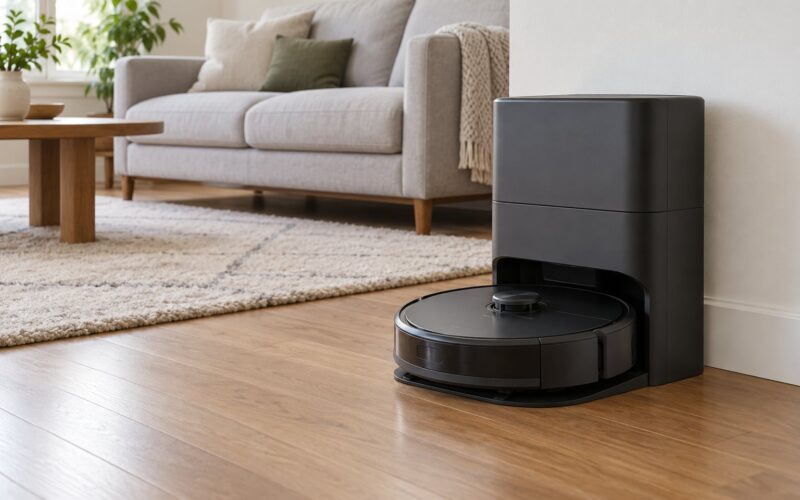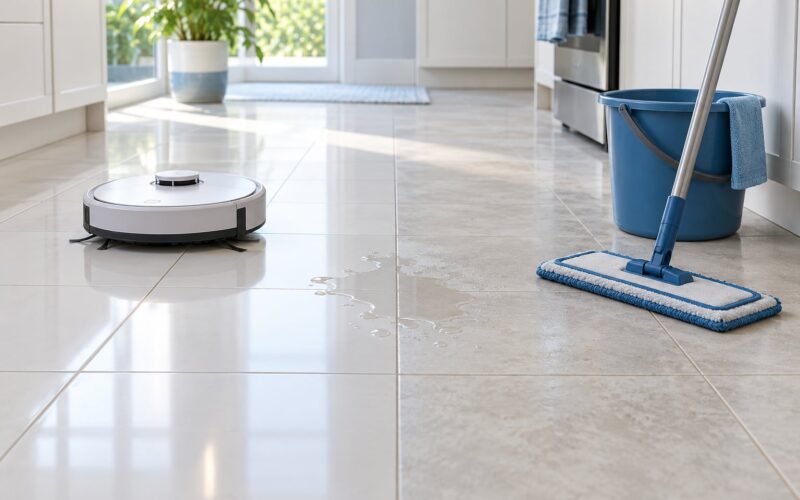
Short answer: most homes should run a robot vacuum once a day, and the schedule should follow the debris, not a calendar rule. So how often should you run a robot vacuum really depends on pets, foot traffic and floor type. Pet households, homes with crawling kids and allergy-sensitive rooms lean daily or even twice daily. Hard floors in a quiet apartment do fine on two or three runs a week. A room nobody walks through can wait a week. Pick a starting schedule, then check what the dustbin says after a week.
I’ve watched enough floors get coated in fine grit to know the usual mistake runs the other way. People buy a robot, feel guilty on day three because the bin held a thin layer of dust, and then schedule it twice a day forever. Meanwhile the hallway keeps its usual film of grit because the schedule was never adjusted to where dirt actually lands.
This guide covers how often to run a robot vacuum by household type, room and floor type, plus the maintenance that has to come with each schedule. Budget ten minutes a week on the roller brush and this gets much easier.
Table of Contents
- How Often Should You Run a Robot Vacuum?
- What Factors Should Change Your Robot Vacuum Schedule?
- How Often Should You Run a Robot Vacuum in Different Homes?
- How Often Should You Run a Robot Vacuum in a Busy or Pet-Friendly Home?
- Should You Run a Robot Vacuum Every Day or Only When It Looks Dirty?
- How Can You Make Each Robot Vacuum Run More Effective?
- Before the run
- After the run
- Scheduling habits that pay off
- Frequently Asked Questions
- Is it bad to run a robot vacuum every day?
- How often should I run a robot vacuum with pets?
- Do robot vacuums work better on hard floors or carpets?
- How often should I clean a robot vacuum if I use it daily?
- Can running a robot vacuum too often damage it?
- Do robot vacuums take a lot of electricity?
- Conclusion
How Often Should You Run a Robot Vacuum?
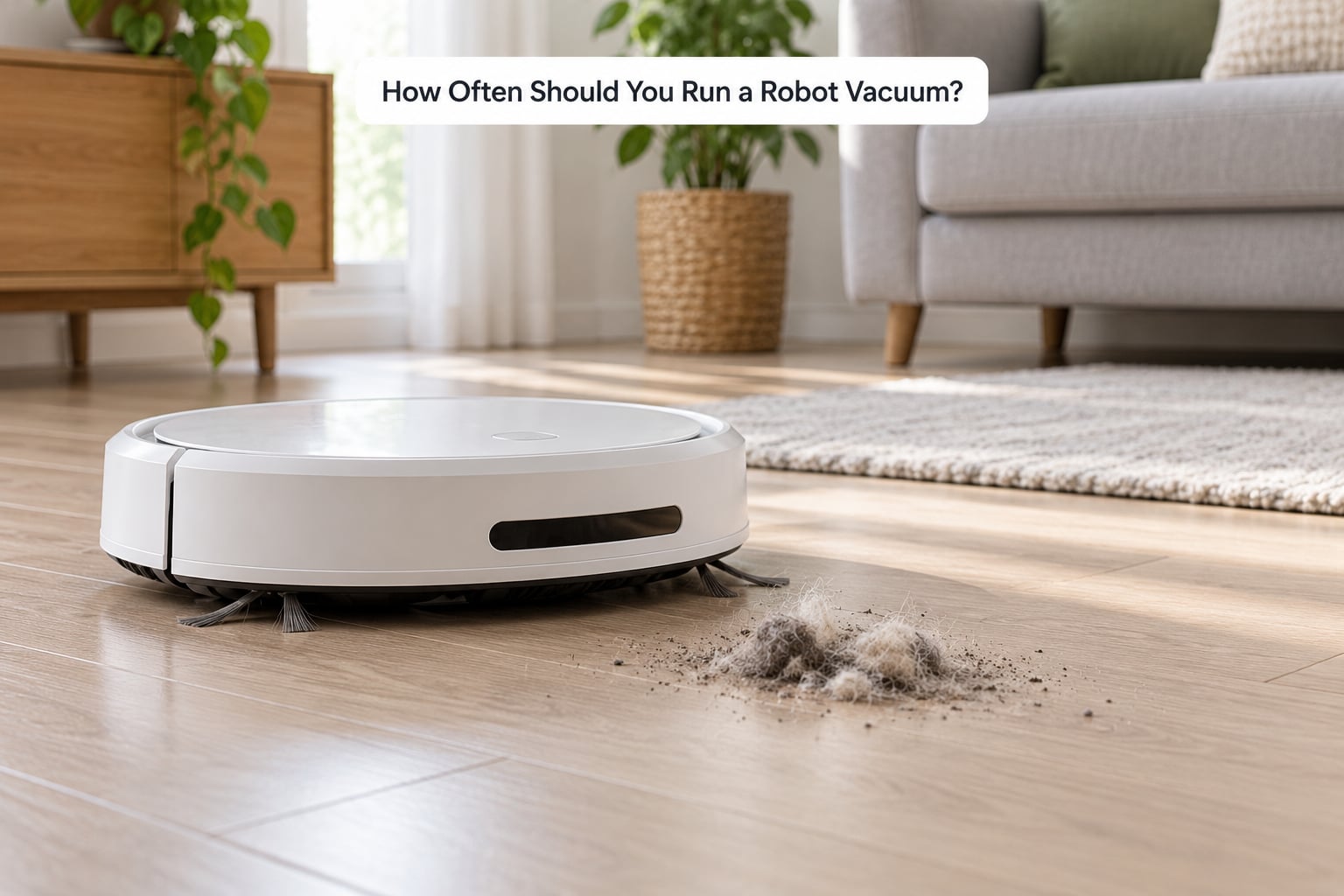
One run per day is the baseline for an average home. Not because the floors need vacuuming every single evening, but because daily runs quietly remove the fine dust and dander that a weekly pass misses, and because a robot that runs on a schedule keeps you from ever thinking about it.
Most units cover a single-floor home of up to roughly 200 square meters in a single 100 to 200 minute cycle. So on a typical layout, one daily run is genuinely enough coverage. Bigger homes and multi-floor houses need either two runs a day or one run plus a targeted second pass in the busiest rooms.
Here is the frequency band most homes land in:
- Twice a day, short or split runs: two shedding pets, a crawling baby, allergy sufferers on carpet, or a busy entryway and hallway. Run the robot early morning and again while the house is empty.
- Every day: most family homes with pets, kids, or mixed flooring where rooms are used throughout the day. This is the sensible default.
- Every other day: one pet that sheds seasonally, or a busy household on mostly hard floors where a dry pass is enough on off days.
- Two or three times a week: apartments, low-traffic homes, hard wood or tile throughout, and households that already vacuum or mop manually in between.
- Weekly: guest rooms, spare bedrooms, vacation homes, closets-level spaces, and any room you never walk through. Running a robot in an unused room is motion that buys nothing.
Time of day matters less than most people think, though it changes how disruptive the noise is. Forum regulars on r/RobotVacuums and r/roomba tend to run theirs mid-morning when everyone’s out, or overnight if the machine is quiet enough not to wake a light sleeper. A home office changes that calculus completely, since 60 dB of brush roll is a real interruption.
What Factors Should Change Your Robot Vacuum Schedule?
Debris load is the deciding factor. The question is never “how often is normal,” it is how fast this particular floor puts dirt back down. Here is how each variable moves the number.
| Factor | What it does to your schedule | Direction |
|---|---|---|
| Shedding pets | Hair re-accumulates within hours in a heavy-shed season; fine dander keeps working into carpet fibers | Daily to twice daily |
| Children | Crumb traffic in kitchens and playrooms, plus dried spills that a dry pass can smear | Daily, add spot cleans |
| Room traffic | Hallways, entryways and kitchens collect grit from outside faster than interior rooms | More often for busy zones |
| Hard wood, tile, laminate | Shows dust quickly in daylight, but a dry pass handles nearly all of it | Every other day to daily |
| Carpet and rugs | Holds grit deep, hides debris from view, and traps allergens near the floor | Daily, weekly deep pass |
| Allergies or asthma | Fine particles stay airborne after vacuuming, so removal matters more than appearance | Daily with a HEPA filter |
| Dustbin size | A small bin fills mid-run on carpet and stops the machine early | More frequent emptying |
| Battery runtime | If a full cycle takes two charges, split the home into zones | Same frequency, two passes |
| Navigation quality | Good mapping means targeted room cleans beat repeated whole-home loops | Fewer full runs |
| Season | Pollen in spring, sand and mud tracked in year-round, coat blowout twice a year | Adjust up and down |
Two of these deserve more attention than they usually get. Battery runtime and navigation quality decide whether one run per day is even physically possible. An owner who moved from an apartment under 800 square feet to a 2,000 square foot duplex found that frequency had to be rethought entirely, because a single pass no longer covered the house.
Season is the factor nobody schedules for. Spring brings pollen through open windows, a dog or cat blows its coat twice a year, wet winter weather tracks mud indoors, and summer brings sand that scuffs finished wood if it sits. Treat the calendar as a reason to nudge the schedule, not as a rule.
How Often Should You Run a Robot Vacuum in Different Homes?
Household type is the fastest way to a workable starting schedule. Use these as a starting point and adjust after a week.
| Room or situation | Traffic | Typical floor | Recommended frequency |
|---|---|---|---|
| Kitchen and dining area | High | Tile, laminate | Daily, spot clean crumbs |
| Entryway and hallway | Highest | Hard floor or runner | Twice daily, or daily plus a spot pass |
| Living room | High | Wood or carpet | Daily |
| Main bedroom | Medium | Carpet or wood | Every other day to daily |
| Kids’ rooms | High, unpredictable | Carpet most often | Daily, mop separately |
| Spare bedroom or guest room | Low | Carpet | Weekly |
| Home office | Medium, but noise-sensitive | Wood or low-pile carpet | Every other day, scheduled outside working hours |
| Small apartment | Low to medium | Mostly hard floor | Two or three runs a week |
| Large multi-floor home | High, but only one floor at a time | Mixed | Daily per floor, alternating floors if needed |
| Vacation home or guest property | Very low | Mixed | Weekly, or only between rentals |
Apartment dwellers usually under-run their machines. A 600 square foot flat on hard floors gets cleaned in a single short cycle, so the honest answer is two or three times a week, not daily. The reason to run more often in a small space is per-square-foot traffic, and most small apartments simply do not have much of it.
Multi-floor homes are the other special case. One robot covers one level at a time unless it is carried, so a daily schedule becomes a rotating one. Some owners run the main floor every morning and the upper floor on alternating days, which keeps the visible main floor clean without doubling the noise.
Workspaces deserve a separate decision. A home office gets walked in and out all day, but noise ruins calls and focus. Run it before the workday starts or after you finish, and every other day is plenty if you are not dealing with pet hair.
How Often Should You Run a Robot Vacuum in a Busy or Pet-Friendly Home?
In busy homes, short daily runs beat one long run. Owners posting on r/RobotVacuums describe the shift clearly: they stopped doing a single full-house clean every evening and started doing a short early run plus targeted room cleans later in the day, and their floors came out cleaner.
That works because a full-house run tends to end on the rooms your home does not use. A robot covers what it covers in the order its map dictates, and the last 30 minutes of a long cycle often hit the quietest bedrooms. Two short runs let you put the busy zones first.
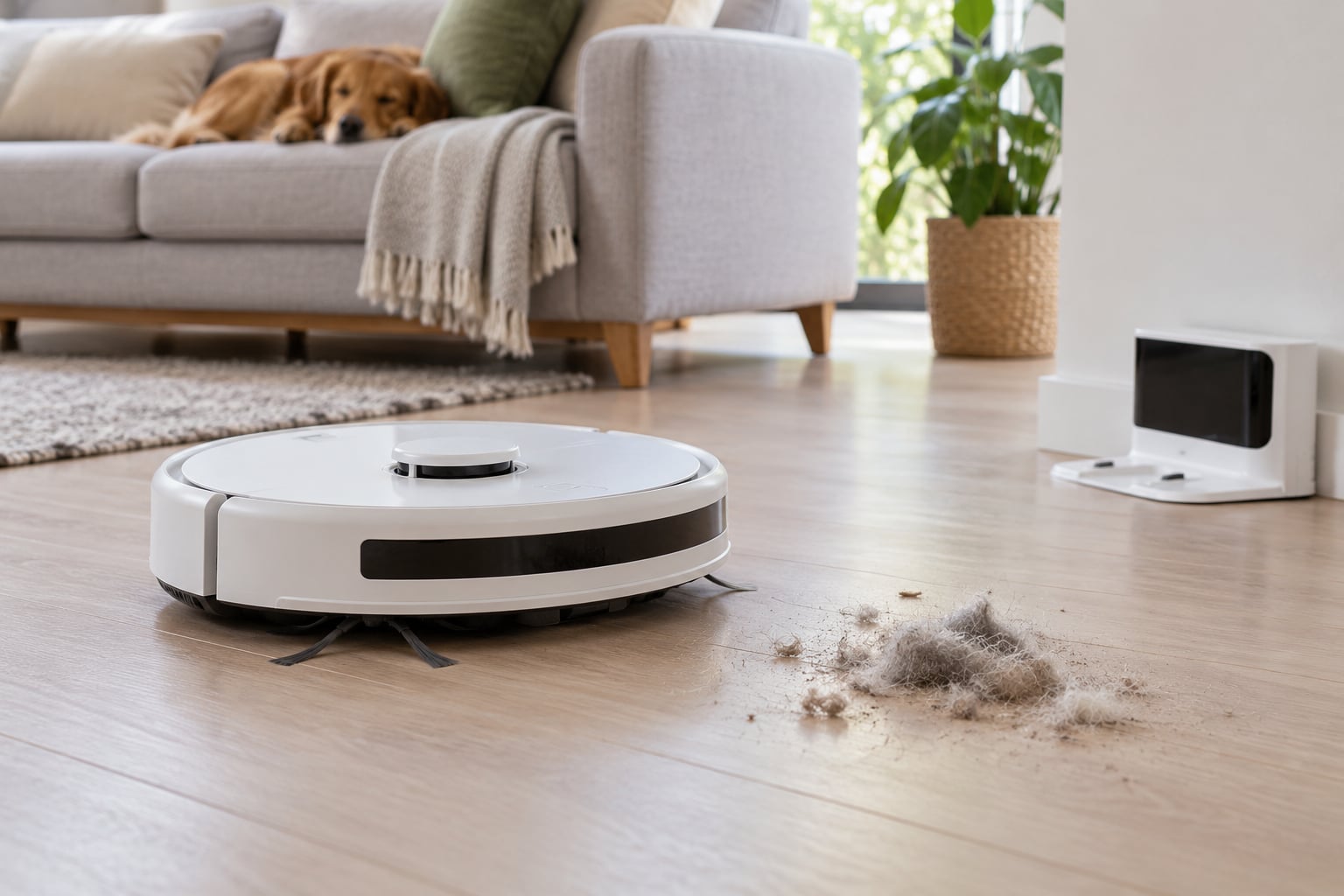
For a pet household, shedding level sets the pace. During a heavy coat blowout, most owners settle on vacuuming nearly every other day, sometimes daily in the rooms the pet actually lives in. In the off-season, two or three runs a week on hard floors is plenty.
A second run earns its place when the first one finished with a partly empty bin and you still saw hair in the same spots. It does not earn its place because it feels virtuous. One owner on r/roomba described the pattern that works well in a two-dog house: hallway cleaned twice daily, pet rooms daily, bedrooms twice a week, about 25 minutes of attention per day in total.
There is a second reason to split runs in a pet home. Hair wrapping around the main roller can stall a motor inside a single long cycle, especially on carpet. Two shorter runs spread the load, and cleaning the roller between them is easier than cutting a compacted mat off it at the end of the week.
Should You Run a Robot Vacuum Every Day or Only When It Looks Dirty?
Run it on a schedule, not on appearance. Fine dust, pollen, pet dander and carpet grit are often invisible under normal light, and by the time you can see them they have already resettled into fibers and upholstery. The floors that look fine after a vacuum are the floors where the robot was working two days ago.
The dustbin is the better guide. Empty it before a run, run, then look at what came out. A light dusting of fine debris means your current frequency is right. A bin stuffed with hair and grit means run more often. A bin that comes back nearly empty twice in a row means you can drop to every other day.
Here is a two-week calibration that works:
- Empty the bin and note the starting level, or empty a self-emptying dock bag.
- Run daily for seven days and check the bin after each cycle.
- Note which rooms leave the most debris by running single-room clean zones.
- Drop to every other day for a week and compare how the floors look and how full the bin gets.
- Settle on a schedule, then review again after a season change.
Watch for signs you are running too little: visible grit in the entryway, hair visible in daylight across hard floors, a bin that fills before the run ends, and a robot that keeps stopping to auto-empty mid-clean. Those all point the same direction.
And signs you are running too much: a bin that comes back nearly empty, scuff marks from debris-caked wheels on finished wood, rollers wearing faster than expected, and that nagging sense you are spending attention on a floor that was already clean. Owners report that stepping down to targeted cleans actually improved their floors, because the robot spent its time where the dirt was.
How Can You Make Each Robot Vacuum Run More Effective?
Frequency only pays off if the run is doing real work. Ten minutes of preparation makes a daily schedule worthwhile; fifteen minutes of skipped prep makes it wasted.
Before the run
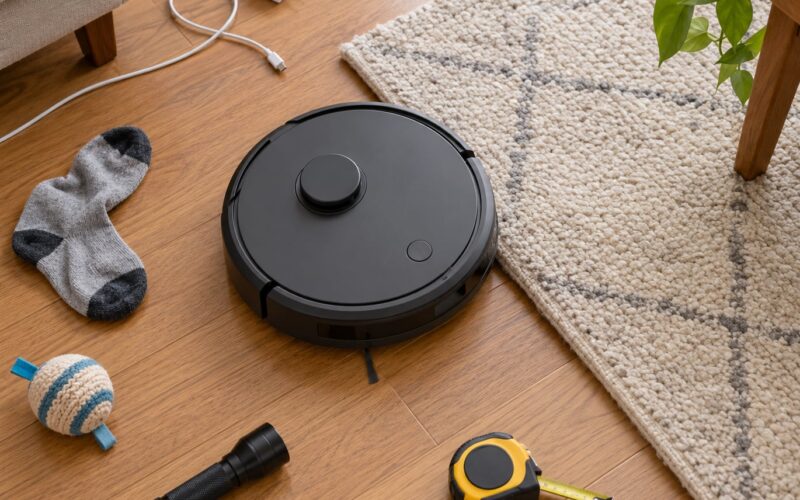
- Pick up charging cables, socks, hair ties and anything under an inch across, which the main roller can snag.
- Lift loose rug tassels and thin mats if your model’s manual says to, since fringes jam side brushes.
- Set no-go zones around floor-level feeds and fragile decor instead of moving them every time.
- Split your map into rooms so a targeted clean can replace a whole-house loop.
After the run
- Empty the dustbin every run or two. A full bin cuts suction and leaves debris behind.
- Wipe the cliff sensors and charging contacts with a dry microfiber cloth so it stops skipping or failing to charge.
- Pull hair off the main roller and side brush weekly. Wrapped hair heats up and stresses the motor.
- Wash or replace the filter on the schedule your manual gives, commonly every two or three months for daily use. A clogged filter is the usual reason suction drops and streaks appear.
- Empty self-emptying dock bags and clean the debris port. Bags are typically rated for 30 to 60 days of use.
Scheduling habits that pay off
- Run when the house is empty, using app scheduling or geolocation if your model supports it.
- Leave it plugged in on the dock. Most robots manage charge cycling themselves and return to the dock between runs.
- Pair vacuuming with mopping on a rotation rather than every run, since a damp pad over grit can smear a floor.
- Check for firmware updates, which often improve navigation and cleaning patterns.
On lifespan: daily running means roughly 365 charge cycles a year, against batteries typically rated for somewhere in the region of 1,000 to 1,500 cycles. That works out to a multi-year battery life in normal use, so frequency alone is not what kills a robot. Clogged filters, wrapped hair and debris scuffing the wheels do far more damage.
Electricity is a non-issue in most homes. A robot vacuum draws a modest amount of power for a short cycle, and the total is small enough that it rarely registers next to heating, laundry and refrigeration.
Frequently Asked Questions
Is it bad to run a robot vacuum every day?
No. Daily runs are what most robot vacuums are built for, and they are the recommended setting for homes with pets, kids or allergies. The one caution is that frequency raises maintenance: empty the bin more often, clear hair off the main roller weekly, and keep filters clean. Daily use does roughly 365 charge cycles a year, well within the cycle count a typical battery is rated for.
How often should I run a robot vacuum with pets?
Run it every day during heavy shedding, and every other day the rest of the year. If you have two pets or one that lives indoors full time, daily keeps dander and hair off hard floors before it works into carpet. Owners on pet-heavy schedules usually clean the hallway twice a day, pet rooms daily, and quieter bedrooms two or three times a week.
Do robot vacuums work better on hard floors or carpets?
They are noticeably better on hard floors, where a dry pass lifts grit cleanly and a damp mop pad follows well. On carpet the main roller does the work, so results depend on suction and brush design, and hair wraps faster. Hard floors can usually go two or three runs a week; carpet benefits most from daily passes plus a deeper clean with an upright or extractor.
How often should I clean a robot vacuum if I use it daily?
With daily use, empty the dustbin after every run or two, wipe the sensors and charging contacts weekly, and clear hair off the main roller and side brush once a week. Handle the filter on the schedule in your manual, often every two or three months. Most owners describe about five to ten minutes of cleaning a week once the habit is established.
Can running a robot vacuum too often damage it?
Rarely, on its own. What wears a robot out is neglect: clogged filters that choke the motor, hair wrapped around the roller that overheats the drive, and grit under the wheels that scuffs finished wood. Over-running just empties batteries and adds chores. If the bin comes back nearly empty twice in a row, dropping to every other day is a sensible change.
Do robot vacuums take a lot of electricity?
Not noticeably. A robot vacuum uses far less power than a washing machine, a space heater or even a hair dryer, and its running time per cycle is short. A daily schedule across a normal home adds only a small amount to your overall electricity use. Consumables such as filters, dust bags and side brushes usually cost more over a year than the power does.
Conclusion
Start with one run a day, then let the dustbin set the real schedule. If you are still working out how often should you run a robot vacuum for your home, check what it collects after a week, raise frequency in rooms that fill up fast, lower it where the bin comes back empty, and add a second run only when a real cleaning or allergy problem calls for it.