Air purifier vs humidifier comes down to one word each: an air purifier removes particles from the air, and a humidifier adds moisture to it. A purifier pulls air through filters to trap dust, pollen, pet dander and smoke. A humidifier puts water vapour back into a room that has gone dry. One subtracts, the other adds.
Last updated: October 2026
Most people only need one of these, and plenty end up with the wrong one. Some buy a purifier and then wonder why their nose still feels scratchy in January. Others run a humidifier through the summer and end up with damp windowsills and a musty bedroom. Getting the two straight makes the buying decision trivial.
Table of Contents
- Air Purifier vs Humidifier: What Each One Does at a Glance
- What Does an Air Purifier Do?
- How the airflow path works
- What an air purifier will not do
- Where a purifier makes the most sense
- What Does a Humidifier Do?
- Three ways a humidifier makes mist
- What a humidifier will not do
- What Is the Difference Between an Air Purifier and a Humidifier?
- Which Device Is Better for Allergies, Dry Rooms, or Smell?
- Can You Use an Air Purifier and Humidifier Together?
- How to Choose the Right Device for Your Home
- If you are buying an air purifier
- If you are buying a humidifier
- Downsides worth knowing before you buy
- When one combined machine makes sense
- Which Should You Choose?
- Frequently Asked Questions
- Do air purifiers remove humidity?
- Can a humidifier remove dust or allergens?
- Which is better for a dry room?
- Do air purifiers kill viruses and bacteria?
- Can an air purifier remove bad smells?
- How much humidity should a bedroom have?
Air Purifier vs Humidifier: What Each One Does at a Glance
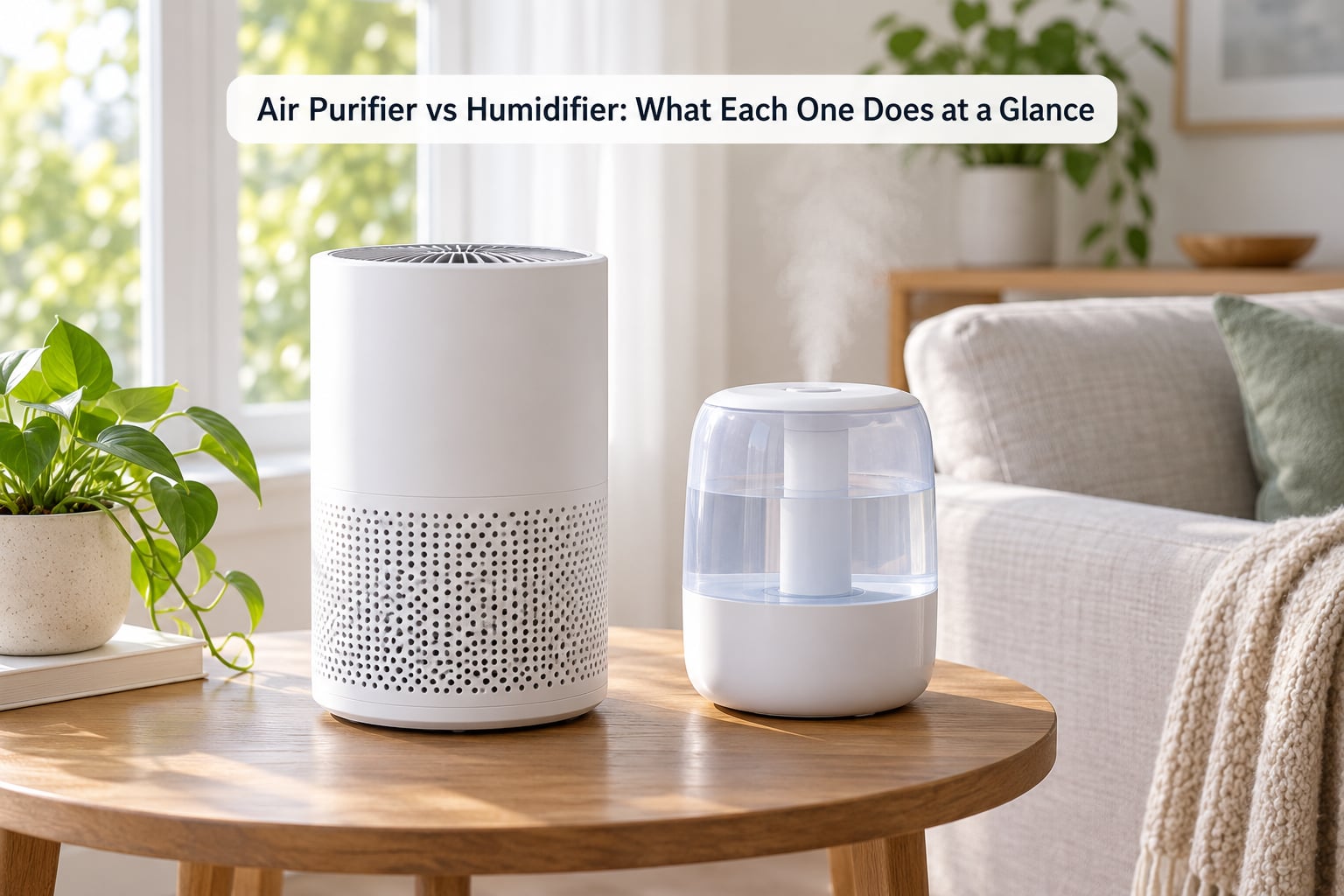
| What each one does | Air purifier | Humidifier |
|---|---|---|
| Core job | Traps airborne particles and recirculates cleaner air | Adds water vapour to raise relative humidity |
| Direction of change | Removes | Adds |
| Mechanism | Fan plus staged filters, usually pre-filter, HEPA and activated carbon | Water tank plus mist, made by ultrasonic vibration, evaporation or steam |
| What it changes | Particle levels in the air | Relative humidity, reported as a percentage |
| Does not do | Does not add or remove moisture, and does not kill germs | Does not filter particles or reduce dust |
| Main upkeep | Wipe or wash the pre-filter, replace filters on schedule | Empty, rinse and dry the tank weekly, keep water fresh |
| Best for | Allergies, asthma, pets, smoke, cooking smells, new carpets | Winter dry heat, chapped skin, static, cracking wood floors |
| Seasonal or year-round | Useful all year if particles are a problem | Mostly a winter device in heating seasons |
The table is the whole comparison in eight rows, and the fourth row is the one people miss. Neither machine does the other device’s job, which is why owning both can make sense while owning the wrong one is a common and expensive mistake.
What Does an Air Purifier Do?
An air purifier moves air through a series of filters and blows it back into the room cleaner than it found it. It never adds anything to the air. Every particle it catches stays trapped in a filter that you eventually throw away.
How the airflow path works
Air enters through the front or side vents, usually at the bottom, and travels upward through the filter stack before leaving through an outlet at the top or back. Most residential units use three stages, and each stage handles a different size of particle.
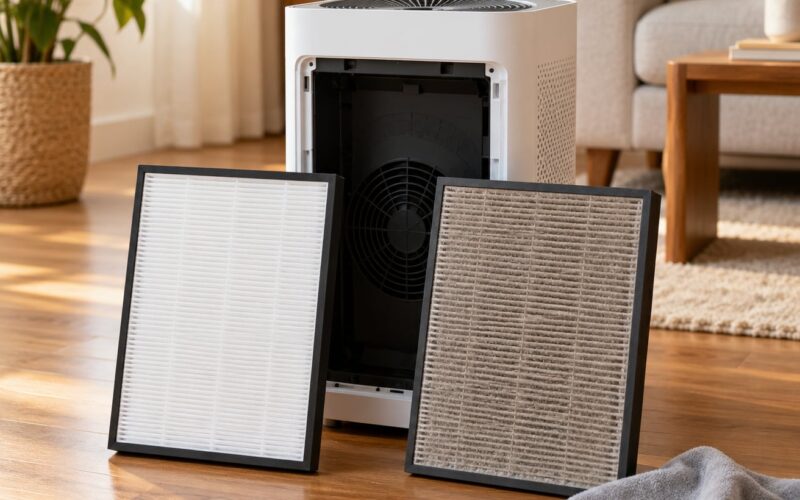
- Pre-filter. A cheap mesh or foam layer that catches hair, lint, large dust and pet dander first. It protects the expensive filter behind it, and on most models it is the only part you are expected to wash.
- HEPA filter. A dense mat of fibres that captures fine particles. The widely quoted figure is 99.97% efficiency at 0.3 microns, which is roughly the width of a large airborne particle. That number describes a test method, not a guarantee for an entire room.
- Activated carbon filter. A black pellet layer that adsorbs gases and vapours. It is the only stage that does anything about odors, and it is what separates a purifier that handles cooking smoke from one that does not.
Sizing is the part worth reading up on. The clean air delivery rate, or CADR, tells you how many cubic feet of clean air a unit pushes per minute, and AHAM sets the standard for how that is measured. A CADR figure near a third of a room’s volume gives roughly four air changes an hour, which is a reasonable target for an allergy bedroom.
Some purifiers add an ionizer or PECO cell that charges particles and makes them stick to the filter. These are effective on paper, and some models also release a small amount of ozone as a byproduct, which is why asthma and chemical sensitivity groups often skip them.
What an air purifier will not do
An air purifier does not change humidity. Not up, not down, not noticeably at all. It also does not kill bacteria, viruses or mold. It captures what is floating in the air, not what is already settled on surfaces or growing inside a wall cavity, and it does nothing to kill odor molecules that are larger than what a carbon filter can adsorb. A purifier also cannot fresh the air in a room that has a source problem. A paint spill or a new carpet will keep off-gassing no matter how good the filter is.
Where a purifier makes the most sense
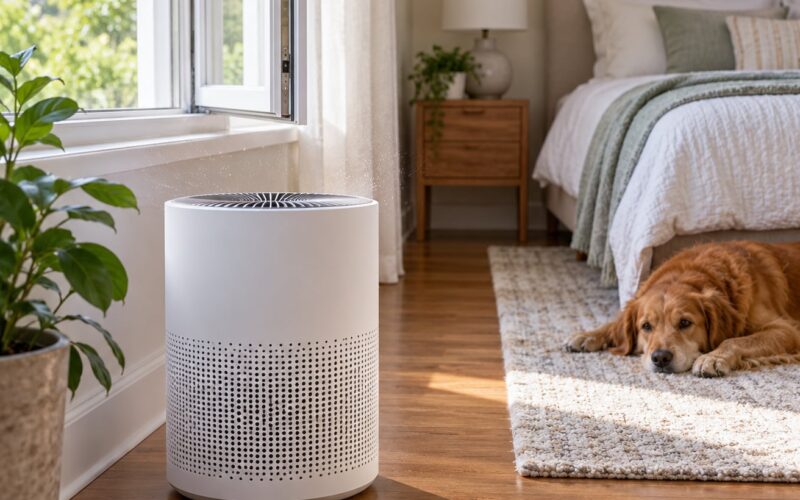
Bedrooms during pollen season, nurseries, home offices and living rooms in homes with pets or a smoker. It is also the right device for anyone who is allergic to dust mites or pet dander, because those allergen particles are exactly the size range a HEPA filter is built to catch.
What Does a Humidifier Do?
A humidifier does the opposite of a purifier. It takes water from a tank, turns it into a fine mist, and releases that moisture into the room until the relative humidity reaches the level you set. It removes nothing. It only changes how wet the air is.
Three ways a humidifier makes mist
- Ultrasonic. A vibrating element shakes the water surface into a very fine cool mist. Quiet, cheap to run and compact, which makes it the most common bedroom type. The fine droplets also carry whatever minerals are in the water, which is why tap water leaves a white dust on nearby surfaces.
- Evaporative. A fan pushes air across a wick or filter sitting in water. The air picks up moisture as it passes, and what leaves the wick is nearly mineral-free. It runs slightly warm, self-regulates well and is a good match for a room with a hard water problem.
- Steam or warm mist. A heating element boils the water. Warm mist travels further and quiets a stuffy room, but the boiling water is a burn risk, which is why pediatric guidance recommends cool mist for nurseries.
Relative humidity is simply the percentage of moisture the air holds relative to how much it could hold at that temperature. Cold outdoor air holds very little water, so when you heat it in winter the humidity percentage drops even though you have not added anything. That is the entire reason a humidifier exists.
What a humidifier will not do
A humidifier does not clean or filter anything. It can even make an air quality problem worse, because many allergens, dust mites and mould spores thrive when there is more moisture available. An uncleaned tank also becomes its own source of bacteria, and an ultrasonic unit running too hard will spray fine mineral dust onto your desk. Used badly, a humidifier can be the reason a room starts smelling musty.
What Is the Difference Between an Air Purifier and a Humidifier?
The difference between an air purifier and a humidifier is easiest to see by the criteria people actually shop on. Each row below is the practical gap between the two devices.
| Criterion | Air purifier | Humidifier |
|---|---|---|
| Removes or adds | Removes particles | Adds water vapour |
| Humidity effect | None | Raises relative humidity to a set target |
| Works with | Fan, filters, some sensors | Water, tank, mist mechanism |
| Readout you can trust | Particle sensor or a separate monitor | Hygrometer or built-in humidistat |
| Noise | Fan hum, usually 20 to 55 dB | Varies; evaporative types are the quietest |
| Recurring cost | Replacement filters every few months | Water, plus filters on some models |
| Placement rule | Clear space, away from walls and soft furnishings | Hard surface, slightly off the wall, mist aimed away from electronics |
| Common mistake | Placed in a corner where it pulls in dirty air | Placed on carpet or wood, causing dampness |
Two other devices cause the same confusion. A dehumidifier removes moisture from the air, so it is the answer in a damp climate, not the answer to a dry bedroom. A diffuser pushes scented oil vapour into the room for smell, which is a third job entirely and one that can raise humidity slightly. If you want scent and you want clean air, a diffuser plus a purifier is the pairing that does both.
Running cost is the quiet differentiator too. A purifier’s ongoing expense is filters, and they have to be bought from the same brand for the unit to work as rated. A humidifier’s ongoing expense is water plus electricity, which is usually trivial. Over five years, a heavily used purifier can cost several times more to keep running than a humidifier does.
Which Device Is Better for Allergies, Dry Rooms, or Smell?
For allergies, the air purifier wins, with one important caveat. HEPA filtration removes pollen, dander and airborne dust reliably, but allergy symptoms often come from humidity as much as from particles. Dust mites thrive above roughly 50% relative humidity, so a humidifier running alongside a purifier can make a mite-sensitive person feel worse, not better.
For a dry room, the humidifier wins outright. Dry skin, chapped lips, a scratchy throat on waking up and static that zaps you off a metal handle are all moisture complaints, and only a humidifier addresses them. Wooden floors that are cupping at the edges are the same story.
For smell, it depends on the source. Smoke, cooking odors, candle wax and paint fumes are gas-phase problems, and they need an activated carbon filter to do anything at all. Plain HEPA units do nothing for them. Pet urine, cooking grease and musty damp smells usually mean something needs cleaning rather than filtering, because the source is in the carpet or the bin.
Nobody buys a device for bacteria or viruses and gets reliable results. Purifiers capture the particles that carry them, but they do not inactivate them, and no home appliance replaces ventilation or handwashing. If you have a persistent medical concern, talk to a doctor rather than to a product page.
Can You Use an Air Purifier and Humidifier Together?
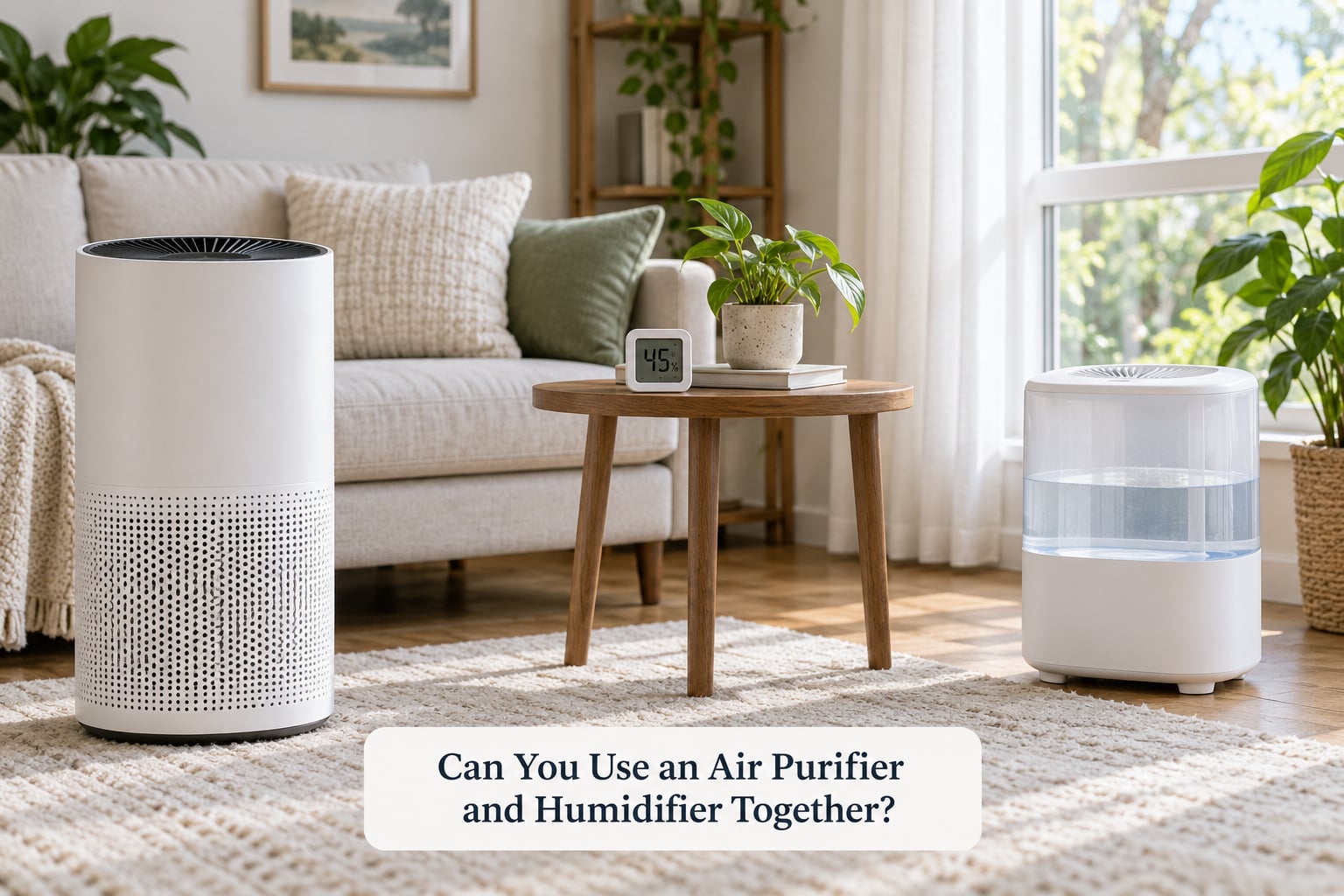
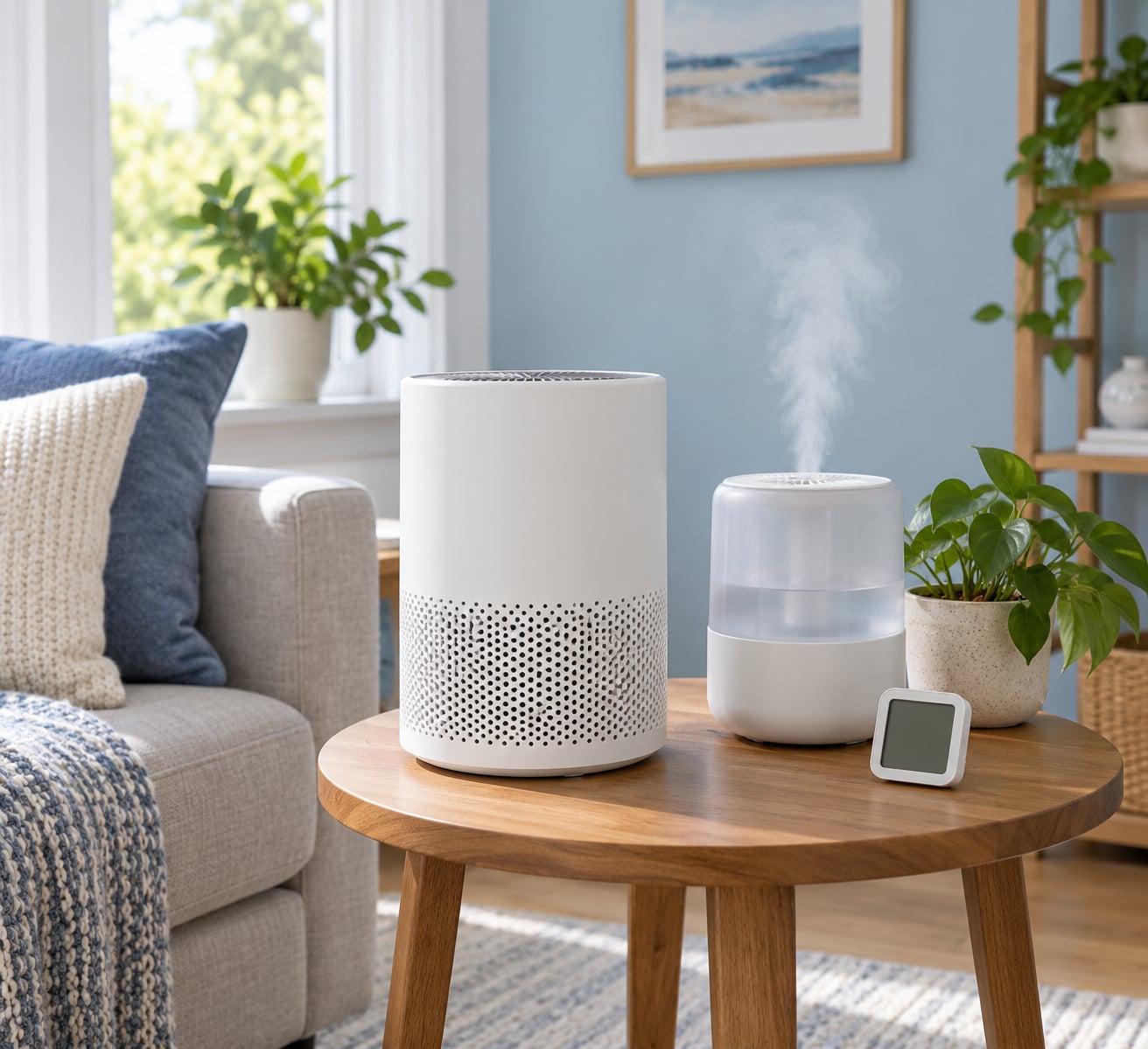
Yes, and plenty of homes run both without trouble. The question I get asked most often is whether mist ruins a HEPA filter, and the answer is that a light mist at normal humidity is fine as long as the filter is not sitting in a wet corner.
- Put them at opposite ends of the room. This is the single placement rule that solves most of the worry. Air from the humidifier disperses through the room long before it reaches the intake.
- Keep the humidifier off the floor. Put it on a hard surface, a small table or a stand, and leave a few centimetres of clearance behind it so air can flow out instead of pooling on a wall.
- Aim mist away from electronics and wood furniture. Continuous dampness next to a TV, a laptop or an oak floor leaves its mark.
- Run a hygrometer. A cheap digital one gives you a number you can trust. Most well-behaved units stop on their own at a set target, and a second sensor in the room tells you the room agrees.
- Keep a gap between target and reality. Set the humidifier a few points below the range you actually want, because a sensor near the outlet reads higher than the far corner of the room.
The risk people regret is over-humidification, not the pairing. The most common near-miss is a humidifier left on high overnight in a closed bedroom, where a slowly dampened sound machine or TV gives up long before anyone notices the smell. A humidistat plus a visible readout is what prevents that.
How to Choose the Right Device for Your Home
Start by measuring rather than guessing. A ten-dollar hygrometer in your bedroom and a cheap PM2.5 monitor in your living room will tell you in a week whether you have a moisture problem or a particle problem, and that answer decides which device to buy first.
If you are buying an air purifier
- Match CADR to room volume. Multiply the room’s volume in cubic feet by a factor of four for regular use, then pick a unit with a CADR at or above that number.
- Check filter cost and interval. Replacement filters run monthly or quarterly, and the price is the real cost of the appliance. Confirm the replacement part number before you buy.
- Prefer washable pre-filters. You will clean it monthly, and units with a washable pre-filter cost less to keep running.
- Check night behaviour. A purifier with a light-free sleep mode is worth real money in a bedroom, because a bright indicator can wake you every night.
- Leave air space. Clearance around and above the unit matters as much as the filter rating.
If you are buying a humidifier
- Get a humidistat and a readout. Setting by dial and guessing produces both over-humidification and a room that never improves.
- Choose evaporative in hard-water areas or when white dust is a problem, and ultrasonic for quiet, cool operation in a small room.
- Size the tank to your schedule. A large tank means fewer refills but a bigger reservoir of standing water to keep clean.
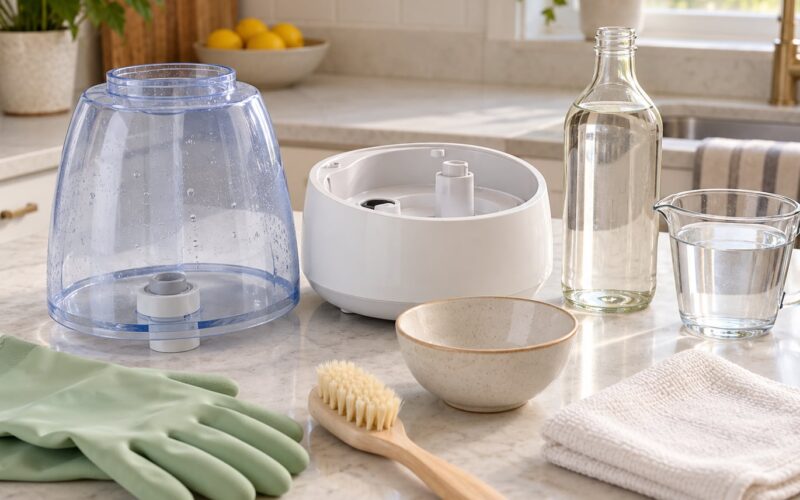
- Check cleanability. A wide tank that you can reach into without a brush is the difference between weekly cleaning and a project you stop doing.
- Look for auto shutoff. Every decent unit shuts off when the tank is empty, but some also shut off at your humidity target.
Downsides worth knowing before you buy
Purifiers have honest drawbacks: filter costs that stack up, noise that some people cannot sleep through, and ionizer or PECO models that can produce small amounts of ozone. Humidifiers have their own: mineral dust from ultrasonic mist, the weekly cleaning habit, a real risk of mould if you skip it, and the possibility of pushing a room past the humidity level where mould and dust mites start to win.
When one combined machine makes sense
Combination purifier-humidifier units exist, and they are a reasonable answer in one specific situation: a small bedroom where floor space is tight and you genuinely want both functions. The trade is that these units are bigger, cost more, and if either the filter or the mist mechanism fails you often lose both functions. For most homes, two separate devices placed at opposite ends of a room are cheaper and easier to service.
Which Should You Choose?
Choose an air purifier if your problem is particles: pollen, dust, pet dander, smoke or general haze. Choose a humidifier if your problem is dryness: winter heat, static, chapped skin and a scratchy throat on waking. Choose both if you live with pets or allergies through the year and also run forced-air heat in winter, placing them at opposite ends of the room.
Choose neither as a substitute for the basics. Open a window when the outdoor air is clean, run your range hood while cooking, change your furnace filter on schedule, and clean up the damp spot behind the sofa. Every indoor air problem is easier to prevent than to filter.
Frequently Asked Questions
Do air purifiers remove humidity?
No. Air purifiers remove particles, not water vapour, so relative humidity stays roughly the same whether the purifier is running or off. Removing moisture is the job of a dehumidifier. If your room feels humid in summer, that is a separate problem from anything a purifier or a humidifier will address.
Can a humidifier remove dust or allergens?
No. A humidifier has no filter and no way to capture anything. It adds moisture to the room, and in some cases that makes things worse, because dust mites and mould spores multiply as humidity climbs. If your problem is airborne dust or pet dander, you need a purifier with a HEPA filter instead.
Which is better for a dry room?
The humidifier, without question. Dry skin, chapped lips, static shocks and a sore throat on waking are all moisture complaints, and a humidifier is the only device built to fix them. A purifier does nothing for dryness. Set a humidistat target in the middle of the 40 to 50 percent range and use a hygrometer to confirm it.
Do air purifiers kill viruses and bacteria?
No. A purifier captures the particles that carry viruses and bacteria, but it does not inactivate them, and it does nothing about germs already settled on surfaces or in a room’s structure. Ventilation, handwashing and staying home when you are unwell do far more than any consumer appliance. For health questions, a doctor is the right source, not a product listing.
Can an air purifier remove bad smells?
Only if it has a real activated carbon filter and you change it on schedule. HEPA alone catches particles but does nothing with gas-phase odors, so smoke, cooking smells and paint fumes need carbon. Persistent smells usually come from a source such as a pet stain, a trash bin or damp carpet, and no filter fixes that at the source.
How much humidity should a bedroom have?
Most guidance points to roughly 30 to 50 percent relative humidity for indoor spaces, with comfort sitting nearer 40 to 50 percent. Below about 30 percent air tends to feel dry and irritating, while sustained levels above 50 to 60 percent encourage mould and dust mites. Measure with a digital hygrometer and check it in winter, when heating changes the number fastest.
If you take one thing from this, measure first. A hygrometer and a cheap particle monitor will tell you in a week whether your problem is moisture or dust, and that single answer removes the guesswork from the whole decision.