If you have ever stood in front of an air purifier spec sheet and wondered which number actually matters, CADR is the one. CADR stands for Clean Air Delivery Rate, and it tells you how many cubic feet of filtered air the machine pushes through a room each minute. Here is the short version before we get into the maths.
What does CADR mean on an air purifier? It is the volume of clean, filtered air the machine delivers per minute, measured in cubic feet per minute (CFM) and tested separately for smoke, dust and pollen. A higher CADR clears particles faster, which means the unit has to be big enough for the room you put it in.
The figure is not marketing fluff. It comes out of a sealed test chamber run by AHAM, the Association of Home Appliance Manufacturers, under the AC-1 method developed with the US EPA. That standard is the reason a 300 CFM purifier from one brand can be compared honestly with a 300 CFM purifier from another, and it is the number I would look at first when comparing anything on a spec sheet in 2026.
It is also the number most easily misused. Box fronts say “covers up to 1,000 square feet” using an assumption buyers never see, and the same purifier printed on three different pages rarely gives you the units or the air-change rate you need to make sense of it. Here is how to read the number properly, size a unit for your own rooms, and spot the claims worth ignoring.
Table of Contents
- Understanding Air Purifier CADR Ratings
- What Does CADR Mean for Different Pollutants?
- How Do You Read an Air Purifier’s CADR Number?
- How Much CADR Do You Need for Your Room?
- How to Calculate the Right CADR for a Room
- CADR for Smoke vs. Pollen and Dust
- What CADR Does Not Tell You About an Air Purifier
- Frequently Asked Questions
- Is a higher CADR always better for an air purifier?
- What CADR rating is best for a bedroom?
- How many times per hour should an air purifier change the air?
- Does a higher CADR mean an air purifier uses more electricity?
- Can one air purifier handle more than one room?
- Conclusion
Understanding Air Purifier CADR Ratings
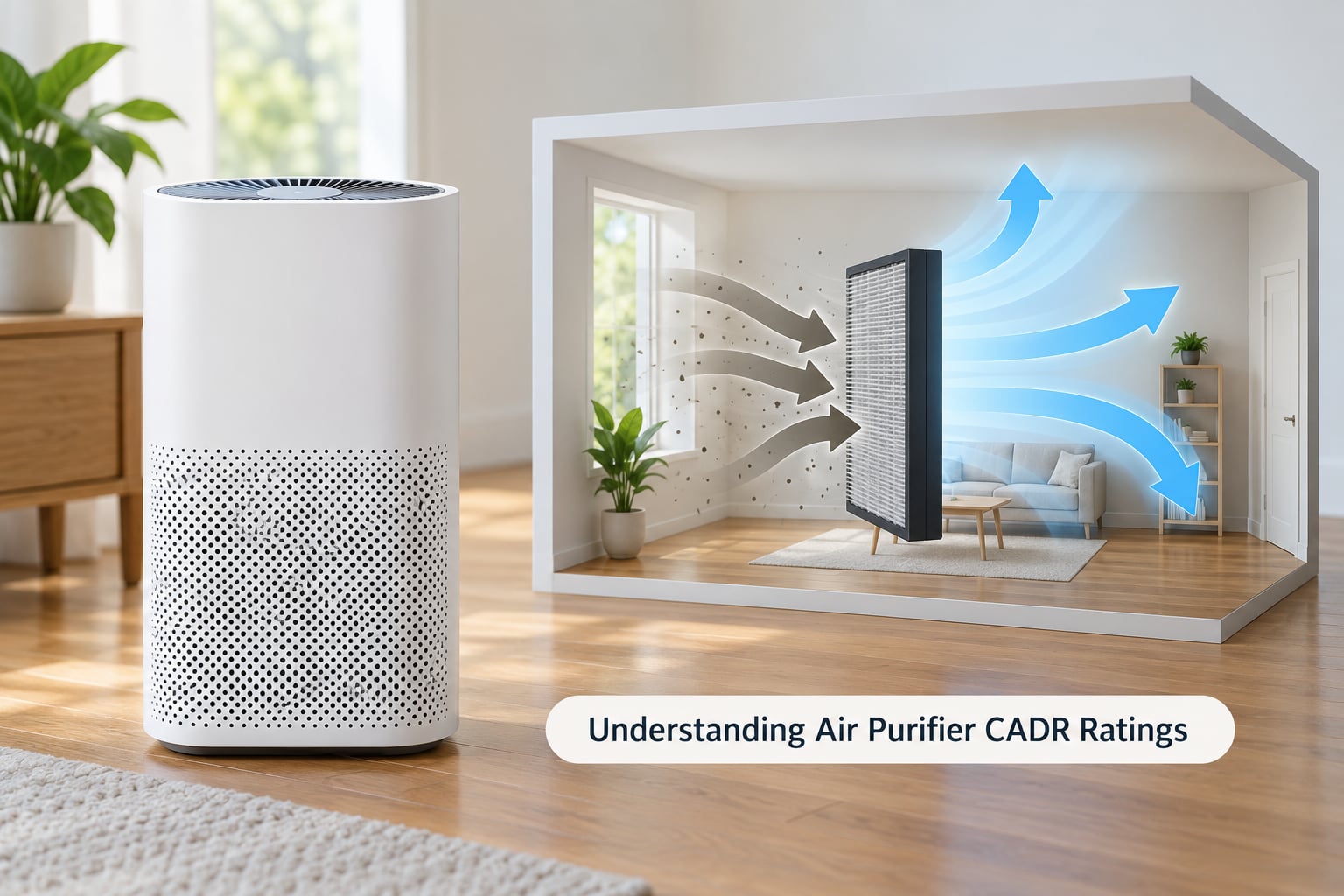
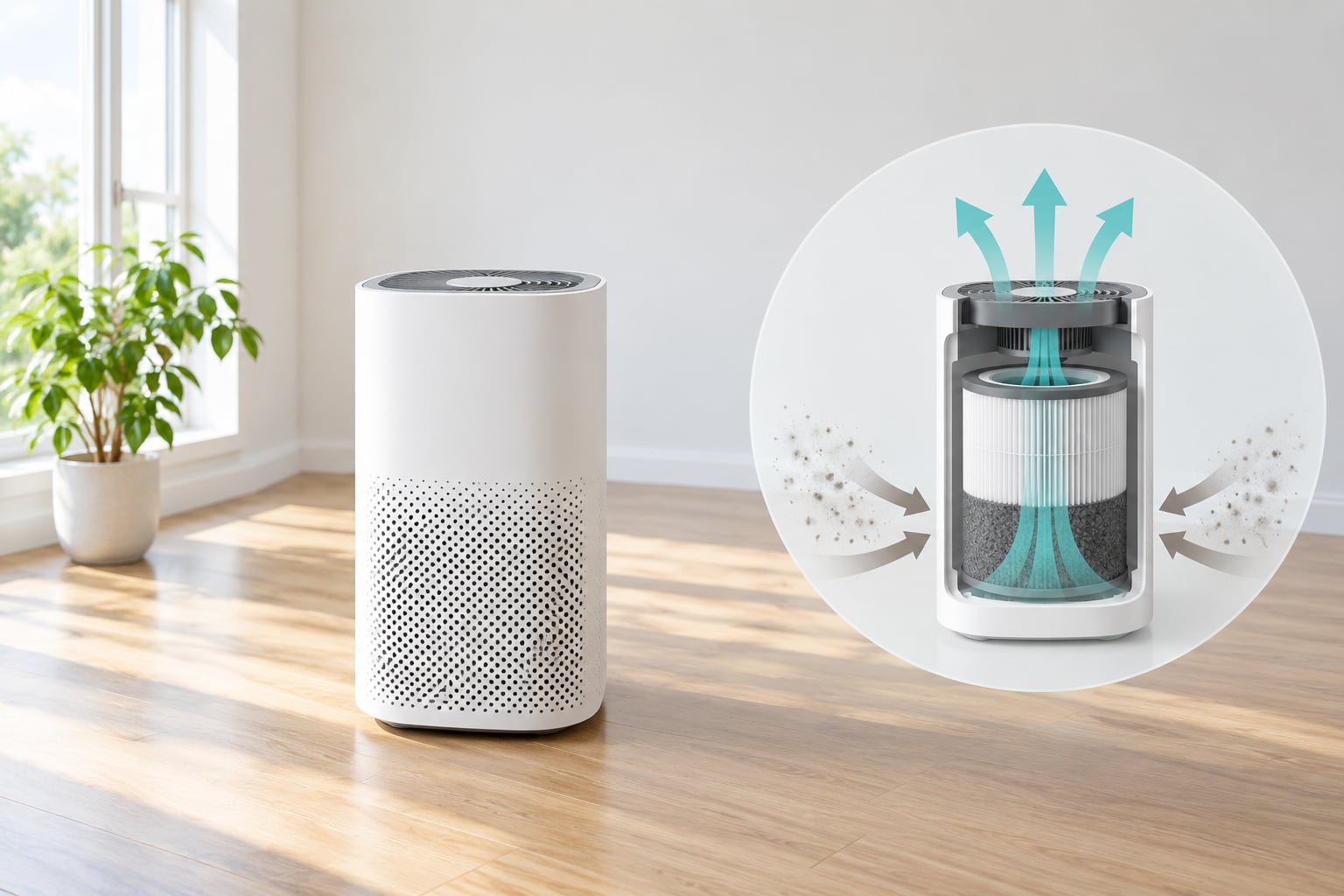
CADR is a rate, not a total. A purifier rated at 300 CFM moves 300 cubic feet of air every minute, which works out to 18,000 cubic feet an hour. Whether that is enough depends entirely on how much air the room contains, which is why the same purifier can be excellent in a bedroom and hopeless in an open-plan living space.
The test itself works like this. The unit is sealed in a chamber of known volume, run at its highest speed, and fed a measured dose of particles in one of three size ranges. The machine tracks how fast the particle count falls, and that decay rate is converted back into a volume of particle-free air per minute. In practice the number combines airflow with filter efficiency, because a leaky filter can never produce a clean air delivery rate no matter how fast the fan spins.
Every rating you will see is one of three, because the three particle sizes behave very differently when they hit a filter and when they are breathed in.
| CADR type | Particle size tested | What it represents | Typical rating on the same purifier |
|---|---|---|---|
| Smoke CADR | 0.09 to 1.0 microns | Fine ultrafine particles, cooking smoke, PM2.5 | Lowest number |
| Dust CADR | 0.5 to 3.0 microns | Household dust, fine particulate matter, some pollen | Middle number |
| Pollen CADR | 5.0 to 11.0 microns | Coarse pollen and larger airborne particles | Highest number |
Units vary by market. North American listings use CFM, most of Europe and Asia list m3/h, and a few use both. Multiply CFM by 1.7 to get m3/h, and multiply m3/h by 0.59 to get CFM.
| CADR in CFM | Equivalent in m3/h | 8 ft ceiling room at 4 air changes per hour | 8 ft ceiling room at 5 air changes per hour |
|---|---|---|---|
| 100 | 170 | 200 sq ft | 160 sq ft |
| 150 | 255 | 300 sq ft | 240 sq ft |
| 200 | 340 | 400 sq ft | 320 sq ft |
| 300 | 510 | 560 sq ft | 450 sq ft |
| 400 | 680 | 750 sq ft | 600 sq ft |
| 500 | 850 | 940 sq ft | 750 sq ft |
These figures assume a ceiling of 8 feet. A 10 ft ceiling holds 25 percent more air in the same footprint, so a room like that needs about a quarter more CADR for the same number of air changes.
What Does CADR Mean for Different Pollutants?
The three ratings answer different questions, so the number that matters to you depends on what you are actually trying to remove. A pollen allergy sufferer can lean on the pollen figure. Someone cooking every evening or living through a wildfire smoke event needs the smoke figure, which is always the lowest of the three.
Higher is not automatically better, either. A purifier with a pollen CADR of 450 and a smoke CADR of 180 is doing exactly what the rating says, and reading only the pollen number would badly oversize it for fine particles. Smoke is the conservative anchor because the particles in that range are the hardest to capture and the ones most relevant to lung health, and most people end up shopping with the smoke number.
One practical warning: the three ratings come from a clean chamber with a single particle type. Real rooms mix sawdust, pet dander, cooking aerosol and outdoor pollution, and under those conditions every purifier removes fewer particles per minute than the label promises. Think of the rating as the machine’s best measured performance, not a running guarantee.
How Do You Read an Air Purifier’s CADR Number?
The CADR figure sits in the specification table on the product page or on a sticker on the base of the unit, usually labelled smoke, dust and pollen. If you cannot find three separate numbers, treat the single figure as a smoke rating, since that is how most non-US listings report it.
Next, check whether the number is third-party verified. An AHAM-verified listing says so explicitly, and that certification is the single most trusted signal on any air purifier spec sheet. A brand that publishes one CADR figure with no particle category and no standard reference is reporting its own lab result, which may be perfectly accurate but cannot be compared to anyone else’s.
The distinction that confuses people most is between air changes and removal. A 300 CFM rating does not promise that your room will be completely clean in an hour. It means the machine moves 300 cubic feet per minute, so in a 1,600 cubic foot room it turns over the entire volume about 11 times an hour before you account for leakage through doors and the poor mixing that happens in any real room.
That multiplication is the whole calculation. Room volume in cubic feet, multiplied by the air changes per hour you want, divided by 60, gives you the CADR you need.
How Much CADR Do You Need for Your Room?
Most guidance aims for four air changes per hour in a bedroom and five or six in a room where people are active all day, and four changes per hour means the entire volume of room air is replaced once every fifteen minutes. A room sized for two changes per hour will feel fine until someone cooks, and then it stays hazy for a long time.
| Room size at 8 ft ceiling | Room volume | CADR needed for 4 air changes per hour | CADR needed for 5 air changes per hour |
|---|---|---|---|
| 100 sq ft | 800 cu ft | 53 CFM | 67 CFM |
| 200 sq ft | 1,600 cu ft | 107 CFM | 133 CFM |
| 300 sq ft | 2,400 cu ft | 160 CFM | 200 CFM |
| 400 sq ft | 3,200 cu ft | 213 CFM | 267 CFM |
| 500 sq ft | 4,000 cu ft | 267 CFM | 333 CFM |
| 750 sq ft | 6,000 cu ft | 400 CFM | 500 CFM |
A quick sanity check that matches community sizing advice: roughly 300 CFM of smoke rating for a 500 square foot room gets you into the four to six air changes per hour range. Anything less and you are chasing particles you cannot catch.
Watch the two-thirds rule when a box claims a room size. Manufacturers usually calculate “covers up to X square feet” at two air changes per hour, which sounds generous but means your actual four-change figure is smaller. Taking two-thirds of the printed claim lands you near three air changes per hour, a realistic working size for a bedroom.
Ceiling height is the other thing sizing advice leaves out. Anyone with a 9 or 10 ft ceiling needs proportionally more CADR than the same floor area suggests, and if you can pass the height into the volume calculation instead of assuming 8 feet, do it.
One large purifier or two small ones also depends on the shape of the space. In separate rooms, two smaller units usually win, because each room gets its own CADR and a doorway will not carry much air between them. Inside one open-plan area, two units often underperform a single large unit of the same total rating, since much of the air they move is immediately re-mixed rather than reaching the far end of the space.
How to Calculate the Right CADR for a Room
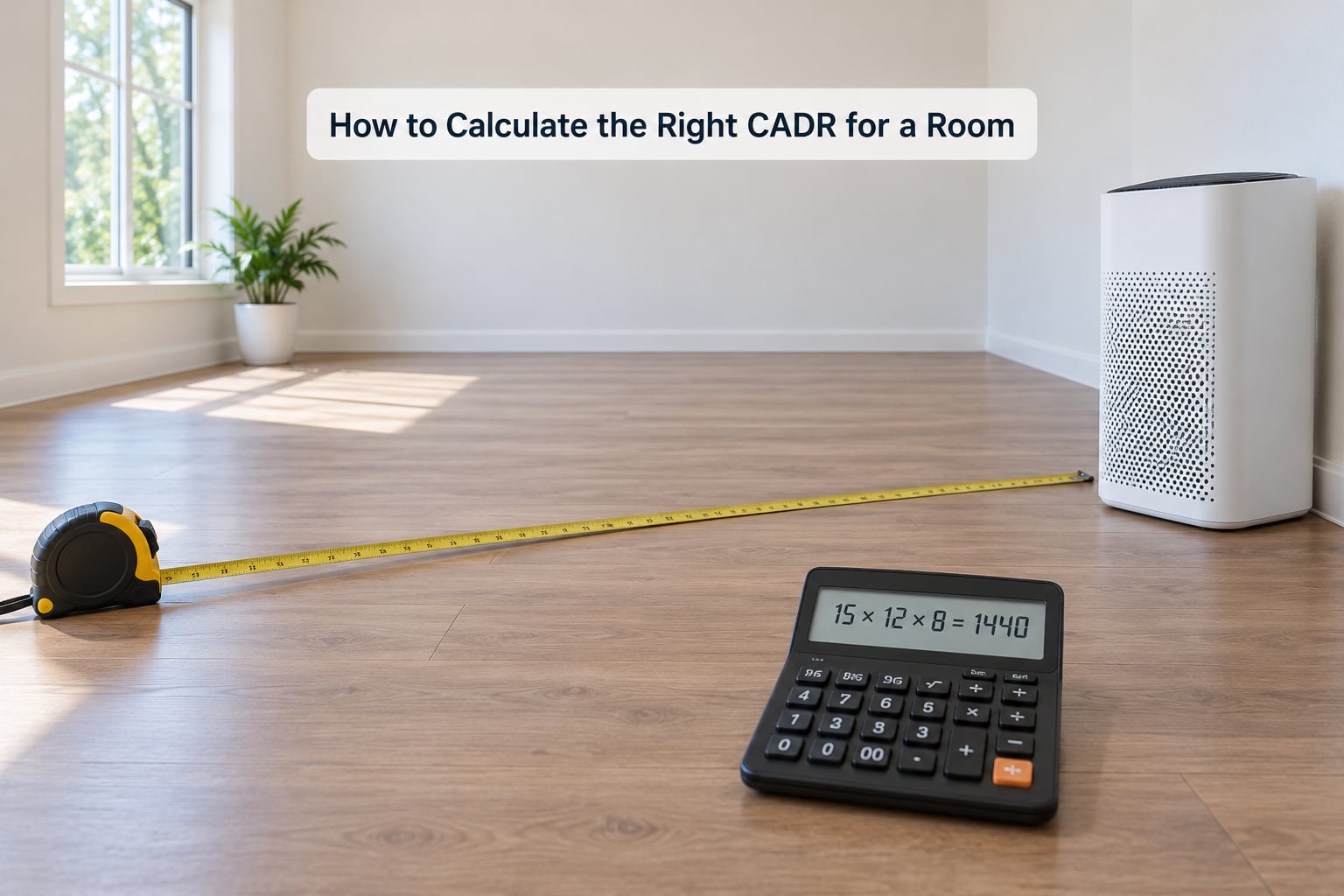
Step one is to measure the room, and do it in all three directions because almost every sizing mistake comes from assuming square footage alone. Multiply length by width by ceiling height to get the volume of the space in cubic feet.
Step two is to pick your air change target. Four per hour is a sensible floor for a bedroom, five for a living room or office where people are present through the day, and six if anyone in the house has asthma or you deal with seasonal smoke. Step three is the division.
Room volume in cubic feet, multiplied by the air changes per hour you want, divided by 60, equals the CADR you need.
Here is the calculation for a 12 by 12 foot bedroom with an 8 foot ceiling. The volume is 12 multiplied by 12 multiplied by 8, which gives 1,152 cubic feet. At four air changes per hour, 1,152 multiplied by 4 is 4,608 cubic feet per hour, and dividing that by 60 gives about 77 CFM. Pushing to five air changes per hour raises the requirement to about 96 CFM, so a purifier rated in the 80 to 100 CFM range is the right size for that room.
If your dimensions are in metres, multiply to get cubic metres and use 0.59 to convert the resulting m3/h figure into CFM. A 12 metre by 12 metre room with a 2.4 metre ceiling is 346 cubic metres, which at four changes per hour comes to roughly 236 m3/h, or about 139 CFM. The same room in imperial units is much smaller, so check which system your tape measure is reading before you convert.
CADR for Smoke vs. Pollen and Dust
Smoke CADR is the number to plan around in most homes, because the particles in the 0.09 to 1.0 micron range are the hardest to filter and the ones that reach deep into the lungs. That range covers cooking aerosol, fine particulate matter and the PM2.5 peaks that show up during wildfire season, and it is where an undersized purifier falls apart first.
Dust CADR sits in the middle and covers the fine particulate in carpets, bedding and textiles, along with pet dander. If your concern is dust mites and general grime rather than a smoke event, the dust number is the honest one to size against, and it will be a little higher than the smoke figure on the same unit.
Pollen CADR is always the largest, because those larger particles are easier to capture and easier to blow around. It is a perfectly valid number to shop by during spring, and it is also the easiest number to over-buy on, since treating a pollen rating like a smoke rating leaves you with a large, loud, expensive machine you do not need.
One thing worth keeping in mind across all three: CADR measures airflow performance, not a health outcome. It tells you how quickly a chamber full of one contaminant gets cleared. It does not tell you how many particles end up in your lungs, and it cannot tell you anything about how well a purifier works when someone else in the house is opening the oven door every twenty minutes.
What CADR Does Not Tell You About an Air Purifier
CADR is a single number in a room full of trade-offs, and treating it as the whole picture leads to bad purchases. These are the things it says nothing at all about.
| What CADR measures | What CADR does not measure |
|---|---|
| Volume of particle-free air delivered per minute | Noise level at maximum speed |
| Capture efficiency for three particle size bands | Electricity use at each fan setting |
| Relative performance between comparable models | Cost and availability of replacement filters |
| How fast a sealed chamber clears a known dose | Gases, VOCs, odors, formaldehyde or CO2 |
| Nothing about the room it sits in | Real-world performance in a busy, non-sealed room |
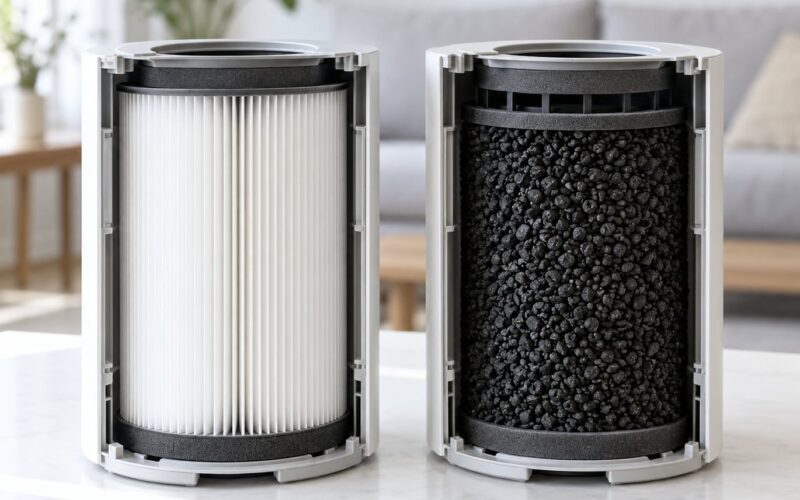
Gases and odors are the biggest blind spot. CADR tests run on particles, so a unit can post an excellent score and still do nothing about cooking smells, paint fumes, formaldehyde off new furniture or volatile organic compounds from cleaning products. That work is done by an activated carbon filter, and its effectiveness depends on how much carbon is in the machine and whether it is sized for the room, which is why carbon is judged separately and informally.
Noise and energy follow the same logic. The fan has to move more air through the same filter to deliver a higher CADR, which means more decibels and more watts at maximum setting. A 600 CFM unit running flat out is loud enough to hear over a conversation, which is fine in a basement and miserable in a bedroom.
Room mixing is the third blind spot. Filters capture what passes through them, and in a real room with a closed door and a ceiling fan off, air moves in lazy loops that leave corners and the space behind furniture untouched. Leaving two or three feet of clearance on every side, away from walls and corners, matters more for results than any spec difference between two models.
Run time and air change terminology confuse readers too. Real air changes per hour, ACH, is the straight volume turnover. Equivalent air changes per hour, eACH, accounts for how the concentration decays as it goes, and it is always lower than ACH for the same machine. If a listing mixes the two terms, work out which one it used before comparing it with anything else.
Finally, CADR comes from a clean chamber. Independent testing groups that track particle counts point out consistently that purifiers underperform when outdoor pollution is already high, because the machine spends its capacity re-cleaning air that has already entered the room. That gap between lab and lived conditions is normal, and it is one more reason to size with some headroom rather than exactly to the number.
Frequently Asked Questions
Is a higher CADR always better for an air purifier?
A higher CADR clears particles faster, but it is only useful if the room is big enough to need it. Oversizing a small bedroom gives you a loud machine at maximum setting and no visible benefit, since auto mode will simply run it slower. Match the rating to your room volume and the air changes per hour you actually want, then compare units within that range.
What CADR rating is best for a bedroom?
For a typical 12 by 12 bedroom with an 8 foot ceiling, about 77 CFM of smoke rating reaches four air changes per hour, and roughly 96 CFM reaches five. Larger bedrooms need more, so measure the room and run the volume calculation rather than relying on a single number. Look for an AHAM-verified smoke, dust and pollen rating rather than a single unverifiable figure.
How many times per hour should an air purifier change the air?
Four air changes per hour is a sensible minimum for a bedroom, which replaces the entire volume of room air every fifteen minutes. Five or six suits living rooms, home offices and homes with asthma or heavy cooking smoke. Running continuously on a lower fan speed generally cleans better than running a bigger unit on maximum for short bursts.
Does a higher CADR mean an air purifier uses more electricity?
At maximum speed, yes. Delivering more air means the fan works harder and draws more power, and high-CADR units are typically the largest and loudest machines on the market. The practical answer is to run a room-appropriate unit continuously on low or auto rather than a bigger unit at full blast, which costs less energy and is much easier to live with.
Can one air purifier handle more than one room?
Only if the rooms are effectively one space. An open-plan living and dining area counts as a single volume, so size the purifier for the combined square footage. Two separate rooms with a door between them need a unit in each, because very little air crosses a doorway and a single machine in the hallway will do almost nothing for either space.
Conclusion
CADR stands for Clean Air Delivery Rate, the cubic feet per minute of filtered air a purifier delivers, measured separately for smoke, dust and pollen under the AHAM standard. It is the most useful number on the box, and it is also the number most often stretched.
So measure your room before you shop, multiply length by width by ceiling height to get the volume, and divide volume multiplied by your target air changes per hour by 60. That gives you the smoke CADR to look for, and anything AHAM-verified near that figure will handle the space properly.