Yes, air purifiers help with pet allergies. A True HEPA unit pulls airborne dander particles out of the room air before you breathe them in, which cuts the exposure driving your symptoms. What it cannot do is reach the dander already settled in carpets, sofas and bedding.
That distinction matters more than any spec on the box. Purifiers are genuinely useful, but they work as one layer of a plan rather than a cure, and the households that notice real relief are usually the ones that sized the unit correctly, placed it in the bedroom and kept the filter clean.
Table of Contents
- Do Air Purifiers Help with Pet Allergies?
- Do air purifiers help with pet allergies only partly?
- How Do Air Purifiers Reduce Pet Dander?
- What happens inside the unit
- Why the room still smells like the pet
- What filtration does not do
- Which Air Purifier Features Matter for Pet Allergies?
- True HEPA certification, not HEPA-type
- CADR and how many air changes you get
- Replacement filter cost and availability
- Noise at the speed you will run
- Ozone and ionization are a deal breaker
- Features that add little
- How Do You Choose the Right Size for Your Room?
- How Effective Are Air Purifiers Against Common Pet Allergens?
- Pet dander
- Dust mites
- Pollen and mold spores
- What still has to be done by hand
- Do Air Purifiers Replace Medication or Medical Advice?
- What Maintenance Makes an Air Purifier Work Better?
- Clean the pre-filter every one to two weeks
- Replace the particle filter on schedule
- Keep the carbon layer fresh for odor control
- Leave airflow clear on all sides
- Use the right mode and read the indicators
- Are Air Purifiers Worth It for Pet Owners?
- Frequently Asked Questions
- Can an air purifier help with cat or dog allergies overnight?
- Is a carbon filter enough for pet allergies, or do I need HEPA?
- Are ionizers and ozone generators safe in a home with pets?
- Can air purifiers help a pet with environmental allergies?
- How soon should I expect to notice a difference after starting an air purifier?
- Conclusion: What to Do First
Do Air Purifiers Help with Pet Allergies?
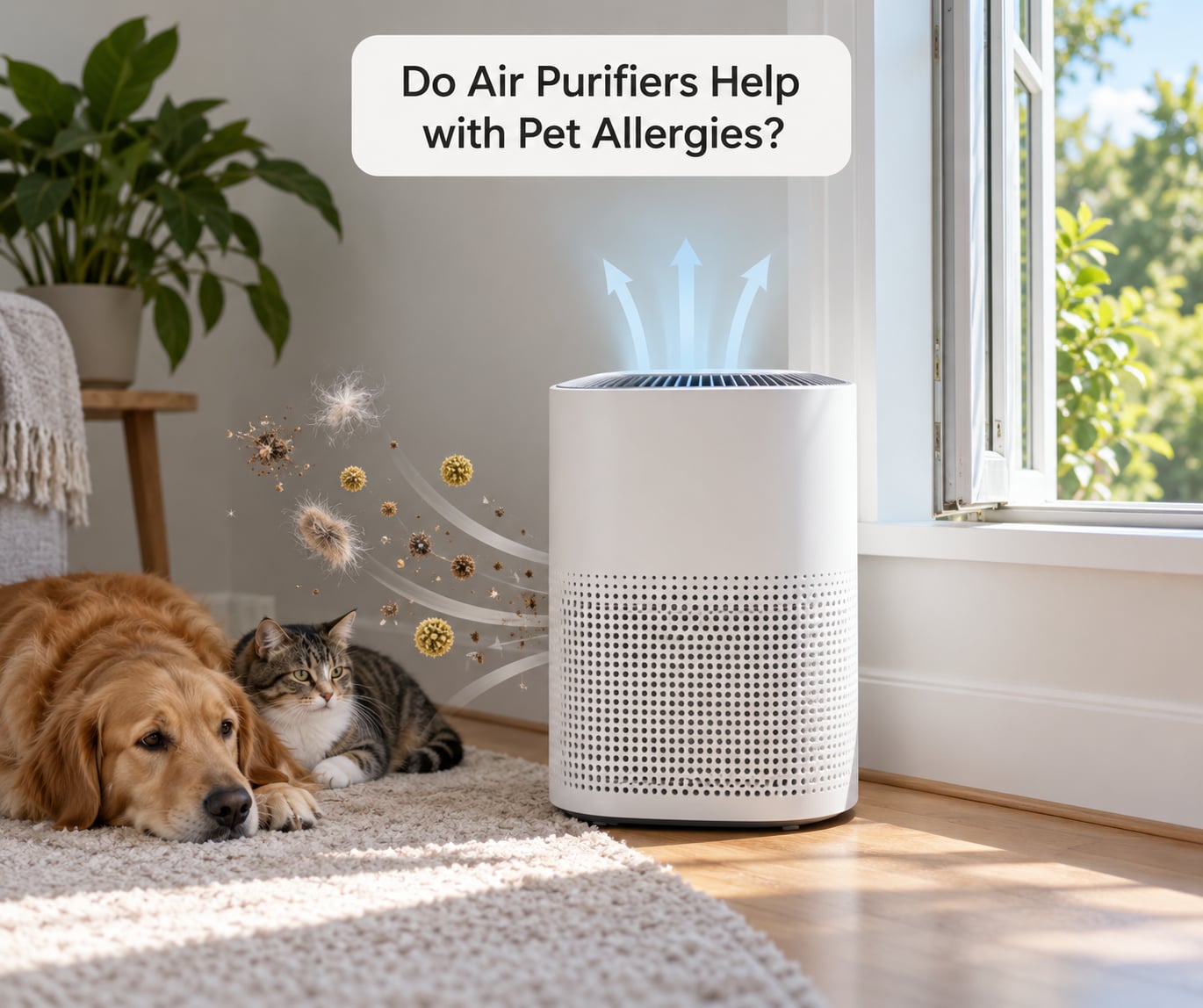
They help, and allergy organizations such as ACAAI and AAAAI treat exposure reduction as a core part of managing allergic rhinitis. A purifier is the most direct way to lower dander in the air you breathe, and it is the only control that works while you are asleep.
It also helps to be blunt about the rest. Owners on r/AirPurifiers and r/dogs often report filling a filter with fur and feeling no different, which usually means the unit was too small for the room or fighting an open door rather than a fault in the purifier itself.
| Feature | What it does for pet allergies | Limitation | What to look for |
|---|---|---|---|
| True HEPA filter | Captures fine airborne dander and dust | Does nothing for settled dander in carpets or bedding | A written 99.97 percent rating at 0.3 microns, not just the word HEPA |
| Activated carbon | Absorbs pet odor and some VOCs | Does almost nothing for particles | Carbon rated separately from the particle filter, with a stated replacement interval |
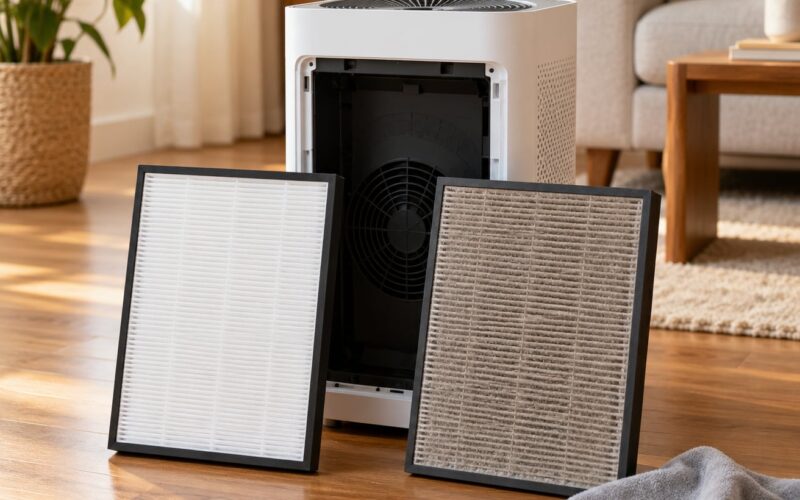
| Washable pre-filter | Catches hair and larger dust before the HEPA | Holds the visible hair that owners mistake for the allergen | Removable mesh or foam pre-filter you can rinse or vacuum |
| CADR rating | Tells you how fast it clears a room | High smoke figures do not predict dander performance | A dust and pollen CADR matched to your room volume |
| Night or quiet mode | Lets it run while you sleep | Low speeds often mean far fewer air changes | A stated noise level at the speed you would actually run |
| UV light or ionizer | UV adds little for dander; ionizers add nothing | Ionizers can release ozone, which irritates airways | A stated ozone-free or no-ionization design |
Do air purifiers help with pet allergies only partly?
Partly is the honest answer. What goes in the filter is the fraction of dander that happens to be suspended in the air at that moment, and the fraction depends on airflow, room size and how much the pet is moving around.
What stays in the carpet, the couch cushions and the sheets is untouched by the machine. Since that is where most of the dander in a typical home actually lives, a purifier in an average pet household can cut airborne levels noticeably while symptoms barely move. Anyone testing whether do air purifiers help with pet allergies in their own home will hit that same gap between air quality and symptom scores.
People often expect a purifier to behave like a vacuum. It cannot, because its job is to clean air, not surfaces, and the two problems need different tools.
How Do Air Purifiers Reduce Pet Dander?
The mechanism is simple enough to describe in one pass. Cat and dog allergies are triggered by proteins, not fur. The main culprits are Fel d 1 in cats and Canis familiaris 1 in dogs, and these proteins are shed in skin flakes, saliva and urine residue rather than in the hair itself.
Those flakes are small. Fine dander particles measure roughly 0.5 to 10 microns, which is light enough to stay suspended for hours after a cat settles on the sofa or a dog gets brushed. That lag is the whole reason a purifier can work at all: the allergen is still floating when you turn the light off.
What happens inside the unit
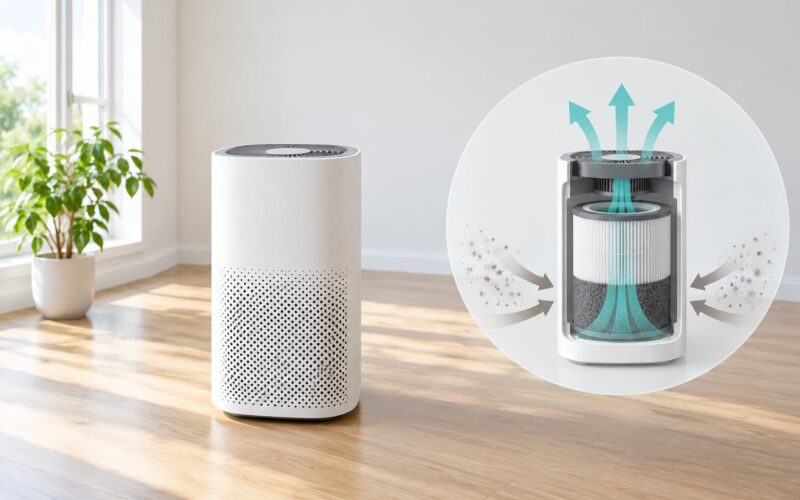
Air is drawn in through the front or side grille and passes through three stages. A pre-filter, often a mesh screen or foam pad, traps hair and larger dust so the fine filter below it does not clog in a week. A True HEPA filter then captures particles down to about 0.3 microns with a stated efficiency of 99.97 percent, which is where the allergenic dander is caught. An activated carbon layer, usually after the particle filter, adsorbs odor molecules and some volatile organic compounds, and that is a separate job from particle capture.
Clean air is pushed back into the room. The cycle repeats several times an hour, and the number of complete air changes per hour is what separates a purifier that helps from one that does not.
Why the room still smells like the pet
Smell is a gas-phase problem, and particles are not. Carbon handles it, and only when there is enough carbon for the volume of the room, which is why some units strip odor noticeably and others barely touch it.
What filtration does not do
Filtration captures allergens. It does not destroy them, neutralize them or treat the allergy itself, so anything trapped in the filter stays there until you change the filter. This is also why a purifier is an environmental control rather than a medical treatment.
Which Air Purifier Features Matter for Pet Allergies?
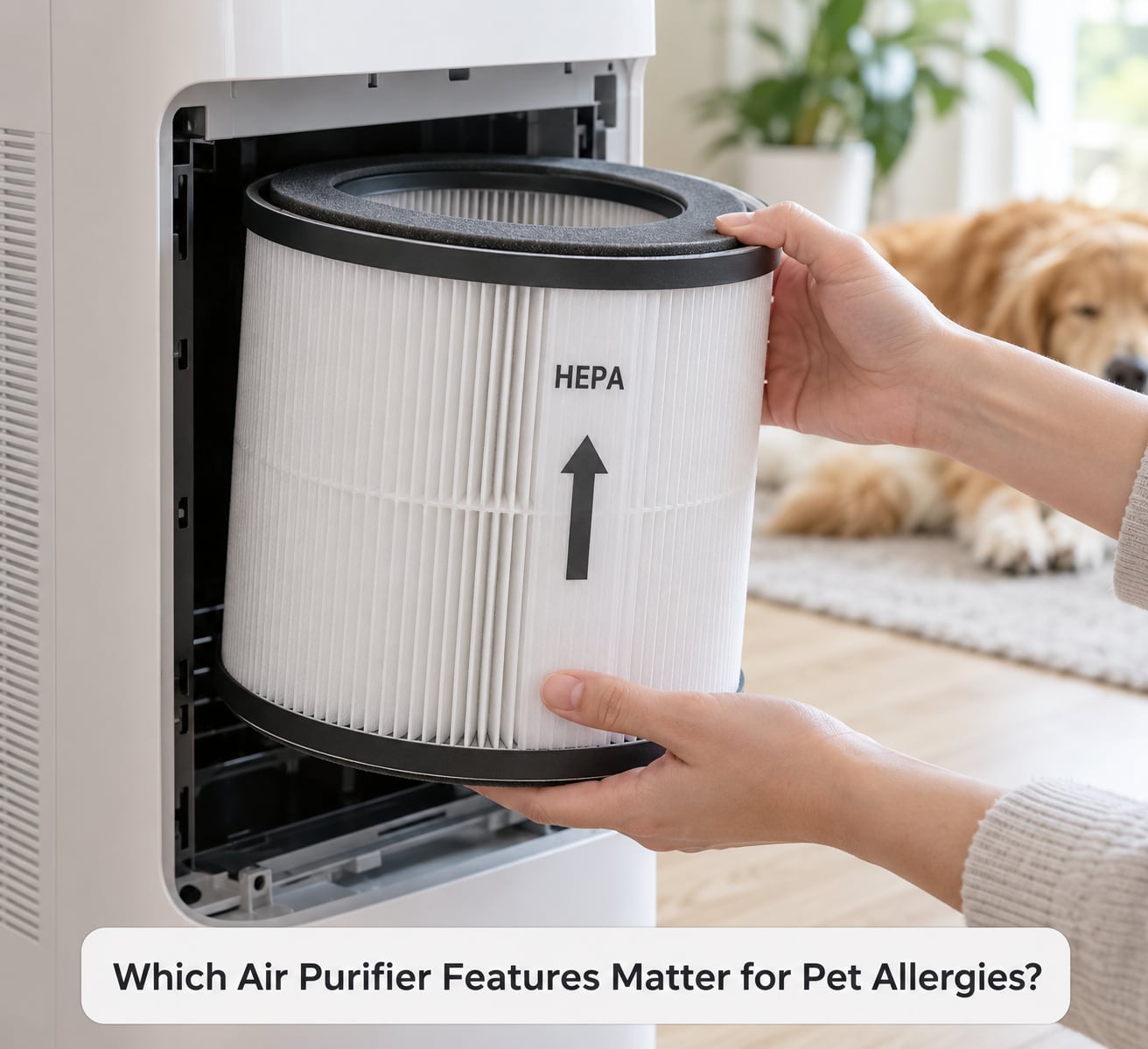
Four things matter more than the rest, and the marketing points usually sit somewhere else on the spec sheet. Filter class comes first, then whether the unit is big enough for the room, then how quiet it is at the speed you need, then whether replacement filters exist at all in your country.
True HEPA certification, not HEPA-type
Ask what the filter is rated to capture and at what particle size. The useful number is 99.97 percent of particles at 0.3 microns, and plenty of cheap units print the word HEPA on a filter that is really HEPA-type, meaning it captures less and lets more through. Without a written figure you are guessing.
CADR and how many air changes you get
CADR, or clean air delivery rate, is the honest number for comparison because it tells you cubic feet of clean air per minute. Take the dust and pollen CADR, divide your room volume by it, and you have your answer. The room number printed on the box is a marketing ceiling and rarely reflects what the unit does with the door closed.
Replacement filter cost and availability
This is the hidden expense. A purifier is a filter housing that needs consumables, so check before you buy that replacement cartridges are sold for your country, how many you need per year, and how long the carbon lasts. Over several years filters usually cost far more than the unit, and a purifier you cannot refill is a piece of furniture with a fan in it.
Noise at the speed you will run
High speeds are loud, and this is the most common bedroom complaint in owner threads on r/AirPurifiers and r/HomeSetup. People buy a good unit, then run it on low at night because of the noise, and low means few air changes. Look for the decibel figure at a mid or high setting and decide whether that is tolerable where it will sit.
Ozone and ionization are a deal breaker
Ionizers and electrostatic precipitators charge particles so they stick to a collector plate. The side effect is ozone, which irritates the airways of everyone nearby, and owners in pet forums describe a sharp smell right after switching such a unit on. For a home with an asthmatic cat or a dog with a compromised airway, choose a design that states it produces no ozone and uses no ionization.
Features that add little
UV lamps add almost nothing for dander, which is a particle problem already solved by the filter. App controls, mood lighting and elaborate touch panels do not move air any faster. Sensor-driven auto mode is genuinely useful because pet activity changes the air without warning, but it is a convenience feature rather than a filtration one.
How Do You Choose the Right Size for Your Room?
Most disappointment traces back to a sizing mistake rather than a bad machine. Match the unit to the room volume, not to the largest room the manufacturer claims.
Measure length, width and height and multiply. A 12 by 12 foot room at 8 feet is about 1,150 cubic feet. Then divide that volume by the unit’s dust and pollen CADR and you get the minutes needed for one clean air change, and running that figure against how many changes per hour you want tells you whether the unit is big enough.
Two rooms are harder than one room. If a doorway between the kitchen and living area stays open, treat it as one larger space or run a unit in each. Owners in r/HomeSetup and r/dogs repeatedly give the same advice for open-plan homes: two correctly placed units beat one oversized unit stuck in a corner, because the purifier only cleans the air it draws through it.
Building work changes the calculation. Renovation dust and sawdust load up a filter fast and reduce airflow, so size for the worst room rather than the average one. Fireplaces and wood stoves add particle load that no bedroom-sized unit is designed to handle.
On noise, work backwards from the room. If the bedroom is where symptoms are worst and where you spend six to eight hours a night, buy the quietest unit that delivers enough air changes for that volume, and accept fewer features elsewhere.
How Effective Are Air Purifiers Against Common Pet Allergens?
Effectiveness varies by allergen, and the differences come down to particle size, whether the allergen stays airborne, and how much of it is trapped in surfaces rather than air. Answers to do air purifiers help with pet allergies therefore differ depending on what is triggering the reaction.
Pet dander
This is where purifiers earn their place. Fine dander of roughly 0.5 to 10 microns stays suspended for hours, and a True HEPA filter is built for that size range. Reported removal in controlled conditions runs in the high range, often quoted between 85 and 95 percent, but real homes land lower because the room keeps generating new dander while the machine runs.
Dust mites
Mite allergens favour soft furnishings and bedding, where they settle and embed, so removal is more modest, often put at 70 to 85 percent. Hot-washing bedding weekly and using allergen-proof covers does more for mites than any purifier.
Pollen and mold spores
Both respond well to filtration, partly because both are largely airborne. Spores typically fall out faster than fine dander, which means a purifier helps but closed windows on high-pollen days and fixed humidity in the home matter more. Mold has a second problem: it grows from moisture, and a purifier cannot dry out a damp wall.
What still has to be done by hand
A HEPA vacuum removes settled dander from carpets and upholstery that no air purifier will ever reach. Brushing the pet outdoors or in a bathroom limits how much dander goes airborne in the first place. Washing pet bedding and your own bedding on a hot cycle cuts the reservoir. Keeping humidity around 40 to 50 percent discourages mold and makes dust mite populations harder to sustain.
And the single most effective change in most homes is keeping the pet out of the bedroom. People in r/PetAdvice and r/dogs say plainly that a pet-free bedroom delivers more relief than any purifier upgrade, because it removes hours of exposure rather than filtering part of it.
Results also depend on consistency. A unit switched on for an hour before bed is cleaning a room that immediately refills. Run it continuously, keep the pre-filter clean and you give the air time to actually change.
Do Air Purifiers Replace Medication or Medical Advice?
No. A purifier is an environmental control, not a treatment, and it should sit alongside whatever your clinician has already recommended rather than instead of it.
Antihistamines, nasal sprays and immunotherapy work on your immune response. A purifier works on the air you breathe, and the two address different parts of the problem. Reducing exposure can lower how much medication you need, and that is a conversation for the person prescribing it.
Ask a doctor or pharmacist about your own situation before you buy anything, and talk to your veterinarian if your pet has breathing or skin problems, since purifiers do not treat atopic dermatitis or asthma in animals and an ozone-producing unit can make either worse.
Get urgent medical help for trouble breathing, wheezing, chest tightness, swelling of the throat or face, or symptoms that spread beyond a mild runny nose and sneezing. Nothing in this article is a diagnosis, and this article is not a substitute for professional advice.
What Maintenance Makes an Air Purifier Work Better?
A neglected purifier quietly stops working, and a saturated filter also slows the airflow that the whole design depends on. Maintenance is not optional with pets.
Clean the pre-filter every one to two weeks
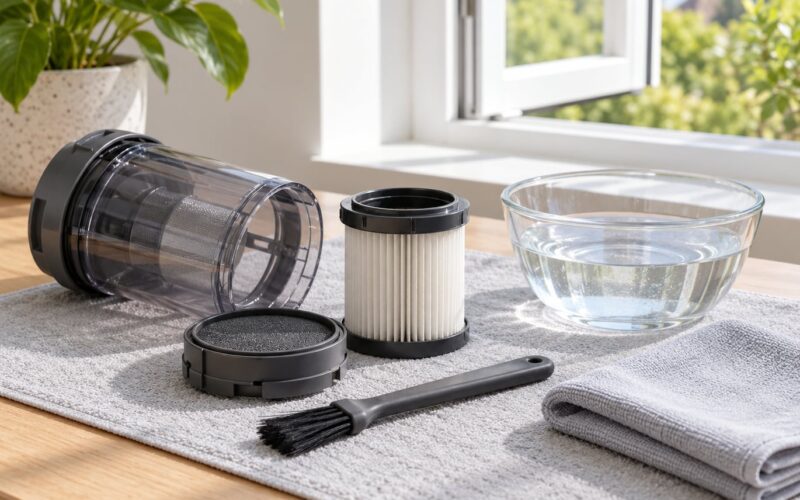
Pet hair clogs the mesh screen within days in some homes. Vacuum it or rinse it according to the manual and let it dry fully before it goes back in.
Replace the particle filter on schedule
Follow the manufacturer’s interval, or replace earlier if pets are shedding heavily. A filter that has visibly darkened is telling you it is full. Genuine replacement filters matter, because a cheap aftermarket cartridge with a thin media layer will not hold the stated efficiency.
Keep the carbon layer fresh for odor control
Carbon saturates on a gas-phase load and stops working while the particle filter still looks fine. If odor returns but the HEPA is new, the carbon is the part that needs replacing.
Leave airflow clear on all sides
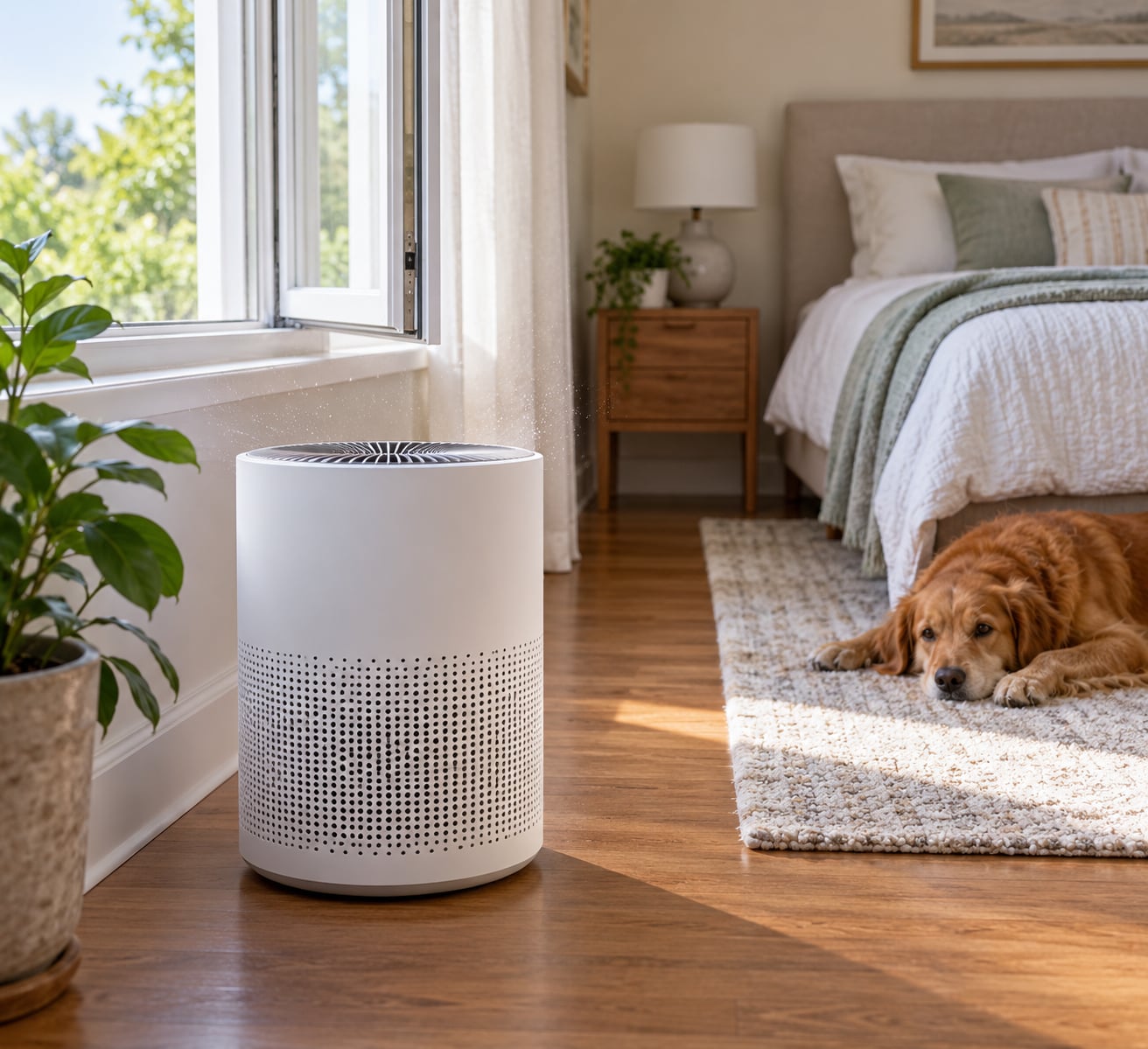
Keep the unit several inches off the wall, away from curtains and out of corners, and never place it where a pet can chew the cord or knock it over. Owners joke that the purifier becomes the pet’s favourite object, which is funny until it ends up on its side mid-night.
Use the right mode and read the indicators
Run continuous or auto mode when symptoms matter and the room is in use. Treat a filter-change light as a real instruction, and investigate any new burning smell or unusual noise right away rather than adjusting with it.
Are Air Purifiers Worth It for Pet Owners?
For most allergy-prone households, yes, provided the pet stays. The people who get the most from a purifier are the ones whose symptoms are worst overnight, whose homes are carpeted or heavily upholstered, or who have several pets generating dander continuously.
It is less worthwhile when the pet is not allowed in the house at all, or in a small closed room with a hard floor where a HEPA vacuum and weekly bedding wash already do most of the work. A purifier does very little about settled allergens, so if your exposure is mostly on surfaces, spend on the vacuum first.
Judge units on specifications you can check: a written 99.97 percent at 0.3 microns figure, a dust and pollen CADR matched to your room volume, an explicit no-ionization statement, a stated noise level and an available replacement filter. Be skeptical of claims about allergy relief or medical-grade purification, because those describe outcomes nobody has measured.
Owners on r/BargainHunt and r/AirPurifiers also flag the running cost and filter pricing as the deciding factor on any purchase, and that is worth doing before you commit rather than after.
Frequently Asked Questions
Can an air purifier help with cat or dog allergies overnight?
Yes, if it runs while you sleep. Overnight exposure is usually six to eight hours of inhaled air in one room, so a correctly sized purifier running continuously on low or auto makes the largest single difference you can make without changing your routine. Expect the airborne dander count to fall within the first hour or two. Symptom changes take longer, and keeping the pet out of the bedroom usually adds more relief than the machine itself.
Is a carbon filter enough for pet allergies, or do I need HEPA?
You need a True HEPA filter for allergies. Activated carbon adsorbs gases and odors, so it handles the smell of a wet dog or a litter box, but it does almost nothing with dander particles. Many units combine both, with carbon as a separate layer you replace on a different schedule. Judge the particle filter on a written capture figure such as 99.97 percent at 0.3 microns rather than on the word HEPA alone.
Are ionizers and ozone generators safe in a home with pets?
They are the reason to be careful. Ionizers charge particles so they collect on a plate, and that process can release ozone, which irritates the airways of humans and animals alike. Owners in pet forums often notice a sharp smell shortly after switching such a unit on. For a home with an asthmatic cat, a dog with an airway condition or an allergy-prone person, choose a design that states it produces no ozone and uses no ionization.
Can air purifiers help a pet with environmental allergies?
Partly, as one part of managing the environment. Filtering airborne particles can reduce the dust, pollen and dander a pet inhales, which helps with itching and irritation in some dogs. It does not treat atopic dermatitis, skin infections or food allergies, and ozone-producing units can make respiratory problems worse. Any pet with breathing or skin symptoms should see a veterinarian, who can also advise on whether an air change plan is worth adding.
How soon should I expect to notice a difference after starting an air purifier?
Air quality changes within about an hour of running, but symptoms take longer. Most people report noticeable easing over one to two weeks, and part of that is simply consistent exposure reduction during sleep rather than an effect you can feel on day one. If nothing has shifted after a month of continuous running in a closed bedroom, the usual causes are an undersized unit, a dirty pre-filter or a pet sleeping in the room with you.
Conclusion: What to Do First
Start at the source. Vacuum carpets and sofas with a HEPA vacuum, wash bedding on a hot cycle, brush the pet away from furniture, and get the pet out of the bedroom if you possibly can, because those steps remove dander no air purifier will ever reach.
Then add one correctly sized True HEPA purifier for the bedroom, checked for a written capture figure at 0.3 microns, a dust and pollen CADR that matches the room volume, and no ionization. Run it continuously with a clean filter, and expect the air to change within the hour while symptoms take a week or two.
Keep your medication plan going and talk to a doctor or pharmacist about your own symptoms, or a veterinarian if your pet is affected too. That is where do air purifiers help with pet allergies in practice: not as the whole answer, but as the control that works while nobody is doing anything else.