Smart scales are very good at measuring your weight and only approximate at measuring body fat. The weight reading is a load cell settling on your actual mass. The body fat percentage is a model output, and for most bathroom models the realistic error runs from about plus or minus 3 percentage points on good four-pole hardware to around 10 points or more on basic foot-pad scales.
That gap between the two numbers is the whole answer. Useful for following a direction over weeks, useless for telling whether you are at 17% or 19% on a given Tuesday. Here is how the estimate is built, what moves it, and how to read it so it stops wasting your time.
Table of Contents
- How Accurate Is Body Fat on a Smart Scale?
- How Do Smart Scales Estimate Body Fat?
- What Affects a Smart Scale’s Body-Fat Reading?
- How Accurate Is Body Fat on a Smart Scale Day to Day?
- What Accuracy Should You Expect From Consumer Smart Scales?
- How Does a Smart Scale Compare With Other Body-Fat Methods?
- How Can You Get a More Reliable Body-Fat Estimate?
- When Should You Avoid Relying on a Smart Scale’s Estimate?
- Frequently Asked Questions
- Are smart scales accurate for measuring body fat?
- Why does my smart scale body-fat percentage change so much?
- Is a smart scale more accurate than a body-fat caliper?
- What is the most accurate way to measure body fat at home?
- Should I weigh myself before or after eating?
- Can a smart scale body-fat reading diagnose anything?
- Conclusion
How Accurate Is Body Fat on a Smart Scale?
The short verdict: accurate enough to track trends, not accurate enough to trust a single digit. If your goal is a rough direction of travel over two to eight weeks, a smart scale does that job well, because it is consistent. If your goal is an exact composition number for a weigh-in, a body composition analysis, or a calorie calculation built on percentages, it will not give you one.
Two different things get called accuracy here, and confusing them is the most common reason people lose trust in the device. Consistency is how repeatable your readings are under identical conditions, and consumer scales are unusually good at this because the same electrodes, the same current and the same algorithm run every time.
Accuracy is how close the reading sits to a real laboratory result, and here the record is much weaker. Validation studies comparing consumer foot scales against reference methods generally report errors in the plus or minus 3 percentage point range for four-pole devices and substantially larger errors for two-pole foot-only pads, with the gap widening at higher body fat levels.
Reviewers on r/loseit put it plainly: the extra metrics are not accurate, but they are consistent over time. That is the honest description of the whole category, and it is enough to make the device worth owning for most people.
How Do Smart Scales Estimate Body Fat?
No smart scale looks at fat directly. Everything comes from bioelectrical impedance analysis, or BIA, which has been used in clinical settings for decades and works on one simple physical fact: water conducts electricity and fat resists it.
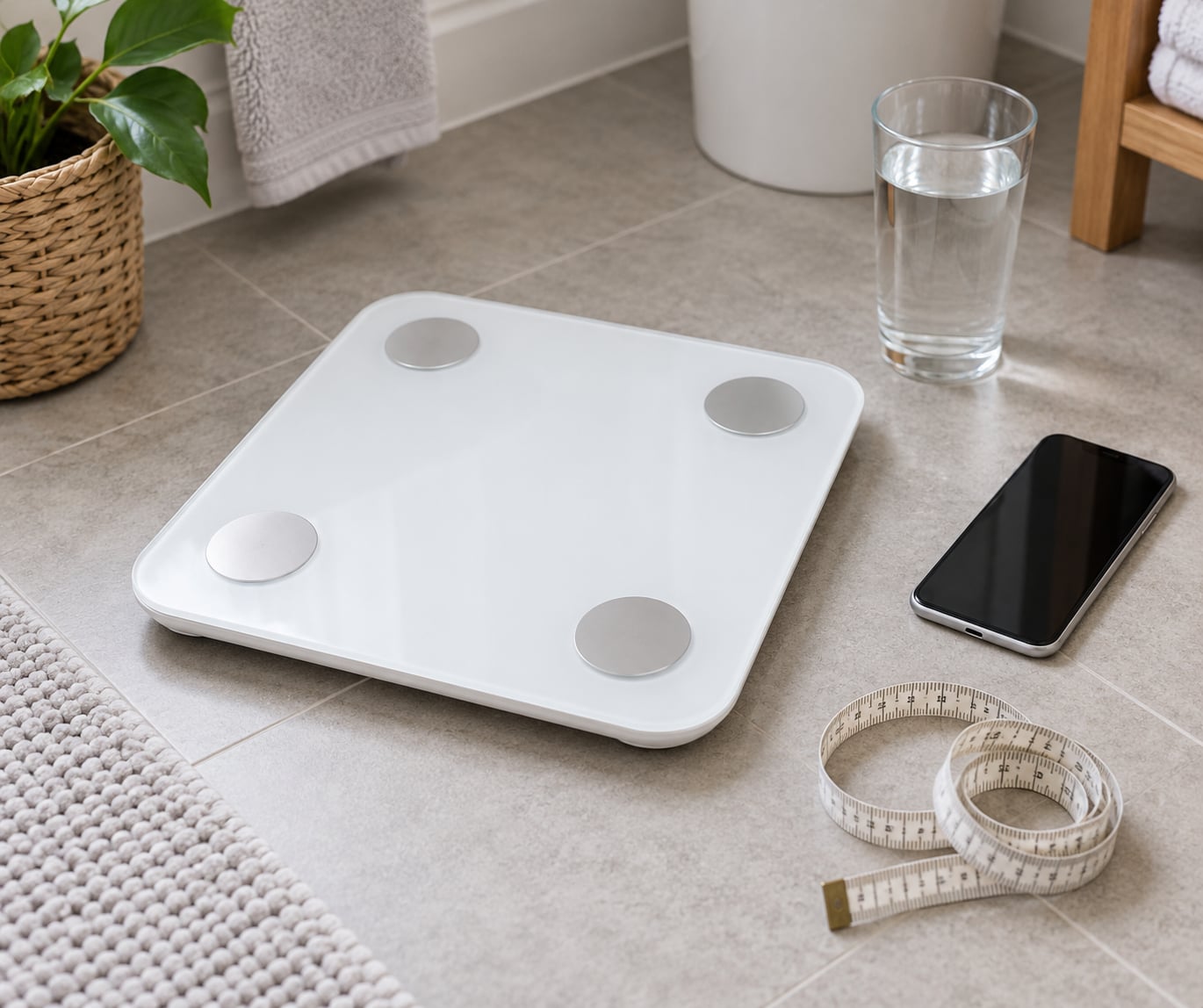
- A small current is passed through you. Most consumer scales run it from one foot to the other through metal pads you stand on barefoot.
- The scale measures impedance. That is the opposition to the current, and it reflects how much of your body is water-rich lean tissue versus fat.
- The raw number goes through an equation. The algorithm combines impedance with your weight, height, age and sex to produce an estimated body fat percentage.
The third step is where the uncertainty enters. The equation is derived from population-level relationships between impedance and measured fat, not from your body today. Get your profile data wrong and every reading that follows is wrong in a predictable direction. Enter an age 20 years high and the scale will quietly report more fat than you carry.
Electrode design matters too. A two-pole scale sends current through the pads in your feet only, so it measures mostly your legs and infers the rest. A four-pole scale adds hand electrodes, or uses a segmental approach, so current travels across more of the body. Multi-frequency devices add further refinement. Segment coverage and measurement variety are the two hardware differences that show up in published accuracy comparisons.
What Affects a Smart Scale’s Body-Fat Reading?
Ranked roughly by how much they move the number on a typical morning:
- Hydration. Your body water is the conductor. When you are dehydrated the impedance rises and the scale reads you as fatter.
- Sodium and carbohydrate intake. Salty food and a big carb meal pull water into the gut and muscles, raising body water, which reads as leaner.
- Exercise and heat. Sweating, a hot shower and a hard training session all move fluid around, so an evening reading rarely matches a morning one.
- Time of day. This is really the sum of the first three, which is why morning readings repeat best.
- Foot contact. Dry, bare, full-weight contact on a hard level floor. Carpet, socks, thin feet or a partly dry pad all add resistance.
- Stored profile data. Wrong height, age or sex quietly biases every result. Users on r/PetiteFitness report scales reading implausibly low body fat for shorter, leaner people, and that error grows as lean mass falls.
- Scale placement. A scale on carpet or a slightly uneven floor under-reads weight and skews everything computed from it.
How Accurate Is Body Fat on a Smart Scale Day to Day?
Day to day, the number is noise. Swings of 2 to 4 percentage points with no change in actual body composition are ordinary, and they are the single biggest source of frustration in owner discussions. People see a jump, decide they gained fat, change their diet, and the whole process becomes worse than having no scale at all.
Over weeks and months, the same noise averages out and the underlying direction becomes visible. That is the real value: a consistent instrument is far more informative than an accurate one used irregularly.
What Accuracy Should You Expect From Consumer Smart Scales?
Set your expectation by device class and by body composition, not by brand claims. Brands frequently advertise weight accuracy to a tenth of a kilogram and publish no body fat accuracy spec whatsoever, because the first number is easy to substantiate and the second is not.
| Type of estimate | Typical accuracy in consumer use | Best used for | Main limitation |
|---|---|---|---|
| Smart scale, two-pole foot pads | Roughly plus or minus 8 to 10 points or worse | Broad trend tracking | Current never leaves the feet |
| Smart scale, four-pole or segmental | Around plus or minus 3 to 5 points | Longer trend tracking, recalibration checks | Still sensitive to hydration |
| Waist circumference tracking | A few centimetres on the tape | Visceral fat trend, cheap and repeatable | Measures shape, not composition |
| Skinfold calipers | Depends entirely on the technician | Check on a trained person’s reading | Skill heavy, not repeatable at home |
| DEXA scan | Within about 1 to 3 points of the true value | Clinical baseline, weigh-ins, medical follow-up | Cost, appointments, radiation dose |
| Air displacement plethysmography | Within roughly 2 to 4 points | Validating a home scale | Specialised equipment, less available |
| BMI | Not a body fat measurement | Population-level screening | Cannot separate fat from muscle |
Video reviewers testing foot-only pads have claimed errors around 10% or more, with the variance widening noticeably above roughly 28% body fat. That pattern makes sense from the physics: as the body holds more fat and less conductive tissue, the impedance signal weakens and the algorithm extrapolates further.
How Does a Smart Scale Compare With Other Body-Fat Methods?
DEXA is the reference most people ask about, and it wins on accuracy by a wide margin. It separates bone, fat and lean soft tissue geometrically rather than through a model of conductivity, which is why labs treat it as the standard. If you need one trustworthy number in 2026 and you can arrange a session, a DEXA scan is where to spend the money.
Air displacement, sold as the Bod Pod in gyms, is the other gold-standard option. One r/PeterAttia poster reported a Bod Pod reading of 32% the same morning their scale read 31.5%. That looks like agreement, but it is partly coincidence: one number was independently measured and the other happened to land nearby.
Caliper skinfold testing sits in the middle. Done by someone trained it is reliable, but a home self-pinch test is worse than a good scale, and the method depends on consistent technique more than on equipment.
Waist measurement and weight trends are the underrated options. Waist circumference needs a tape and thirty seconds, correlates with visceral fat, and never tells you a wrong decimal. Many people tracking fat loss get a clearer signal from a weekly average of weight plus a monthly waist measurement than from a daily body fat figure.
None of this means a clinical method is necessary for everyday tracking. Paying for DEXA twice a year and using a scale the other 363 days is a sensible split, and far better than not measuring anything.
How Can You Get a More Reliable Body-Fat Estimate?
You cannot make the estimate accurate, but you can make it repeatable, and repeatable is what turns a number into information.
- Fix the conditions. Hard level floor, no carpet, scale in the same spot every time.
- Pick one moment in the day. Morning, after the bathroom and before food or drink, is the most repeatable point because you are closest to your baseline hydration state.
- Stand barefoot and still. Full weight evenly on both pads, dry feet, wait for the reading to settle.
- Take two or three readings and log the average. It takes a minute and removes most contact noise.
- Check your profile data. Accurate height, age and sex, re-entered every time you change any of them.
- Read the weekly trend, not the daily number. A seven-day average is the unit of meaning here.
Add a monthly waist measurement and a quarterly DEXA or air-displacement session if you want calibration. That gives you a scale for free and an anchor for the real number every few months.
When Should You Avoid Relying on a Smart Scale’s Estimate?
Some situations make the output close to meaningless. Right after a long run or a hot bath, body fluid is in motion and the reading tells you about your shower schedule. During illness, with fever, or when you are holding water from swelling, the same applies.
At the lean end the maths gets harder. Impedance-based estimates lose resolution as lean mass falls, and the error grows in the very range where people are chasing single-digit changes. Video testing has shown the spread widening at higher body fat levels too, so both extremes are worse than the middle.
During pregnancy the extra fluid shifts the number substantially, and it is not a composition figure you should act on. Anyone with an implanted electronic medical device should check with their clinician before using a foot scale that passes a current through the body, and follow the manufacturer’s guidance.
If the change you are chasing is smaller than your error bar, no consumer device can resolve it. When you need an exact number for a clinical decision, a medication dose, a sports weigh-in or a nutrition plan built on percentages, ask a doctor or registered dietitian and ask for a measurement with a known error range.
Frequently Asked Questions
Are smart scales accurate for measuring body fat?
Not to the precision people assume. They measure weight accurately and estimate body fat through bioelectrical impedance. Expect roughly plus or minus 3 percentage points on four-pole models and considerably more on basic foot-pad scales, especially at the lean or very high body fat ends. Track the trend over weeks rather than trusting any single reading.
Why does my smart scale body-fat percentage change so much?
Because your reading is mostly a hydration reading. Body water conducts the current, so water loss from heat, exercise, illness, salt or a low-carb phase raises impedance and the scale reports more fat. Two to four point swings overnight are normal and say nothing about real body composition.
Is a smart scale more accurate than a body-fat caliper?
For a home user, usually yes. Caliper skinfold testing depends heavily on the technician, the site selection and the pinch, so results vary widely between people doing it. A scale gives you the same number every morning under the same conditions, which is what trend tracking needs. In a trained professional’s hands, calipers can be competitive.
What is the most accurate way to measure body fat at home?
Use a four-pole smart scale under fixed conditions and read the multi-week trend, then calibrate it against a DEXA scan or air displacement test once or twice a year. Pair it with a monthly waist measurement, which is repeatable on its own. No home setup beats a clinical scan for a single absolute number.
Should I weigh myself before or after eating?
Weigh in the morning, after using the bathroom and before eating or drinking. That is when you are closest to your baseline hydration state, so readings repeat best. Weighing right after a meal captures the meal and its water, and weighing in the evening captures whatever you ate and drank during the day.
Can a smart scale body-fat reading diagnose anything?
No. It is a consumer wellness estimate produced by a population-level equation, not a medical measurement. It cannot detect health conditions, it cannot tell you where fat sits, and it should not be used to change medication, start a restrictive diet or interpret symptoms. Ask a doctor or registered dietitian about your individual situation.
Conclusion
How accurate is body fat on a smart scale? Accurate enough to tell you which direction you are moving over a month or two, and not accurate enough to be the number you argue about. Start by establishing a baseline: pick a morning slot, a hard floor and a correct profile, then record the reading for three weeks before drawing any conclusion at all.
From there, treat the body fat figure as a convenience, the same way you treat a step count. Use the weekly average to notice a stall, use waist measurements to sanity-check it, and get a clinical scan when you genuinely need a trustworthy number rather than a direction.