Sleep tracking on a fitness band works by reading your movement and your heart overnight, then letting an on-device algorithm guess whether you were awake or asleep at each moment. A band never looks at your brain. It infers sleep from an accelerometer, an optical heart rate sensor, and increasingly a blood oxygen sensor, then rolls those readings into stages and a single sleep score.
I have worn the same style of band for years and the pattern holds: the first month of data is noise, and after that the trend lines start earning their keep. Understanding what is actually being measured makes the numbers far less annoying.
Updated for 2026. Everything below describes how consumer wearables behave in general. A fitness band is a wellness tool, not a diagnostic device.
Table of Contents
- What Does a Fitness Band Measure While You Sleep?
- How Sensors Turn Sleep Data into a Sleep Report
- How Does a Fitness Band Detect Sleep Stages?
- Why heart rate variability matters more than movement
- Light sleep vs deep sleep vs REM sleep
- Why Sleep Scores Differ Between Fitness Bands
- How Accurate Is Sleep Tracking on a Fitness Band?
- Why your band says you were awake when you were asleep
- How to Get More Reliable Sleep Data
- What Sleep Metrics Are Most Useful?
- Does Sleep Tracking on a Fitness Band Have Privacy Risks?
- Frequently Asked Questions
- How does my smartwatch know if I’m sleeping?
- Does a fitness band need a heart rate sensor to track sleep?
- Why does my band say I was awake when I was asleep?
- Is 40 minutes of deep sleep per night good?
- How accurate is fitness band sleep tracking compared with a sleep study?
- Which smart watch is best for sleep tracking?
- Conclusion: What to Check First
What Does a Fitness Band Measure While You Sleep?
A band collects five kinds of data while it sits on your wrist, and it is worth separating what is measured from what is concluded.
Movement. A tri-axial accelerometer records how much you move on three axes, thousands of times a night. Some bands add a gyroscope for orientation. This raw stream is called actigraphy.
Heart rate. An optical sensor, usually a green LED, shines light into your skin and measures how much light comes back as blood pulses under the surface. This is photoplethysmography, or PPG. It works in the dark, which is why night readings are possible at all.
Heart rate variability. The gap between one heartbeat and the next, measured in milliseconds. HRV is the difference between measuring how fast your heart beats and measuring how your nervous system is settling down.
Breathing and blood oxygen. Newer bands add a red and infrared SpO2 sensor that watches for oxygen drops, which is how sleep apnea screening creeps into a cheap wearable.
Wear time. The band logs how long it was on your wrist, because it can only report sleep for the window it was actually in contact with skin.
Movement, heart rate and wear time are measurements. Light sleep, deep sleep, REM and a score from 0 to 100 are conclusions. That gap is where most confusion comes from.
How Sensors Turn Sleep Data into a Sleep Report
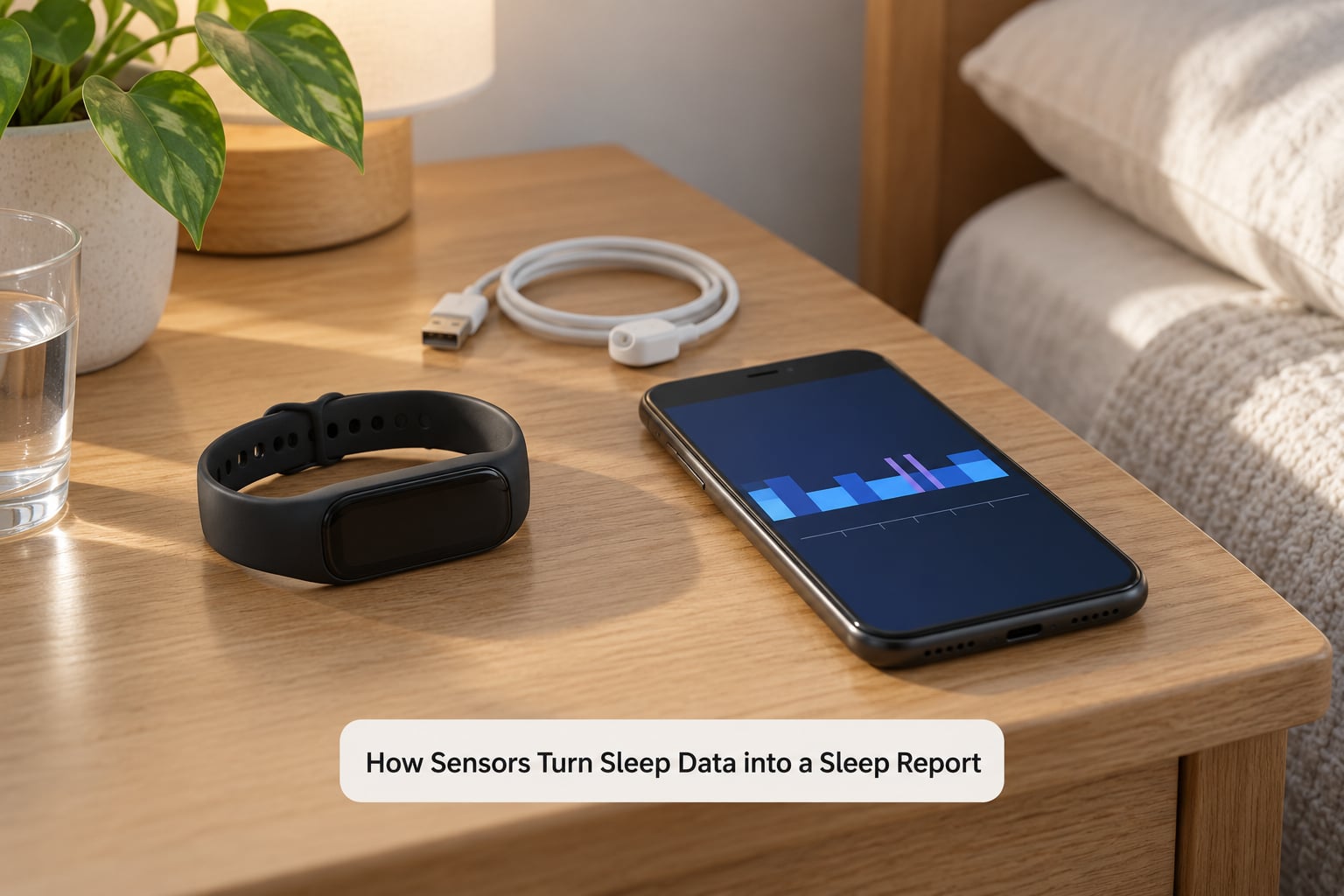
Between the sensor and the score in your app there are four steps, and the whole thing runs on the band or your phone overnight rather than in the cloud.
1. Sampling. The accelerometer and optical sensor wake on a fixed schedule, often every few seconds for motion and every minute or so for heart rate.
2. Scoring each moment. Raw numbers get converted into an activity value. No movement plus a falling, steady heart rate reads as sleep. Movement plus a rising heart rate reads as awake. A short burst of movement in the middle of an otherwise still hour gets flagged as a brief awakening.
3. Building the timeline. Each minute is labelled asleep or awake, then consecutive asleep blocks are grouped into sleep periods. The app fills the gaps: from your bedtime to your wake time it subtracts the awake minutes it detected.
4. Rolling it up. Duration, time in bed, efficiency (asleep time divided by time in bed), interruptions, stage estimates and consistency are computed, and those inputs are weighted into a single sleep score.
Garmin’s own health-science page says the same thing in its own words: sleep times and stages are identified from a combination of heart rate, heart rate variability and body movement data.
How Does a Fitness Band Detect Sleep Stages?
Stages are estimated, not measured. A clinical sleep study called polysomnography attaches electrodes to your scalp, jaw and chest to record brain waves, eye movement and muscle tension. A wristband has none of that. It assigns stages from patterns in your movement and heart data.
Why heart rate variability matters more than movement
Here is the part most explanations skip. Movement alone cannot tell stages apart reliably. Research has repeatedly found that stillness looks much the same in light sleep and deep sleep, which is why motion-only bands tend to flatten everything into one undifferentiated block.
HRV is what separates them. As you drop into deeper sleep, your parasympathetic nervous system takes over, heart rate falls, and beat-to-beat variability settles into a narrower, steadier band. REM looks different again: heart rate becomes irregular, variability rises and spikes, and the wrist often twitches through rapid eye movement. So the algorithm watches for the moment your HRV pattern changes shape, and calls that a stage boundary.
Shorter, shallower sleep after alcohol, a late hard workout or a stressful day shows up first in that HRV shape, which is why two people with identical movement data can get different stage splits.
Light sleep vs deep sleep vs REM sleep
Typical adult ranges, for context only: light sleep makes up roughly half the night, deep sleep around 13 to 23 percent, and REM around 20 to 25 percent. Band estimates routinely swing well outside those bands, so treat the percentages as a direction, not a measurement.
Why Sleep Scores Differ Between Fitness Bands
Two bands on the same wrist, same night, will disagree. Five things cause it.
Sensor set. A band with a heart rate sensor and HRV support has more to work with than a motion-only tracker. Wearers comparing budget models against Garmin or Fitbit watches usually find the gap is bigger than the price gap suggests.
What gets weighted. Garmin leans hard on HRV and body movement. Fitbit builds an explicit sleep score from duration, efficiency, stages, disturbances and HRV. Xiaomi, Redmi, Amazfit and Huawei bands tend to weight motion more heavily, which is cheaper to run on a small sensor. You will get a different split even with identical hardware.
Sampling rate. A band sampling motion once a minute will miss short awakenings that a band sampling every few seconds catches.
Fit and placement. A loose band slides, which fabricates movement out of nothing. Sensor contact matters more than which wrist you pick.
Firmware. Algorithms get updated after you buy the device. Owners of long-lived hardware report accuracy drifting over the years, and a firmware update is often the fix.
How Accurate Is Sleep Tracking on a Fitness Band?
Reasonably good at one thing, weak at another. Total sleep time is usually within about 30 to 60 minutes of a clinical study. Wake and sleep transitions are decent if your heart rate behaves normally. Exact deep and REM minutes are estimates, and comparing them to a PSG stage chart is not a fair test.
Why your band says you were awake when you were asleep
This is the most common complaint in owner threads, and there are two usual causes.
A low resting heart rate is the sneaky one. Wake detection partly relies on heart rate rising when you move. Amazfit owners in particular report that because their resting heart rate is so low, the band never registers a wake-up that clearly happened.
The other cause is constant low-level motion: a restless partner, a worn-out band, a mattress that makes you shift. The band sees movement and calls you awake, adding up to an hour of phantom wake time on a night you know you slept fine.
Long-term owners on Reddit also describe data that stopped updating or grew less accurate after four years on the same device. Sensors age, straps stretch, algorithms change. If a number used to look different and no longer does, hardware age is a fair suspect.
How to Get More Reliable Sleep Data
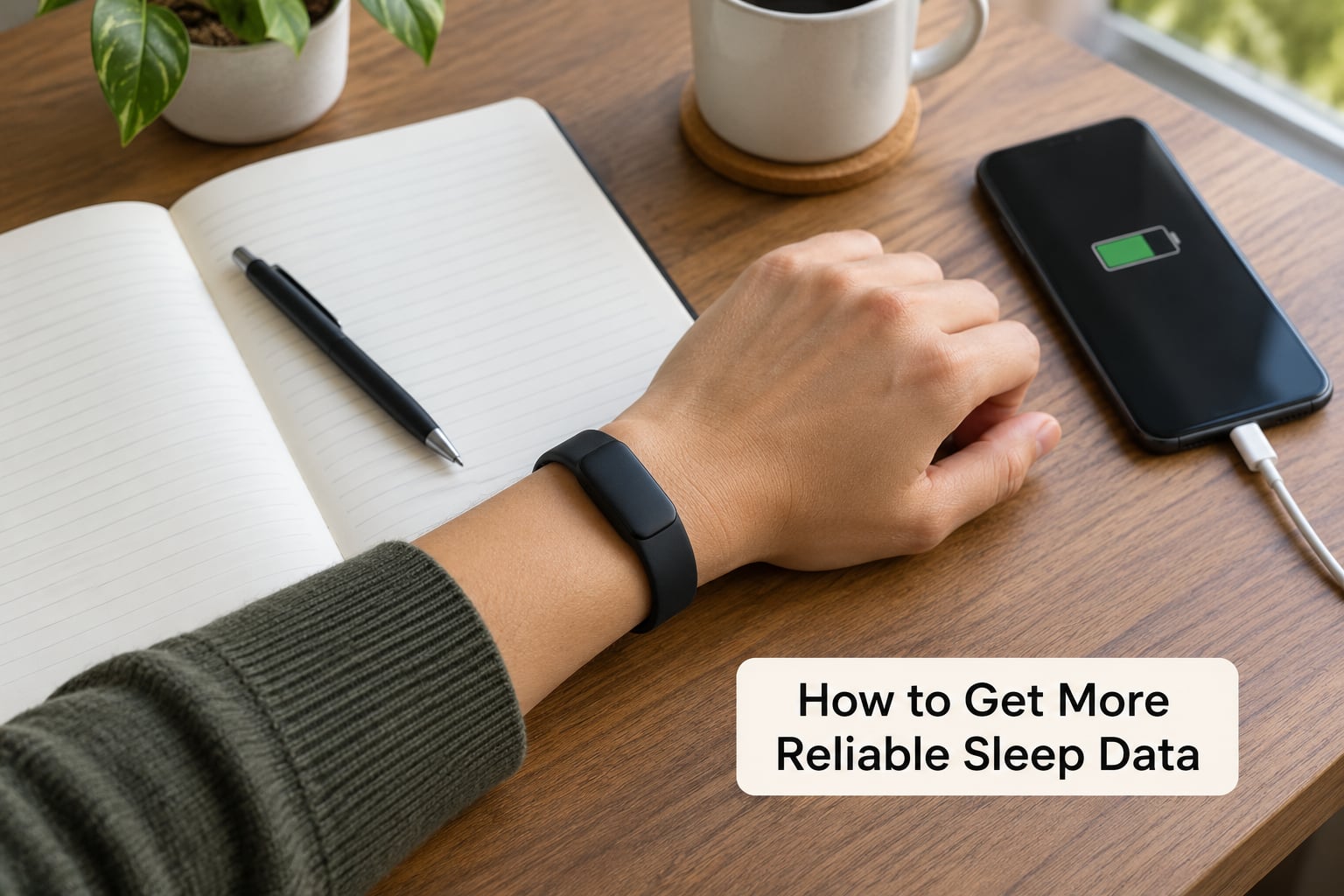
Most bad sleep data comes from wearing habits, not from the sensor.
Wear it every night, including naps. Auto-detection has a short latency, so a nap that starts and ends in thirty minutes may be logged as a restless lie-in. Owners who start the sleep activity manually report more consistent nap capture.
Fit the strap snugly. One finger-width back from the wrist bone, tight enough that it does not rotate when you make a fist. Too tight and the optical sensor reads distorted pulses; too loose and it invents movement.
Charge before bed. A full charge is usually several nights of continuous sensing on budget bands, while heavy HR and SpO2 monitoring is what drains a battery first. Turning continuous heart rate off makes the numbers worse, not the battery better in any way you care about.
Update the firmware. Stage and wake algorithms get revised after purchase. This is free accuracy.
Compare nights, not single scores. One night’s 71 is noise. Four weeks of averages is a signal. Users consistently trust the trend line more than the absolute number, and rightly so.
Check your resting heart rate for sanity. If it reads implausibly low or high, your stage data is built on shaky ground too.
What Sleep Metrics Are Most Useful?
Most of these numbers are worth something. Very few of them mean what people assume.
| Metric | What it tells you | How much to trust it |
|---|---|---|
| Total sleep time | Hours actually spent asleep | Good, usually within an hour |
| Bedtime and wake time | Your schedule and its consistency | Good, this is the most useful pair |
| Sleep efficiency | Asleep time as a share of time in bed | Fair, inflates when wake detection misses |
| Awakenings | Night fragmentation | Fair, misses very short wakings |
| Deep sleep | Physical restoration time | Estimate only, often overstated |
| REM sleep | Memory and emotional processing | Estimate only, the least stable number |
| SpO2 overnight | Oxygen drops that hint at breathing issues | Screening hint only, never a diagnosis |
| Sleep score | A weighted summary, brand-specific | Useful for tracking yourself, not for comparing brands |
The two numbers worth acting on are consistency and interruptions. Everything else is mostly colour.
One honest word about SpO2 and sleep apnea. Bands are increasingly asked to screen for it, and repeated overnight oxygen drops do show up. But a wrist optical reading is less precise than the fingertip sensor used in a clinic, and false positives are common. If a band flags repeated events, take it as a reason to raise the topic with a doctor, not as a result.
Does Sleep Tracking on a Fitness Band Have Privacy Risks?
Yes, and it is a fair concern. Your sleep report is one of the most revealing things a wearable produces. It maps your bedtime, how restless you are, how your heart behaves at night, and for many people whether they have a sleep problem at all.
That data typically syncs to a phone app and then to a vendor account, often with a cloud component that handles account features and analytics. What matters is what you agreed to and what the app currently has permission to reach.
Worth doing: read the connected-apps list in your phone settings and remove anything you do not recognise. Check the vendor’s privacy settings for sharing research data or personalised recommendations. Delete sleep history inside the app if you want it gone, and know that syncing to a third-party health platform usually means a copy lives there too.
Encryption, a strong account password and two-factor authentication cover the boring but effective part. If sleep data ever came from a compromised account, revoke that account’s access to your health platforms rather than just changing your password.
Frequently Asked Questions
How does my smartwatch know if I’m sleeping?
It combines an accelerometer with an optical heart rate sensor. Sustained stillness plus a falling, steady heart rate is read as sleep, while movement plus a rising heart rate is read as awake. An algorithm compares both streams minute by minute, builds a timeline of sleep and awake periods, and then estimates light, deep and REM stages from heart rate variability patterns.
Does a fitness band need a heart rate sensor to track sleep?
It can track sleep without one, using motion alone. That is called actigraphy, and it reliably catches sleep and wake periods, but it struggles to separate light sleep from deep sleep because stillness looks similar in both. Adding optical heart rate and heart rate variability data is what makes stage estimates and wake detection noticeably better.
Why does my band say I was awake when I was asleep?
Two causes come up repeatedly. A low resting heart rate gives the wake-detection threshold too little signal, so real awakenings never register. Constant low-level movement, from a restless partner, a loose strap or an old mattress, does the opposite and invents awakenings that never happened. Check strap tightness first, then compare your resting heart rate against what you know is normal.
Is 40 minutes of deep sleep per night good?
For most adults, forty minutes of deep sleep sits at or slightly below the typical 70 to 110 minute range, though individual needs vary. The problem is that wrist bands estimate deep sleep from heart rate and movement patterns rather than brain activity, and the margin of error can be larger than the gap you are trying to read. Use it as a rough trend, not a diagnosis.
How accurate is fitness band sleep tracking compared with a sleep study?
Total sleep time usually lands within about 30 to 60 minutes of a clinical polysomnography study. Wake and sleep transitions are reasonably close. Exact deep and REM durations are estimates that can be off by a large share, because no wrist sensor records brain waves. Wearables are best treated as trend trackers rather than substitutes for a sleep study.
Which smart watch is best for sleep tracking?
For sleep data specifically, prioritise a device with an optical heart rate sensor and heart rate variability tracking over a cheaper motion-only band, and make sure the app shows stages and interruptions rather than just a single score. Software support matters too, since stage algorithms improve after purchase. Wearers who care about long-term trends often find a dedicated ring gives more consistent results than a wrist band.
Conclusion: What to Check First
Start with wear time. A band you take off before bed cannot tell you anything, and one you wear every night including naps gives you a trend within a few weeks. Then compare several nights instead of judging a single score, because one night tells you almost nothing.
If your stages look wrong, check strap tightness and firmware before you check the algorithm. And keep the framing straight: fitness bands estimate, and they are good at trends and rough durations. Persistent problems with falling asleep, staying asleep or breathing through the night belong with a doctor, not with an app score.