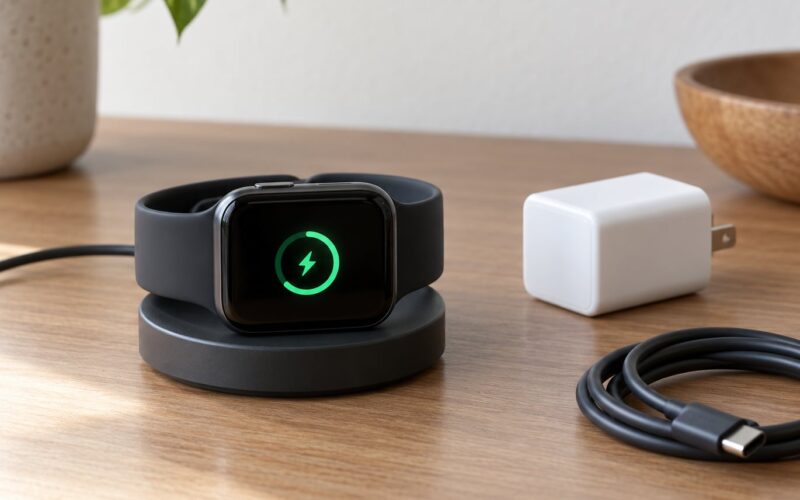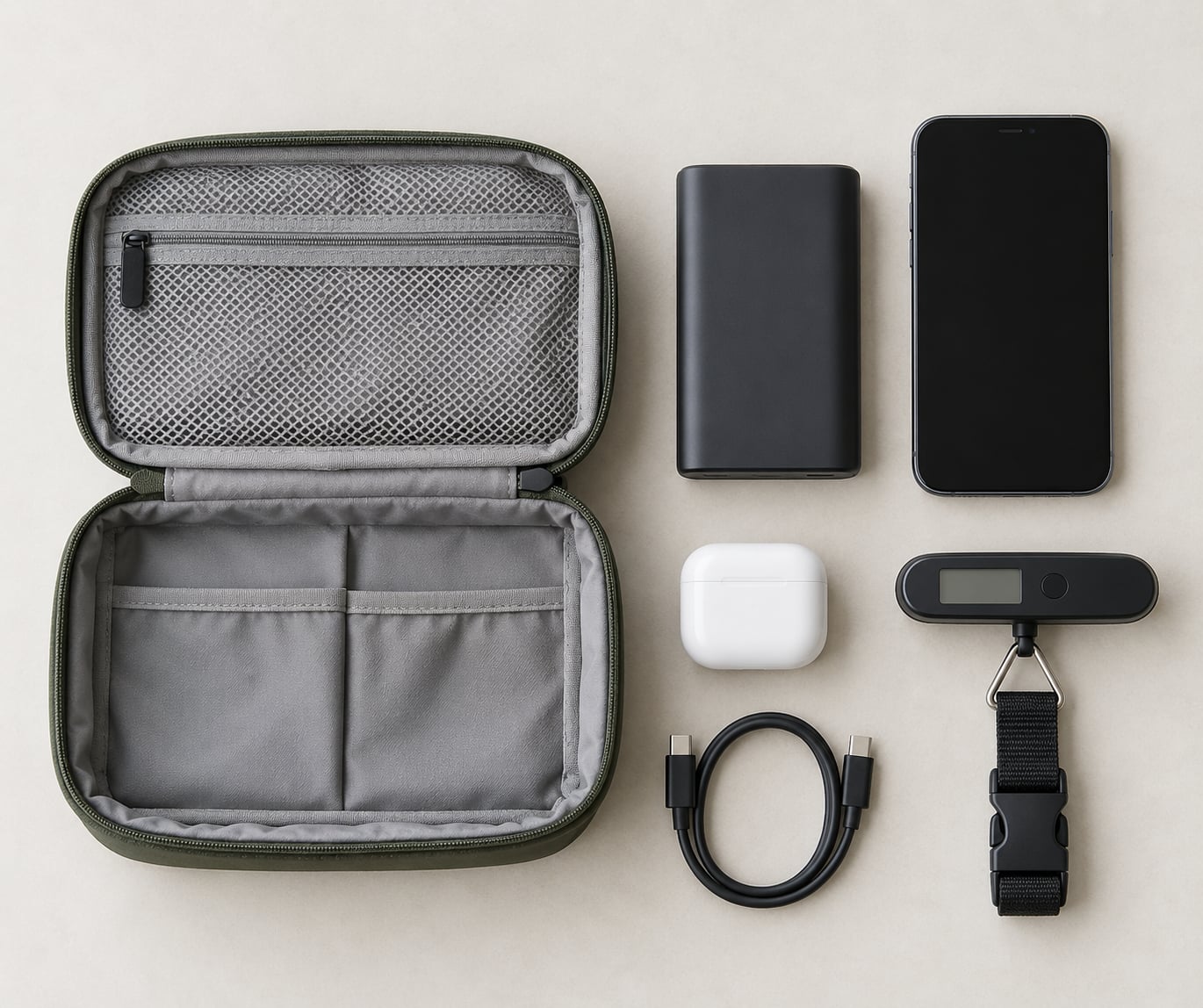
If you want the short answer: most travelers do well with a 10,000mAh power bank, and 20,000mAh is the right call for week-long trips or anyone charging more than a phone. Learning how to pick a power bank size for travel takes about five minutes. Count the charges your trip needs, multiply by your device battery size, add a conversion-loss allowance of 25 to 35 percent, then check the airline limit of 100 watt-hours.
It is worth doing properly, because power bank sizing is one of those purchases where the wrong number means either a dead phone in a taxi or an extra half kilo in your bag for every day of the trip.
A note before we start: the number printed on the side of a power bank is the battery’s nominal capacity, not what comes out of the port. Airlines count the same battery in watt-hours. Both matter, so both appear below.
Table of Contents
- What You Need Before You Choose a Capacity
- Step-by-Step: How to Pick a Power Bank Size for Travel
- Step 1. Count what you need before you pick a power bank size for travel
- Step 2. Calculate the power bank capacity for travel
- Step 3. Choose the smallest capacity that covers the trip
- Step 4. Check physical size, weight and airline rules
- Step 5. Match the power bank to your devices and ports
- Common Sizing Mistakes and How to Fix Them
- Frequently Asked Questions
- How much power bank capacity do I need for travel?
- Is a 10,000mAh power bank enough for a week-long trip?
- What power bank size is allowed in carry-on luggage?
- How do I calculate power bank capacity for multiple devices?
- Is a larger power bank better if I am traveling?
- Can I charge a laptop and a phone with the same travel power bank?
What You Need Before You Choose a Capacity
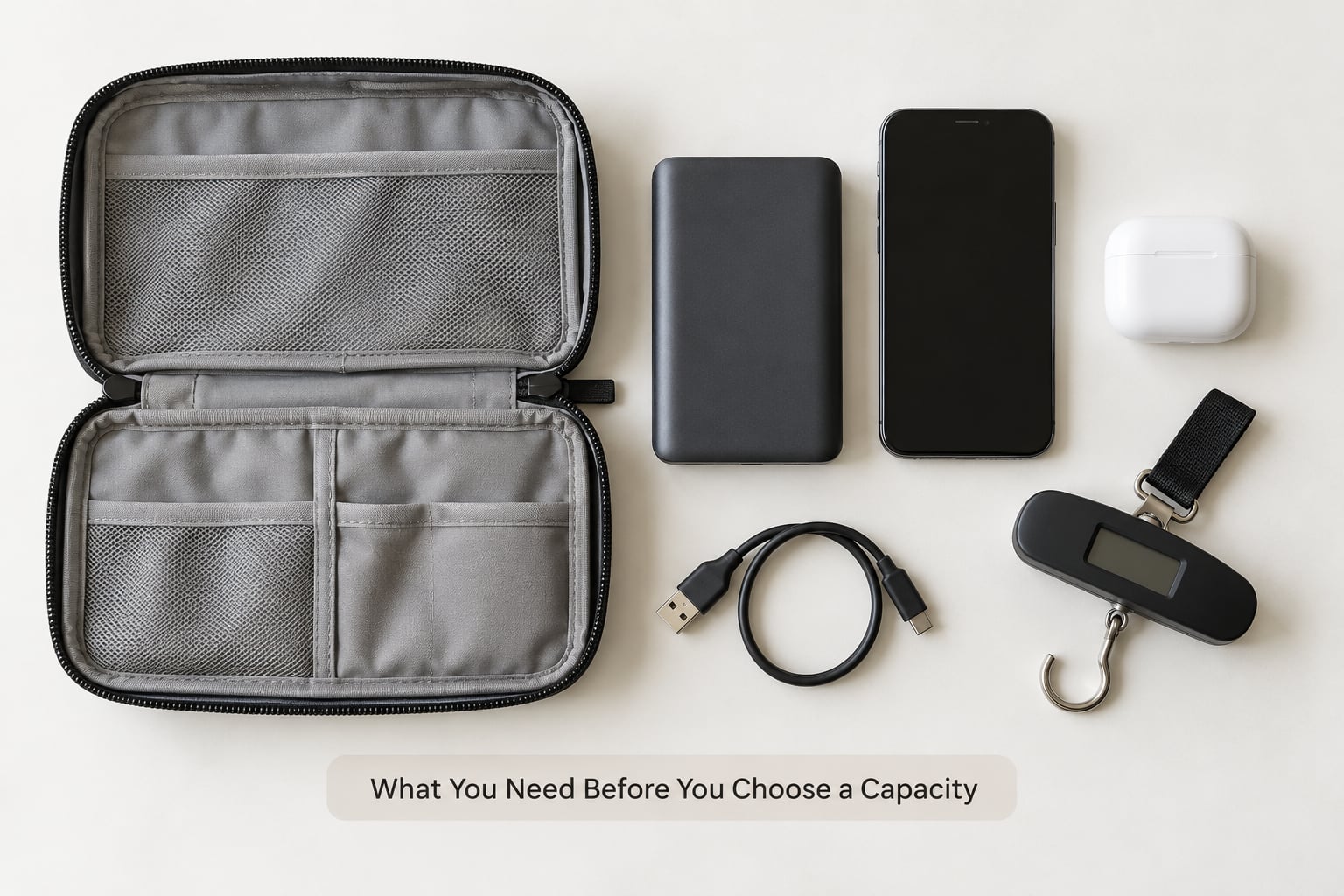
Four inputs decide the number, and you probably already know three of them without opening a single spec sheet.
- Your device battery size. Most modern phones fall between 3,000 and 5,000mAh, and your phone’s spec page or settings screen lists it. Earbuds and smartwatches are tiny by comparison, usually well under 1,000mAh together.
- How many devices travel with you. One phone is a different trip from phone, watch, earbuds and camera batteries.
- Charging sessions per day. One full charge a day if you sleep near an outlet, two if you are navigating all day with the screen on.
- Your airline’s watt-hour ceiling and your weight budget. Both cap the answer regardless of what you want.
The table below turns those four inputs into a rough size, so you can start from a tier instead of a blank page.
| Labeled capacity | Usable at the port | Phone charges | Tablet charges | Best for | Rough weight |
|---|---|---|---|---|---|
| 5,000mAh | 3,500 to 4,250mAh | About 1 | None | Day trip, light phone use | 120 to 180g |
| 10,000mAh | 7,000 to 8,500mAh | About 2 | None | Long weekend, phone plus earbuds | 180 to 250g |
| 20,000mAh | 14,000 to 17,000mAh | About 3 to 4 | 1 to 2 | Week or longer, multi-device | 350 to 450g |
| 27,000mAh | 19,000 to 23,000mAh | About 4 to 6 | 2 | Maximum permitted carry-on, little or no wall power | 500 to 600g |
Those usable figures assume 70 to 85 percent conversion efficiency, which is where most quality banks land. Poorly made banks can sit closer to 50 percent, which is one more reason to skip the cheapest listings.
Step-by-Step: How to Pick a Power Bank Size for Travel
Step 1. Count what you need before you pick a power bank size for travel
Start with devices, not with marketing numbers. List everything you will actually charge away from an outlet: phone, watch, earbuds, camera batteries, e-reader, tablet, handheld console.
Then estimate sessions. A phone with the screen on for a long travel day might need one full charge daily, sometimes more if you are using offline maps and camera all day. A watch or a pair of earbuds might need charging every second day rather than every day.
Multiply and you have the total watt-hours or milliampere-hours your trip consumes. This is the only number that should drive the decision, because it is the number your devices will actually ask for.
Step 2. Calculate the power bank capacity for travel
The formula is simple enough to do on a phone in an airport queue:
Needed capacity = (device battery mAh × number of charges) × 1.3
The 1.3 factor covers conversion loss in the bank’s electronics, the phone’s own charging circuit drawing power as it fills, and cable losses. Cutting it to 1.0 is the most common sizing mistake, and it is why banks feel empty halfway through a long day.
Worked example. A three-day trip with one phone rated at 4,000mAh, needing one and a half charges a day, so five charges in total. Five times 4,000 is 20,000mAh of delivered energy. Times 1.3 gives about 26,000mAh, so the smallest sensible capacity is the 27,000mAh tier or a 20,000mAh bank paired with nightly recharging.
If you also want a tablet charged twice on a ten-day trip, add its 8,000 to 12,000mAh battery size into the same sum before applying the factor. Two devices are not the same calculation as one device used twice.
Step 3. Choose the smallest capacity that covers the trip
Once you have a number, pick the tier just above it and stop. Oversizing has a cost you feel every single day: the step from a 10,000mAh bank to a 20,000mAh bank is usually somewhere around 200 to 300 extra grams, which is real weight in a one-bag setup.
Going one tier higher than the calculation is sensible when any of these are true: you are travelling without reliable wall power, delays are likely, you are sharing with a partner or family, or you are heading somewhere cold. Cold is worth a separate mention, since phone and power bank batteries lose usable capacity in low temperatures, and a ski trip can cost you a meaningful share of rated capacity compared with a summer beach trip at the same altitude.
Two small banks sometimes beat one large one. A pair of 10,000mAh units gives you 20,000mAh of capacity, lets you charge two devices at once, keeps each bank inside the airline limit with room to spare, and means one failed or stolen unit is not a trip-ending loss. For most two-device trips I would take that over a single brick.
Step 4. Check physical size, weight and airline rules
Rules for spare lithium batteries apply worldwide: carry-on only, terminals protected from damage, and a watt-hour ceiling. The ceiling is the piece most people get wrong, because capacity is checked in watt-hours, not milliampere-hours.
| Labeled capacity | Approximate watt-hours | Carry-on | Notes |
|---|---|---|---|
| Up to 20,000mAh | Up to about 74Wh | Allowed | No special permission needed |
| 20,000mAh to 27,000mAh | 74Wh to 100Wh | Allowed | The usual ceiling for spare batteries |
| Above 27,000mAh | 100Wh to 160Wh | Allowed with approval | Airline permission required in advance |
| Above 160Wh | Above 160Wh | Not permitted on passenger aircraft | Freight only |
The conversion is straightforward: watt-hours equal milliampere-hours multiplied by the 3.7V cell voltage, divided by 1,000. A 30,000mAh bank works out at roughly 111Wh, which sits in the approval range rather than the free range, so it can be refused at the gate. If your trip involves more than one airline, confirm with each carrier before you fly.
Checked luggage is not an option for spare batteries, whatever the airline’s baggage policy says about other items. Keep the bank in your personal item or carry-on, with terminals covered by the caps that come on the unit or a small case.
Then weigh the choice. Bank weight roughly scales with cell capacity, so a 20,000mAh unit in the 350 to 450g range is twice the carry weight of a 10,000mAh one. Check the listed weight against your own bag allowance rather than assuming it is negligible.
Step 5. Match the power bank to your devices and ports
Capacity is only half the compatibility question. Check what you will plug in.
- USB-C covers most modern phones, tablets and thin laptops, and pairs with USB Power Delivery for fast charging when the bank supports it.
- USB-A still matters if you carry older accessories, camera batteries or a device without USB-C.
- Wireless charging is convenient but slower and less efficient, and a MagSafe or Qi2 pad only works well with compatible cases and phones.
- Laptop support needs a bank with enough output wattage and a port that negotiates power delivery. A 20,000mAh bank with a low-watt USB-A port will not charge a laptop at any useful speed.
Count your cables too. A bank with two ports still needs two cables, and a bank with a built-in cable saves you carrying one. Pass-through charging, where the bank charges your phone while it recharges itself, is genuinely useful on long transport days but slows both sides down.
Finally, buy from a brand that publishes safety certification. Look for marks such as UL, CE or equivalent, and check that the watt-hour rating is printed on the casing. That number is what security and your airline will read.
Common Sizing Mistakes and How to Fix Them
Picking capacity by how thin the phone is. Looks tell you nothing about the battery inside. Fix: read the battery size from your phone’s specification page and start there.
Ignoring conversion loss. Treating 20,000mAh on the label as 20,000mAh delivered. Fix: multiply by 1.3 before you round up a tier.
Buying one oversized bank for every trip. A 27,000mAh unit for a weekend in a city with a hotel room is dead weight. Fix: size each trip separately, and pack the small bank for short ones.
Reading the airline limit as a milliampere-hour limit. Security reads watt-hours. Fix: convert before you fly, using 3.7V as the cell voltage, and stay under 100Wh if you want zero permission requirements.
Forgetting the cable and port count. A single-port bank with no cable means a second purchase later. Fix: count devices that need charging simultaneously and pack one spare cable.
Trusting an unbranded listing at face value. Forum conversations about power banks keep returning to the same complaint: cheap banks that never deliver their stated capacity. Fix: pick banks with a printed watt-hour rating and recognised safety marks, and test the new one fully before you leave.
Ignoring the cold. Winter trips and high mountain routes reduce what a lithium battery can deliver. Fix: add one tier of headroom for cold-weather travel rather than treating a warm-climate number as universal.
If you only change one habit, change this one: run the count before you open a shopping page. Sizing from your actual trip takes five minutes and removes almost every regret that follows.
Frequently Asked Questions
How much power bank capacity do I need for travel?
Most travelers need between 10,000 and 20,000mAh. A 10,000mAh bank delivers roughly 7,000 to 8,500mAh at the port, which is about two full phone charges and suits a long weekend. A 20,000mAh bank covers a week or more, or several devices. Add your device battery size times the number of charges, then multiply by 1.3 to cover conversion loss.
Is a 10,000mAh power bank enough for a week-long trip?
Only if you can recharge it most nights. At roughly two full phone charges, a 10,000mAh bank handles short trips, day outings and cases where you sleep near an outlet every other night. For seven days away with no reliable wall power, step up to 20,000mAh or carry two smaller banks. Weight is the trade: the larger tier adds roughly 200 to 300 grams.
What power bank size is allowed in carry-on luggage?
Spare lithium batteries travel in carry-on bags only, never checked luggage. The limit is 100 watt-hours for most batteries, which works out to about 27,000mAh at the standard 3.7V cell voltage. Between 100Wh and 160Wh, airlines may permit a battery with approval obtained in advance. Above 160Wh is not allowed on passenger aircraft.
How do I calculate power bank capacity for multiple devices?
Add up the battery size of every device times how many times you will charge it across the whole trip, then multiply the total by 1.3 for conversion loss. For example, a 4,000mAh phone charged five times plus earbuds charged twice uses about 21,000mAh, so you would need roughly 27,000mAh of labeled capacity to cover it without recharging the bank.
Is a larger power bank better if I am traveling?
Not automatically. Larger means more weight in your bag and a shorter battery life in cold weather, and anything above 100 watt-hours needs airline approval. Size up when you have little access to wall power, expect delays, share with others, or travel in cold conditions. Size down for city trips, hotels and short flights where outlets are always nearby.
Can I charge a laptop and a phone with the same travel power bank?
Often, but check the output wattage and port type first. A laptop typically needs USB-C Power Delivery at 45W or more, which means a bank with a dedicated high-wattage USB-C port. A 20,000mAh bank with only 10W USB-A output will not charge a laptop at a useful speed, though it will still charge phones and smaller devices.
Start with the count, not the shopping page. Work out how many charges your devices need across the trip, multiply by their battery sizes, add the 1.3 conversion factor, then round up to the nearest tier. Ten thousand milliampere-hours suits most city trips, twenty thousand covers a week or multiple devices, and anything above 27,000mAh needs airline approval before you fly.