To track weight trends instead of daily numbers, take one weigh-in under the same conditions each morning, write it down, and average the last seven readings. That rolling weekly average is your real weight. Single readings bounce around by a pound or more for reasons that have nothing to do with fat, so the trend line, not the number on the scale this morning, is what tells you whether things are working.
It takes about five minutes a day and ten minutes on a Sunday. If you have ever changed your whole eating plan because Tuesday looked bad, this is the fix for that.
Table of Contents
- What You Need
- Choose your scale type
- Get the conditions right
- How to Track Weight Trends Instead of Daily Numbers: Step-by-Step
- Set a Consistent Measurement Routine
- Record Each Measurement Without Fixating
- Calculate a Rolling Weekly Average to Track Weight Trends
- Review the Trend Once a Week Instead of Daily Numbers
- Use a Longer Window When Progress Seems to Stall
- Common Mistakes
- Frequently Asked Questions
- How often should I weigh myself if I want to track trends?
- Should I look at my weight every day or only once a week?
- What is the best way to calculate a weekly weight average?
- Why does my weight fluctuate even if my habits have not changed?
- How long should I wait before deciding that my weight has plateaued?
- Are smart scales accurate enough for tracking long-term trends?
- Conclusion
What You Need
You need three things: a scale, somewhere consistent to log readings, and a fixed set of weighing conditions. The scale matters least of the three. How you handle the first two decides whether the data is worth anything.
Choose your scale type
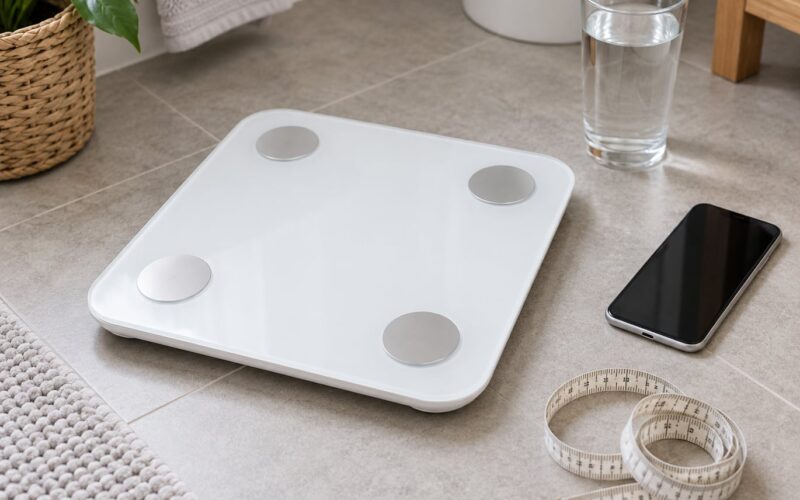
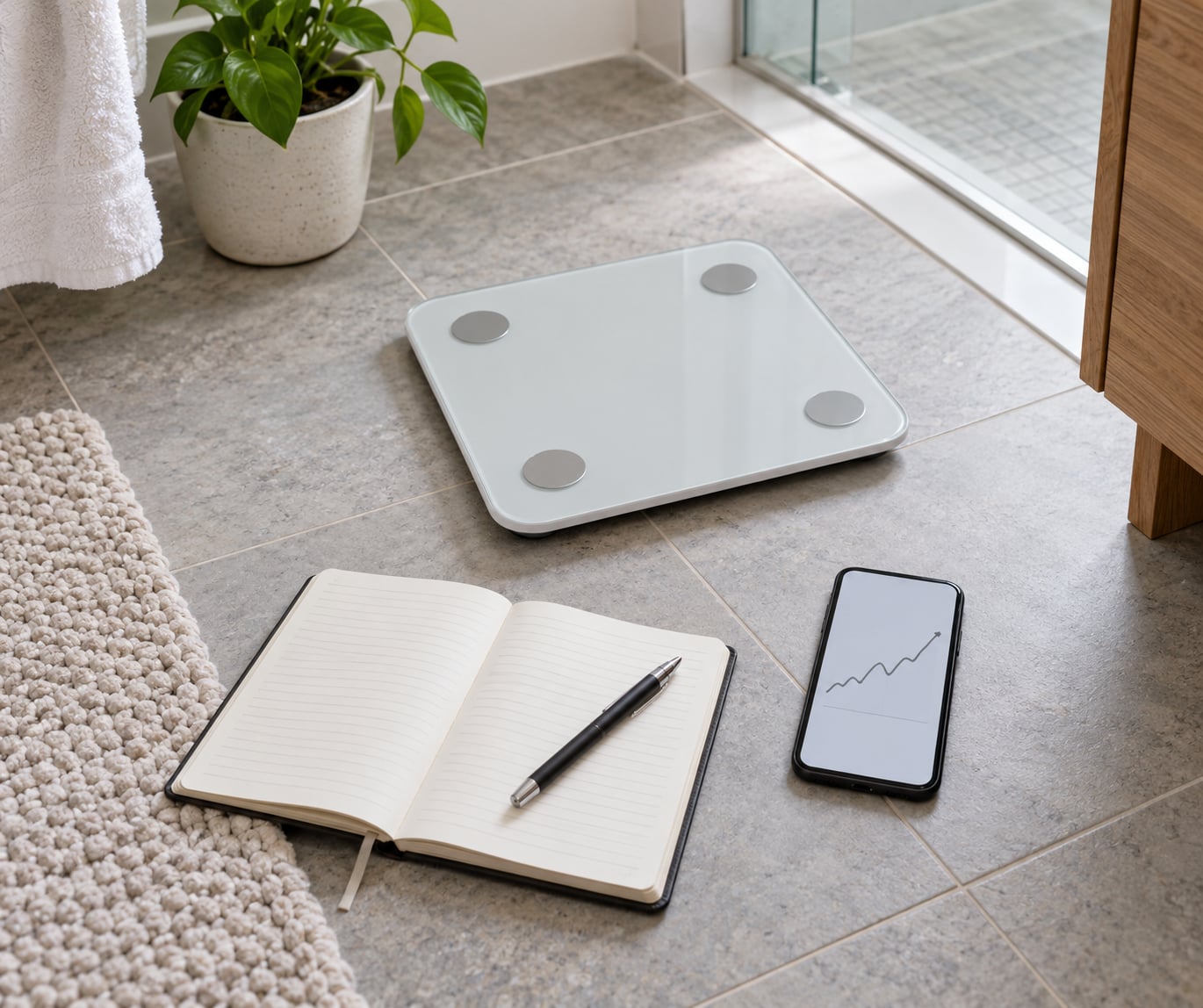
A basic digital scale is the workhorse. If yours has four auto-profile memories and syncs to an app, great, but the app is a convenience, not the source of truth. I keep a cheap scale and a paper notebook in the bathroom, and once a week I type the week into a spreadsheet. That redundancy has saved me more than once when an app changed its menu or an update reset a sync.
Smart scales are useful for one thing: they remove the friction of writing a number down. A reading that gets logged automatically happens every day, and daily data is what makes a weekly average possible at all. The trade-off is that you become a passenger of someone else’s software, and app defaults are not always what you want.
A paper log is underrated. A notebook on the shelf next to the scale takes three seconds and nothing else. The failure mode is real, though: you skip a day, then a week of blanks, and a weekly average over a week with three readings is not a weekly average. If you go this route, keep a fixed day of the week for your review so gaps show up before they become a month.
Get the conditions right
Consistent conditions are what turn seven unrelated numbers into one comparable series. Same time of day, ideally first thing in the morning. Same state: after using the bathroom, before food or drink. Same scale, on the same hard floor, not on carpet and not on a tile seam that catches the back foot. Same units, so you never mix pounds and kilograms in the same column.
If you weigh at night instead of in the morning, that is fine. Just be consistent, because the difference between a morning reading and a night reading is often one to two pounds all on its own.
How to Track Weight Trends Instead of Daily Numbers: Step-by-Step
Set a Consistent Measurement Routine
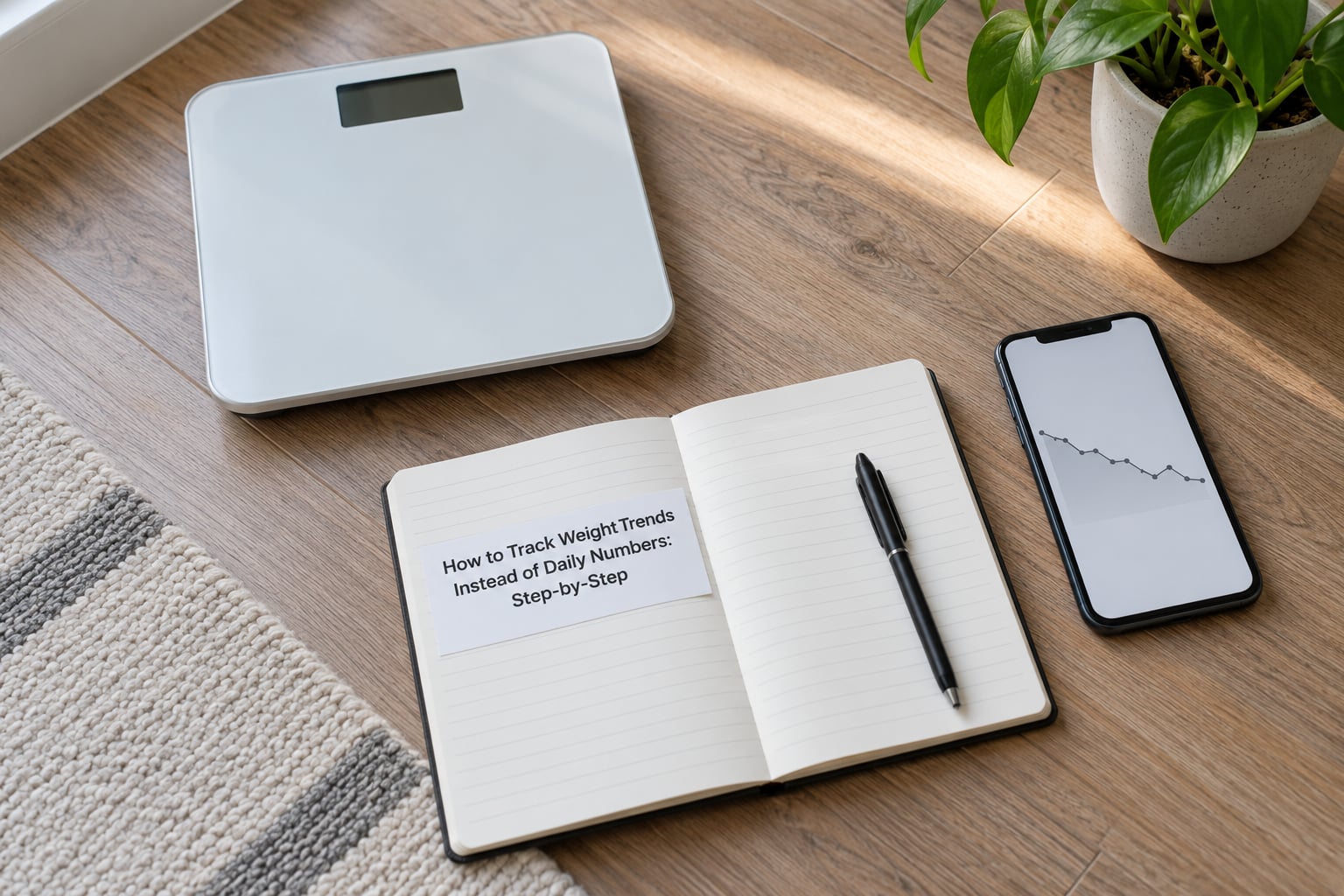
Pick the conditions once and write them down next to the scale, where you will see them. Mine say: up, bathroom, no food or drink, before brushing teeth, same spot on the tile. Specific enough that a bad day does not require a judgement call.
How do you know the routine is producing comparable data? After ten days, look at the spread. If your readings jump around by three pounds or more, look for a cause in the list before blaming the scale. The usual suspects are weighing after a salty meal the night before, a long run, a late night of drinking, or shifting the scale to a different spot on the floor. Fix the cause and the spread usually tightens.
A cheap second test is to step on the same scale twice in the same minute. If the two readings differ by more than about a pound, the scale is not resolving differences that size, and that matters for trend tracking even though it does not affect long-term direction much.
Record Each Measurement Without Fixating
Write the reading, nothing else. No comment, no mood, no judgment about the number. People who log a note like “bad” next to a heavy reading tend to stop logging within a month, and the missing weeks are exactly the data you cannot recover later.
A spreadsheet is the most flexible option and the one I would set up first. Give yourself four columns: date, weight, seven-day average, and a short note column you mostly ignore.
In Google Sheets, the weekly average for the first complete week goes in column C with =AVERAGE(B2:B8). Every row after that uses =AVERAGE(B2:B8) shifted down one row, so the window always covers the seven most recent readings. Insert a line chart with the raw weights as faint dots and column C as a solid line, and you have the chart that shows what your week actually did.
Android users can log through Google Health Connect, which many apps and smart scales write to, or through Mi Fitness if that is the scale you own. Menu names and sync behaviour change between app versions, so look for the weight or body measurement entry rather than trusting a specific path. Whatever you use, make sure you can export the data. App data you cannot export is data you do not really own.
Calculate a Rolling Weekly Average to Track Weight Trends
This is the whole method. Keep the last seven readings. Each morning, add the new number to the top and drop the oldest one. The average of those seven is your trend weight for the day.
A worked example makes it concrete. Seven readings: 182.4, 182.9, 181.8, 182.6, 181.5, 181.1, 180.9. That sums to 1273.2, and 1273.2 divided by 7 is 181.89. So your trend weight is about 181.9 even though Tuesday said 182.9 and Sunday said 180.9. The scale reading on Sunday is nearly two pounds below the average, and a person chasing daily numbers would find that either inspiring or alarming depending entirely on mood. It tells you almost nothing on its own.
For anyone who wants the maths to react faster, an exponential moving average does the same job with more weight on recent days. The formula in plain text is: EMA today equals 0.1 times today’s weight plus 0.9 times yesterday’s EMA, with the first day set equal to the first weight. A period of about seven days is the usual equivalent to the rolling average, so treat the two as the same choice rather than two different ideas.
One practical note: the average needs about a week of data before it means anything. Until you have seven readings, you are averaging a partial week, and the trend is closer to your raw weight than to your real weight.
Review the Trend Once a Week Instead of Daily Numbers
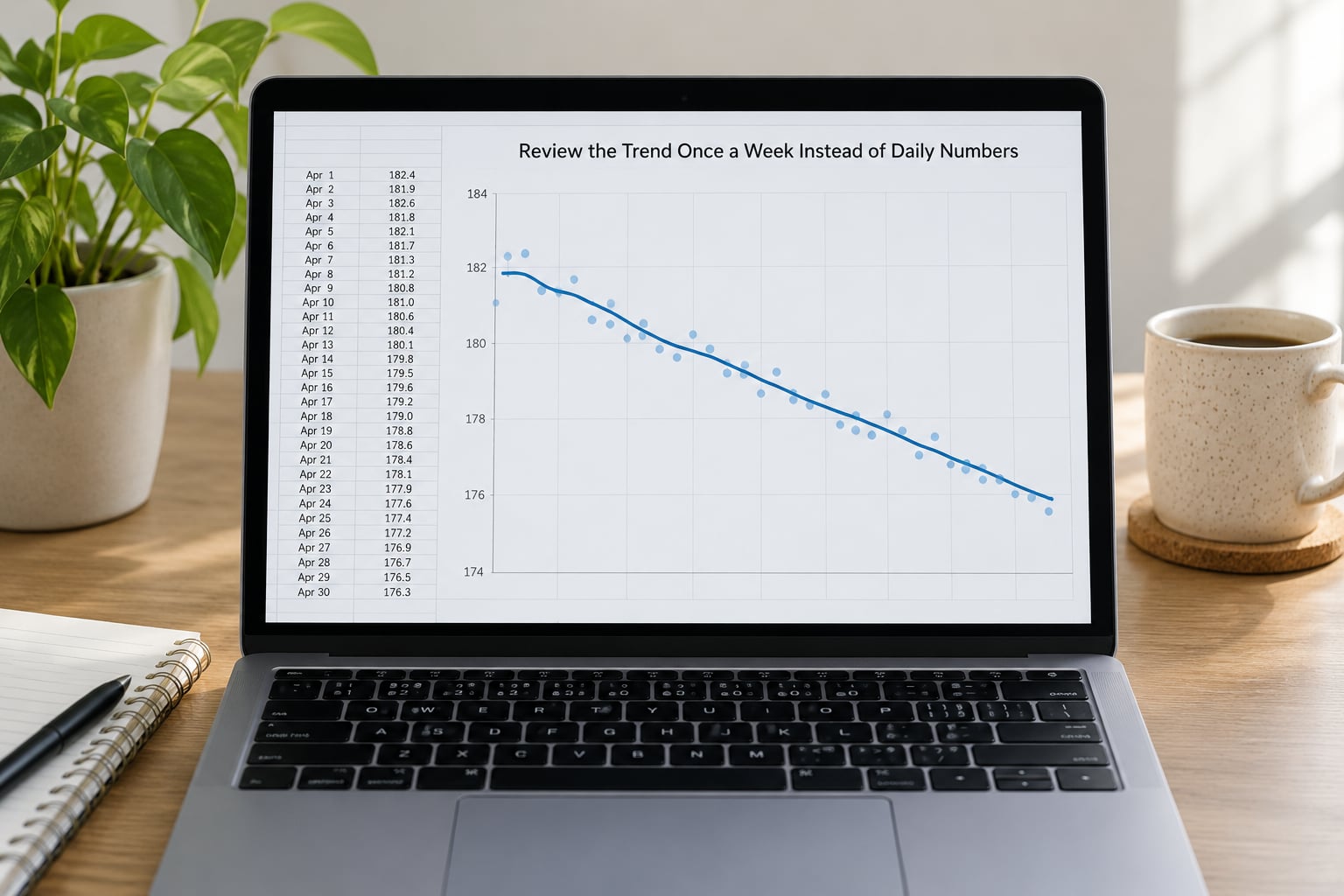
Pick a fixed review day, Sunday evening works well. You are checking three things and nothing else: did the weekly average move, in which direction, and by how much.
Annotate the chart when something explains a shift. A holiday, an illness, a change in training, a new medication. Those notes turn a confusing two-week wobble into something you can read later instead of re-litigating every morning.
Also look at the gap between today’s scale weight and this week’s trend weight, because the four combinations mean different things. Scale above trend means you are carrying water right now and your underlying direction may be fine. Scale below trend means you are lighter than your trend, often early in a change that will show up next week. Scale and trend close together means the two agree and the week’s change is real. Scale far from trend in either direction means the current reading is mostly noise and the average deserves more weight than the number.
At a healthy pace, a trend line falling about one pound a week is a reasonable target for a lot of adults, and slower is often more durable. Anything much faster usually means you are losing water and muscle alongside fat. Your trend line is the only number you should quote when you compare weeks, and comparing it against your starting trend weight is how you work out your actual percentage loss.
Use a Longer Window When Progress Seems to Stall
When the weekly average stops moving, resist the urge to cut more food the same day. Switch to a 14-day average first, which smooths out more of the noise. If the 14-day line is still falling slightly, nothing has stalled. If it is flat for three to four weeks while your habits are unchanged, that is a real plateau and it is time to look at intake, activity, sleep, or anything medication-related.
Why use a longer window? A 30-day average is the right tool for maintenance and for preventing weight creep, where you want to catch a slow drift rather than react to it. It also tells you whether a plateau is genuinely flat or just stubbornly noisy.
One more subtlety worth knowing: smoothed averages lag. On a steady slope, an exponential moving average sits slightly behind where you actually are, because it is still carrying older, higher readings. That lag is why the trend can look flat for a few days after real progress has started. Judge direction over two to three weeks, not over a single flat week.
Common Mistakes
Weighing at random times. A morning reading and a post-dinner reading are different measurements, so mixing them produces noise that has nothing to do with your body. Fix it by picking one window and writing it down.
Comparing unlike measurements. Do not compare this week’s average against last Tuesday’s single number. The fix is simple and slightly painful: compare averages to averages, or points to points.
Reacting to water retention. A salty meal, a hard training session, hot weather, alcohol or a period can all push the scale up a few pounds for days. The correction is to wait seven days before drawing any conclusion at all.
Averaging the wrong number of readings. A seven-day average over three readings is just a three-day average with a misleading label. If you miss days, use the days you have and know that the week is softer, or wait for a full seven.
Changing the routine when the trend disappoints. Moving the scale, weighing at a new time, or switching apps mid-week restarts your data for no good reason. Fix it by holding the routine steady for at least four weeks before judging it.
Trying to fix a plateau with a bigger cut. The most common response to a flat trend is to eat less, which usually deepens the problem. Look at consistency first: portions, sodium, alcohol, sleep, activity, and whether your weigh-in conditions drifted.
The practical tip: add a second measurement that does not come off the scale. Waist circumference at the navel, once a week, on the same tape, tells you something the scale cannot during recomp or when you are already lean. Tracking weight trends gets far more useful when it has one companion signal rather than standing alone.
Frequently Asked Questions
How often should I weigh myself if I want to track trends?
Weigh in once a day, every day, if you want a reliable trend. A rolling weekly average needs seven readings, so daily weigh-ins are what make the method work. Once a week is enough only if you are happy with a slower, coarser picture. The timing matters far more than the frequency: same conditions each time beats weighing more often at random.
Should I look at my weight every day or only once a week?
Weigh daily, but only look once a week. Recording a number takes three seconds; studying it every morning is what causes the anxiety and the false plateau panics. Treating the daily reading as a raw data point and the weekly average as the result gives you the benefit of daily accuracy without the emotional cost of daily interpretation.
What is the best way to calculate a weekly weight average?
Add the seven most recent readings, divide by seven, then each day add the new reading and drop the oldest one. In a spreadsheet this is a single AVERAGE formula over a moving seven-cell range. An exponential moving average does the same job with more weight on recent readings, and is worth using if you want a smoother line that still reacts within a few days.
Why does my weight fluctuate even if my habits have not changed?
Because most of what a scale measures on a given morning is not fat. Water follows sodium and carbohydrate intake, digested food still in your gut adds weight, alcohol and hard training sessions cause temporary fluid shifts, and heat, illness and hormonal cycles move things around. Swings of two to three pounds across a week are common even when your intake has been identical.
How long should I wait before deciding that my weight has plateaued?
Wait for a 14-day average to flatten and stay flat for three to four weeks before you call it a plateau. One flat week is usually noise, and smoothed averages also lag behind a real change by a few days. If the 14-day line is still drifting down slowly, your plan is working. Only a genuinely flat multi-week trend on an unchanged plan warrants a review.
Are smart scales accurate enough for tracking long-term trends?
For trends, yes. A smart scale’s job is to be repeatable, not laboratory accurate, and small day-to-day errors largely cancel out inside a weekly average. Judge it by consistency instead: step on twice in the same minute, and if the readings differ by much, either calibrate it or move it. Two pounds of drift between devices is normal, so pick one scale and stay with it.
One note before you start: this is general information about tracking numbers, not medical advice. If you are on medication, pregnant, managing an eating disorder or a health condition, or if your weight is changing unexpectedly without a clear reason, talk to your doctor or a registered dietitian about what the numbers mean for you.
Conclusion
Pick your weighing window tonight and write it next to the scale. Tomorrow morning, weigh in, write the number down, and average it with the last six readings. Do that for a week, then look at the line once. That is how to track weight trends instead of daily numbers, and the first week is the only part that takes any real effort.