Here is how to clean earbuds and charging case safely: use dry tools first, a soft brush, a lint-free cloth and cotton swabs for earwax and lint. A swab lightly dampened with 70% isopropyl alcohol is the only liquid most makers allow. Never pour or spray anything, and always let every part dry fully before it goes back on the charger.
It takes about ten minutes for both earbuds and the case. The reward is louder sound, clearer microphone calls and a case that charges properly again. Most people never clean their gear until one earbud starts sounding muffled or refusing to charge, and by then the cause is usually a thin film of wax and skin oil on a metal contact or the acoustic mesh.
Here is the short version, then the full method. Wipe the buds down dry, clean the ear tips separately, brush the mesh outward, go over the case wells and charging contacts with a dry swab, let everything air dry, and reassemble.
Table of Contents
- What You Need
- Step-by-Step
- 1. Check the Manufacturer’s Instructions
- 2. Disconnect and Prepare the Earbuds
- 3. Clean the Earbuds Gently
- 4. Clean the Charging Case
- 5. Dry and Reassemble
- Common Mistakes
- Alcohol concentration: 70% versus 90 to 99%
- How often to clean: a weekly rhythm that is enough
- What Not to Do When You Clean Earbuds and Charging Case
- Frequently Asked Questions
- Can I use alcohol to clean my earbuds?
- Can I wash earbuds or the charging case with water?
- How do I remove stubborn earwax from a speaker grille?
- How often should I clean wireless earbuds and their case?
- What should I do if cleaner or water gets inside the charging case?
- Will cleaning my earbuds damage their waterproofing?
- Clean Carefully and Keep Them Working
What You Need
You do not need a kit. Everything useful costs almost nothing and sits in a kitchen drawer already.
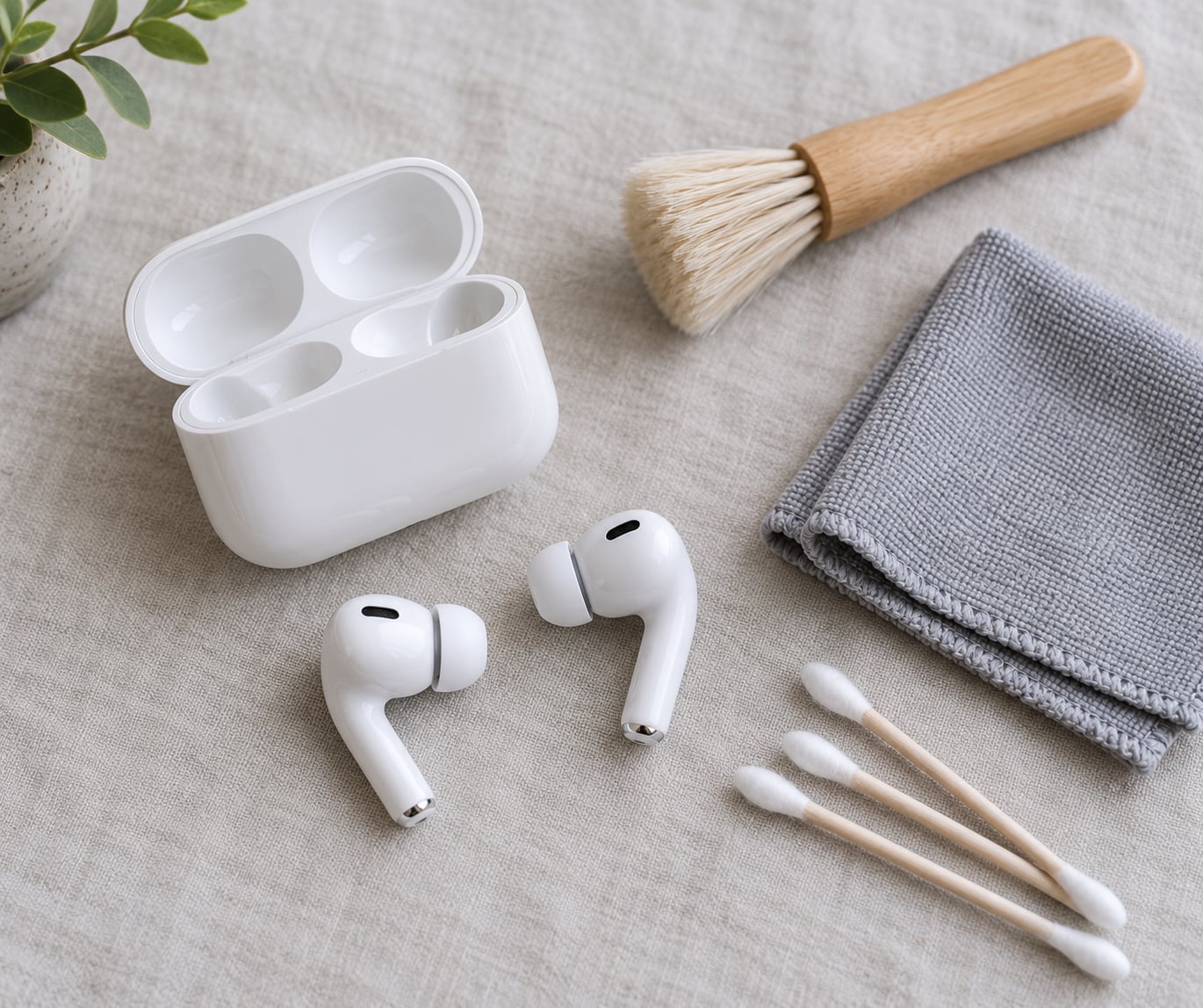
- Soft dry brush — an old toothbrush with soft bristles, or a small detailing brush. This lifts loose dust and lint off the mesh without pushing it deeper.
- Dry lint-free cloth or microfiber cloth — for the shells of the earbuds and the outside of the case.
- Cotton swabs — one per earbud, never reused. This is your main tool for wax and for the charging contacts.
- Dry wooden toothpick or a silicone earbud cleaning pick — useful for lifting a wax plug out of a nozzle edge. Use it only on removable silicone parts.
- 70% isopropyl alcohol — for stubborn grease, used sparingly and only where your maker permits it.
- A soft toothbrush for the ear tips — the same brush is fine if you rinse it first.
Here is the split that matters: what is safe, and what destroys earbuds.
| Safe to use | Never use |
|---|---|
| Dry lint-free or microfiber cloth | Running water or a sink full of water |
| Soft dry brush or old toothbrush | Bleach, hydrogen peroxide, household sprays |
| Cotton swabs, dry or lightly dampened | Pouring or spraying alcohol into openings |
| 70% isopropyl alcohol, dabbed on a swab | Cleaning putty, eraser crumbs or sticky tack |
| Mild soapy water for removable ear tips only | Compressed air or a hair dryer on the mesh |
| Dry wooden toothpick on silicone parts | Metal picks, tweezers pushed into a nozzle |
Two items deserve extra emphasis because they look helpful and are not. Cleaning putty and compressed air both push debris and residue deeper into the acoustic mesh, and that damage is permanent. Earwax and oils need to come off mechanically, not be shoved further into the grille.
Step-by-Step
1. Check the Manufacturer’s Instructions
Start here, because it takes two minutes and it overrides everything else on this page. Find the model name printed on the case or on the charging case lid, then look for the support or user guide page for that model. Apple, Samsung, Jabra, Soundcore, Anker and every Xiaomi and Redmi bud line publish their own cleaning notes, and they are not identical.
Look specifically for three things: whether the ear tips are washable, whether any liquid is permitted at all, and whether the case contains a desiccant packet you are meant to remove before opening. Manufacturer manuals from Jabra and similar brands consistently say to use a dry swab on the charging pins, keep liquids away, and store the buds in the case when they are not in your ears.
2. Disconnect and Prepare the Earbuds
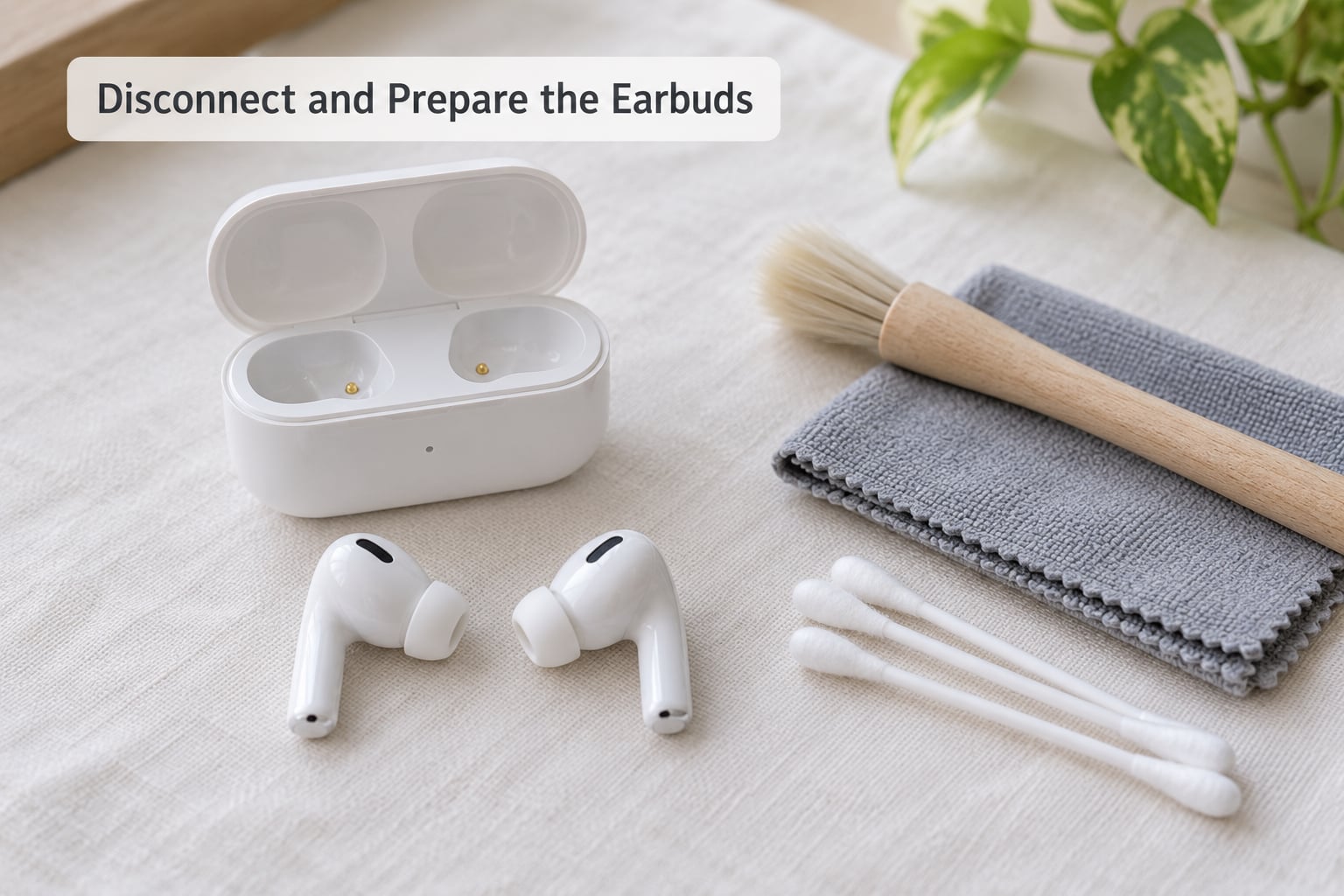
Put the buds in the case, close the lid, and if the case charges wirelessly, take the whole thing off the pad or out of the cable. Never clean an earbud while it is charging or while it is still paired to your phone. A powered device can register a wet swab as a fault, and moisture plus active current is exactly how a good speaker dies.
Take the buds back out, then work on a clean, dry, well-lit surface. A white sheet of paper makes stray wax and grit obvious. Keep one swab per side and never double back with a used one, because you will just spread the wax around.
3. Clean the Earbuds Gently
Take the removable silicone or foam ear tip off first. That is the dirtiest part and the only part that gets washed. Rinse the tip under lukewarm water, add a drop of mild dish soap, rub it between your fingers for thirty seconds, rinse again and let it air dry on a towel. Do not pull wax off a tip with your fingernail; a fingernail cuts silicone and the tear traps more debris than you removed.
Now the bud body. Hold it so the speaker grille faces away from you and brush outward with the soft dry brush, so loose material leaves the mesh instead of driving into it. Tilt it under a bright lamp and you will usually see a pale ring of wax around the nozzle edge.
For that ring, use a fresh dry cotton swab and roll it gently across the outside of the grille. Do not push the swab into the opening. If a plug is sitting right in the mouth of the nozzle, loosen it with the dry wooden toothpick from the side and lift it out. Anything that resists means it stays where it is.
The body gets a dry microfiber wipe. The microphone ports along the stem and the in-ear sensor get one careful cotton swab touch, because wax there makes your phone microphone sound like it is under a blanket and blocks the wear-detection sensor so one bud keeps playing.
4. Clean the Charging Case
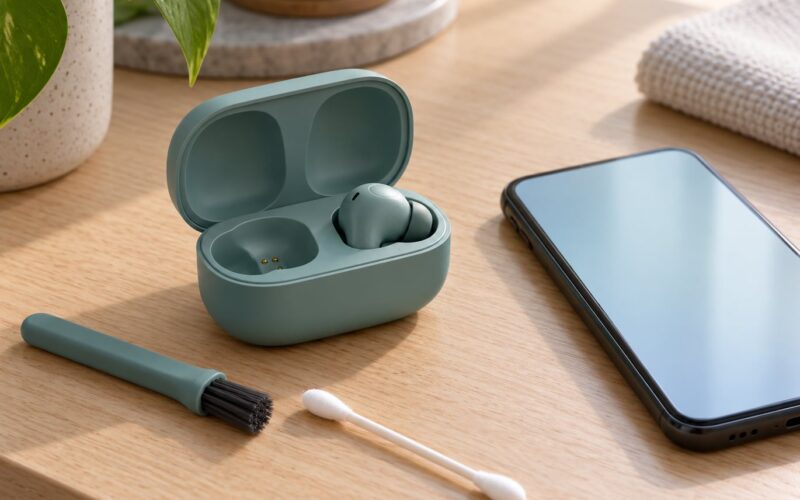
The case is where cleaning pays off most, because the most common hardware failure is a case that will not charge. Open the lid and look at the metal pins in the bottom of each well. A film of wax and skin oil on those contacts stops power transfer, and the symptom is one bud that charges and one that never does, or intermittent charging where you have to reseat the bud three times.
Take a fresh cotton swab and rub each contact firmly until the metal looks bright again. Community support threads on Galaxy Buds and MyEarFun describe this exact fix: alcohol on a cotton swab for the contact grooves works when a case stops charging correctly. Run the swab along the inside of each well and around the lid sensor too.
Clean the hinge seam and the interior corners with a dry swab or a soft brush, because grit collects there and can stop the lid seating properly. Wipe the exterior with a dry cloth. If you want to disinfect the shell, dampen the cloth with 70% isopropyl alcohol and wipe, keeping the liquid well away from the charging port and the lid gap.
Never pour cleaner into the case, and never run a wet swab around the charging port. If your case has a desiccant packet in the lid, pinch it out with dry fingers and discard it. Do not wash the case itself; plastic and metal cases are not sealed against water even when the earbuds inside carry an IPX rating.
5. Dry and Reassemble
This is the step people skip, and it is the one that saves the hardware. Leave the buds, the tips and the case open on a dry towel for at least two hours after any alcohol use, and longer if you live somewhere humid. Four hours overnight is safer than two during monsoon weather. Touch a bud with a clean dry fingertip: if there is any coolness or dampness at all, it is not ready.
While they dry, check each bud under a lamp. Look for residual lint in the mesh, residue on the sensor, and a contact well where you missed a patch. A quick second dry pass now takes ten seconds; a damp bud going back into a closed case takes days to fail.
Reassemble the tips, pop the buds into the case, and charge them normally. If sound was muffled, it should improve immediately. If one side still sounds quiet after a full clean and a full charge, the mesh is probably packed solid and the bud needs service rather than more scrubbing.
Common Mistakes
Almost every damaged earbud I have seen came from one of these, and each has a simple fix.
- Liquid straight into an opening. Dab it on a swab or cloth instead. A swab can be controlled; a pour cannot.
- Rinsing the earbuds or case under a tap. Water-resistance ratings cover sweat and rain on the earbuds, not a rinse with liquid forced into the mesh and the microphone ports.
- Alcohol with no approval. Check the manual first. Samsung recommends a lightly damp microfibre towel, and several brands say dry only.
- Cleaning putty or compressed air on mesh. Both permanently clog the grille. Use a soft dry brush.
- Charging before everything is dry. A sealed case traps the moisture against the contact pins and the board.
- Forgetting the ear tips. If the tips are removable and washable, wash them. Most of the grime is on the tip, not the bud.
- Cleaning daily with alcohol. Frequent alcohol dries out silicone and rubber. Dry method every day, alcohol once a week at most.
- Shoving a cotton bud deep into a port. Swab the outside only. Anything compacted inside needs a service.
Alcohol concentration: 70% versus 90 to 99%
Editors say 70%. Forum users say 99% and higher. Here is the trade-off, and it comes down to residue and coatings rather than electronics damage.
| Concentration | When it makes sense | Watch out for |
|---|---|---|
| 70% isopropyl | The default. Lifts grease well and leaves enough water behind to clean rather than just smear | Needs a full dry time afterward |
| 90 to 99% isopropyl | Good for metal charging contacts and stubborn wax, used on a powered-off device | Dries almost instantly, can be too thin for greasy silicone |
| Household rubbing alcohol | Often only 40 to 70% and mixed with fragrance additives | Additives leave a film on mesh |
| Disinfecting wipes | Occasional use on a bud body | Not daily; they dry silicone out |
The forum argument for high concentration is sound on its own terms. People on r/Earbuds and r/howto prefer 99% isopropyl on a powered-off device because it leaves no residue and evaporates quickly. The editorial caution is also sound: 70% is the electronics default because it stays wet long enough to actually dissolve oils. Use 70% for grime on shells and tips, and reserve 90 to 99% for metal contacts.
How often to clean: a weekly rhythm that is enough
| Interval | What to do | Time |
|---|---|---|
| After workouts or runs | Dry wipe the buds and drop them in the case | 30 seconds |
| Weekly | Dry brush the mesh, clean both earbud wells and the metal contacts with swabs, wash the tips | 5 minutes |
| Monthly | Full dry clean, hinge and lid sensor, one lightly damp 70% isopropyl wipe on shells, check the desiccant packet | 10 minutes |
| After an ear infection | Full clean plus a disinfecting pass before you wear them again | 15 minutes |
Humid climates deserve one extra weekly pass on the contacts, because salt and moisture film them faster. A dry case is not a bacteria-free case: your ear canal is warm and wet, and buds that sit damp against silicone every night grow biofilm. If you have had an ear infection, disinfect the buds, wash the tips, and leave everything dry overnight before wearing them. If pain, discharge or blocked hearing continues, see a doctor rather than cleaning harder.
What Not to Do When You Clean Earbuds and Charging Case
The single most important rule is that nothing wet goes inside anything. No exceptions for a quick dip, a rinse, a dropped bud, or an hour in the sun to dry faster. Sunlight and heat warp silicone and can swell the battery.
The second rule is that the mesh is not a surface you scrub. Treat wax as something to lift at the edge with a dry swab, not something to dissolve with a chemical. There is no safe solvent that sits on acoustic mesh and leaves it unchanged, which is why ear tip wax should be removed mechanically.
And the third is frequency. Alcohol once a week on contacts and shells is reasonable. Alcohol daily on silicone tips dries them out until they crack and lose the seal that gives you bass.
Frequently Asked Questions
Can I use alcohol to clean my earbuds?
Yes, but only 70% isopropyl alcohol applied to a cotton swab or cloth, never poured or sprayed, and only if your maker allows it. Some brands permit liquid only on the case and dry swabs on the buds. Keep alcohol off the silicone ear tips, since daily use dries them out, and give everything a full dry time before charging.
Can I wash earbuds or the charging case with water?
No. Water-resistance ratings cover sweat and rain on the earbuds, not a rinse with liquid forced into the mesh and microphone ports. Water inside a bud is a common cause of dead drivers. Removable silicone or foam ear tips are the exception: wash those in lukewarm water with mild soap and let them dry fully.
How do I remove stubborn earwax from a speaker grille?
Brush outward first with a soft dry brush so loose material leaves the mesh instead of driving deeper. Then roll a fresh dry cotton swab across the outside of the grille, and lift a plug sitting at the nozzle edge with a dry wooden toothpick. Never push a swab into the opening. Wax packed inside the mesh needs service, not scrubbing.
How often should I clean wireless earbuds and their case?
Wipe the buds dry after workouts, do a proper weekly clean of the mesh, the earbud wells and the metal charging contacts, and a full deep clean once a month. Wash removable ear tips in the weekly pass. In humid weather, add an extra contact clean, because film builds on the pins faster and causes intermittent charging.
What should I do if cleaner or water gets inside the charging case?
Open the case, remove both earbuds, tip it upside down over a towel and let it air dry fully with the lid open, ideally overnight or longer. Do not use a hair dryer or rice, since heat warps the plastic and pushes the moisture deeper. Once it is completely dry, clean the contacts with a dry swab and test charging. Skip the case if corrosion appears.
Will cleaning my earbuds damage their waterproofing?
A dry clean will not. Waterproofing is slowly worn away by sweat, soap and daily wear at the seals, not by brushing or swabbing. What breaks it is liquid getting into openings, so keep water, alcohol and cleaning sprays away from the mesh, ports and charging contacts. Remove ear tips when you swim or shower, since soaked silicone sits against the seal.
Clean Carefully and Keep Them Working
Start with your model’s own instructions, because that page settles the alcohol question your particular buds require. Then work dry: soft brush outward on the mesh, cotton swab across the nozzle edge, washable ear tips in mild soapy water, dry swabs on the case wells and metal contacts. No liquid poured into anything, nothing scrubbed into the grille, and a full drying period before the buds go back on the charger. Ten minutes of that once a week is usually the difference between earbuds that keep working for years and a case that stops charging in a year.