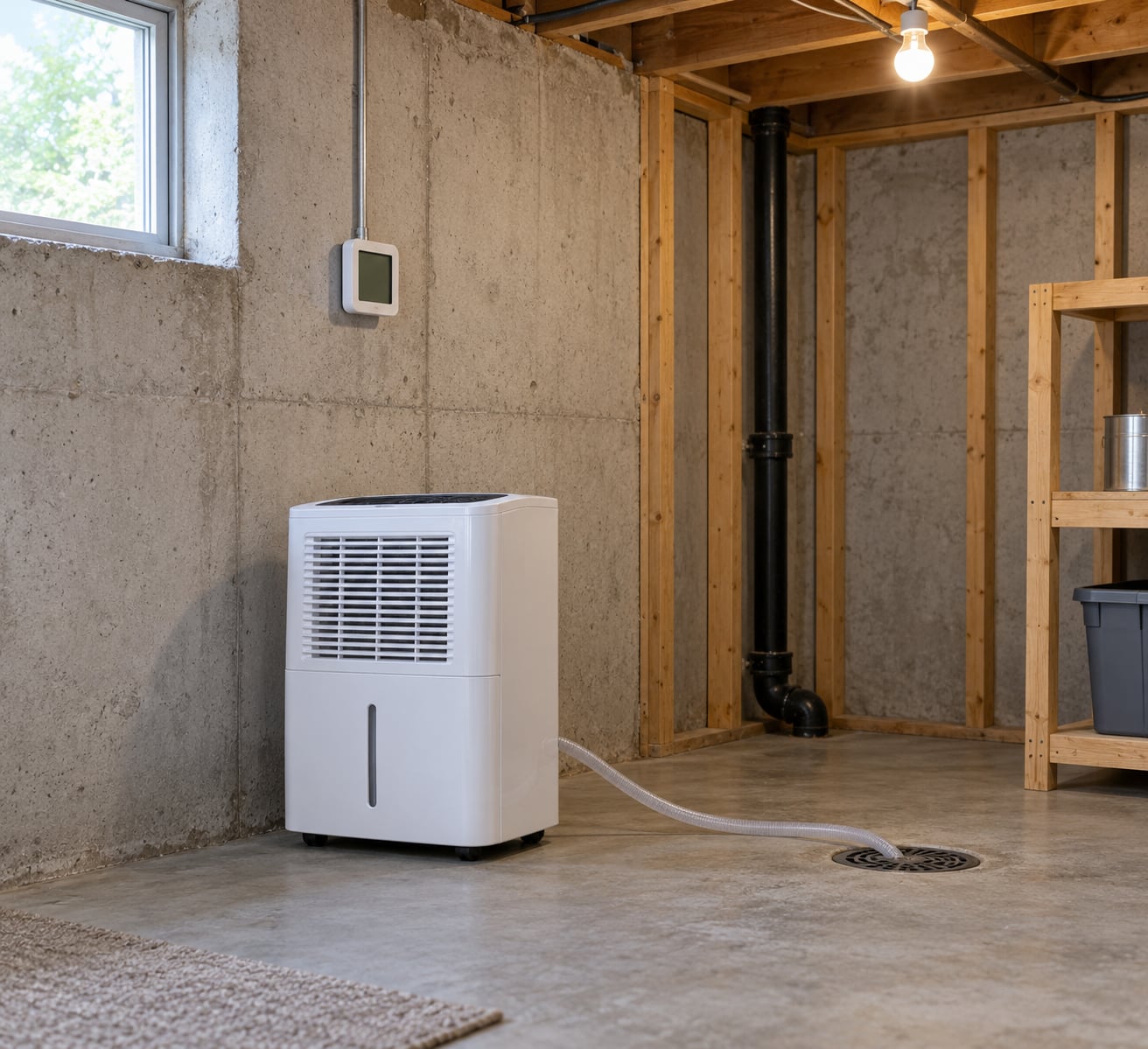
To pick a dehumidifier for a basement, measure the floor area and ceiling height, read the relative humidity with a hygrometer, then match the room’s coldest temperature to a unit rated in pints per day (PPD) rather than square feet. Buy the drainage and pump features the space needs, not the smart-home extras.
That order matters more than any brand name. Most people who end up unhappy bought a machine by capacity badge and then discovered it iced up in a 55F room, filled a bucket twice a day, or hummed loud enough to hear through a finished ceiling.
Here is how I would work through the decision, in order.
Table of Contents
- How to Pick a Dehumidifier for a Basement
- How to Pick a Dehumidifier for a Basement by Measuring the Space
- What Size Dehumidifier Does Your Basement Need?
- Why the advertised PPD number overstates what you’ll get
- Should you oversize, or is a bigger unit wasteful?
- Compressor or Desiccant Dehumidifier for a Basement?
- Which Features Matter Most for Basement Dehumidification?
- How Much Noise and Energy Will a Basement Dehumidifier Use?
- How to Set Up and Maintain Your Basement Dehumidifier
- Why is it running but not collecting water?
- Frequently Asked Questions
- How many pints per day does a basement dehumidifier need?
- What humidity level should I set in a basement?
- Can a dehumidifier run in a cold basement?
- Is it better to use a dehumidifier with a pump or a floor drain?
- How often should I empty and clean a basement dehumidifier?
- Do I need a separate dehumidifier for each basement room?
- Conclusion
How to Pick a Dehumidifier for a Basement
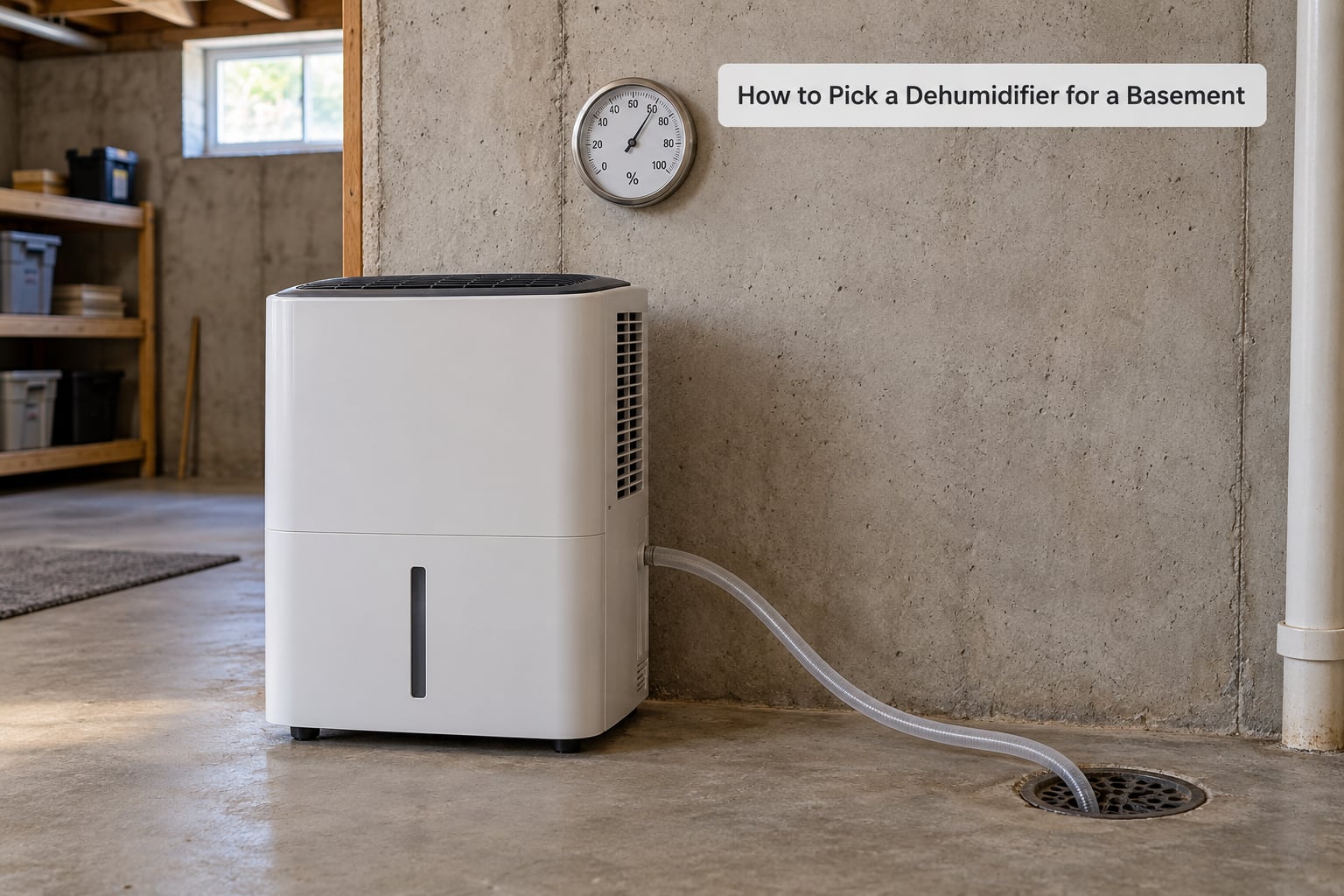
The selection framework has five steps, and each one narrows the field. Measure the space, read its humidity, find its coldest temperature, size the rated capacity, then pick the features your basement can actually use.
How to Pick a Dehumidifier for a Basement by Measuring the Space
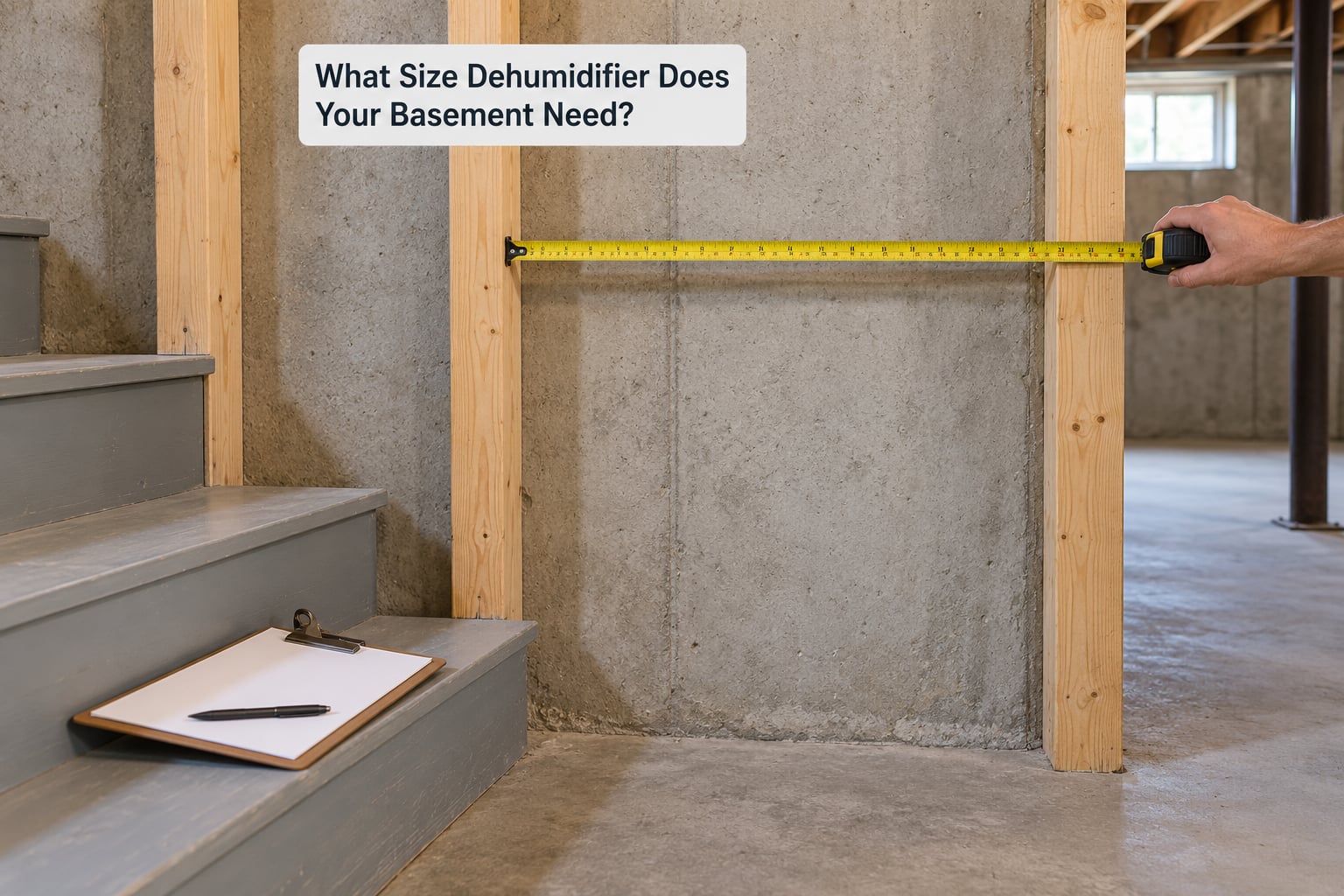
Start with floor area in square feet, then multiply by ceiling height to get cubic feet. Air volume is the honest starting number because moisture sits in the whole volume of air, not on the floor plan.
A 1,000 sq ft basement with a 7 ft ceiling is about 7,000 cubic feet. With an 8 ft ceiling it is 8,000. That difference changes the sizing recommendation enough that I would not skip the ceiling measurement.
Next, find the coldest temperature the basement actually sees, not the thermostat setting. Put a cheap digital thermometer on the floor in the corner farthest from any heat source and read it in the middle of winter. Compressor units need this number because their cooling coil stops working in a cold room.
Then check for standing water, efflorescence on the foundation wall, wet perimeter floor, or a musty smell that returns within days of airing the space out. Standing water or a high water table is a plumbing and drainage problem, and a dehumidifier is a temporary measure until it is fixed.
Finally, note what is stored down there and whether anyone sleeps or works in the space. Storage-only rooms tolerate a noisier, cheaper machine. A finished bedroom under the house does not.
What Size Dehumidifier Does Your Basement Need?
Size on rated pints per day, not on the square footage printed on the box. As a rough starting point, a 1,000 sq ft basement sitting at 70% RH needs a unit rated around 60 PPD. A 2,000 sq ft basement in the same band needs roughly 90 PPD, and you should go one tier higher if the space stays that damp or has a known water source.
This is a basement dehumidifier size chart organized by relative humidity band. Read down your basement’s typical humidity, then across to your square footage.
| Basement area | Below 50% RH | 50-60% RH | 60-70% RH | Above 70% RH |
|---|---|---|---|---|
| 400 sq ft | 20 PPD | 30 PPD | 40 PPD | 50 PPD |
| 600 sq ft | 25 PPD | 35 PPD | 45 PPD | 55 PPD |
| 800 sq ft | 30 PPD | 40 PPD | 50 PPD | 65 PPD |
| 1,000 sq ft | 35 PPD | 45 PPD | 60 PPD | 75 PPD |
| 1,200 sq ft | 40 PPD | 50 PPD | 65 PPD | 85 PPD |
| 1,500 sq ft | 45 PPD | 60 PPD | 75 PPD | 95 PPD |
| 2,000 sq ft | 55 PPD | 70 PPD | 90 PPD | 110 PPD |
| 2,500 sq ft | 65 PPD | 80 PPD | 100 PPD | 130 PPD |
These numbers assume standard 7 to 8 ft ceilings and unconditioned space. Add roughly 15% for a 9 ft ceiling, and add more if you are drying out a finished basement after a leak or a flood.
Why the advertised PPD number overstates what you’ll get
Dehumidifier capacity is rated under lab conditions set by the AHAM standard: 86F room temperature with 60% relative humidity, measured at the outlet. A real basement sitting at 65F and 70% RH is a harder job than the rating condition, so a unit advertised at 100 PPD may realistically pull 60 to 70 PPD on a warm day, and much less in a cold one.
The Department of Energy publishes a second set of figures based on a 65F rating temperature, which is closer to basement reality. When you see both numbers, the 65F figure is the more useful one. Treat the 86F figure as a ceiling and add a margin of safety on top of your table number.
Should you oversize, or is a bigger unit wasteful?
Oversizing one tier is usually smart. A larger compressor runs its fan and compressor in shorter cycles instead of running continuously, which means better humidity control, less coil icing, and often better efficiency because ENERGY STAR units cost roughly the same per hour at 50 and 70 PPD.
Oversizing by two tiers is where it turns against you. The unit blasts a finished room with noise it was never designed to hide, and the humidistat’s setpoint range may not go low enough for wood storage. One tier of headroom is the useful target.
Compressor or Desiccant Dehumidifier for a Basement?
Compressor and desiccant units both work in basements, but they fail in opposite temperature conditions. Compressor models are cheaper to run and quieter at normal basement temperatures, yet they freeze up below roughly 41F. Desiccant models keep pulling water out well below that floor, at the cost of higher electricity use.
| Refrigerant compressor | Desiccant | Thermoelectric | |
|---|---|---|---|
| Coldest usable temperature | About 41F before coil icing | Below 40F, including unheated rooms | Generally 50F and up |
| How water leaves | Condenses on a cold coil and drips | Absorbed into a rotating desiccant wheel | Condenses on a cooling plate |
| Electricity draw | Lowest of the three for large volumes | Highest per pint removed | Moderate, weak at high humidity |
| Noise | Moderate fan, compressor thump on start | Louder air movement | Mostly fan noise |
| Best basement fit | Climate-controlled or 55F-plus basements | Unheated winter basements, crawl spaces | Small damp closets and cabinets |
My rule: if your basement holds 55F or warmer through winter, buy a compressor unit with auto-defrost. If it drops into the 40s and stays there, frost complaints are the top failure mode owners report in forums, and a desiccant unit removes that risk entirely.
For a 500 to 700 sq ft unheated space, desiccant is often the calmer answer than fighting a compressor through winter. For a finished basement that people use, compressor wins on running cost and noise at normal temperatures.
Which Features Matter Most for Basement Dehumidification?
The features worth paying for are the ones that remove manual work and prevent failure. The rest are optional.
- Continuous drain line. A unit that runs 12 hours a day will fill a bucket twice or three times. A 1/4 in drain port with a hose to a floor drain or a condensate pump removes that chore permanently.
- Built-in pump. If the floor drain sits below the unit’s drain outlet, a pump with 15 to 16 ft of vertical lift is the difference between a working installation and a flooded one.
- Digital humidistat. An analog dial drifts. A digital setpoint lets you hold 45% instead of guessing between 55% and 65%, and it stops the short-cycling that wears out compressors.
- Auto shut-off and restart. Tank-full shut-off prevents a flood. Auto-restart after a power outage matters more than it sounds, since basement power is the first thing that goes during a storm.
- Auto-defrost or a frost sensor. Essential in a basement that touches the low 40s. Without it the coil ices, the fan stops, water backs up, and the unit can be damaged permanently.
- Washable pre-filter. Cheap to add and it catches the drywall dust that comes with a basement. Clogged filters cut airflow and can trigger coil icing on their own.
- Casters and recessed handles. Small, and you will care about them every time you move the unit to clean behind it.
- Wi-Fi and app control. Convenient for logging humidity trends. Not worth paying extra for if you will run a separate hygrometer on the shelf anyway.
One more thing before you shop. Homeowner forums repeat the same point over and over: the real fix is often outside the room. Grading away from the foundation, cleaning gutters, adding a catch trench or French drain, or installing a sump pump. A common story is a unit running six straight months until a new sump pump solved a groundwater infiltration problem. Fix the water first, then size the machine.
How Much Noise and Energy Will a Basement Dehumidifier Use?
Noise matters more than the spec sheet suggests, because a basement dehumidifier runs near-continuously in humid months. Manufacturers quote a range, so look at the low number and treat the high number as what you will actually live with.
A 50 PPD compressor unit typically lands somewhere in the 52 to 58 dB(A) range, and a 70 PPD unit runs a bit louder. In an unfinished storage room that is unremarkable. In a finished bedroom it is the difference between a machine you tolerate and one you turn off at night.
Two things reduce noise: sleep or quiet mode, which drops the fan to its lowest setting, and choosing a unit that cycles rather than runs flat out. Oversizing one tier helps here too, since the compressor spends more time off.
On electricity, compare average wattage and multiply by your run time. Use your utility’s actual rate to convert.
| Unit size | Typical average draw | 8 hours a day | 16 hours a day | 24 hours a day |
|---|---|---|---|---|
| Small, 20-30 PPD | 200 W | 48 kWh/mo | 96 kWh/mo | 144 kWh/mo |
| Medium, 40-50 PPD | 280 W | 67 kWh/mo | 134 kWh/mo | 202 kWh/mo |
| Large, 70-80 PPD | 400 W | 96 kWh/mo | 192 kWh/mo | 288 kWh/mo |
| Whole-home, 100 PPD plus | 550 W | 132 kWh/mo | 264 kWh/mo | 396 kWh/mo |
A desiccant unit changes this picture substantially. It has no compressor, so the wattage looks modest, but it runs at full draw continuously to do the same work. Budget it as a 24-hour load even if you set it to run only in humid months.
How to Set Up and Maintain Your Basement Dehumidifier
Setup takes about twenty minutes and decides whether the unit works properly for the next several years.
- Level it. A compressor unit that is not level can have refrigerant pooling issues and a noisy run. Most have adjustable feet for this.
- Leave clearance. Keep about 6 in between the unit and any wall, furniture or shelving. Intake and discharge need unobstructed airflow or the coil ices.
- Place it centrally. If the basement is one open space, put the unit where damp air mixes rather than against a dry corner. If it has been divided into finished rooms, plan on two units.
- Plan drainage before positioning. Run the hose to a floor drain, a sump basin, or a condensate pump outside. Check the fall over the whole run and secure it so it cannot kink.
- Close the door. Keep the basement door shut while the unit runs, and the stairwell door to the house closed. Damp basement air will migrate upstairs through every opening it finds.
- Set the target. EPA guidance points to 30 to 50% RH indoors, and keeping a basement under 60% is the practical floor for mold and dust mite control. 45% is a good storage setting.
- Add an independent hygrometer. The built-in humidistat tells you what the machine thinks. A cheap hygrometer on a shelf tells you what the room is actually doing.
Monthly, rinse or vacuum the pre-filter and empty the tank if you are not plumbed. Check the hose for kinks and the drain outlet for biofilm. A clogged condensate line is the most common cause of a basement dehumidifier that suddenly stops collecting.
Why is it running but not collecting water?
- The room is below the unit’s rated temperature and the coil has iced over. Auto-defrost handles this; without it, the unit may need a manual defrost cycle or a room warmer.
- The humidistat setpoint is below what the room can reach, so the compressor cycles on for seconds and shuts off.
- The filter is packed with dust and the airflow has dropped.
- The drain hose is pinched, kinked or clogged and water is backing up into the tank.
- The ambient air is drier than you think. An independent hygrometer settles this in a minute.
Frequently Asked Questions
How many pints per day does a basement dehumidifier need?
For most basements, plan on 35 to 50 PPD per 1,000 sq ft when humidity sits between 50% and 60% RH. At 60 to 70% RH, the same 1,000 sq ft space needs closer to 60 PPD. Always check the coldest temperature too, because a compressor unit rated at 60 PPD pulls far less in a 55F room than the AHAM rating suggests.
What humidity level should I set in a basement?
Set the humidistat between 45% and 50% RH for storage and finished space, and never above 60%. EPA indoor guidance points to 30 to 50% relative humidity, and CDC guidance on mold notes that keeping RH below 50% reduces the risk of mold growth. Below 40% can make wood and drywall brittle, so 45% is the safer floor.
Can a dehumidifier run in a cold basement?
A refrigerator-style compressor unit works down to roughly 41F before the coil ices up, so an unheated winter basement is a problem. Choose either a unit with auto-defrost, which periodically heats the coil, or a desiccant model that has no cold limit. Thermoelectric units are weak at high humidity and are not a good fit for a whole basement.
Is it better to use a dehumidifier with a pump or a floor drain?
Use whatever the space allows. A floor drain is free and needs no power, so gravity drainage into one is the cleanest setup. A built-in pump with 15 to 16 ft of vertical lift is the answer when the drain is lower than the unit or there is no drain at all. Check the floor drain itself for a working trap and a clear path before relying on it.
How often should I empty and clean a basement dehumidifier?
If you are using a tank rather than a drain line, check it daily during humid months, since a mid-size unit can fill in eight to twelve hours. Rinse the filter every month and clean the tank to avoid biofilm. Inspect the drain hose monthly for kinks and buildup, and pour a diluted bleach solution through an unused condensate line every few months.
Do I need a separate dehumidifier for each basement room?
One central unit handles an open basement with finished ceiling height, since air circulates across the space. It does not handle a basement divided into finished rooms, because each closed room holds its own moisture. Homeowners report exactly this and plan on two units, or one unit per sealed section, rather than trying to move a single machine around.
Conclusion
Measure the basement, record the coldest winter temperature, read the relative humidity with a hygrometer, and use rated pints per day to size the unit, adding one tier of margin. Then choose compressor or desiccant based on whether that space drops below 50F, and pay for continuous drainage before anything else.
Everything after that, including apps and filters, is a preference. Getting those first three numbers right is how to pick a dehumidifier for a basement that actually holds humidity down instead of just running.