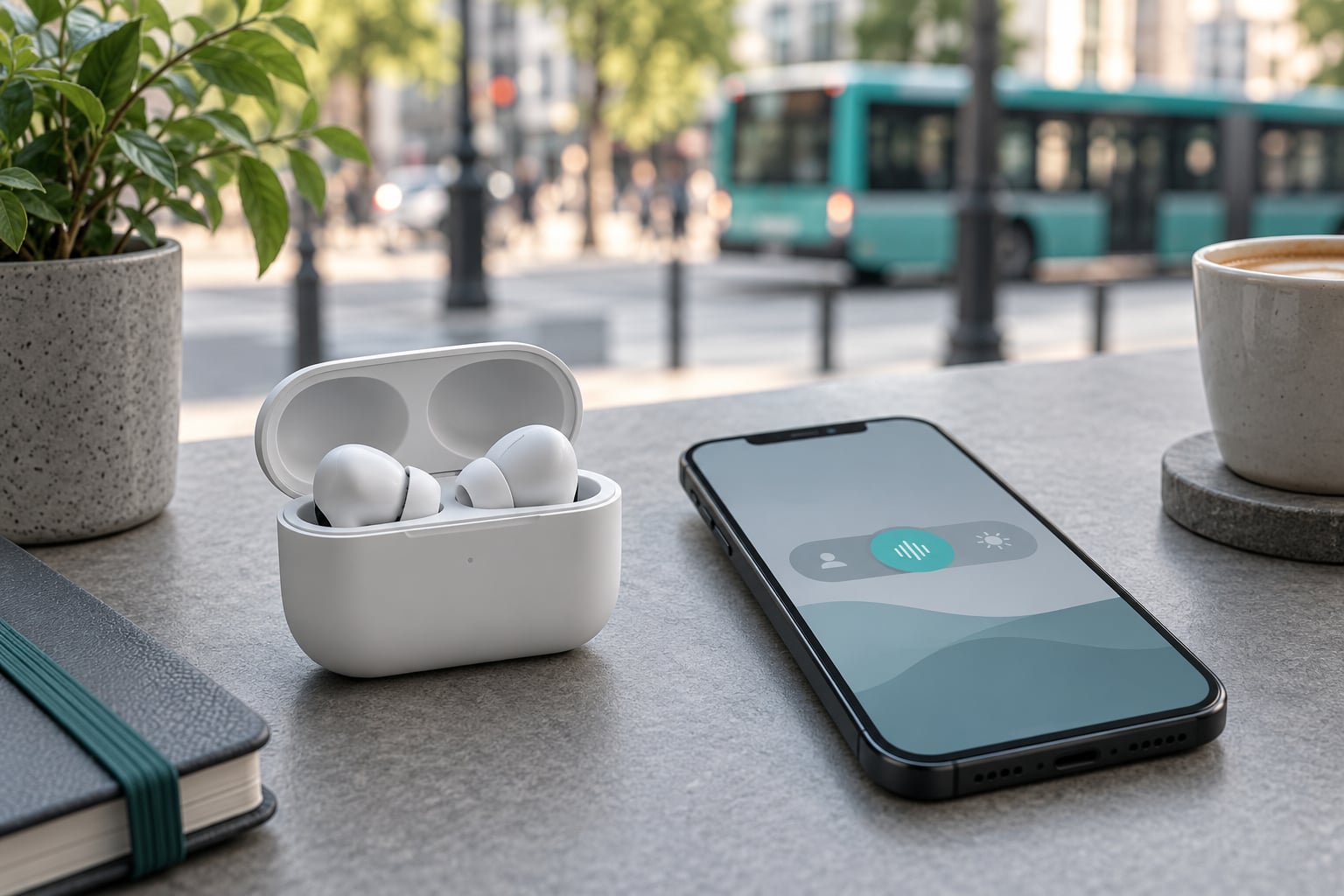
ANC and transparency mode use the same microphones and do opposite jobs. Active noise cancellation listens to outside noise and plays an inverted copy to cancel it, so the world goes quiet. Transparency mode opens those microphones up and passes outside sound straight into your ears so you stay aware. One takes noise away, the other hands it back.
That is the whole difference, and this guide covers the practical parts: how each mode works, which one drains more battery, and which to pick on a train, at a shop counter or while crossing a road. If you own Xiaomi, Redmi, Samsung, Nothing or Sony earbuds rather than Apple ones, the labels differ but the mechanism does not, so anc vs transparency mode explained the same way applies to all of them.
Table of Contents
- What Is the Difference Between ANC and Transparency Mode?
- Anc vs transparency mode explained in one line
- How Does Active Noise Cancellation Work?
- Feedforward, feedback and hybrid architectures
- What ANC cannot cancel
- How Does Transparency Mode Work?
- Transparency mode is not the same as turning noise control off
- ANC vs Transparency Mode at a Glance
- When Should You Use ANC?
- When Should You Use Transparency Mode?
- How to Switch Between ANC and Transparency Mode
- What each brand calls each mode
- How to tell which mode is currently active
- Which Mode Uses More Battery?
- ANC vs Transparency Mode Explained for Different Listening Situations
- Frequently Asked Questions
- Is there a downside to transparency mode?
- What uses more battery, ANC or transparency mode?
- Can ANC earbuds be used as hearing protection?
- Is it better to have ANC on or off?
- What is ANC vs ENC in earbuds?
- How do I know if ANC is on or transparency mode?
- Conclusion
What Is the Difference Between ANC and Transparency Mode?
Active noise cancellation (ANC) is designed to remove noise. Small microphones on the outside of each earbud pick up engine rumble, air conditioning and other steady background noise, and the earbud plays a matching sound wave that cancels it before it reaches your eardrum.
Transparency mode is designed to let noise in. The same microphones capture the outside world and the chip sends that sound to the earbud driver so you hear your surroundings without taking an earbud out. Music usually keeps playing, often at a reduced level.
Anc vs transparency mode explained in one line
ANC subtracts sound from your listening; transparency adds the room back into it. Everything else, including the microphones doing the work, stays the same.
How Does Active Noise Cancellation Work?
Cancellation happens in three steps, and the earbud repeats the loop thousands of times a second:
- Sense. External microphones measure the noise coming from the environment.
- Invert. A chip on the earbud flips the waveform, producing what is called an anti-phase or inverse signal.
- Cancel. The speaker plays that inverted signal alongside your music. Where the two waves overlap at your ear, they flatten out.
Because two waves only cancel cleanly when they are steady and matched, ANC works best on low, unchanging frequencies. Aircraft cabin rumble, a bus engine, a train on rails, an air conditioner and traffic hiss are where it earns its keep.
Feedforward, feedback and hybrid architectures
Vendors arrange the microphones in one of three ways. Feedforward puts a mic outside the earbud to sample incoming noise and react before it arrives, which reacts fast but has no way to correct its own error. Feedback listens inside the earbud, near the driver, and self-corrects continuously but reacts more slowly. Hybrid uses both and is what most current earbuds ship with.
What ANC cannot cancel
Voices, crying babies, doorbells and sudden bangs are irregular and higher in frequency, so they slip through largely untouched. ANC is not silence, it is a large reduction in the low end, and the ear tip seal still decides how much of the rest gets blocked.
How Does Transparency Mode Work?
Nothing new is switched on. The earbud keeps its microphone array running, processes the outside sound and sends a cleaned-up version to the driver, so you hear the room at roughly natural volume while your music continues underneath.
A detail that surprises people: the cancellation circuitry usually stays partly active in transparency mode. Long-running discussions on head-fi.org and the MacRumors forums describe the chip still removing low-frequency rumble while higher frequencies pass through, which is why your music stays audible instead of being buried by engine noise.
Transparency mode is not the same as turning noise control off
Off seals the earbud and cuts the external microphone path entirely. Transparency actively opens it up and processes what comes in, which is why an earbud in transparency mode lets you hear a cashier clearly while an earbud switched off mostly gives you the music and a dull thud of bass bleeding through.
Most apps also offer an adjustable transparency slider, so you can dial how much outside sound gets through. Conversation or voice-passthrough modes go one step further and drop the music volume automatically while you speak.
ANC vs Transparency Mode at a Glance
| What to compare | ANC (noise cancellation) | Transparency mode |
|---|---|---|
| What it does | Removes outside noise | Passes outside sound into your ear |
| Audio path affected | Sound arriving at your ears while you listen | Same microphones, signal reversed in purpose |
| Effect on your music | Music unchanged, background fades | Music stays, often lowered automatically |
| Environmental awareness | Low, voices still get through partly | High, you can follow a conversation |
| Battery cost | Highest continuous drain | Lower than ANC, higher than off |
| Comfort | Pressure sensation for some ears | Claustrophobic for very sensitive ears |
| Best for | Planes, trains, open-plan offices | Counters, crossings, announcements, calls |
When Should You Use ANC?
Reach for noise cancellation when the noise is steady and you want it gone. That is the cabin of a plane, the metro at 8am, an open-plan office and a shared flat where the washing machine runs on a schedule you did not choose.
It also helps when you are trying to concentrate, because masking steady background noise makes music at a moderate volume feel less fatiguing. Turn it on for the trip, then off again when you arrive.
There are cases where less isolation is the better choice. If your ears feel pressure, if you are walking somewhere unfamiliar, or if you are driving a passenger, full ANC works against you. Some earbuds also let you pick a light or adjustable ANC level instead of maximum, which cuts the pressure feeling without giving up all the benefit.
When Should You Use Transparency Mode?
Switch to transparency whenever missing a sound would cost you something. Paying at a counter, hearing an airport announcement, crossing a road where you need to judge traffic, or taking a phone call while one earbud stays in.
It is also the better mode for people who find strong ANC uncomfortable. Sound-sensitive listeners often report that a fully cancelled room creates more pressure than the noise it removes, and that a moderate transparency setting feels far easier to wear for hours.
At home, transparency lets you keep one earbud in without going deaf to a doorbell or a smoke alarm. It works the same way for mild hearing loss, though it is not a hearing aid and it does not amplify anything.
How to Switch Between ANC and Transparency Mode
On Android the path is usually the same shape, with the labels differing by brand. In the Xiaomi Earbuds or Mi Buds app, open your device, find the noise control option and tap between noise cancellation, ambient sound and off.
If the controls are on the earbuds themselves, most models cycle through the modes with a long press on the touch panel or a press and hold on the stem. On Samsung Galaxy Buds the same gesture steps through the three modes, and Nothing Ear and JBL models cycle on a long press too.
Voice assistants can do it for you. Saying a wake phrase followed by a command such as turn on transparency or turn on noise cancellation works on most current earbuds once the assistant is set up in the companion app.
What each brand calls each mode
| Brand | Cancellation | Passthrough |
|---|---|---|
| Apple | Noise Cancellation | Transparency, plus Adaptive Audio |
| Bose | Quiet Mode | Aware Mode, with ActiveSense |
| Sony | Noise Cancelling, with Auto NC Optimizer | Ambient Sound |
| Samsung | Noise Cancellation | Ambient Sound |
| Xiaomi and Redmi | Noise cancellation | Ambient sound mode |
| Nothing | Noise Cancellation | Transparency |
Menu names shift with firmware updates, so check the label your current app shows rather than the one in this table.
How to tell which mode is currently active
- Check the companion app, where the active mode is usually highlighted on the device card.
- Look for a tone or a voice prompt when you change modes with the earbud control.
- Some earbuds play a slightly higher pitch in transparency mode, since outside sound is no longer being inverted.
- In a quiet room the difference is small. Walk somewhere busy and the mode becomes obvious within a second.
Which Mode Uses More Battery?
ANC costs the most power. The microphones stay live, the chip runs its processing loop and the driver actively generates a cancellation signal the entire time. Transparency mode uses the same microphones and chip but stops generating the full cancelling waveform, so it draws less than ANC and more than plain playback with noise control off.
Results vary by model and by how strongly each mode is implemented, and manufacturers rarely publish comparable figures. Treat off as the baseline: if you need the last hours out of a charge, turn noise control off for the parts of the day that do not need it.
Adaptive modes land in the middle but switch often, and each change wakes the microphones again. On a long flight or a full workday, picking one mode and staying in it beats letting an adaptive mode hunt back and forth.
ANC vs Transparency Mode Explained for Different Listening Situations
| Situation | Pick | Why |
|---|---|---|
| Long-haul flight | ANC | Engine drone is exactly the low, steady noise ANC removes |
| Metro or bus commute | ANC | Removes engine and rail noise without raising the volume |
| Open-plan office | ANC | Masks steady chatter and HVAC, easier on the ears at low volume |
| Crossing a road | Transparency | You need real-time judgement on cars and bikes |
| Shop counter or cafe | Transparency | Hear the cashier without removing an earbud |
| Phone call | Transparency | Hear the person and the ambient noise around them |
| Waiting for a gate or announcement | Transparency | You hear the chime while music keeps going |
| Running or cycling | Transparency or off | Awareness beats isolation for safety outdoors |
| Sound-sensitive ears | Light transparency | Reduces noise without the pressure feeling of full ANC |
A practical habit: set transparency as your default and switch into ANC only when the noise demands it. You notice the difference far more that way, and you stop paying the battery cost for silence you did not need.
Frequently Asked Questions
Is there a downside to transparency mode?
Yes. Transparency mode lets more outside sound reach your ear, so loud environments get tiring fast, and the extra sound can drown out quiet music. Some listeners also find it uncomfortable in the same way full ANC is uncomfortable. Wind hitting the external microphone is the most common complaint, producing a hiss or falling-rain sound outdoors. Keeping the volume lower usually fixes the fatigue part.
What uses more battery, ANC or transparency mode?
ANC uses more battery than transparency mode on most earbuds. Keeping cancellation running means live microphones, continuous processing and a driver generating an inverted signal the whole time. Transparency runs the same microphones but stops the full cancelling waveform, so it costs less. Turning noise control off entirely is the cheapest option. Exact differences depend on the model.
Can ANC earbuds be used as hearing protection?
No. Noise cancelling earbuds are entertainment products, not certified hearing protection. They reduce low-frequency noise for listening comfort, but they do not attenuate dangerous levels evenly and they cannot protect against sudden impacts. At a concert, near machinery or near fireworks, use proper rated ear defenders. If you are concerned about your hearing, an audiologist can fit you with appropriate protection.
Is it better to have ANC on or off?
It depends on the noise. ANC is better when the background is steady and loud, such as aircraft, trains or air conditioning, because it removes noise instead of forcing you to raise the volume. Off is better in quiet rooms, where ANC adds only pressure sensation and battery drain. Many listeners are surprised by how much ANC helps at moderate volume, since it lowers the overall level your ears have to handle.
What is ANC vs ENC in earbuds?
ANC means active noise cancellation and affects what you hear, reducing outside noise before it reaches your ears. ENC means environmental noise cancellation, sometimes also called noise reduction, and affects what the person on the other end of a call hears, cleaning up the microphone signal going out. They sit on opposite sides of the call. Some earbuds are marketed with ENC but offer no ANC for listening.
How do I know if ANC is on or transparency mode?
Open the companion app first, since the active mode is normally highlighted on the device card. Many earbuds also play a tone or announce the change when you long-press the touch panel or stem. In a quiet room the two modes sound similar, so test in a busy place where the difference is immediate. If no indicator appears, press the control once more and listen for the confirmation tone.
Conclusion
ANC removes the world, transparency hands it back, and both run on the same microphones inside the same earbud. That is the whole of anc vs transparency mode explained: pick cancellation for steady noise on a plane, train or in a noisy office, and pick transparency at a counter, on a call or near a road.
Start today by opening your earbud app and switching between the two modes once. You already own both features, and after that first comparison you will pick the right one without thinking.