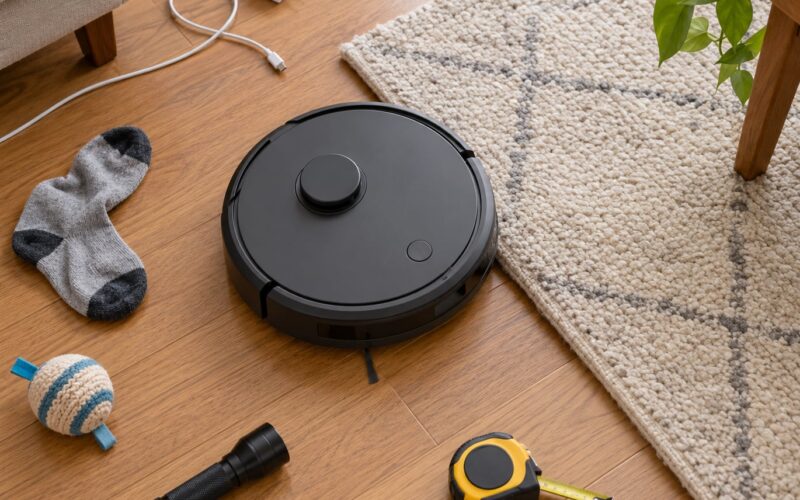
If you want the short version: a robot vacuum mop cleans more often without asking anything of you, and a separate mop scrubs harder where the robot cannot reach. Neither one replaces the other, which is why most households that end up happy with their floors run both on a weekly schedule.
That is the honest answer to robot vacuum mop vs separate mop which cleans better, and it is not as tidy as a single winner. A robot wins on consistency, coverage and frequency. A flat microfiber mop in your hands wins on dried-on stains, sticky spills, grout lines and the strip of floor along the skirting board.
Below I break the comparison down by the actual tasks: hard-floor scrubbing, debris pickup, spills, edges, floor safety, upkeep and running cost. Last updated for 2026.
Table of Contents
- Robot Vacuum Mop vs Separate Mop Which Cleans Better at a Glance
- How Well Does Each Option Mop Hard Floors?
- Which One Handles Spills, Hair and Everyday Debris Better?
- How Do Robot Mops and Separate Mops Compare at Edges and Tight Spaces?
- Which Is Safer for Wood, Tile and Other Floors?
- What Does Each Option Require for Maintenance?
- How Do Price and Long-Term Running Costs Compare?
- Robot Vacuum Mop vs Separate Mop: Which Should You Choose?
- Frequently Asked Questions
- Is a robot vacuum mop as good as mopping by hand?
- Do robot vacuum mops clean sticky spills and dried stains?
- What is the best mop for tile and hard floors?
- Are robot mops safe for wood floors?
- Is it worth buying both a robot vacuum and a separate mop?
- How often should mop pads be washed and replaced?
- Conclusion
Robot Vacuum Mop vs Separate Mop Which Cleans Better at a Glance
| Task | Robot vacuum mop | Separate mop | Better option |
|---|---|---|---|
| Dried-on stains and deep scrubbing | Light downward pressure, mostly a wipe | Full body weight, scrubbing motion, corner access | Separate mop |
| Everyday dust, crumbs and pet hair | Suction plus mop pad on a schedule | Only when you decide to do it | Robot |
| Sudden liquid spills | May drive straight through it | Positioned on the spot in seconds | Separate mop |
| Edges, skirting boards and furniture legs | Side brush and pad stop short | Flat pad slides right into the gap | Separate mop |
| Grout lines | Too little pressure to lift embedded dirt | Brush or pad presses into the channel | Separate mop |
| Water control on wood and laminate | App-set dampness, pad saturation varies | You squeeze exactly how wet the pad is | Separate mop |
| Frequency and consistency | Runs daily, on schedule, unattended | Depends entirely on your mood | Robot |
| Maintenance time per week | Empty tank, rinse pad, refill water | Empty bucket, rinse pad, wring, refill spray bottle | Robot |
| Homes larger than one battery charge | Needs docking and top-ups mid-run | Covers as much as you are willing to mop | Separate mop |
| Upfront cost | Combos cost considerably more than a stick vacuum | A flat mop and bucket are close to nothing | Separate mop |
| High-pile carpet | Surface debris only, pad will dampen it | Does not deep-clean carpet at all | Neither, use a vacuum |
| Best-suited home | Mostly hard floors, busy schedule, pets, allergies | Kitchen spills, grout, edges, deep weekly clean | Both |
The pattern repeats across every row. Where the deciding factor is effort per square metre, the robot takes it. Where the deciding factor is pressure and placement, the mop in your hand takes it.
How Well Does Each Option Mop Hard Floors?
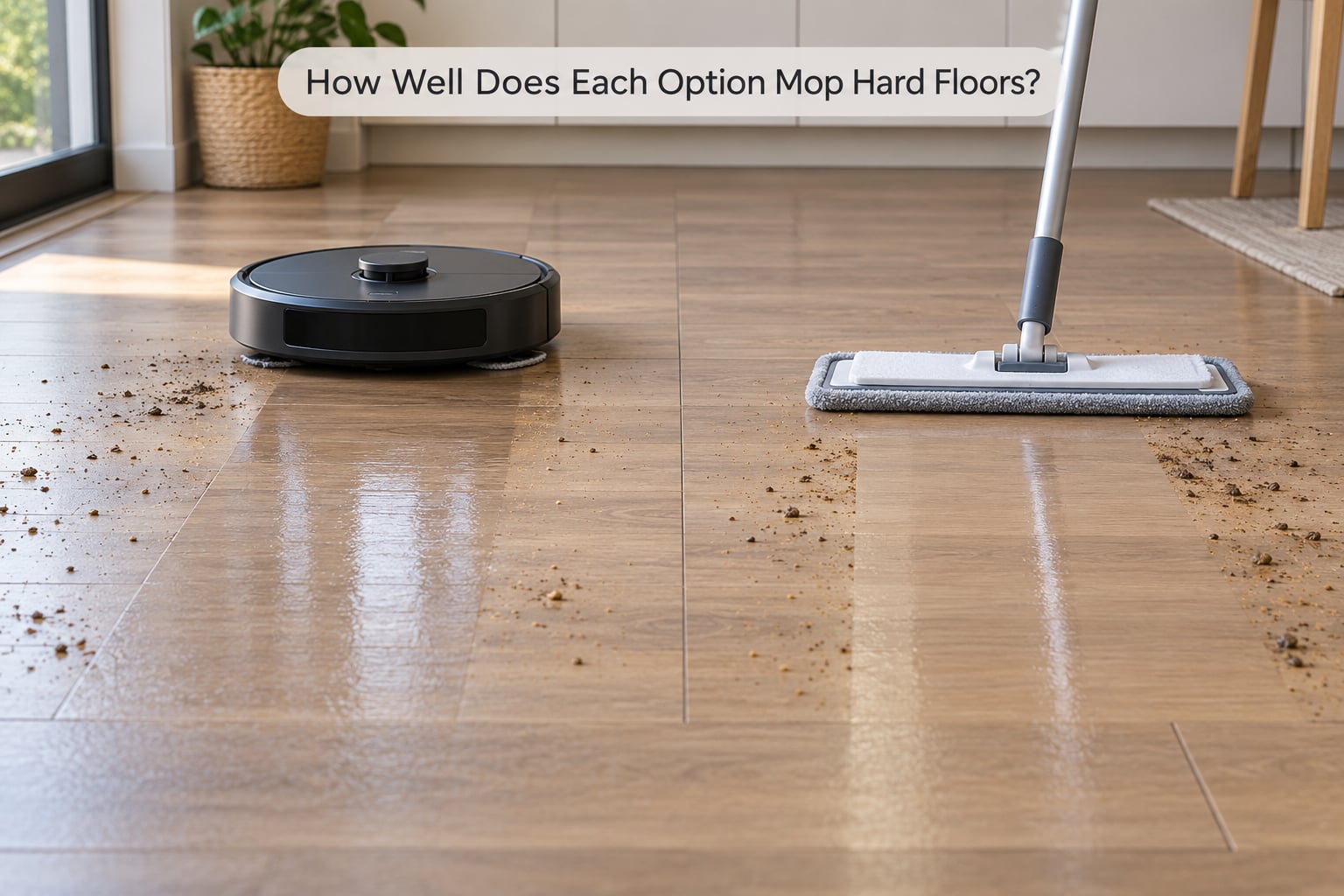
A separate mop cleans hard floors better on a single pass. That is not a marketing judgement, it is physics: a person applies their full weight through a flat pad, you can press the pad into a grout channel, and you can scrub a sticky spot in small circles until it lifts.
A robot mop is doing maintenance-level work. Water is dispensed across a rotating or flat pad, the machine drives over the floor, and dirty water is drawn back into a separate tank. On sealed tile, polished concrete and vinyl plank, that is genuinely enough to remove dust film, footprints and light dried-on marks in a no-carpet home.
The gap shows up in the residue. Dried milk, cereal paste and syrup that has bonded to the surface usually need pressure and a degreaser, and the robot will smear them thinner instead of lifting them. Owners describe this repeatedly on cleaning forums, where the recurring advice is that robot vacuum and mop combos handle maintenance cleaning well and still need a proper mop for anything dried on.
Which One Handles Spills, Hair and Everyday Debris Better?
For dry debris, the robot wins clearly. Hair, crumbs, grit and dust get pulled into the dustbin or bag by suction on every scheduled run, so the floor never accumulates a visible layer in the first place. Repeat that every day and you end up with a floor that needs mopping far less often.
A separate mop does almost nothing about dry debris. Wiping a floor with a damp pad just moves grit around, and if you pick it up off a dusty floor you end up spreading the dust into a thin film that looks like the floor is still dirty.
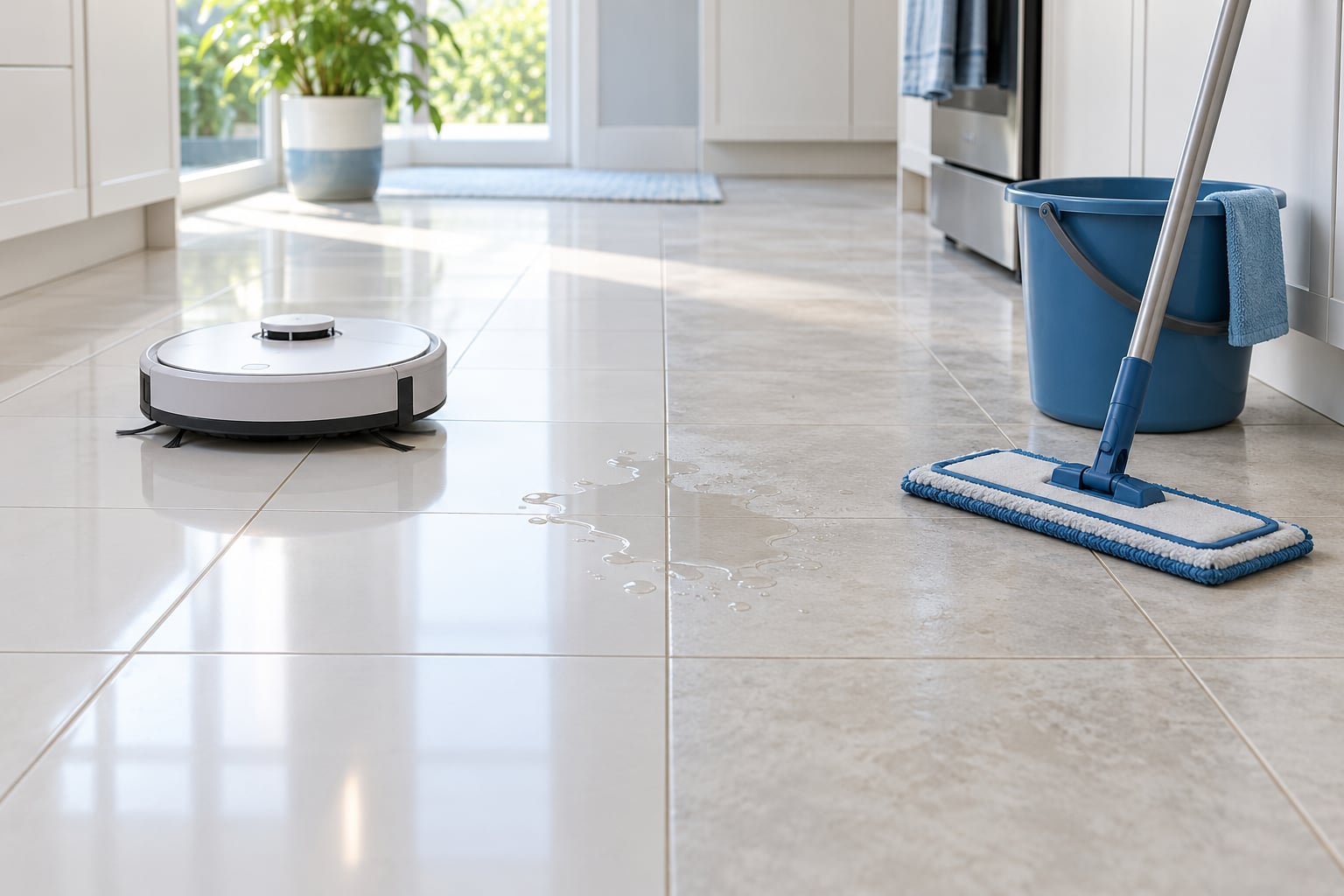
Liquid is where it flips. A spill of water, juice or wine gets handled by whoever gets there first, and a robot on its evening schedule may be in another room. Even a model with obstacle avoidance has been known to roll over a small puddle and drag it across a hallway, which is why people who cook a lot tend to keep a mop within arm’s reach.
How Do Robot Mops and Separate Mops Compare at Edges and Tight Spaces?
The separate mop wins every edge case. Its pad is flat and narrow, so it slides under a bed frame, along the skirting board and into the corner where two walls meet, and the side of the pad can be held upright to get into a right angle.
A robot works in a circle or a rectangle, which means its coverage is limited by the shape of its own body. The mop pad sits maybe 10 to 15 cm behind the outer edge of the chassis, so a band of floor along every wall stays untouched unless the model has an edge-swing or side-mop feature, and even those stop short of the corner itself.
This is the single most common complaint in owner threads: the middle of the room looks great and the perimeter still needs a wipe by hand every week.
Which Is Safer for Wood, Tile and Other Floors?
A separate mop is safer, because you control the water. A spray bottle lets you put a fine mist on the pad rather than soaking it, and on unsealed or older hardwood you can keep the floor barely damp instead of wet.
Robots add a variable you cannot see directly: pad saturation. A pad that has run several passes keeps re-wetting itself, and on laminate or engineered wood that repeated moisture in the same joint line is where swelling and edge damage tend to start. The safer features to look for are adjustable dampness in the app and automatic mop lifting when carpet is detected, though carpet lift says nothing about protecting wood.
Whichever you use, read the flooring manufacturer’s care instructions before the first run. Test either method in a spot nobody sees, like inside a wardrobe or behind the sofa, and check it the next morning before you trust it across the whole room.
What Does Each Option Require for Maintenance?
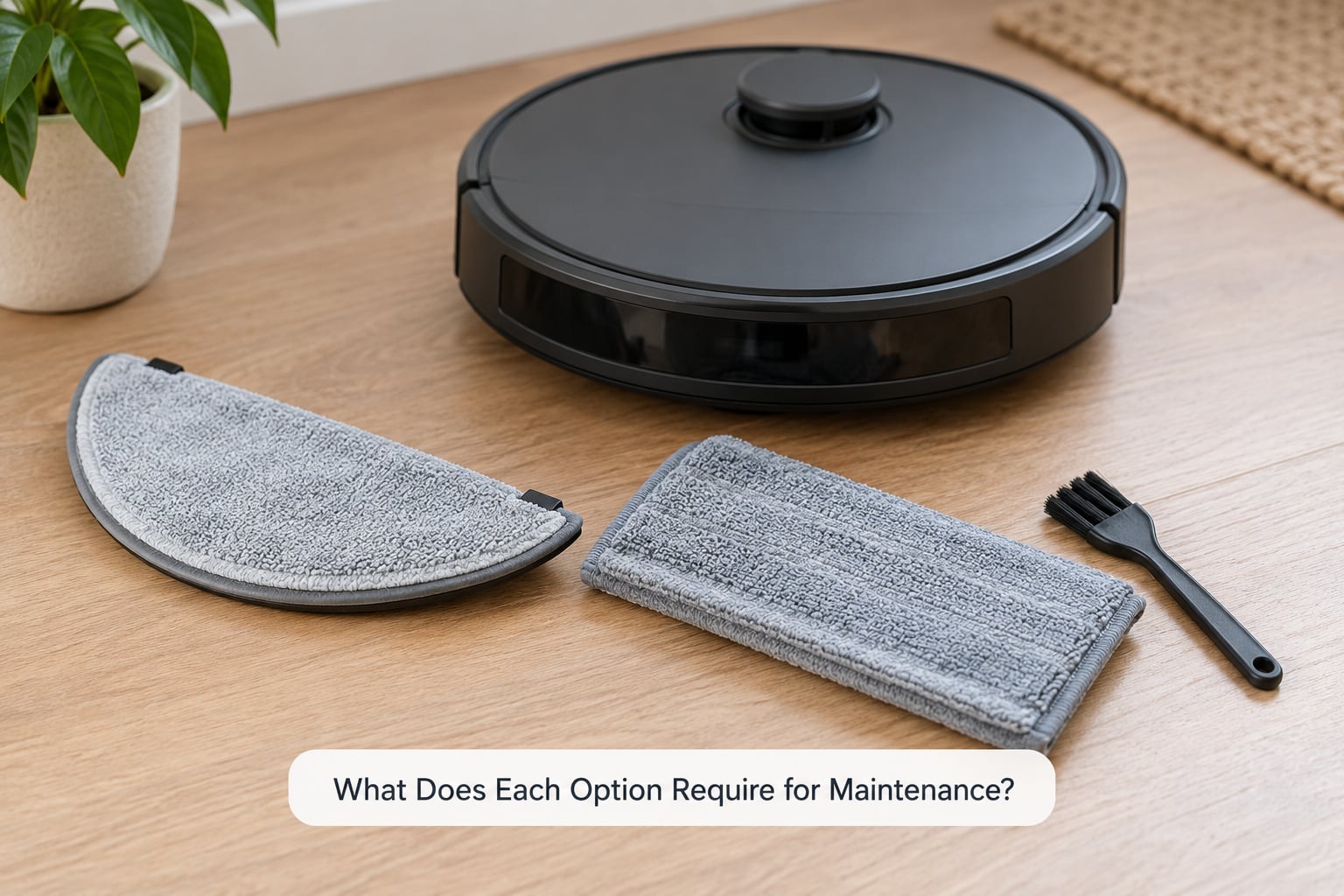
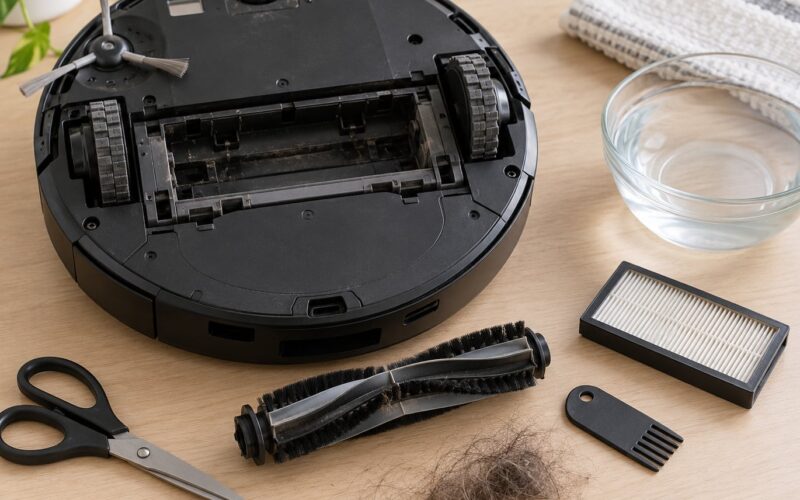
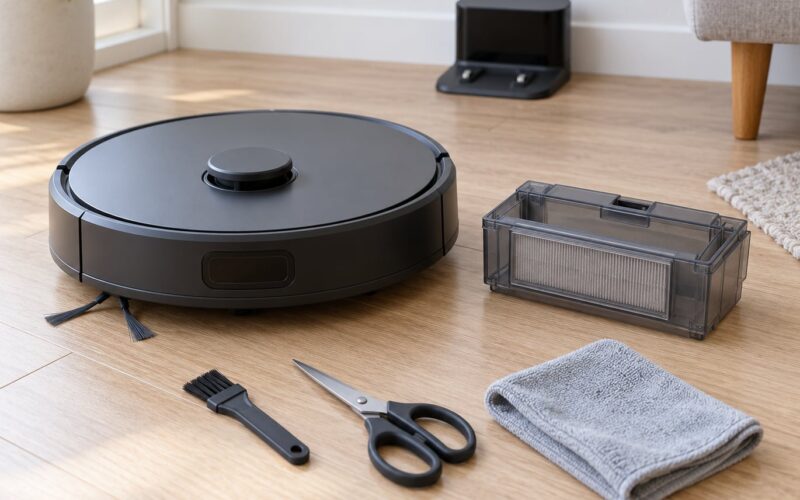
The robot’s weekly routine is short: empty the dirty water tank, refill the clean tank, take the pad out and rinse it under the tap, and wipe the filter roughly once a month. Base stations that wash the pad with hot water and then dry it with warm air remove most of that list, which is a bigger quality-of-life difference than any suction figure.
The manual routine is longer and wetter: empty the bucket, rinse the pad, wring it out, refill the spray bottle and mop head. It is the same motion repeated for every room, which is exactly why it gets skipped.
Drying is where robots earn their reputation, sometimes unfairly. A damp pad sitting in a closed tank for days grows bacteria and starts to smell, and the stale-mop smell that shows up within weeks of ownership is nearly always a drying problem rather than a hardware fault. Look for self-drying, and never leave a pad folded in a bucket overnight.
How Do Price and Long-Term Running Costs Compare?
Upfront, the robot combo is the expensive option by a wide margin, and a good flat mop with a bucket is close to nothing. Over three to five years, though, the gap narrows sharply, because the robot needs the same consumables a manual user does: mop pads every few months, a filter or two a year, and detergent if you use it.
Running costs for both are dominated by water and electricity, and neither is significant. The real difference is repair risk, which sits almost entirely with the robot, since a docked robot that fails is expensive to fix and the manual mop that fails is easily replaced.
Where budgets differ is total ownership, not consumables: you own a bag of dust, a tank of water and a machine that needs a place in the kitchen. Total cost depends entirely on the model you pick and how much you run it.
Robot Vacuum Mop vs Separate Mop: Which Should You Choose?
Choose a robot if your home is mostly sealed hard floor, you have pets or allergies, and the real problem is that nobody has time to clean daily. It wins on frequency, and frequency is what actually keeps a floor looking clean.
Choose a separate mop if you cook, if you have tile with grout, or if the annoyance that drives you is dried-on marks and the strip along the walls. It wins on pressure and placement, and no amount of scheduling changes that.
Choose both if you can. The routine that works for most people is a robot run two or three times a week to handle hair, crumbs and dust, plus a proper mop session once a week for the kitchen, the edges and the grout. That pairing gives you the robot’s consistency without giving up the one job a robot cannot do.
If you are still torn, three questions settle it: what share of your floors is carpet, how often something sticky hits the ground, and how much water is your flooring rated for. Carpet-heavy and sticky-mess-heavy homes should lean manual or vacuum-first; hard-floor-only homes should lean robot.
Frequently Asked Questions
Is a robot vacuum mop as good as mopping by hand?
For maintenance cleaning, yes. On sealed hard floors a robot removes dust, hair and light film on a schedule you would never keep by hand. For deep cleaning it is not equivalent, because the pad works under light downward pressure rather than your full weight. Dried-on stains, sticky spills and grout lines still need a manual mop.
Do robot vacuum mops clean sticky spills and dried stains?
Rarely on the first pass. Robot mopping works by wetting a pad and driving it across the surface, so a bonded stain gets spread thinner instead of lifted. A spill that happens right in front of the robot may even get run over. For anything sticky, spray a cleaner on the spot and use a flat mop, then let the robot handle it from there.
What is the best mop for tile and hard floors?
A flat microfiber pad on a spray mop is the most useful all-rounder for tile, vinyl plank and sealed concrete. It puts water where you want it, presses into grout, and fits into edges and corners. Keep a separate pad for the bathroom so you are not moving toilet residue across the kitchen, and change pads when they start to smell.
Are robot mops safe for wood floors?
Usually, on sealed hardwood, provided you keep the dampness setting low and check the flooring warranty. The risk is repeated moisture in the joints rather than one wet pass, since the robot rewets the same pad repeatedly. Set dampness to the lowest useful level, vacuum first so the pad is not dragging grit, and test in a hidden corner before a full run.
Is it worth buying both a robot vacuum and a separate mop?
For most homes with hard floors, yes. The robot covers frequency and hair pickup, the mop covers pressure, edges and grout. Splitting the jobs means neither chore gets skipped, and the robot keeps the floor clean enough between deep cleans that the weekly mop session is quick. In a small flat with no pets, a mop alone may be enough.
How often should mop pads be washed and replaced?
Rinse the pad after every run and wash it properly once a week, then let it dry completely with airflow before it goes back on. Swap a robot pad every two to three months, or sooner once it stays smelly or loses pickup. A manual pad usually lasts several months if you wash and dry it properly, and keeping two in rotation makes the weekly wash easier.
Conclusion
The cleaning difference comes down to pressure and frequency. A separate mop scrubs harder and reaches where a robot’s body cannot, while a robot keeps floors maintained daily without asking anything of you.
Start by checking your floor type, the messes you actually deal with, how much upkeep you are willing to do, and whether the budget stretches to a robot. If it does, run both on a schedule rather than picking one and hoping it covers the gaps.