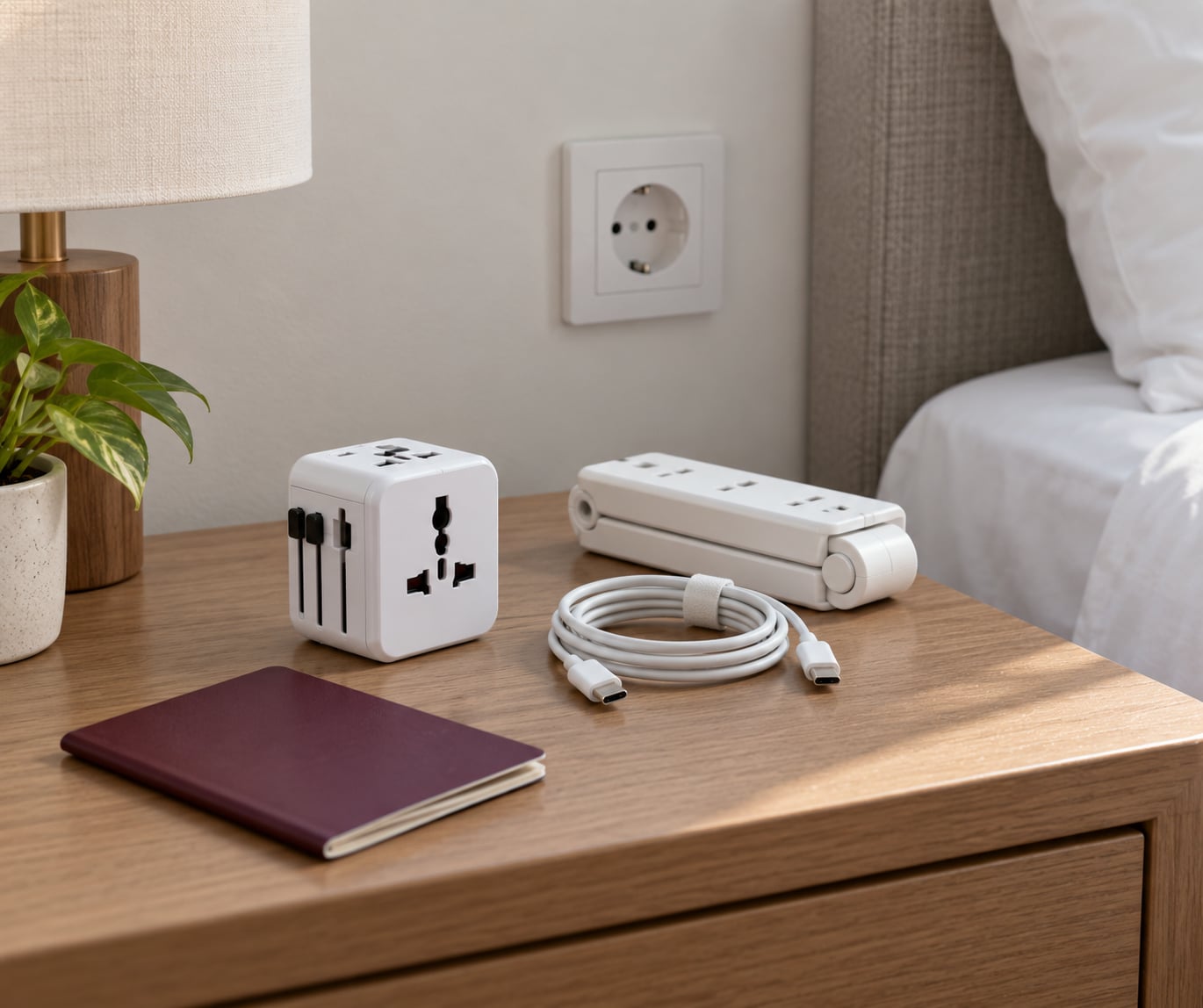
Most people asking how to safely use a travel adapter abroad only need one thing: a charger labelled Input: 100-240V, 50/60Hz. That range means the charger already handles every wall voltage in the world, so the adapter’s only job is to change the shape of the plug so it fits. Check the label, choose a certified adapter with a replaceable fuse, push it in firmly without forcing it, and never daisy-chain it or bury it under bedding.
What trips people up is treating plug shape and voltage as a single problem. They are two separate problems, and almost every traveller only has the first one. A plug adapter passes the local voltage straight through; it does not step it up or down. Only an appliance with a single voltage on its label, like a North American hair dryer, needs a real voltage converter.
The whole check takes about a minute per device, and doing it at home beats hunting for an electronics shop at the other end of a long flight. This guide walks through what to gather, how to use an adapter once you land, and the specific signs that mean you should unplug something immediately.
Table of Contents
- What You Need
- Step-by-Step: How to Safely Use a Travel Adapter Abroad
- Step 1: Check the plug type and voltage where you are going
- Step 2: Decide whether you need an adapter, a converter, or both
- Step 3: Check every device’s voltage and wattage requirements
- Step 4: Use the correct adapter and inspect it before plugging in
- Step 5: Connect devices in the safest order and monitor the setup
- Common Mistakes and Fixes
- Frequently Asked Questions
- What is the safest travel adapter?
- Can I use my American phone charger in Europe?
- Do I really need a voltage converter for Europe?
- Do universal travel adapters really work in every country?
- Why does my travel adapter get hot, and what if it sparks or smells burnt?
- Conclusion
What You Need
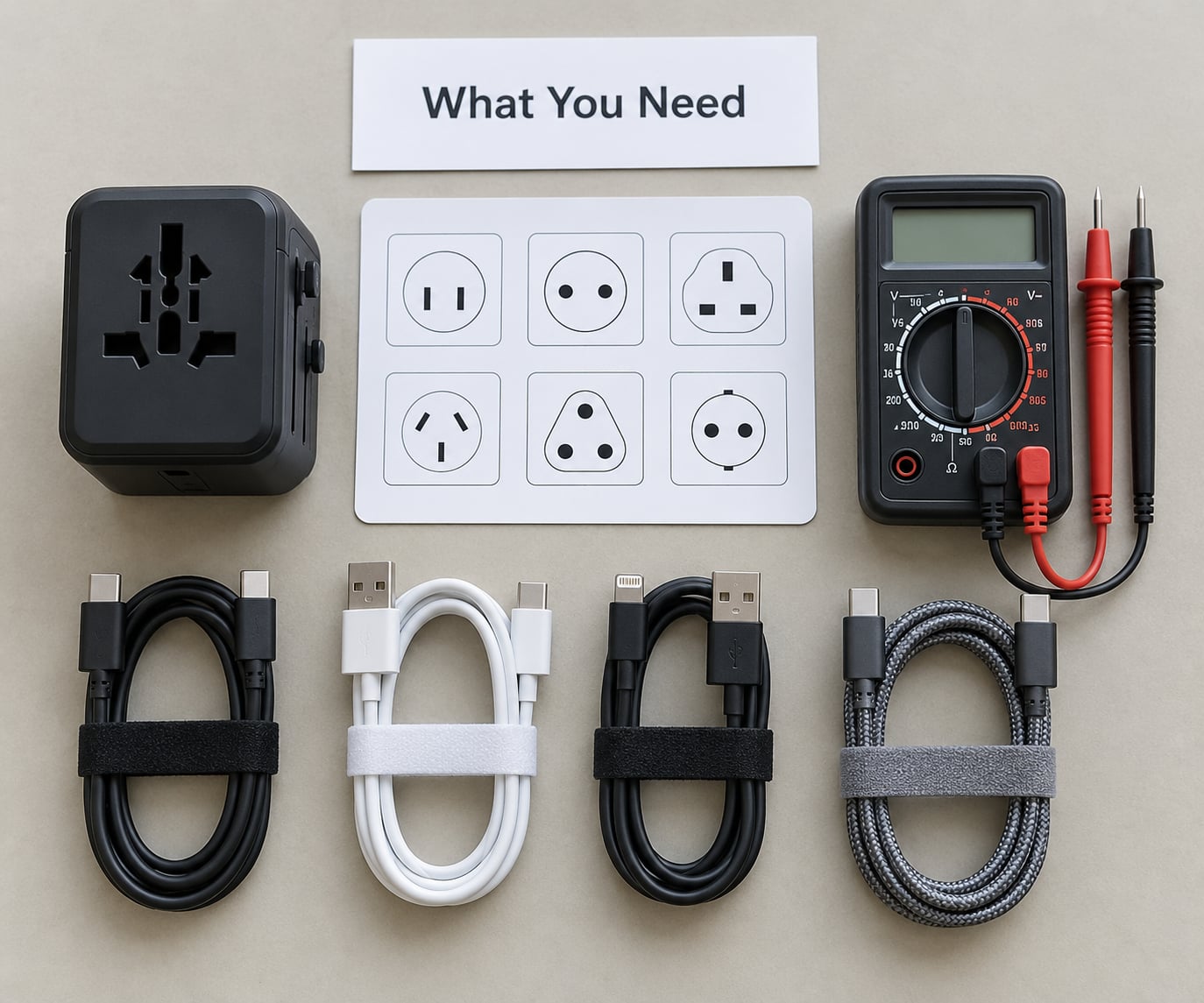
Gather five things before you pack, and the safety decisions mostly make themselves.
- The destination plug type. Look up the country on the IEC World Plugs reference, which is the same table most manufacturers use. Note the letter (Type A, C, E, F, G, I, J, K, L, M, N) and whether it has an earth pin.
- The local voltage and frequency. Most of the world runs 220-240V at 50Hz, North America runs 120V at 60Hz, and Japan sits at 100V with Type A plugs. Frequency matters less than voltage, but it is not irrelevant to motors and clocks.
- Each device’s input label. Every phone charger, laptop brick and camera charger has a tiny specification label on the body. You are looking for the word Input and the range after it.
- A plug adapter, or a plug adapter plus a voltage converter if you are packing a single-voltage appliance.
- The device’s power rating in watts, written on the same label, so you can add up a multi-device setup before you plug anything in.
Two optional extras earn their place. A short two-to-three metre extension cord solves the hotel problem where the only outlet is behind the bed or a heavy laptop brick slowly pulls the adapter out of a loose socket overnight. A plain (not surge-protector) power strip with a replaceable fuse lets you charge several devices from one wall socket, and long-term travellers on forums like the Rick Steves community reliably recommend exactly that combination.
What you should not pack is your US power strip. Grounded three-prong strips from North America do not work on European sockets without an adapter that accepts that pin, and many American surge protectors use components that do not belong on a 230V circuit. If you want a strip, buy a European one at your destination.
Step-by-Step: How to Safely Use a Travel Adapter Abroad
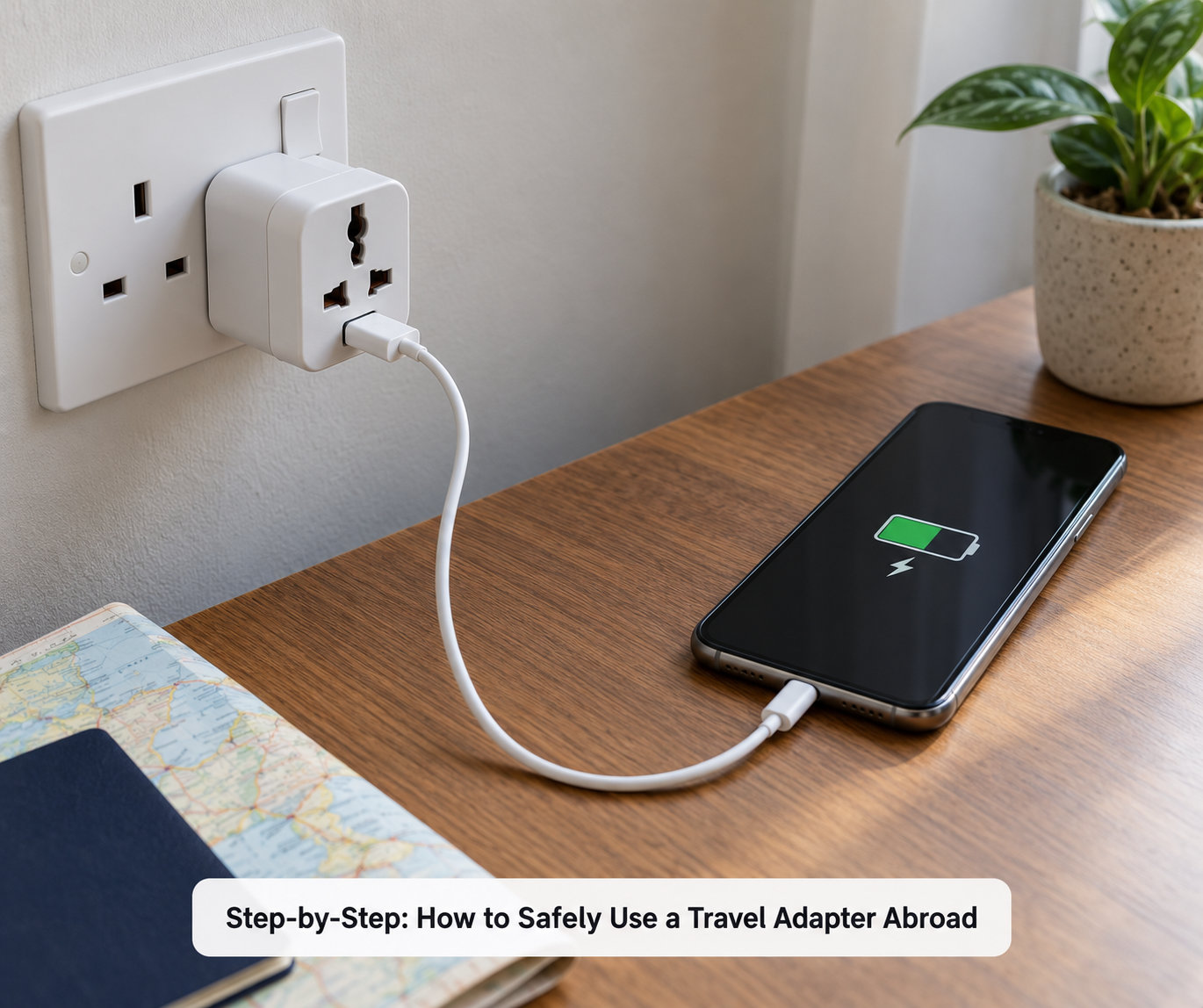
Step 1: Check the plug type and voltage where you are going
Start with the destination, not the adapter. Find the country on the IEC World Plugs chart and write down two things: the plug shape and the mains voltage.
This is where the tidy mental model breaks. A plug adapter that fits perfectly in a Lisbon socket is still useless in Tokyo if your charger says 100-127V, and a charger that works everywhere is still useless in Lisbon if your adapter only carries Type A pins. Shape and voltage are independent. Knowing one tells you nothing about the other.
| Region | Plug types you will meet | Watch out for |
|---|---|---|
| North America, Central America, Japan | Type A, Type B | Japan uses Type A at 100V; the plug fits but the voltage is not what a US device expects |
| Europe, UK, most of Africa, Asia | Type C, E, F, G | Type E and F earth clips need a socket that actually has a hole for them |
| India, Sri Lanka, Nepal | Type D, Type M | Round pins with wide spacing; plenty of cheap universal adapters do not cover them |
| South Africa, Lesotho, Namibia | Type N, Type M | Three large round pins, rarely included in all-in-one adapters |
| Switzerland, Liechtenstein | Type J | Three round pins in an offset triangle; an adapter rarely seats flat |
| Denmark | Type K | Earth pin sits in the middle of a triangle and can block other sockets in a strip |
| Italy, San Marino, Vatican City | Type L | Three round pins in a straight line, usually a three-in-one with Type C |
| Australia, New Zealand, China, Argentina | Type I | Angled pins; many adapters labelled universal silently lack this one |
For a multi-country trip, a good all-in-one adapter covering A, C, E, F, G and I plus a separate Type D/M/N/J/K/L unit covers almost everywhere. Photograph the label on the adapter before you leave so you can identify it in a dim hotel room.
Step 2: Decide whether you need an adapter, a converter, or both
A plug adapter is a passive plastic block that changes the shape of the plug. A voltage converter is an active box that steps electricity up or down. They solve different problems and only one of them is usually needed. Most of the confusion in how to safely use a travel adapter abroad starts at this exact fork in the road.
You need a converter only for appliances built for a single voltage, typically 110-120V: older hair dryers, curling and flat irons, some electric shavers, kitchen gadgets and the small charger base that came with an electric toothbrush. You do not need one for a phone charger, a laptop brick, a USB-C GaN charger, a camera battery charger or a modern toothbrush base, because all of those are dual voltage.
Converters have a wattage ceiling and they generate heat doing the conversion. A 1500W hair dryer already draws about 6.5 amps at 230V (watts divided by volts), which is why most travel adapters are simply not built for it. For heat tools, buy a dual-voltage model or use the hotel’s.
Step 3: Check every device’s voltage and wattage requirements
Turn each charger over and read the input line, not the output line. Output tells you what arrives at the device (5V, 9V, 20V), which is irrelevant to the wall. Input tells you what the charger will accept.
| What the input label says | What it means | What to do |
|---|---|---|
| Input: 100-240V, 50/60Hz | Dual voltage, works on both 110-120V and 220-240V | Plug adapter only, no converter |
| Input: 100-127V only | North American single voltage | Fine in 120V countries; use a converter or leave it at home elsewhere |
| Input: 220-240V only | Single voltage for Europe and much of Asia | Fine in 220-240V countries, wrong in the Americas and Japan |
| Only an output line, no input | Usually a USB power bank or a cable, not a mains charger | Check the maker’s specification page before assuming anything |
| No label at all | Unknown, and unknown is treated as single voltage | Do not plug it into a 230V socket until you can confirm it |
Then add up the watts. If a 65W laptop charger, a 45W phone charger and a small camera charger all share one adapter, check the adapter’s rating on its face. A part of the answer that catches people out on USB-C bricks is port power sharing: many multi-port chargers cannot deliver full wattage to every port at once, so a device may charge slowly or not at all when three are plugged in. Look for the total output figure, not the per-port figure.
Step 4: Use the correct adapter and inspect it before plugging in
Before the first plug-in of the trip, run through the adapter itself. It should have an independent safety mark printed on the body: CE in Europe, FCC in the United States, UL or ETL in North America. A brand that publishes a specification sheet is a reasonable proxy for a company that actually tests things.
Check for a visible fuse holder, ideally a replaceable cartridge type, and check the amp rating printed on the face. Look at the socket openings for safety shutters, and make sure the earth pin or clip lines up with the socket rather than being bent back to make it fit. Most importantly, push it in until it sits firm. A connector that wobbles or has to be held in place with tape will arc at the contact points, and arcing is the mechanism behind both the sparks people report and a lot of adapter fires.
Run a finger across the pins and the housing. Any adapter that feels warm, smells faintly of burnt plastic, or has scuffed, bent or discoloured contacts has already failed a test. That covers the market-stall adapter with no markings and the borrowed one from a friend, which are the two adapters most likely to have no meaningful safety testing behind them.
Step 5: Connect devices in the safest order and monitor the setup
Plug the adapter into the wall first, with nothing attached to it. Check that it is seated and does not move. Then connect your device, and only then switch anything on.
Watch the first minute. A working setup is uneventful: the adapter is the same temperature as the room, the device shows a charging symbol, and nothing smells unusual. A small spark at the moment of insertion in an older socket is common and usually harmless, caused by the brief arc as the contacts meet. A sustained smell, a discoloured faceplate, a socket that has gone dead, or an adapter that is too hot to hold comfortably is not normal. Unplug it immediately at the wall, not at the device end.
Keep the setup in the open. Heat builds up when an adapter sits under bedding, behind a nightstand, inside a bag on a shelf, or wrapped in clothing overnight, which is exactly how a sleeping bag or a pile of jumpers ends up on top of a charging phone. Store spares dry and away from condensation; a damp adapter in a hotel bathroom is a bad combination. And do not chain a plug adapter into the end of another adapter, a multi-plug, or a surge-protector power strip: each hop adds a joint that heats up, and the whole chain is then running past the rating of the weakest link in it.
For mains-powered medical equipment such as a CPAP machine, bring the manufacturer’s spec sheet and confirm the device is rated for the local voltage before the first night. Frequency differences of 50Hz versus 60Hz rarely matter for electronics, but they do slow down motors, some hair dryers and older clocks.
Common Mistakes and Fixes
These are the errors that show up again and again, in airports and in forum threads, and each one has a concrete fix. Knowing how to safely use a travel adapter abroad is mostly about sidestepping all eight of them.
- Assuming a plug that fits is a plug that is safe. Japan, South Korea and Taiwan use Type A at 100V, so a US charger will slide straight in and then be fed roughly double the voltage it expects. Fix: read the input label, not the socket shape.
- Packing a converter you do not need and skipping the one you do. A 300W converter in the bag is wasted space; the Type G adapter you skipped is the reason you are buying one at the airport. Fix: decide from the input labels before you pack.
- Running a high-wattage appliance through an adapter. A 1500W hair dryer at 230V pulls roughly 6.5 amps, and a kettle or a space heater pulls more, on a component usually rated for phones and laptops. Fix: plug heat tools straight into the wall, or use a dual-voltage model.
- Buying an uncertified adapter because it was in the airport queue. No mark, no fuse, no specification sheet, a loose fit, and a surface that feels warm while idle. Fix: if it has no safety mark and no rating, leave it.
- Ignoring heat, scorch marks or a burning smell. People post about adapters running hot in r/koreatravel and r/videography threads because they are unsure whether it is normal. Mild warmth under load is expected; a smell or a discoloured plastic face is not. Fix: unplug it and use a different adapter.
- Using wet, cracked or damaged equipment. A cable with a bare conductor or a plug with a bent pin can short the socket. Fix: if you would not trust it at home, do not plug it in abroad.
- Covering the adapter or blocking its ventilation. Fix: keep it in open air, on a hard surface, and visible overnight.
- Overloading a single adapter with a laptop, three phones and a camera. Fix: add a second adapter or a plain fused power strip rather than stacking more devices on one.
If a device will not charge abroad, work down this list: confirm the socket itself is switched on, since many hotel bedside outlets are controlled by the room switch; reseat the adapter and push it fully home; try the device in a different outlet to rule out a dead circuit; check the charging cable is seated at both ends; and confirm the adapter’s output matches the device’s required input, which is where a 5V-only brick fails to charge a USB-C phone that wants 9V or 20V.
Frequently Asked Questions
What is the safest travel adapter?
The safest travel adapter is one with an independent safety mark (CE, FCC, UL or ETL), a built-in replaceable fuse, safety shutters over the socket openings, a firm non-wobbling fit in the wall outlet, and grounding support for three-prong devices. For phones, laptops and cameras, a reputable flat two-prong adapter rated 100-240V is plenty. Avoid unbranded adapters with no certification mark, no fuse and no printed rating.
Can I use my American phone charger in Europe?
Almost certainly yes. Nearly all modern phone chargers, laptop bricks and USB-C GaN chargers are labelled Input: 100-240V, 50/60Hz, which means they handle both 120V and 230V. You only need a Type C/E/F or Type G plug adapter to fit the socket. The one exception is an old wall wart for a landline phone or a very cheap replacement charger, so check the label before you leave.
Do I really need a voltage converter for Europe?
For most devices, no. Europe runs at 220-240V, so only single-voltage appliances built for 110-120V need one: older hair dryers, flat and curling irons, some electric shavers, and a few kitchen gadgets. Anything reading 100-240V works with a plug adapter alone. Running a 120V-only appliance on 230V without a converter will destroy it and can trip a breaker.
Do universal travel adapters really work in every country?
They cover the common shapes, not every shape. Most all-in-one adapters handle Types A, C, E, F, G and I. They frequently miss Type D and M in India, Type N in South Africa, Type J in Switzerland, Type K in Denmark and Type L in Italy. Check the printed type list on the adapter itself rather than trusting the word universal, and carry a small country-specific unit for the awkward one.
Why does my travel adapter get hot, and what if it sparks or smells burnt?
Mild warmth at the plug while a device is charging is normal, because some power is lost as heat at the contacts. Heat that is uncomfortable to hold, plus a burning smell, discoloured plastic, a dead socket or sparks that continue after the first insertion, are not normal. Unplug it at the wall straight away, stop using that adapter, and move to a certified replacement. Sparks on first insertion in an old socket are usually just the contacts arcing as they meet.
Conclusion
Start with the destination, not the adapter: note the plug type and local voltage, then read the input label on every charger you are packing. Anything reading 100-240V needs nothing more than a certified plug adapter with a replaceable fuse and a firm fit.
Save the converters for single-voltage appliances, keep the setup uncovered and visible, and unplug at the wall the moment you notice a burning smell, discolouration or heat you cannot hold. Do those three things and learning how to safely use a travel adapter abroad stops being a worry you carry through every border crossing. Last reviewed in 2026, and check the IEC World Plugs reference for any country on your list.