Learning how to ride an electric scooter safely in traffic comes down to four things: ride where you are legal, stay where drivers can see you, keep a speed you can stop from, and get off the scooter when a situation stops making sense. The scooter itself is the easy part. Cars, doors, junctions and wet metal are what hurt people.
I have commuted on small electric scooters for years, mostly through city streets with no protected lane, and the habits that keep me upright are boring and repeatable rather than clever. None of them require you to be fast. All of them require you to decide early, because a scooter has no crash protection and small wheels find every pothole.
One thing to say up front: e-scooter law varies by country, state and city. What follows is general guidance, not legal advice, and your local rules always win.
Table of Contents
- What You Need
- Equipment
- Route and legal checks
- Wet weather, night and fast roads
- Step-by-Step: How to Ride an Electric Scooter Safely in Traffic
- Step 1: Check the Scooter Before You Leave
- Step 2: Choose a Safer Route
- Step 3: Take Control at the Start
- Step 4: Hold a Predictable Position in Traffic
- Step 5: Handle Intersections, Crossings and Hazards
- Step 6: Slow Down, Brake and Dismount
- Common Mistakes Riders Make in Traffic
- Riding too fast for the space available
- Weaving between moving cars
- Using headphones or looking at a phone
- Ignoring blind spots
- Relying on the brake light alone
- Treating a sidewalk as unrestricted
- Carrying a passenger or heavy cargo
- Riding on a phone call or in a group bunched together
- Charging care
- Frequently Asked Questions
- Are electric scooters legal on sidewalks?
- Can an electric scooter go on the highway?
- Do I need a licence, registration or insurance to ride an e-scooter?
- Should a 12 year old have an electric scooter?
- Is riding an e-scooter in the rain and at night safe?
- What should I do if I am hit while riding an e-scooter?
- Conclusion
What You Need
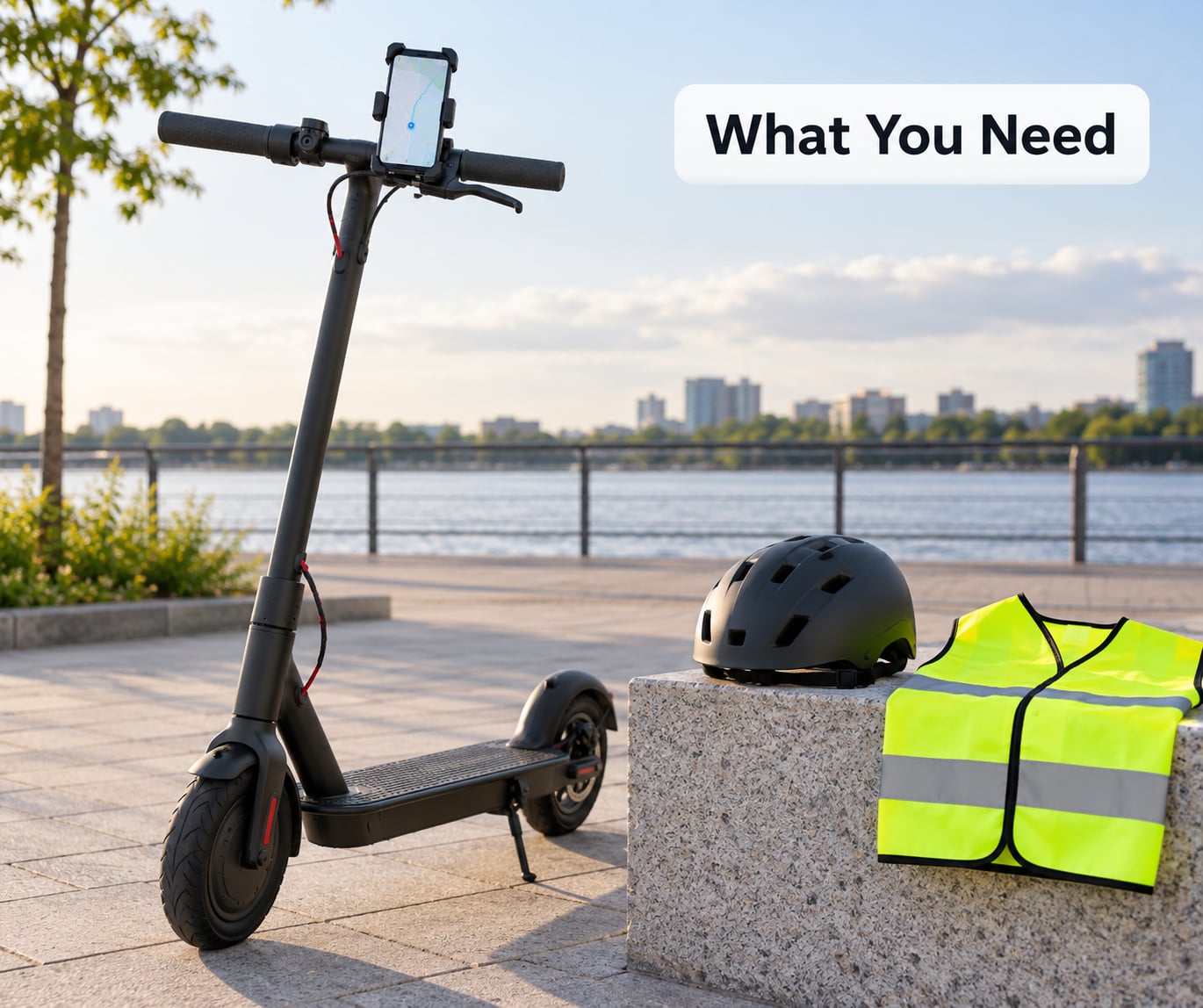
You need a scooter in roadworthy condition, a certified helmet, visible clothing, a route you have already thought about, and a clear understanding of what class of vehicle you are. Get those right and the rest of this guide is technique.
Equipment
- Scooter condition. Dual braking (a lever on the handlebar plus a fender or disc brake) is worth having on any road with real traffic. Regenerative braking helps but does not replace a friction brake.
- Front and rear lights. A light works two ways: it helps you see and it helps you be seen. A single bright headlight is not enough, because drivers mostly see you in mirrors and out of the corner of an eye.
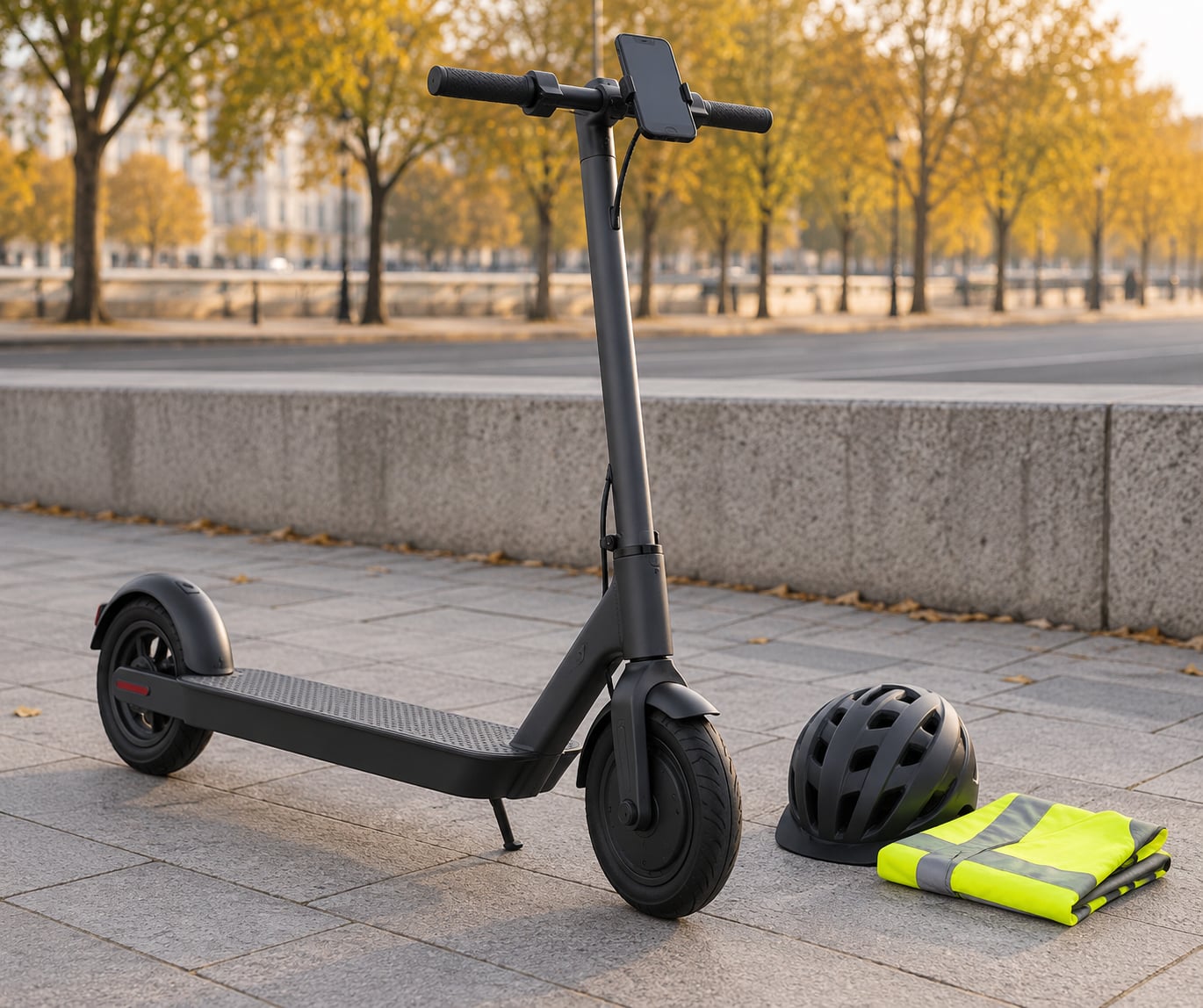
- Retroreflective strips or a high-visibility vest. A headlight beam disappears on a dark road. Reflective material throws light back from someone else’s headlights, which is the light that actually reaches their eyes.
- Certified helmet. Look for a certification mark such as CPSC or EN 1078, and a helmet that fits level and snug rather than tipped back. Replace it after a real impact.
- Gloves, closed-toe shoes, optional knee and elbow pads. Gloves matter more than people expect, because bare hands slip on the levers in the wet and on a fall.
- Bell or audible signal. Pedestrians and cyclists come out of a side path without checking behind them.
- Phone in a secure handlebar holder. Only if you take calls or navigation hands-free. Nothing else.
Route and legal checks
Before you ride, check what speed class your scooter falls into. Lightweight scooter-type vehicles and pedal cycles are treated very differently from mopeds or motor vehicles, and the class decides your speed cap, minimum age, helmet duty and whether you need a licence, registration or insurance. Many cities cap this class at 15 mph (about 25 km/h) for shared and private scooters alike, and many require riders under a certain age to stay off motor roads.
Check three things: the maximum speed you are allowed, whether your route has a cycle lane or shared path, and whether sidewalk riding is permitted where you are. Note the answer, because the rules differ block by block in some cities.
Wet weather, night and fast roads
Wet weather needs a slower speed, more following distance and a route with fewer painted lines and metal covers in it. Night riding needs a lit route, two working lights and reflective gear; an unlit road at walking pace is often the smarter choice. Fast roads with no lane are the case to simply avoid, whatever your scooter’s top speed is.
Step-by-Step: How to Ride an Electric Scooter Safely in Traffic
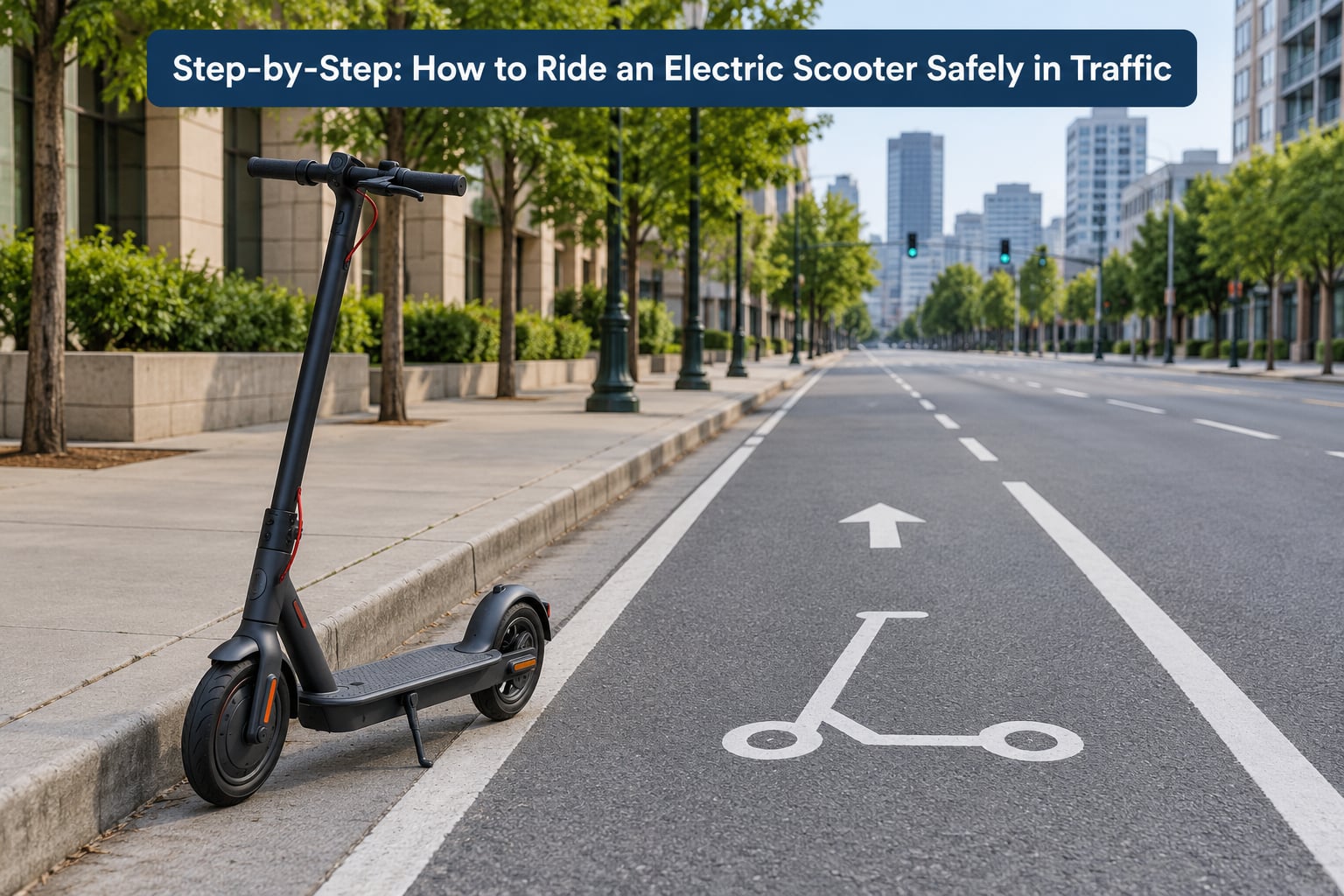
Ride defensively in six stages: inspect, route, launch, position, negotiate conflicts, brake. Most crashes happen in stages four and five, where the rider is moving and a car is deciding something at the same time.
Step 1: Check the Scooter Before You Leave
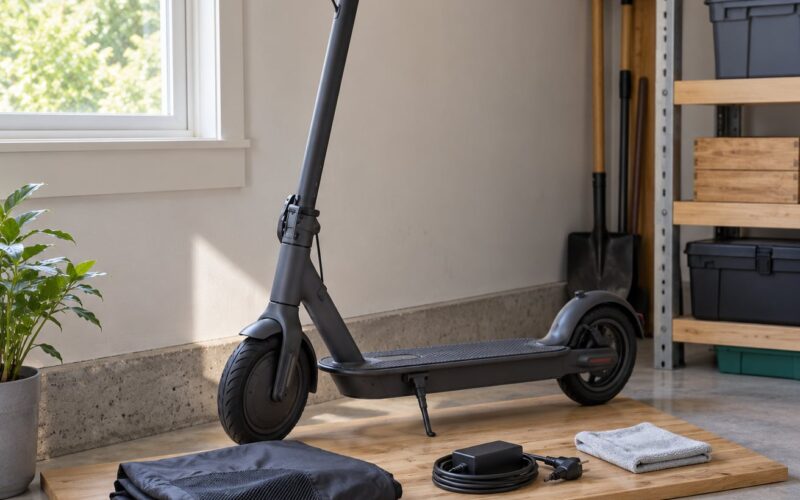
Check the scooter before you leave by working around it in a circle, and allow yourself two minutes. Squeeze the brake lever and confirm it feels firm and does not pull the lever to the bar. Press the brake fender or disc and confirm the wheel slows. Spin each wheel and look for cuts, embedded grit or a low tyre.
Then check the rest: stem and handlebar bolts tight, deck and grip tape intact, kickstand fully up, front wheel centred and tracking straight, no loose or flashing fault light, and the battery charged enough for the trip plus a margin. Turn the lights on. Bell, both brakes and throttle in turn.
How do you know it passed? Push it a short distance in a clear space and it rolls straight, brakes evenly and makes no rattling or grinding. If the brake lever feels spongy, the wheel wobbles or a fault light is on, do not ride it into traffic. A morning brake-and-light check takes two minutes, and experienced commuters treat it as non-negotiable for exactly this reason.
Step 2: Choose a Safer Route
Choose a safer route by preferring, in order: a separated cycle track, a protected cycle lane, a quiet residential street, then a busier road with a painted lane. A painted lane with a buffer of parked cars is a real improvement over nothing; a painted lane with a fast road alongside it is where you will be passed at speed differences you cannot control.
Avoid multi-lane roads without a lane, high-speed roads, and any junction where a whole line of cars turns across your path. If two routes are similar, take the one with fewer turns and fewer driveways, because each one is a place a car can appear in front of you.
Step 3: Take Control at the Start
Take control at the start by standing beside the scooter first, both feet on the ground, then lifting one foot and swinging it across. Hold the bar with both hands, thumbs around the grips, index fingers resting on the brake lever. Knees slightly bent absorbs bumps; locking your knees does not.
Before you accelerate, look behind you over your shoulder and check to each side, because at walking pace a scooter has no mirrors worth trusting. Signal with an outstretched arm, not a hand signal borrowed from cycling, since a scooter handlebar makes the cycling signal awkward and easy to misread.
Accelerate smoothly to a speed you could hold for the whole block, and keep both hands on the bar. If you cannot hold the bar with one hand to signal, your speed is fine and your technique is not; slow down and signal properly.
Step 4: Hold a Predictable Position in Traffic
Hold a predictable position in traffic by riding straight, in the correct lane, in the direction of travel, at a steady speed. Predictability is what makes you easy for a driver to read, and reading is what prevents side-swipe collisions.
Stay at least 1.5 m (about 5 ft) from parked cars, or about a metre for a rider moving faster. That gap is the door zone, the strip a car door swings into, and a door opening into your path is the single most common near miss riders describe. If a cycle lane puts you inside a line of parked cars and you cannot hold 1.5 m, move out into the live lane and signal first.
Keep your speed near the traffic around you rather than well under it. Riding at 10 mph (16 km/h) in a 30 mph lane repeatedly invites drivers to pass close. Match the flow, hold your line, and avoid weaving.
Step 5: Handle Intersections, Crossings and Hazards
Handle intersections, crossings and hazards by slowing early and deciding before you arrive, not at the point of conflict. Slowing is what gives you a second look and an escape route.
- Intersections. Slow on approach and look right, then left, then right again. Watch specifically for vehicles turning across your path and for anyone edging forward despite the light. Turning cars are the hazard riders fear most, and eye contact matters: if the driver does not see you, assume they have not seen you.
- Turns and roundabouts. Signal, move toward the correct side only if it is safe to do so, and never take a turn so tight that a lorry can clip your rear quarter. Roundabouts work best if you enter at a steady speed and take the lane a cyclist would take.
- Marked crossings. Dismount and walk the scooter across. Crossing on the scooter in a car lane feels faster and is the moment a turning car expects you least.
- Buses and trucks. Stay out of the blind spot beside a large vehicle. A bus pulling out of a stop, a lorry turning left across a lane, and a car reversing are all cases where you are genuinely invisible.
- Pedestrians. Slow to walking pace around anyone on foot, pass on the side you are legally required to use, and ring your bell well before you pass rather than after.
- Surface hazards. Small wheels drop into potholes that a car would barely notice. Metal drain covers, painted lines, tram rails, manhole covers, sand and wet leaves are all slick. Cross these square-on, standing, and without turning the bars mid-manoeuvre. Rough surfaces, grit and drainage are the same cluster of complaints on every route without a proper lane.
Step 6: Slow Down, Brake and Dismount
Slow down, brake and dismount by remembering that you need more stopping distance than you expect, because a scooter is a small target travelling at a low speed next to much heavier vehicles. Braking is progressive: ease pressure on the lever, shift your weight slightly back, keep both hands on the grips, and never grab the front brake hard on a slippery surface.
For an emergency stop, squeeze the lever firmly with both hands, keep the bar straight, and lower your body. If you must stop very fast, brake and put a foot down rather than sliding sideways into a car door.
Get off and walk whenever you are uncertain: an unfamiliar junction at night, a road surface you cannot read, a crowd spilling across the lane, a driver visibly angry and closing in, or a lane that has narrowed into a squeeze. Walking takes seconds. Dismounting through heavy traffic is the habit that most reliably keeps riders uninjured, because a rider on foot is a person a driver expects to be there.
Common Mistakes Riders Make in Traffic
Most of the dangerous riding habits I see are attempts to feel faster or more in control than the situation allows. Each one has a simple correction.
Riding too fast for the space available
Speed feels safe while the road is empty and expensive when it is not. Fix: set a speed you could hold for a full block, and drop it further on a road with driveways and parked cars.
Weaving between moving cars
Each lane change puts a solid object on both sides of you at a speed difference you do not control. Fix: hold your lane, hold your speed, and only move when there is clear space ahead and behind.
Using headphones or looking at a phone
You lose the one sense that tells you a car is there. Fix: one earbud at most for audio, and the phone in a mount for navigation, not for anything you read.
Ignoring blind spots
Staying visible does not mean being in the mirror. A car’s blind spot beside the front door, the space directly behind a reversing vehicle, and the arc a turning wheel sweeps are all places you disappear. Fix: stay out of them, and assume anything hidden behind a large vehicle is a moving hazard until you have seen it pass.
Relying on the brake light alone
A dim rear light at dusk is not a safety system. Fix: a proper rear light plus reflective material, on all the time you ride, not just after dark.
Treating a sidewalk as unrestricted
Riding a scooter along a footway at traffic speed is dangerous for pedestrians and illegal in many places, and the crowds and blind corners there are their own hazard. Fix: follow local rules, slow to walking pace around people, and use a footway as a slow shared space rather than a road substitute.
Carrying a passenger or heavy cargo
A second rider changes braking distance, steering balance and the weight limit, and many scooters are not rated for it. Fix: one rider, keep the load low and close to the deck, and leave extra stopping room.
Riding on a phone call or in a group bunched together
Both reduce your reaction time and, in a group, hide the lead rider’s hazards from everyone behind. Fix: ride single file, keep a following gap of a few seconds, and let faster riders pass with a signal.
Charging care
Battery problems come from heat, water and unattended charging, not from traffic. Fix: charge on a hard, dry surface away from combustible material, keep the charger dry, and do not ride a scooter with a swollen, damaged or wet-charged battery.
Frequently Asked Questions
Are electric scooters legal on sidewalks?
It depends entirely on your city, and the answer changes block by block in some places. Many jurisdictions prohibit riding any scooter on a footway, others allow it at walking pace only, and a few exclude only the faster classes. Where it is allowed, pedestrians still come first. Check your local transport authority or council rules before you ride, and treat the footway as a shared slow space rather than a road replacement. If the law is unclear where you are, the road with a low speed limit is the safer legal choice.
Can an electric scooter go on the highway?
No, in most jurisdictions. Highways and motorways are typically restricted to motor vehicles, and this class of scooter does not meet the performance, braking or crash-protection standards those roads assume. Even where a fast e-scooter might be classified as a moped, motorway entry is usually barred. Roads with posted speeds well above your scooter’s realistic speed are a bad idea regardless of the legal wording, because the speed difference is the danger, not the sign.
Do I need a licence, registration or insurance to ride an e-scooter?
For light scooter-type vehicles and pedal cycles, usually no licence and no registration, though helmets and minimum ages often apply. Faster models may be classed as mopeds, which can require registration, a licence, insurance and a helmet. Your insurance may also cover you while riding a private e-scooter as a bicycle, or exclude it entirely, so check with your provider. After a crash, your motor policy may not respond at all, which is why documenting the scene matters.
Should a 12 year old have an electric scooter?
Only with the right conditions. Many cities set a minimum age for riding this class in traffic, often 14 or 16, and require a helmet regardless. A 12-year-old on a fast road in traffic is a small target with no crash protection. If a child rides, keep the speed class low, use a closed route with no main roads, make the helmet non-negotiable, and never let two children share one scooter. Check the local minimum age before anything else, because it may settle the question for you.
Is riding an e-scooter in the rain and at night safe?
It is manageable but it removes your margin. Water reduces braking grip and makes metal drain covers, painted lines and manhole covers slick, so slow down and cross those square-on. Riding at night needs a lit route, a working front and rear light, and reflective clothing, because a headlight alone does not make you visible in mirrors. Riders report that unlit roads are the real danger, not darkness by itself. If the route is dark, wet and busy, take another route or take transit.
What should I do if I am hit while riding an e-scooter?
Get out of the traffic first if you can move, and do not move if you suspect a spine, neck or head injury. Call emergency services for loss of consciousness, confusion, vomiting, worsening headache, drowsiness, slurred speech, blurred vision or weakness, and get medical advice after any head impact even if you feel fine. Note the time, take photographs of the vehicles, lane and signage, exchange details, and report the collision to the police where your law requires it. Keep the scooter and the driver’s insurance details for the claim.
Conclusion
Before every ride, do the same four things. Check the brakes, tyres, lights and bolts, and confirm the battery and steering are sound. Pick a route with a protected lane or a low speed limit, and drop it if it needs a main road. Ride at a speed you can stop within, hold a straight line 1.5 m clear of parked doors, and slow early at every junction. And stay visible, predictable and ready to get off and walk. If you can ride an electric scooter safely in traffic anywhere, it is a route with those four answers, not a scooter with more power.