Electric scooter range is simply energy supply divided by energy demand. Your battery stores energy in watt-hours, and your speed, body weight, hills, wind, temperature and riding style decide how fast that energy gets spent. Because air resistance climbs steeply with speed, a scooter that advertises “up to 40 miles” usually delivers somewhere between 24 and 32 on a real commute.
That gap is the single most common source of frustration on scooter forums, and most of it comes down to conditions, not defects. Riders on r/ElectricScooters regularly post measurements showing 60 to 75 percent of the advertised figure on flat urban routes, and heavier riders with backpacks self-report closer to 50 percent. This guide explains where every one of those miles goes, and how to find out which factor is eating yours.
Table of Contents
- What Does Electric Scooter Range Actually Mean?
- How Is Electric Scooter Range Measured?
- Electric Scooter Range Explained and What Reduces It
- Rider Weight and Cargo
- Speed and Acceleration
- Terrain, Hills, and Wind
- Tire Pressure and Wheel Condition
- Battery Age, Charging, and Temperature
- Firmware, Power Modes, and Battery Settings
- Maintenance Problems That Quietly Reduce Range
- How to Test Your Scooter’s Real-World Range
- How Much Range Should You Expect?
- Frequently Asked Questions
- Why does my electric scooter’s range drop so much after a few months?
- Does a heavier rider always reduce the advertised range?
- Is it normal for an electric scooter to lose range when going uphill?
- Should I charge the battery to 100% before every long ride?
- What tire pressure should I use to get the best electric scooter range?
- Can eco mode double the real-world range of an electric scooter?
- Conclusion
What Does Electric Scooter Range Actually Mean?
Range is the distance a scooter covers on a single full charge, measured in miles or kilometers. Manufacturers publish it as “up to” a number, which is the best result they can document under controlled conditions, not a promise about your Tuesday morning ride.
Entry-level scooters are typically advertised at 15 to 25 miles. Mid-range models sit at 30 to 50, and long-range models claim 60 or more. Those bands are useful for comparing products but useless for planning, because every one of them assumes a light rider, flat ground and gentle speed.
One clarification worth making early: advertised range is always one-way. Riders routinely misread “up to 30 miles” as a round-trip figure and end up walking home. Size for the round trip and you will never be caught out.
How Is Electric Scooter Range Measured?
There is no single industry standard for scooter range testing, and no independent certification body audits the numbers. What you are looking at is a manufacturer’s own internal test, and the conditions usually look like this:
- A test rider weighing around 165 lb (75 kg), sometimes as light as 130 lb
- Flat, smooth pavement with no stops
- The lowest riding mode, often eco or an energy-saver setting
- A steady 15 mph rather than anything near top speed
- Mild temperature, ideally near 70F and no headwind
Rider weight in the range 130 to 165 lb is the number experienced owners consistently agree on when they reverse-engineer published figures. The conditions never match a commute with traffic lights, a crosswind, or a hill halfway home. That mismatch, not battery quality, is what makes the advertised number feel inflated.
Electric Scooter Range Explained and What Reduces It
Energy in equals distance out. The battery supplies watt-hours, and everything you do on the scooter consumes them. To calculate a rough figure yourself, multiply battery voltage by amp-hours: a 48V 15Ah pack gives you 720 watt-hours. Then divide by real-world consumption of roughly 20 to 30 Wh per mile on flat ground at moderate speed.
That gives about 24 to 36 miles for a 720Wh pack under commuting conditions. The ranked list of what shaves it down further, biggest impact first:
- Riding fast — the single largest variable, and the one riders most often underestimate
- Hills and elevation gain — typically a 30 to 50 percent hit on a hilly route
- Cold weather — a 20 to 30 percent drop once temperatures fall below 50F
- Extra rider weight or cargo — 10 to 25 percent for heavier riders carrying a backpack
- Stop-and-go traffic — repeated hard acceleration from a standstill
- Dual motor models — both motors drawing power instead of one coasting
- Underinflated tires — more rolling resistance on every rotation
- Headwind — air resistance is felt from the front, so a tailwind genuinely helps
- A worn battery — the slowest of all, but the hardest to notice
Compare scooters on watt-hours rather than advertised miles. Watt-hours is a verifiable number printed on the battery label; the miles are a marketing calculation that each company performs slightly differently.
Rider Weight and Cargo
Yes, a heavier rider reduces range, but not for the reason most people assume. The extra mass doesn’t mainly cost you energy on flat ground. It costs you on every acceleration, every hill, and every start from a stop.
Think of it this way: to roll a 45 lb scooter plus 200 lb of rider down a flat street at a steady 15 mph takes almost no extra energy. But getting both moving from a standstill takes noticeably more, and that gap repeats at every red light. Add a backpack with a laptop, and now you’re launching 15 extra pounds into motion several dozen times a day.
Riders heavier than the test weight, or anyone carrying a full backpack, should plan on 10 to 25 percent less than the advertised number. That matches what owners report in practice.
Speed and Acceleration
Speed matters more than anything else, because the aerodynamic drag on your body and the deck rises steeply as you go faster. Double your speed and the air you’re pushing through doesn’t just double, it multiplies several times over. Riders frequently describe the relationship as nonlinear, and they’re right.
Using a 720Wh pack, here’s roughly what the same ride costs at different average speeds on flat pavement:
| Average speed | Energy used per mile | Realistic range on 720Wh |
|---|---|---|
| 15 mph | 20 to 25 Wh | 29 to 36 miles |
| 20 mph | 28 to 35 Wh | 21 to 26 miles |
| 25 mph | 40 to 50 Wh | 14 to 18 miles |
| 30 mph | 55 to 70 Wh | 10 to 13 miles |
That is the whole reason range and speed trade against each other. Covering the same three miles at 25 mph burns roughly twice what it does at 15 mph.
Acceleration matters too, though less than top speed. A smooth roll-out from a light instead of a full-throttle launch saves real energy across a city commute full of stops. You don’t need to crawl at 12 mph the whole way, just ease off the throttle between lights and hold a steady pace where you safely can.
Terrain, Hills, and Wind
Flat ground is the friendly case, and every hill you climb is energy you will never get back on the way down unless the scooter has regenerative braking. A route with genuine elevation gain can cost you 30 to 50 percent of your range.
Rough surfaces add a second cost. Cracked pavement, gravel paths and grass force the tires to deform repeatedly, and that rolling resistance is paid over and over. Bike paths and smooth asphalt are meaningfully kinder to a battery than a canal towpath.
Wind works the same way air resistance does, except you don’t choose it. A steady headwind on a bridge can feel like the scooter is dragging; a tailwind gives some back. This is why riders who commute the same route at the same speed notice the gauge draining differently across the year.
Regenerative braking recovers roughly 5 to 10 percent in stop-and-go riding, and more on long descents, but it is not a substitute for capacity. Treat it as a small bonus rather than a range strategy.
Tire Pressure and Wheel Condition
Underinflated tires are the cheapest range loss to fix. Soft tires deform more with every rotation and waste energy as heat, and on a scooter the effect is noticeable within a mile or two of correct pressure.
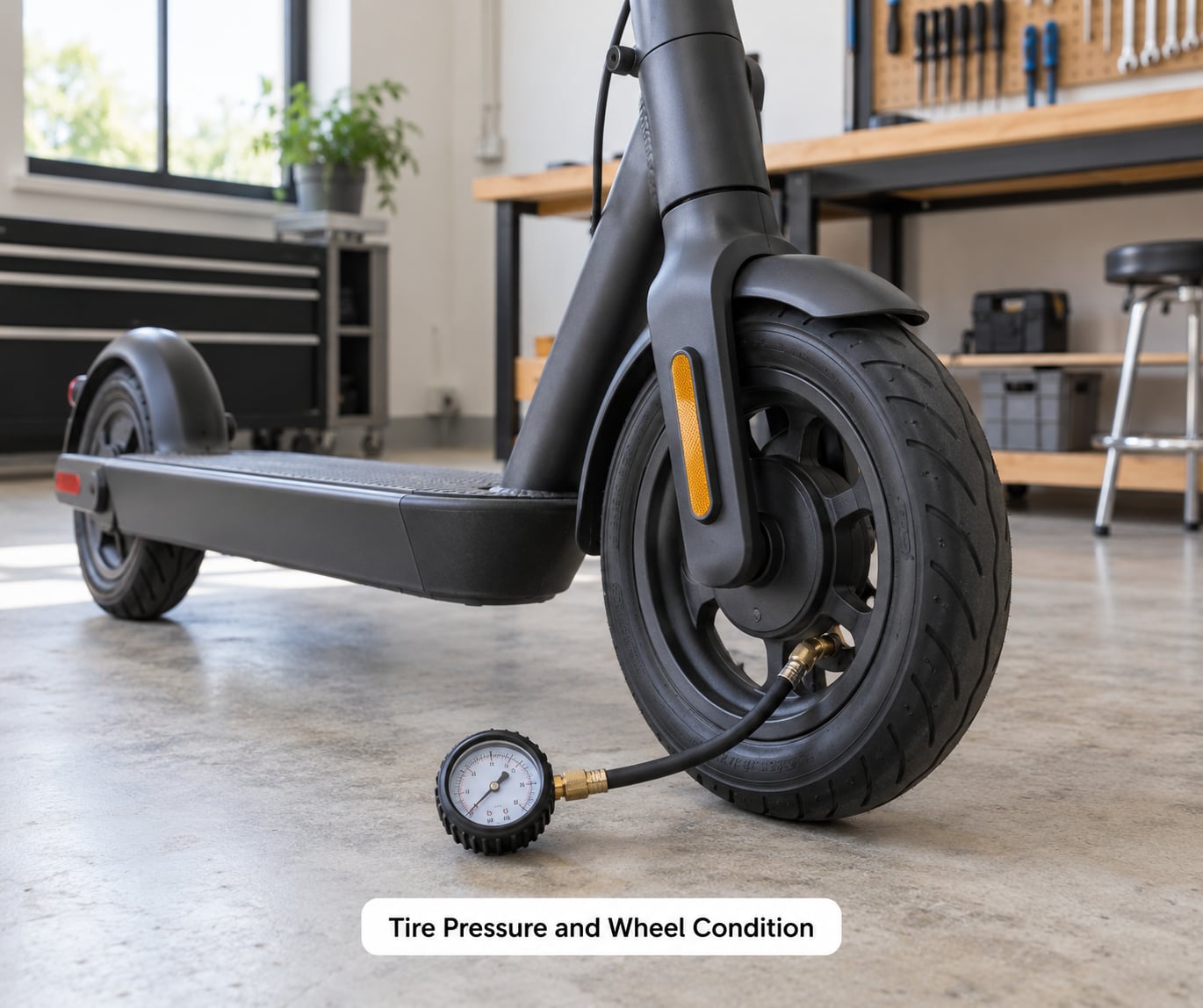
Overinflating causes its own problem: a firm tire skips over surface imperfections instead of absorbing them, which is harsher, less comfortable and no better on battery. Most solid and tubeless scooter tires sit in the 40 to 60 PSI range, but the number molded into the sidewall wins every time.
Check pressure cold, before a ride, using the gauge that came with the scooter or a digital gauge. Also spin the wheels by hand and look for a tire worn flat on one side, which usually points to a wheel alignment or bearing problem rather than a battery issue.
Battery Age, Charging, and Temperature
Every lithium-ion pack loses capacity as it ages, and scooter packs are no exception. Owners tracking their batteries over a couple of years typically report a steady 8 to 10 percent capacity loss, which lines up with what the cells are rated for in charge cycles. Most packs are specified for 300 to 500 full cycles before they reach the bottom of their usable range.
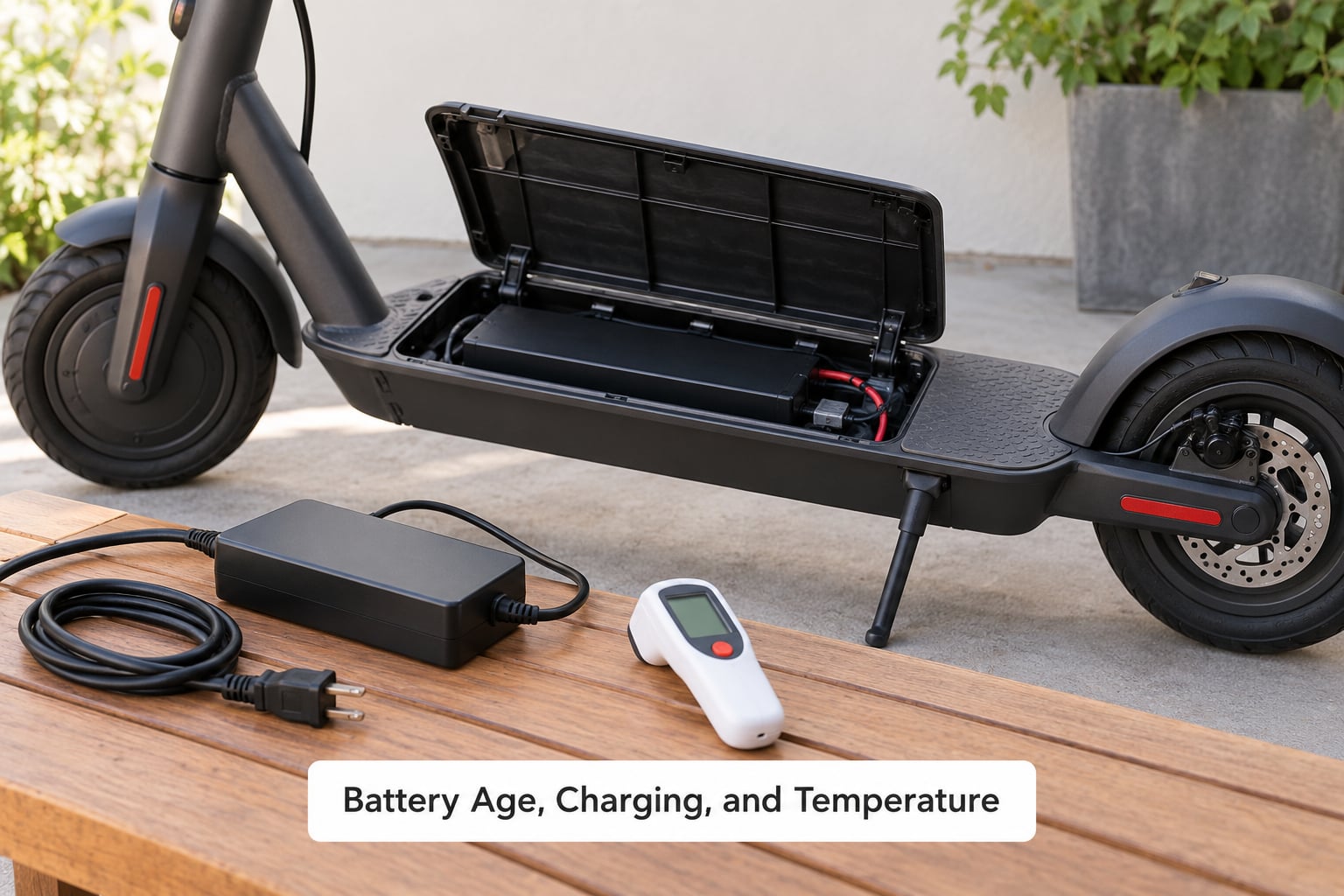
Cold weather hits harder and faster than aging. Below about 50F, lithium-ion chemistry slows down and the pack simply cannot deliver its rated current efficiently.
| Temperature | Expected range | What changes |
|---|---|---|
| 70F or warmer | 100 percent of baseline | Reference conditions |
| 60F | 90 to 95 percent | Slight reduction |
| 40F | 75 to 85 percent | Noticeable sag under load |
| 32F | 65 to 75 percent | Power feels soft |
| 20F or below | 50 to 60 percent | Cutback mode may engage |
Charging habits matter for longevity more than for any single ride. Owners favor keeping daily charging between 20 and 80 percent, and storing the scooter at moderate temperature rather than in a cold shed or a hot garage, since heat is what wears cells fastest. There’s no need to ride immediately after charging or to let the pack sit completely depleted for weeks; both extremes stress the cells.
If your scooter sat unused through a cold winter, warm it up indoors before assuming anything has gone wrong.
Firmware, Power Modes, and Battery Settings
The riding mode you pick can change range more than most riders expect. Eco mode caps motor output and top speed, comfort mode sits in the middle, and sport mode unlocks full power. Sport mode on a commuter route can cut your mileage by a third without any change in distance.
Some scooters also ship with a range limiter or speed setting stored in the app that caps the top speed below the mechanical maximum. If your range suddenly improves after an app update, or drops after one, that setting probably moved. Manufacturers also ship firmware that manages battery temperature and current limits, so ride-to-ride consistency can shift slightly after an update even when nothing physical changed.
A quick sanity check after any firmware change: ride the same loop twice and compare. If the numbers differ by more than about 10 percent with identical conditions, the software is worth a look before you blame the battery.
Maintenance Problems That Quietly Reduce Range
Mechanical faults rarely announce themselves as a range problem. They just make the scooter work harder, and the gauge reads lower at the same distance.
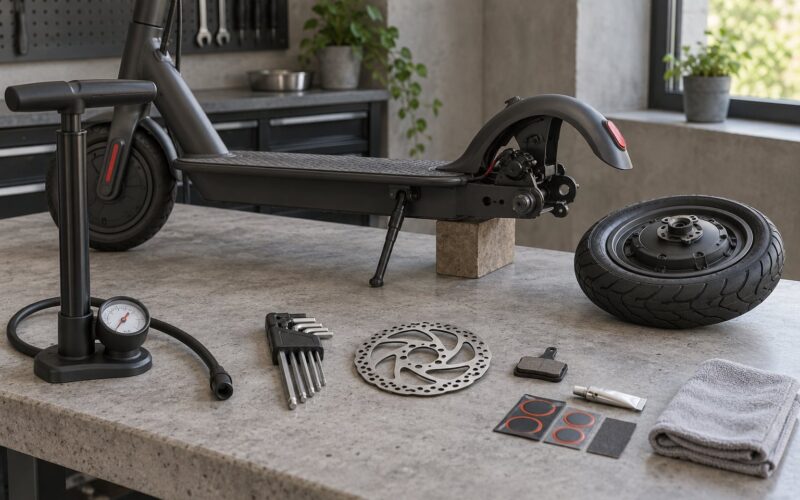
Check for a brake rotor dragging on one side, a fender or deck spacer rubbing after a bump, a wheel with visible side wear, and any loose hardware around the stem or folding hinge. A worn tire with the tread gone down to the cord layer costs significantly more than a fresh one.
The distinction to hold onto: mechanical problems tend to appear suddenly and stay at a fixed level, while battery aging is gradual and month over month. If your range dropped 20 percent in a week, look at the mechanical list first. If it dropped 10 percent over two years, that’s the pack doing what packs do.
How to Test Your Scooter’s Real-World Range
You can measure your own range in about fifteen minutes of planning. Pick a flat loop route of known distance, ideally two to three miles, and note the exact distance somewhere you’ll remember it.
Charge to full, ride with your normal load including your usual backpack, stick to your usual riding mode, and aim for your normal average speed. Don’t ride the route faster than you normally would just to finish early; that defeats the test.
Record the odometer reading when you reach full throttle cutoff. Divide the route distance by the charge percentage used, and you now have your personal Wh per mile figure. Multiply that by your pack’s watt-hours and you have a planning number that reflects you specifically, not a lab rider.
Run the same loop three times, in the same conditions, and use the average. One ride tells you almost nothing.
On the battery gauge itself: expect it to be optimistic in the middle and pessimistic at the bottom. A four-bar gauge that reads three bars at 40 percent real charge will have you planning a trip you can’t finish. Treat the gauge as a rough indicator of state of charge, never as a distance readout, and use your odometer to know how far you’ve actually gone.
How Much Range Should You Expect?
Take the advertised number and discount it for your conditions. For typical flat urban commuting, most owners land at 60 to 75 percent of the claim. Riders planning around 50 percent aren’t being pessimistic; they’re building in margin for hills, cold and traffic.
| Riding condition | Plan on this share of advertised range |
|---|---|
| Flat, mild weather, eco mode, light rider | 70 to 85 percent |
| Flat urban commute, normal speed and stops | 60 to 75 percent |
| Some hills, backpack, heavier rider | 50 to 65 percent |
| Hilly city, below 50F | 40 to 55 percent |
| Worst realistic case, sport mode, cold, hills | 30 to 40 percent |
For sizing: double your round trip, then add 20 percent for margin. A four-mile daily commute means planning for roughly 10 miles of usable range.
Worked example. A 48V 15Ah pack gives you 48 multiplied by 15, or 720Wh. Divide by 25 Wh per mile, typical for a moderate flat commute with stops, and you get about 29 miles. Apply a 65 percent planning discount for winter and hills, and you can plan on roughly 19 miles before a charge. That’s the number to route your day around.
Frequently Asked Questions
Why does my electric scooter’s range drop so much after a few months?
A sharp drop over weeks is usually mechanical rather than battery aging: a dragging brake rotor, a fender rubbing after a bump, underinflated tires, or a wheel with side wear. Gradual loss over a year or two is normal for a lithium-ion pack and typically runs 8 to 10 percent. Check tire pressure and spin the wheels for rubbing first, since those fixes take minutes.
Does a heavier rider always reduce the advertised range?
Heavier riders see less range, and owners report reductions of 10 to 25 percent, especially with a backpack. Most of the extra cost comes from acceleration and hills rather than steady flat riding. You can claw some back by staying in a lower riding mode, easing off the throttle at lights, and choosing routes with fewer climbs.
Is it normal for an electric scooter to lose range when going uphill?
Yes. Climbing costs 30 to 50 percent of range on a route with real elevation gain, and that energy is not fully returned on the way down unless the scooter has regenerative braking, which typically recovers 5 to 10 percent in stop-and-go riding and a bit more on long descents. Plan a round trip with the return leg downhill if you can.
Should I charge the battery to 100% before every long ride?
For a single long ride, charging fully is fine. What wears cells fastest is sitting at a high state of charge for long periods, so owners often keep daily charging between 20 and 80 percent and top up to full only before a planned long trip. Store the scooter at moderate temperature, since heat accelerates wear more than any charging habit.
What tire pressure should I use to get the best electric scooter range?
Use whatever is molded into the tire sidewall, which on most scooter tires falls around 40 to 60 PSI. Underinflation is the common problem, adding rolling resistance that drains the pack over every rotation. Overinflation skips over bumps and rides harshly. Check pressure cold, before riding, and look for tires worn flat on one side, which points to an alignment or bearing issue.
Can eco mode double the real-world range of an electric scooter?
No, but it can meaningfully extend it. Eco mode caps motor output and top speed, which cuts the aerodynamic drag that dominates at higher speeds. Riders switching from sport mode to eco on a commute often see a 20 to 35 percent improvement. It works because you go slower, not because the battery magically stores more, and very short trips will see little change.
Conclusion
Electric scooter range explained comes down to one idea: advertised figures describe a light rider on flat ground at a gentle speed, and every condition you add takes a bite out of them. Speed takes the biggest bite, then hills, then cold, then rider weight and cargo.
Start your diagnosis with the cheap checks. Set tire pressure to the sidewall figure, look for anything rubbing or dragging, and check your riding mode. Then run a timed loop and compare against your own Wh per mile. Most people who do that find 15 to 20 percent they were simply leaving on the table.