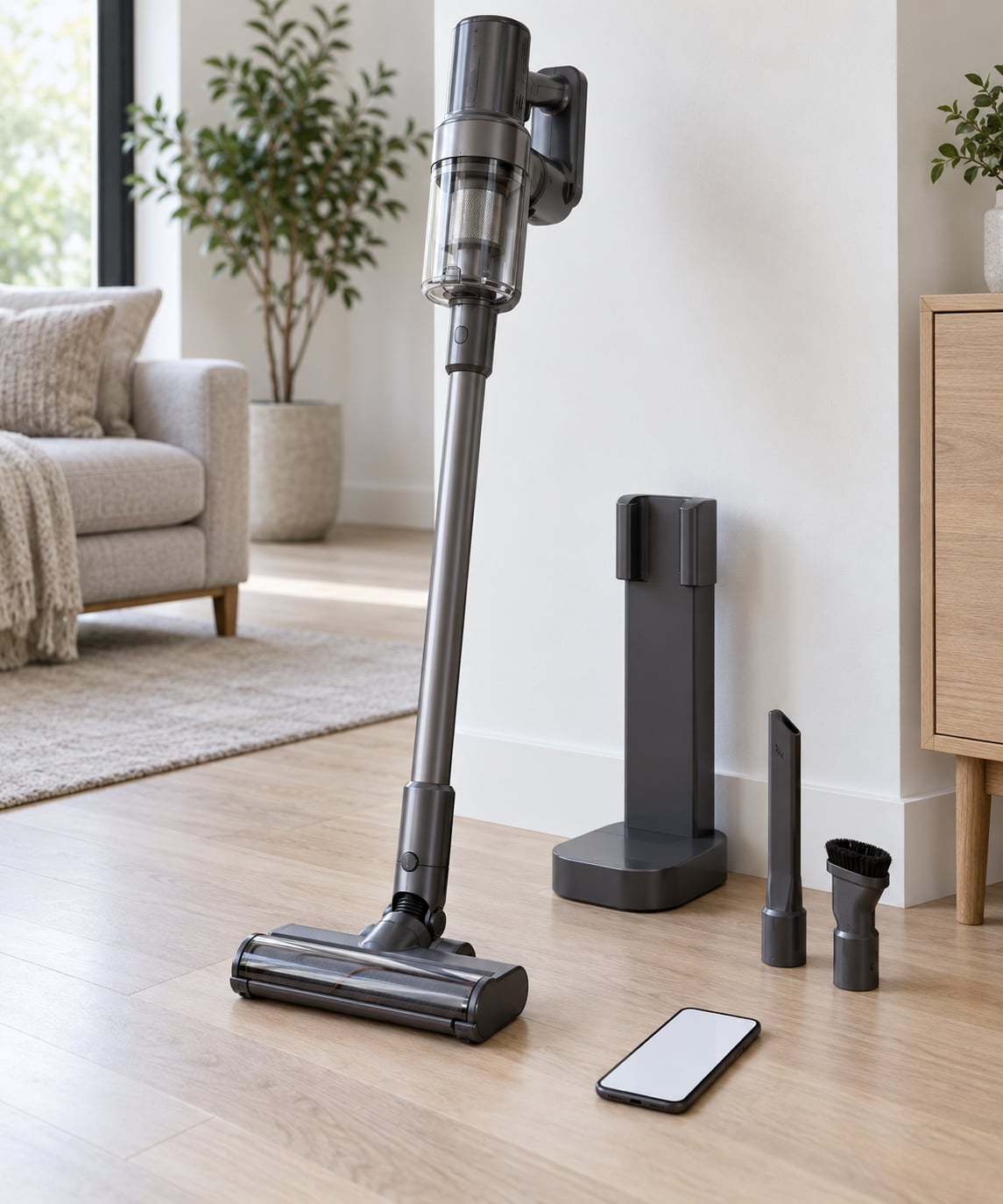
To choose a cordless vacuum by suction power, stop looking at a single headline number and start with the mess you actually clean. Write down your floor types and the debris that shows up most, then compare only measurements taken the same way. A useful rule of thumb for mixed flooring sits around 100 to 150 air watts, or roughly 20 to 25 kPa of static pressure. The whole comparison takes about half an hour once you know which four figures on the spec sheet matter.
The reason this matters is that suction figures rarely transfer between brands. Two vacuums can both claim “strong suction” and deliver completely different results on a carpet edge or a pile of pet hair. The measurement type, the test conditions and the cleaning head behind the number all change what it means.
Table of Contents
- What You Need Before You Compare Any Numbers
- How to Choose a Cordless Vacuum by Suction Power Step by Step
- How Much Suction Power Do You Actually Need?
- Check the Type of Suction Measurement Before Comparing Brands
- Match Suction to Your Home and Cleaning Tasks
- Test the Vacuum Before You Buy
- Common Mistakes When Comparing Suction Power
- Frequently Asked Questions
- Does higher kPa always mean a better vacuum?
- How many air watts do I need for carpets and pet hair?
- Why does my cordless vacuum lose suction after a few minutes?
- Is a 1000W vacuum motor actually powerful?
- Should I keep a corded vacuum if I own a good cordless one?
- How to Choose a Cordless Vacuum by Suction Power: Conclusion
What You Need Before You Compare Any Numbers
Gather five things before you read a single spec page. Without them, any power figure will feel meaningful when it may not apply to your house at all.
Your floor mix. Hardwood, tile and vinyl need almost nothing from raw suction. Carpet is where power gets tested, and high-pile carpet is where weak vacuums embarrass themselves. Note the percentage of each, because a small apartment that is mostly hard floor needs far less than a two-carpet family home.
Your worst debris. Pet hair, kibble, cereal, flour, sand and cat litter each behave differently. Fine dust needs airflow and filtration. Embedded hair in carpet needs agitation and static pressure. Large crumbs need a wide floor head and a strong burst of airflow.
Where it will live. A closet that cannot hold a wall dock rules out models designed around a dock and a charging base. Stairs, a loft or a car interior make weight and balance more important than peak power.
How long you clean at once. Maximum power drains a battery quickly. Most people do fifteen-minute sessions in a flat and longer passes in a bigger house, so runtime matters more than the spec sheet’s maximum.
How the brand tested. Ask whether the figure was measured at the floor head or at the motor inlet, on a new filter, and with the bin empty. Also ask whether it is a maximum at full battery or an average. Brands rarely publish the condition, which is the root of the confusion.
While you collect this, learn the three ideas behind the numbers. Airpower combines airflow and suction pressure into one figure and is the most honest measure of picking power. Suction force (usually kPa or pascals) is static pressure at the nozzle with air blocked, which is useful but easy to inflate. Real-world pickup is grams of debris lifted in a timed pass, and almost no brand publishes it. Everything in this guide is about closing the gap between the first two and the third.
How to Choose a Cordless Vacuum by Suction Power Step by Step
Work through this in order. Each step narrows the field, so you are not comparing a dozen numbers that were never measured under the same conditions.
| Home profile | Debris you fight most | Useful power band | What matters more than power |
|---|---|---|---|
| Flat or apartment, mostly hard floors | Crumbs, dust, hair on hard floor | Lower to mid band, roughly 80 to 120 air watts | Weight, crevice tool, bin size |
| Mixed floors, one or two rooms of carpet | General household dirt, pet hair | Mid band, roughly 100 to 150 air watts or 20 to 25 kPa | Auto suction mode, motorized head |
| Pet owners, shedding year round | Embedded hair on rugs and upholstery | Mid to upper band, 130 to 200 air watts | Anti-tangle brush roll, mini motorized head |
| High-pile carpet or thick area rugs | Dirt worked deep into the pile | Upper band, 180 air watts and up | Brush agitation, dwell time, runtime |
| Stairs, multi-level, hard to store | Anything, but space is tight | Moderate band is usually fine | In-hand weight, wall mount, balance |
How Much Suction Power Do You Actually Need?
Most people need far less power than the packaging suggests. Hard floors clean beautifully at modest figures because debris sits on top of the surface rather than in it. A vacuum that feels weak on tile is still strong enough for hardwood, and a high-power model will simply be heavy and short-lived on a battery.
Carpet changes the equation. Deep pile resists the airflow before the dirt even reaches the nozzle, so a weak machine walks over the same patch again and again with the same result. If you have carpet anywhere, aim for the middle of the range rather than the top of it, unless you have high pile or a serious pet hair problem.
Pet hair deserves its own line. Hair on upholstery and rugs does not come loose on its own, so you need agitation from a good brush roll alongside suction. A bare floor head with enormous suction will still leave hair behind. Look at the head design first, then the power.
Watch out for the reverse trap too. Plenty of mid-band vacuums clean hard floors beautifully and then disappoint on carpet, because the number was measured at the motor rather than at the floor head. That gap is exactly what testing catches.
Check the Type of Suction Measurement Before Comparing Brands
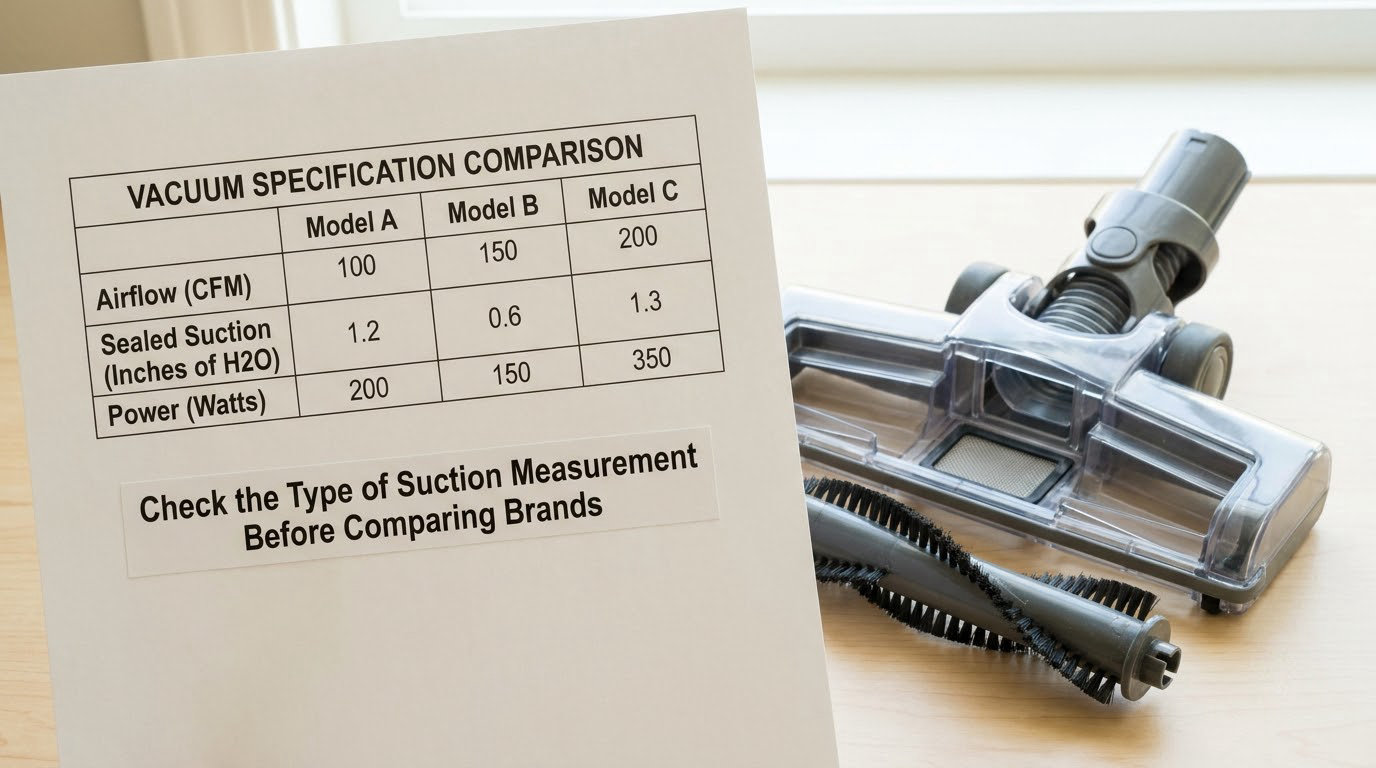
Five measurement types show up on cordless vacuum spec sheets, and only one of them is designed for comparing products fairly.
Air watts (AW) is airflow multiplied by suction pressure at the floor head. Because it captures both halves of picking power, it is the figure most worth comparing. The catch is that many brands do not publish it, so you may need to check review testing that measures it independently.
Kilopascals (kPa) and pascals (Pa) measure static pressure with the airflow blocked. High numbers are easy to advertise and say little about how fast air moves through a clogged filter or a long wand. Treat kPa as a hint, not a verdict.
CFM, or cubic feet per minute measures airflow volume. Airflow alone is also incomplete: a wide open inlet moves lots of air with almost no pressure behind it. Suction alone has the mirrored problem.
Motor wattage (W) describes the motor’s electrical input, not the air. A 1000W figure sounds enormous next to a 250W figure, and it can still produce less usable suction, because efficiency, sealing, filter condition and battery voltage all sit between the label and your floor. Motor power is the weakest of the five for comparison purposes.
Water lift in inches of column (inH2O) appears mostly in carpet cleaners and tells you about carpet deep cleaning rather than dry pickup. If you are cross-shopping against uprights, that is the number to look at, and it is not comparable to kPa.
Two habits make this much easier. First, never compare a kPa figure to an air watt figure directly, even with a conversion chart, because brands test at different points and different fill levels. Second, prefer a brand that publishes the test condition over one that publishes an impressive number alone.
Match Suction to Your Home and Cleaning Tasks
Once you have a band, match it to the trade-offs that decide whether you will still enjoy the machine in year two.
Apartments and small flats. Stay in the lower to middle of the band. Weight dominates here, because you lift the vacuum off the floor more often than you push it. A six-pound body that glides beats a heavy machine with a spectacular number, and nobody has ever regretted a lighter vacuum for picking up a few crumbs late at night.
Mixed flooring. Target the middle band and prioritize a model with auto or reactive suction, which ramps the power up when it senses resistance and drops back down on hard floors. That saves battery and keeps noise down. The forum complaint you hear most often is that auto mode reacts too slowly on a sudden mess, so look for a manual boost button too.
Pet households. Push into the mid-to-upper band and read the brush roll section carefully. Anti-tangle combs, hair-screw tools and a soft roller all reduce wrapping, which is what owners complain about most with pet models that advertise anti-tangle features and then tangle anyway. Budget for a mini motorized head for upholstery, since it makes a bigger difference than extra kilowatts.
Carpet and rugs. Here the trade-off becomes runtime. Maximum power on carpet is exactly where the battery dies fastest, so a machine that holds its power for the whole room matters more than one that starts higher. Look for a battery that can be swapped and a charger you can mount near the cleaning area.
Stairs and multi-level homes. Balance beats peak power. A wand-mounted motor puts the weight in your hand, a floor-head motor keeps it low and stable. Ask about the in-hand weight rather than the total weight, because that is the number your arm feels.
Add the quiet costs to the same list. Noise rises with airflow, and a machine too loud to use gets used less. Sealed systems matter if anyone in the house reacts to dust, and a washable filter costs nothing to maintain compared with a sealed cartridge you replace on a schedule.
Test the Vacuum Before You Buy
Numbers tell you what a machine can do. A ten-minute test tells you what it will do in your hallway with a cat in it.
In a shop, run it on the hardest floor available for a full minute and watch three things: does the head glide or drag, does the bin seal properly, and does your arm start to complain. Then pick up a handful of grit from a display corner and let the vacuum chase it toward a wall. Edge performance is where designs differ more than the brochure suggests.
If the model has a reactive sensor, test it on carpet. Cover a patch with dry cereal or crumbs and note how long it takes to ramp up. Anything over a couple of seconds means you will be sweeping again with a second pass, and you just paid for a mode that was supposed to handle it.
At home, during the return window, run the same timed pass on your own floors and weigh what you collect. Do it on maximum and on the middle setting. That comparison tells you whether the low setting is actually usable, which is the setting you will live on most of the time.
Finally, test the parts that decide your patience: emptying the bin without shaking dust into the air, washing the filter, and swapping the battery. If any of those are awkward, the extra suction will not make them better.
Common Mistakes When Comparing Suction Power
Comparing incompatible figures. A 25 kPa claim and a 150 air watt claim are not the same measurement, so ranking them against each other means nothing. Fix: compare like with like, and lean on air watts when a brand publishes it.
Buying maximum power for every home. The top of the range usually arrives heavier, louder and shorter-running. Fix: pick the band that matches your worst room, not the highest number you can find.
Ignoring the floor head. A weak head behind a strong motor will leave hair in the carpet and crumbs at the skirting board. Fix: read the head and brush roll specifications as carefully as the power figure.
Believing the runtime number at full power. Maximum mode claims are measured briefly on a new battery with a clean filter. Fix: assume real usable time is shorter, especially on carpet, and check whether spare batteries are sold separately.
Forgetting filter maintenance. A clogged filter cuts airflow, which cuts suction, and owners often blame the motor. Fix: check how often the filter needs cleaning and whether it is washable, then set a reminder.
Treating reviews of the old model as reviews of the new one. Brands refresh motors and heads while keeping the name. Fix: check the date of testing and whether the reviewer measured at the floor head.
Buying on specs alone. You will live with the weight, the bin and the noise. Fix: hold it, or watch a full cleaning pass in a video at real speed before deciding.
A few final habits help. Buy the accessories you will actually use, since a crevice tool and a dusting brush cover most tasks and unused extras just add clutter. Ask about parts availability, because a proprietary battery or dock can decide whether the machine is worth keeping in five years. And if your home is mostly hard floor with light debris, remember that the lowest adequate band is the correct answer, not a compromise.
Frequently Asked Questions
Does higher kPa always mean a better vacuum?
No. kPa measures static pressure with the airflow blocked, so it captures only half of picking power. A machine can post a high kPa figure and still move little air, which shows up as poor pickup of fine dust and crumb. Give air watts the most weight, treat kPa as supporting information, and always read which test point the brand used.
How many air watts do I need for carpets and pet hair?
Around 100 to 150 air watts handles mixed flooring, and roughly 130 to 200 air watts suits pet owners with carpeted rooms. High-pile rugs and thick area rugs benefit from 180 air watts and above. Those are useful bands, not rules: brush agitation, floor head design and a clean filter change the result as much as the figure itself.
Why does my cordless vacuum lose suction after a few minutes?
Three things are usually at work: the battery voltage drops as it drains, dust loading narrows the airflow path, and a clogged filter adds resistance. Owners on r/VacuumCleaners describe the same pattern on high power across several brands. Empty the bin, clean the filter and compare a short burst against a full charge, and you will see the difference clearly.
Is a 1000W vacuum motor actually powerful?
Not necessarily. Motor wattage describes electrical input, not airflow or suction at the floor head, and it is the least useful of the common spec figures. A higher watt number can sit behind poorer sealing, a restrictive filter or an inefficient design. Judge motors by measured airpower or kPa instead, and treat watts as background information.
Should I keep a corded vacuum if I own a good cordless one?
Many households keep one, and there is no rule against it. A corded machine is still the faster tool for deep carpet cleaning, construction dust and whole-house sessions on a single charge. A mid-range cordless vacuum handles daily messes and stairs well. Many owners on r/VacuumCleaners simply use the corded vacuum weekly and the cordless one the rest of the time.
How to Choose a Cordless Vacuum by Suction Power: Conclusion
Start by writing down your floor mix and the debris you deal with most, because that list sets the power band before any specification page does. Aim for roughly 100 to 150 air watts in a mixed-flooring home, and move higher only when carpets or pet hair justify the extra weight and the shorter runtime.
Then compare only figures measured the same way, weight airflow and head design above raw kPa, and treat any single number that arrives without a test condition as marketing. The final check is simple: hold the vacuum, run it for a minute on your hardest floor, and pick the one whose cleaning you would actually repeat twice a week.