If you have never worked out how to pick a Bluetooth speaker for outdoor use, the answer is a fixed order: confirm an IP67 or IP68 rating, match real battery hours to how long your outing lasts, match wattage to how many people need to hear it, then check weight and mounting so you can actually carry it. Speakers fail outdoors through water, sand, heat and UV far more often than through sound quality, so durability specs decide the purchase before any feature list does.
That order matters because the specs that look impressive on a product page rarely address the thing that ruins a speaker. A 40W speaker with a splash rating dies in the first wet season. A beautifully tuned 5W speaker with a dust-tight seal is perfect for a picnic table and hopeless for a beach with twelve people on it.
This guide walks through each factor in the order you should check it, what the numbers actually mean, and what they quietly leave out. Last updated October 2026.
Table of Contents
- What Matters Most for an Outdoor Bluetooth Speaker?
- How to pick a Bluetooth speaker for outdoor use, in order
- Start by naming where you will use it
- How to Check Waterproofing and Outdoor Durability
- What IP ratings do not cover
- How Much Battery Life Do You Need?
- What Speaker Size and Portability Should You Choose?
- How to Judge Sound Quality Outside
- Which Bluetooth and Extra Features Matter?
- How to Match a Speaker to Your Outdoor Situation
- What Should You Avoid When Choosing an Outdoor Speaker?
- Frequently Asked Questions
- What is an IP67 speaker?
- How many watts should an outdoor Bluetooth speaker have?
- How long should an outdoor speaker battery last?
- Is IPX7 enough for a beach or pool?
- What Bluetooth speaker is best for hiking?
- Do waterproof Bluetooth speakers work in saltwater?
- Conclusion: Make the Smartest Outdoor Speaker Choice
What Matters Most for an Outdoor Bluetooth Speaker?
The four things that decide whether an outdoor Bluetooth speaker works for you are water and dust protection, battery life, output power, and how easily you can carry and mount it. Everything else, RGB lighting, voice assistants, multi-speaker ecosystems, is optional.
What changes is the priority order. At a pool or on a beach, the IP rating moves to the top and weight barely matters. On a hiking trip, weight and battery jump to the top and the IP rating only needs to cover an occasional shower.
How to pick a Bluetooth speaker for outdoor use, in order
- Name the environment: pool, beach, hiking trail, backyard, patio, RV or boat.
- Verify the IP rating and read what it excludes.
- Match battery hours to your session length, at realistic volume.
- Match wattage to group size and how far away people will stand.
- Check weight, carrying points and mounting options.
- Decide whether you need stereo pairing, an app, or a microphone at all.
Start by naming where you will use it
Write the environment down before you look at a single product page. Salt water and chlorine at a pool, wind and open space at a beach, dust and vibration on a tailgate, and condensation on a boat deck are four completely different problems.
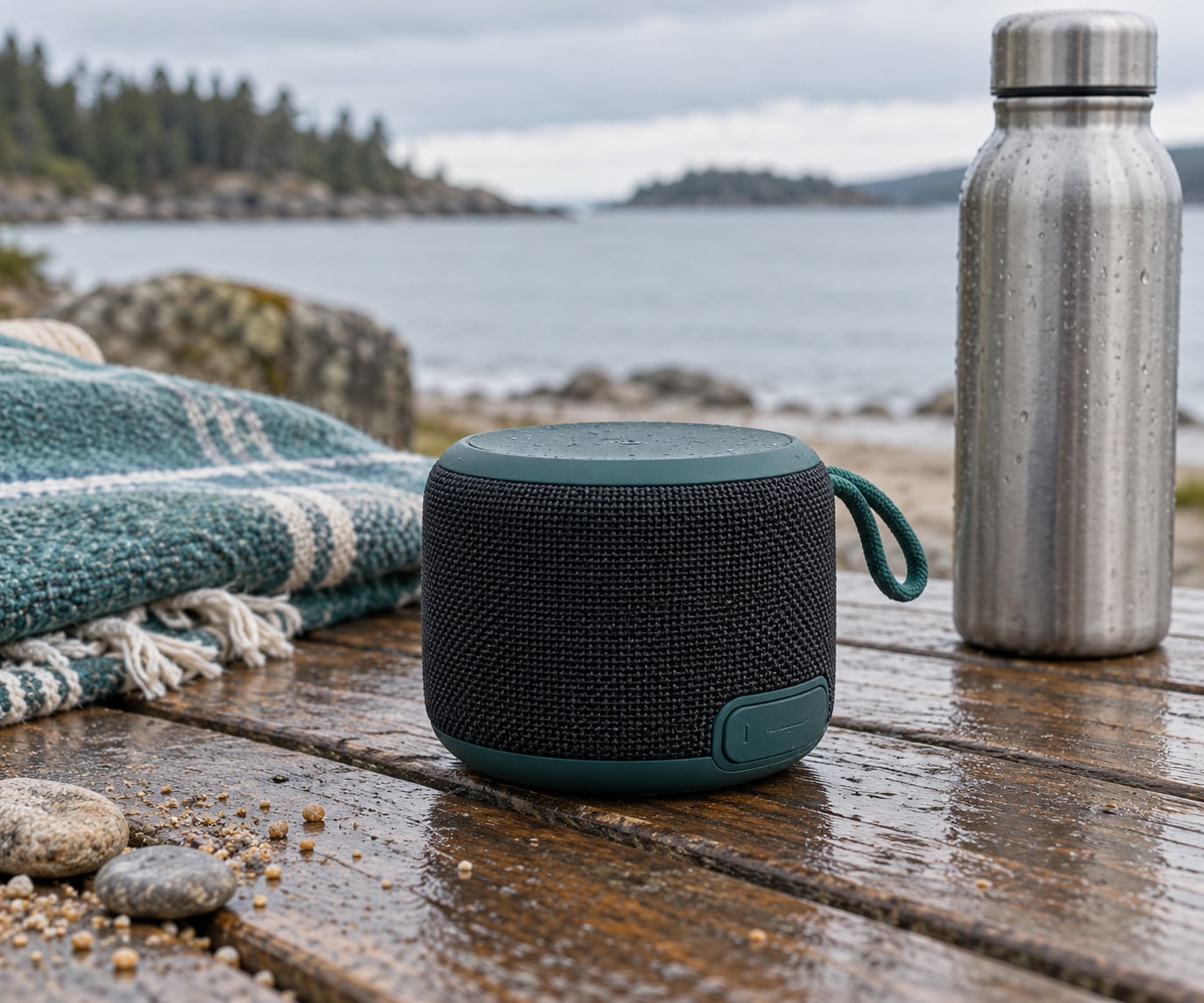
Long-term owners on outdoor speaker forums consistently report that the single most effective way to keep sand out is to keep the speaker off the ground, clipped to a bag or hung from a chair arm or umbrella pole. Mounting beats every IP rating in practice.
How to Check Waterproofing and Outdoor Durability
Check the two-digit IP code, then read it digit by digit. The first digit rates solid-particle protection from 0 to 6, and the second rates water protection from 0 to 9, where X means that half was never tested.
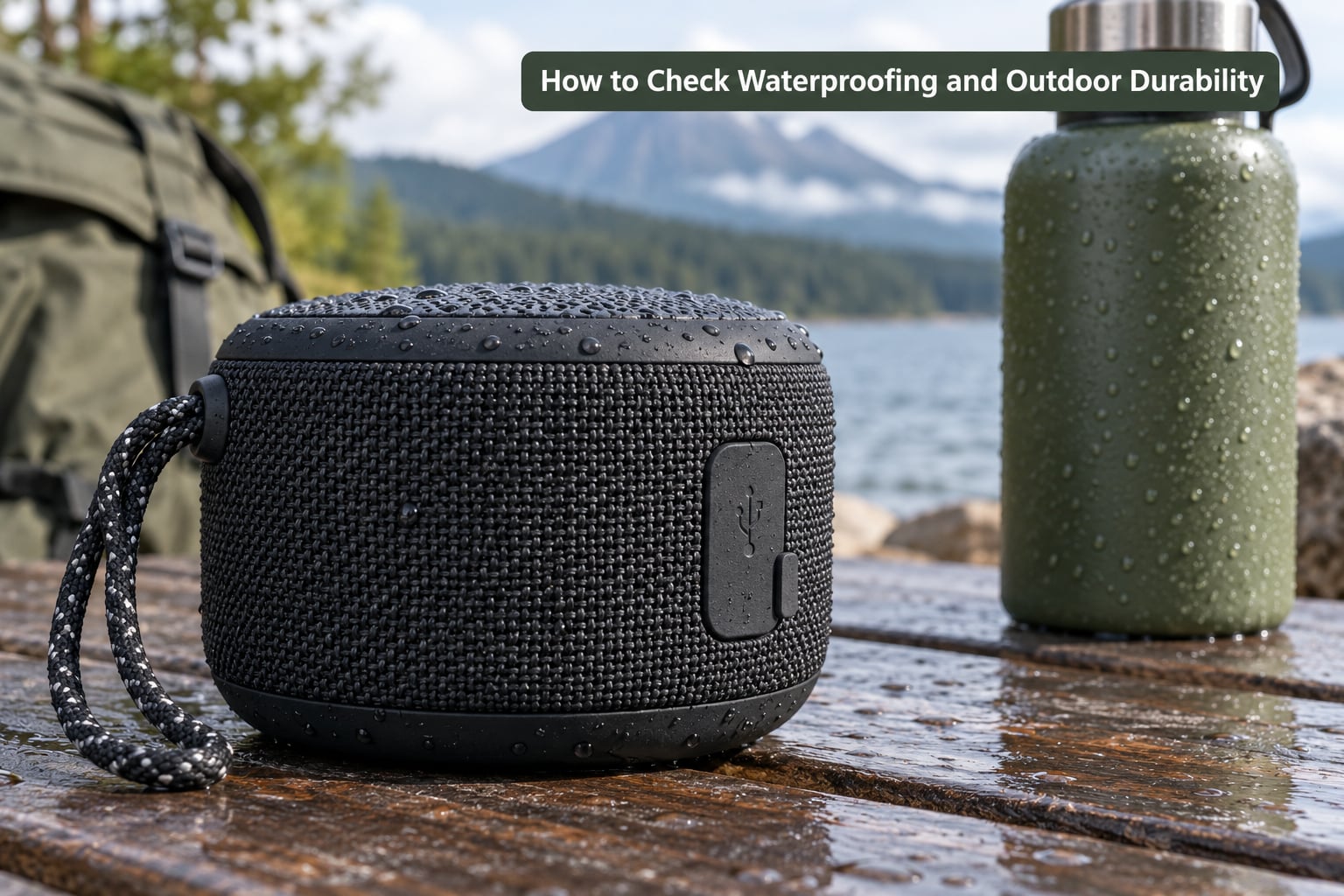
IP67 is the number worth insisting on. IP67 means dust-tight and submersible to one metre for thirty minutes in fresh water. IPX7 gives you the same water protection but leaves dust completely untested, which is why it is a poor choice for a beach, where sand is the more likely problem.
| Rating | Dust protection | Water protection | Real-world meaning | Good enough for |
|---|---|---|---|---|
| IPX4 | Not tested | Splashes from any direction | Keeps out light rain and spray | Patio, deck, covered balcony |
| IPX5 | Not tested | Water jets from any direction | Survives a hose, not a dunk | Backyard, occasional wash-down |
| IP65 | Dust-tight | Water jets | Dust-sealed body with jet resistance | Worksite, dusty outdoor events |
| IPX7 | Not tested | Submersion to 1 m for 30 min | Waterproof, but sand can still grind into seams | Poolside, rain, dry sand |
| IP67 | Dust-tight | Submersion to 1 m for 30 min | The all-round outdoor rating | Beach, pool, camping, boat deck |
| IP68 | Dust-tight | Deeper and longer, maker-specified | Handles repeated dunking and washing | Frequent pool and water use |
What IP ratings do not cover
Every IP rating is tested in still fresh water, and that is the limit of what it tells you. It says nothing about salt water or chlorine, both of which corrode contacts and degrade port seals over time. It does not certify pressure jets from a pressure washer, drops from a tailgate step, or UV exposure that yellows and weakens rubber casings.
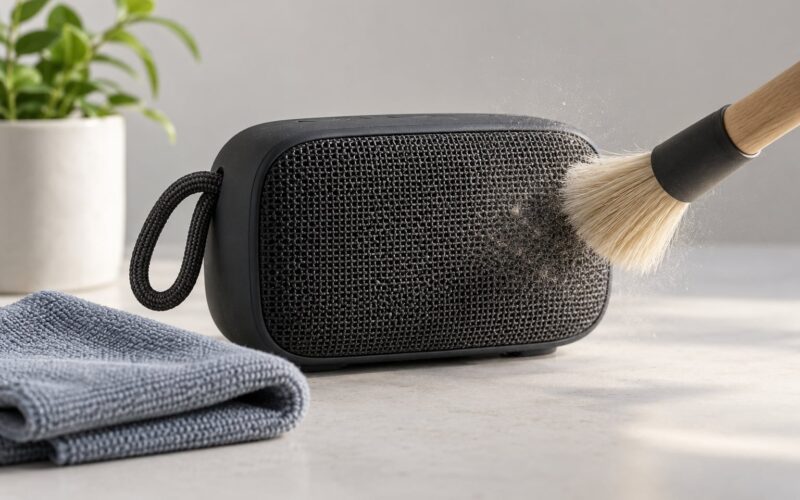
Owners report that corroded USB-C contacts are one of the most common early failures, and they almost always trace back to plugging in a wet port. Rinse the speaker with fresh water after pool or ocean use, let it dry for an hour or two, and only then charge it.
Drops are a separate rating entirely, usually stated in metres or feet on the box, and buying it is worth it if your speaker will live in a backpack. For heat, lithium batteries should stay out of direct sun and out of a hot car, and charging below freezing or above roughly 40 degrees is where damage starts.
How Much Battery Life Do You Need?
Work out how long your session actually is, then demand at least a third more than that in claimed playtime. Manufacturer figures are almost always measured in a lab at about half volume with extras turned off, so a speaker claiming twenty hours may give you seven at the volume an open space demands.
| Typical outing | Hours needed | Minimum acceptable claim |
|---|---|---|
| Backyard cookout, short walk | 2-3 | 10 hours |
| Camping day trip | 6-8 | 15 hours |
| Full beach or pool day | 8-10 | 20 hours, or a power bank |
| Weekend trip or work tailgate | 12-20 | Carry a second charge or bank |
Volume is the biggest factor. Going from a quiet room to an open beach can eat a third of your runtime, and features like lights, party mode and a companion app connection drain it faster still. Cold weather pulls capacity down too, so a winter camping speaker runs shorter in January than in July.
Buy the USB-C port. A proprietary barrel connector locks you out of third-party cables, and a speaker that can charge your phone in reverse turns out to be the difference between a full day and a halfway day.
What Speaker Size and Portability Should You Choose?
Match weight to how you will move the speaker, not to how big you want it to look. Anything above a kilogram is a car speaker or a backyard speaker, and calling it portable does not make it one.
Pocket-sized models under 500 grams handle a picnic blanket, a bike handlebar or a tent pole. They are fine for one or two people within a couple of metres and they lose bass in open air fast. Compact models around one to two kilos are the sweet spot for a day trip, since they carry a full-size driver and still fit in a backpack. Medium speakers of three to six kilos work as patio units you move once and leave set up. Larger party systems need their own table and a mains outlet nearby.
Look for a carabiner loop, a moulded strap or a screw mount, plus a rubber base. The base matters more than people expect, because a speaker that walks across a table at full volume ends up on the floor or in a puddle.
How to Judge Sound Quality Outside
Judge outdoor speakers by their midrange clarity and their behaviour above roughly 70 percent volume, because that is where you will actually run them. Open air is brutal for bass: air carries low frequencies poorly and wind scatters them further, so the bass you liked in a shop flattens by the time you are twenty feet from the speaker.
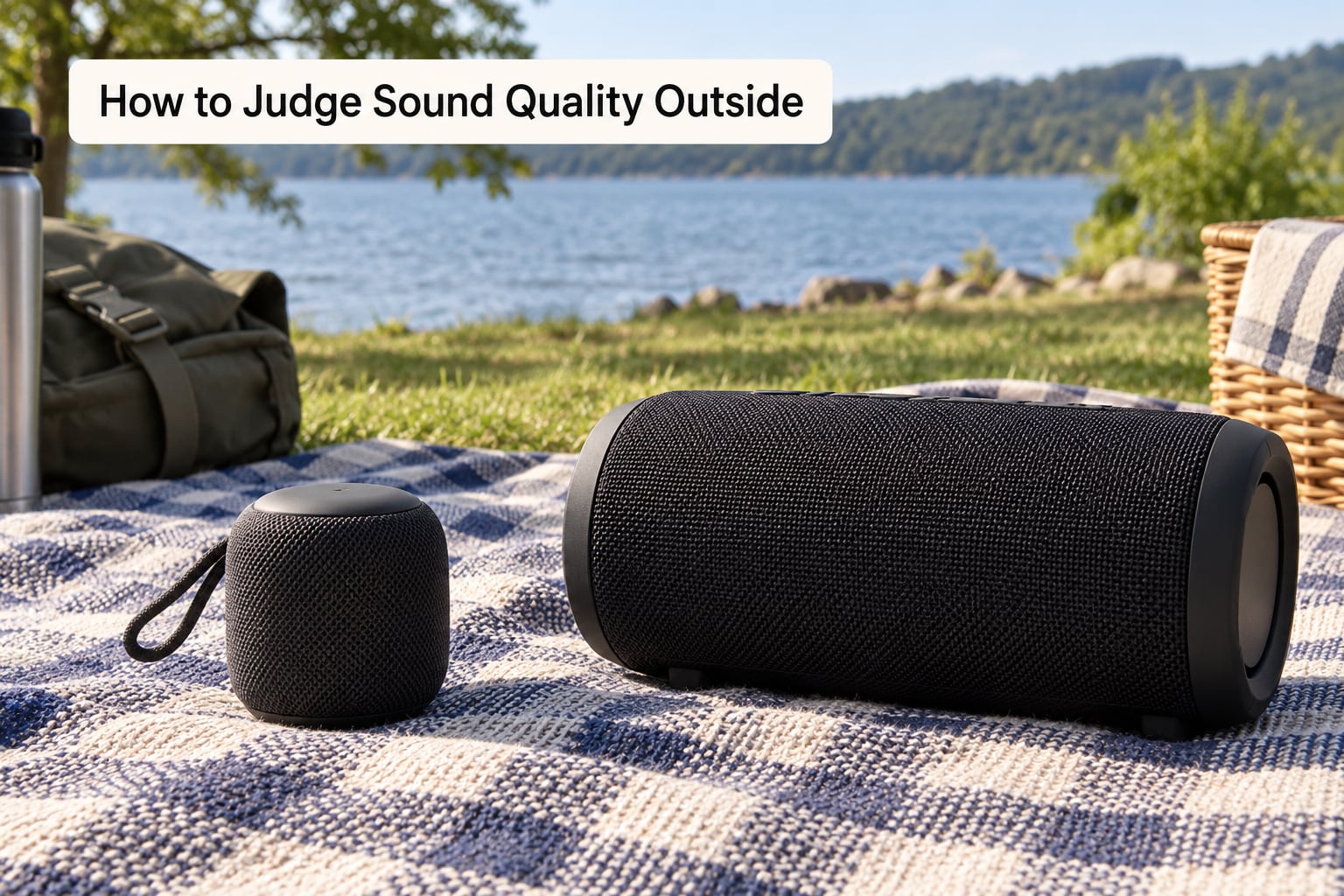
A full-range driver plus a passive radiator gives the most usable low end in a small body. The radiator is the flat disc or slot that moves air to fake the bass a driver that size cannot physically produce. Cheap speakers without one sound thin outdoors even at the same wattage.
Watch for distortion at high volume. A small speaker pushed to its limit outdoors sounds worse than a larger one running comfortably, so a modest volume ceiling on a well-tuned mid-size speaker beats a big wattage number from an underpowered driver. Omnidirectional designs spread sound in all directions, which suits a table everyone shares; directional designs win when the speaker sits against a wall or under a patio roof.
Microphones matter only if you take calls on it. Most onboard mics are tuned for the tabletop, so a speaker sitting on wet grass will sound terrible to the person on the other end.
Which Bluetooth and Extra Features Matter?
Bluetooth 5.3 or 5.4 gives you more stable connections and better power management, but the practical difference between versions is smaller than the spec sheet implies. What actually matters outdoors is range and line of sight, since bodies, walls and crowds eat signal.
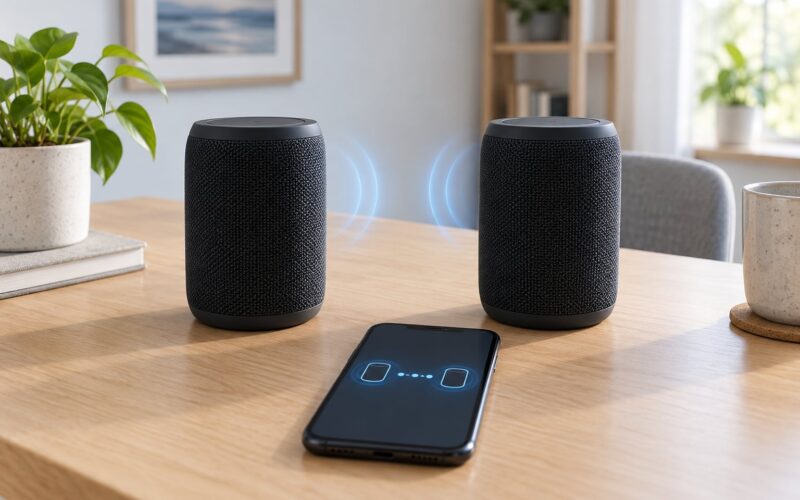
Multipoint pairing is worth having if two people bring their own phones to the same cookout. True wireless stereo pairing, where two speakers link as left and right channels, is worth it for a beach or a deck where you want real stereo rather than mono; check that both speakers are the same model and generation, and read long-term owner reports, because firmware updates have broken TWS pairing for some brands.
Treat app-only EQ as a trade-off. A companion app with proper EQ presets genuinely helps outdoors, where a boost mode often exists to lift treble against wind noise. But if basic playback requires a cloud login, skip it, and leave the light-up LEDs switched off from the start. Nobody at a cookout is watching them.
The extras that earn their place: a sealed port cover, USB-C in and out, an aux input for a backup source, and a microphone. Skip anything you would not use at the actual outing.
How to Match a Speaker to Your Outdoor Situation
Use this table to narrow the search before you start reading reviews. The dominant condition in each row tells you what to prioritise and what to ignore.
| Situation | Top priority | Minimum spec | Can compromise on |
|---|---|---|---|
| Beach | Sand and salt protection | IP67, sealed port cover, floats | App features, stereo pairing |
| Poolside | Water ingress | IP67, secure flat placement | Weight, mounting hardware |
| Hiking and backpacking | Weight | Under 500 g, carabiner loop, 12 h+ | Wattage above 10 W |
| Backyard and patio | Output power | 20-45 W for 6-10 people, IP65+ | Weight, water rating below IPX5 |
| Camping | Battery and durability | IP67, 15 h+, dust-tight | Bluetooth version |
| Travel and road trip | Compact size and battery | Under 700 g, 12 h+, multipoint | Wattage above 15 W |
| Boat or RV | Corrosion resistance | IP68 or IP67, USB-C, freshwater rinse habit | Weight |
What Should You Avoid When Choosing an Outdoor Speaker?
- Believing the battery number. The fix: assume half the claim, then add a third. A twenty-hour speaker is a ten-hour speaker in practice.
- Treating IPX7 as sand-proof. The X means dust was never tested. Sand grinding into a grille seam is the beach failure nobody warns you about.
- Charging a wet port. Corroded contacts are the most common early death. Dry first, always.
- Buying a one-kilogram speaker for a hike. You will leave it at the trailhead. Carry weight under 500 g if it goes on your back.
- Trusting “360-degree sound” on its own. The phrase describes dispersion, not loudness or clarity. Read the driver size and check reviews at real outdoor volume.
- Assuming bigger means louder. A larger driver with a passive radiator at moderate volume sounds better than a small one at full.
- Leaving it in a hot car or direct sun. Heat cycling degrades the battery far faster than use does.
- Storing it empty for months. Recharge it roughly every three months if it is not in use. Most early failures owners blame on the brand are storage failures.
Frequently Asked Questions
What is an IP67 speaker?
An IP67 speaker is dust-tight and submersible in fresh water to one metre for thirty minutes. The first digit rates solid-particle protection and the second rates water protection. IP67 is the rating to insist on for outdoor use because IPX7 models give you the same water protection while leaving dust untested.
How many watts should an outdoor Bluetooth speaker have?
About 5-10 W covers one or two people within a couple of metres. A group of four to eight people needs roughly 20-45 W, which is the community sweet spot. Ten or more listeners in the open generally need 80 W or more, because open air loses volume much faster than a closed room.
How long should an outdoor speaker battery last?
Work from your session length, then demand a third more. A two-hour cookout needs a ten-hour claim, a camping day needs fifteen hours, and a full beach day of eight to ten hours needs a twenty-hour claim or a power bank. Manufacturer figures are measured at low volume in a lab.
Is IPX7 enough for a beach or pool?
For water, yes. For sand, no, because the X means dust was never tested. At the beach, choose IP67 so the casing is dust-tight, keep the speaker elevated off the sand, and rinse it with fresh water afterwards. Salt water corrodes contacts over time and no IP rating covers it.
What Bluetooth speaker is best for hiking?
Weight decides first. Look for something under 500 grams with a carabiner loop and at least twelve hours of claimed playtime, because you will not carry a two-kilogram speaker up a trail. Sound quality matters far less than the weight, as long as it can play clearly within a few metres of you.
Do waterproof Bluetooth speakers work in saltwater?
They can, but only with care. IP ratings are tested in still fresh water and say nothing about salt or chlorine, both of which attack port seals and contacts. Rinse the speaker with fresh water after ocean use, dry it fully for an hour or two, and never charge a wet port.
Conclusion: Make the Smartest Outdoor Speaker Choice
Decide your conditions first, then spend on the specs those conditions demand. Beach and pool use means IP67 minimum and a sealed port cover; a full day out means a twenty-hour battery claim and USB-C; a hike means under 500 grams and a carabiner; a backyard full of people means 20-45 W and a spot to set it down.
Once you know how to pick a Bluetooth speaker for outdoor use, ignore the feature list and check the two digits after IP, the real playtime, the wattage against your group, and the weight against your bag. Everything else is decoration.