The short version: store the scooter or its removable battery indoors at roughly 10-25 C (50-77 F), set the charge to about 40-60% unless your manual says otherwise, keep it clean and dry, and top it up once a month. Never charge a pack that is at or below freezing.
Most riders are surprised by how much damage a few months of neglect can do. Cold slows the chemistry inside a lithium cell and raises its internal resistance, so a pack that sits in a freezing shed for months can come out in spring with noticeably less range or not power on at all. The battery is also by far the most expensive part of the scooter, which is why a few careful hours now are cheaper than a replacement pack later.
The whole job takes about an hour once you know the steps. The part that catches people out is not the storage itself. It is forgetting about the scooter until April.
Table of Contents
- What You Need
- Step-by-Step: How to Store an Electric Scooter in Winter
- 1. Choose a Dry, Stable Storage Location
- 2. Clean and Dry the Scooter Before Storage
- 3. Check the Tires, Brakes, and Folding Mechanism
- 4. Set the Battery to the Manufacturer’s Recommended Charge
- 5. Disconnect the Charger and Protect the Charging Port
- 6. Cover and Secure the Scooter Correctly
- 7. Inspect and Recharge It During Long-Term Storage
- Common Mistakes
- Frequently Asked Questions
- Can I leave my electric scooter outside in winter?
- How cold is too cold for a lithium battery?
- Is it safe to keep an electric scooter in the house?
- What percentage should I store my scooter battery at?
- How often should I charge during winter storage?
- What should I check before riding again in spring?
- Conclusion
What You Need
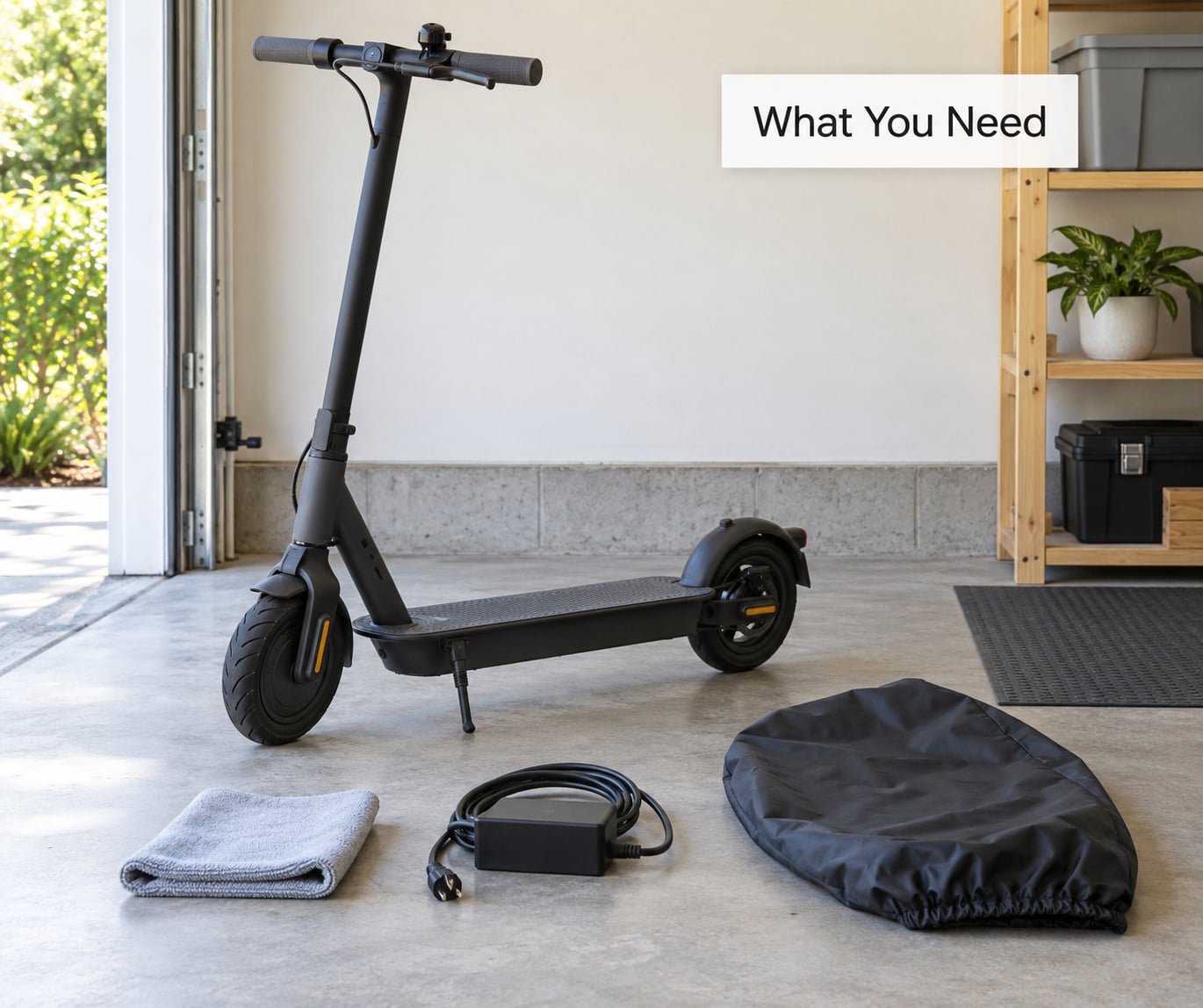
Gather these before you start, so you are not hunting for a charger with cold hands at dusk.
- The owner’s manual for your exact model. It overrides everything in this guide.
- The correct charger that came with the scooter, or the replacement the manufacturer specifies.
- A soft, dry cloth plus a damp cloth for the deck. Avoid pressure washers and car shampoo, both of which push water into seals.
- A breathable fitted cover. Not a plastic tarp, not a sealed bin bag.
- A stable indoor spot on a flat floor, away from a heater, radiator, or direct sun through a window.
- A way to secure the scooter so it cannot tip or roll. A wall hook, a lock, or a chock against the kickstand all work.
- A calendar reminder for a monthly check-in. This is the single most useful item on the list.
If your battery is removable, you will also need a dry shelf or corner where the pack can sit upright by itself.
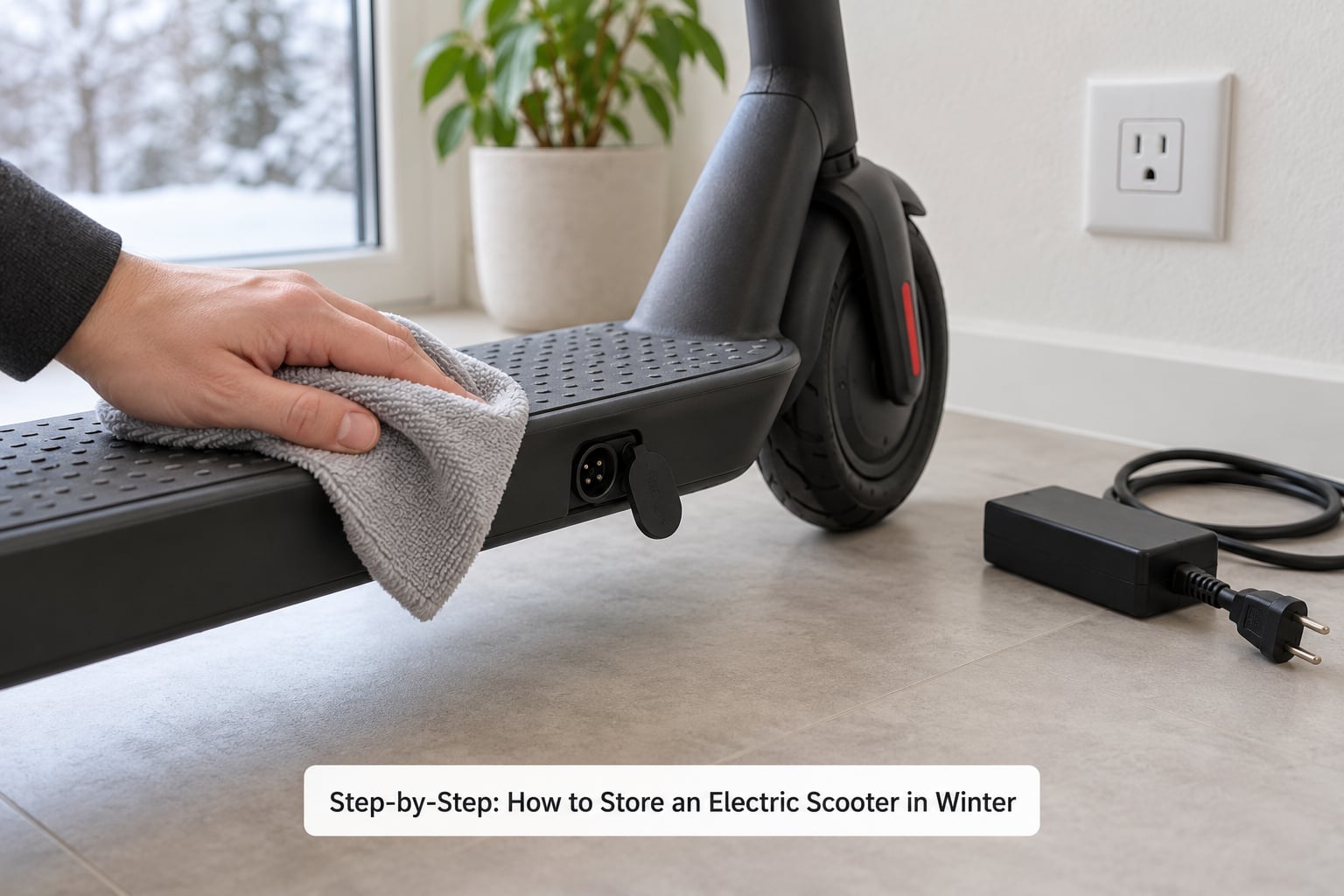
Step-by-Step: How to Store an Electric Scooter in Winter
1. Choose a Dry, Stable Storage Location
Put the scooter somewhere dry and above freezing if you can manage it. A conditioned room, a heated garage, or a hallway corner beats a shed every time. An unheated garage is acceptable only if it stays above 0 C (32 F) and the scooter is off the concrete floor.
Temperature is the variable that decides everything else, so here is how each band changes the plan.
| Storage temperature | What it does | What to do |
|---|---|---|
| Below 0 C (32 F) | Lithium plating risk on charge, frozen brake lines, brittle tires | Move it indoors. If that is impossible, store with the battery removed and at 40-60% |
| 0-10 C (32-50 F) | Reduced capacity, slower charging, condensation as the air warms | Acceptable short term. Check monthly and top up to 50-60% |
| 10-25 C (50-77 F) | The ideal band for long-term storage | Nothing special. Monthly check-in only |
| Above 25 C (77 F) | Accelerated self-discharge, swollen cells, heat damage from chargers | Cool, shaded spot away from heaters. Never charge near a radiator |
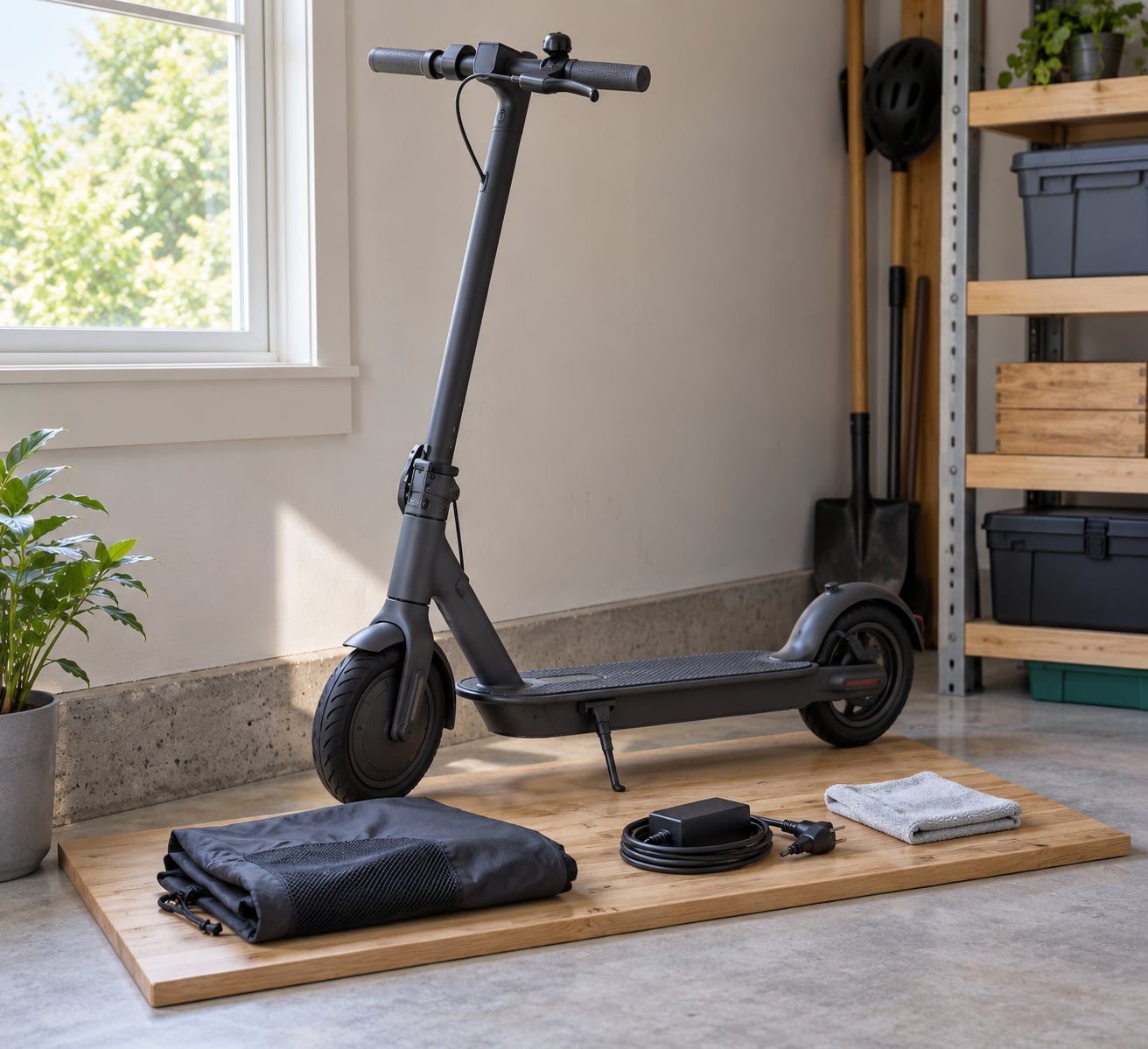
Keep it away from rain, snow, and sunlight, and give it enough ventilation that damp air can escape. Concrete floors wick moisture and cold straight up into the frame, so a wooden board or a pallet helps.
2. Clean and Dry the Scooter Before Storage
Winter road salt is the quiet destroyer. Wash salt and mud off the deck, frame, wheels, brake discs, and any exposed connectors before the scooter sits for months.
Use a damp cloth, a soft brush around the wheels, and a dry cloth to finish. Do not hose it down, and do not aim water at the charging port, display, or the stem fold, because that seam routes moisture straight toward the dashboard.
Let it air dry completely indoors before you cover anything. Storing a wet scooter under a cover guarantees trapped condensation.
3. Check the Tires, Brakes, and Folding Mechanism
Months of standing leaves a flat spot in the tire rubber, and cold makes rubber brittle. Inflate the tires to the pressure printed on the sidewall, which is usually in the 35-50 psi (2.5-3.5 bar) range, so they hold their shape rather than sitting deflated on one line.
Spin both wheels and check that the brakes bite. A cable or hydraulic line that has frozen or seized needs sorting now, not in March.
Work the folding hinge and the stem latch through their full travel a few times and put a drop of light oil on the pivot. This is also the time to sweep grit out of the brake calipers, where road salt hides and eats metal.
4. Set the Battery to the Manufacturer’s Recommended Charge
Here is where most of the confusion online comes from, so it is worth being precise. For a standard lithium-ion pack, store it at about 40-60% charge. Sitting at 100% for months stresses the cells, and sitting at 0% risks a deep discharge that the battery management system may not recover from.
The advice to store at 80% or higher applies to different chemistry. Sealed lead-acid, used on mobility scooters and some older e-bikes, sulfates when it sits partly discharged, so it wants to go into storage full. LiFePO4 packs are far more forgiving than standard lithium-ion and tolerate a wider range.
So the rule that reconciles every source is simple: the pack chemistry sets the target, and the owner’s manual beats all of it. Check the manual for your exact model before you do anything else, and follow it over any number you read online, including this one.
To check the level, power the scooter on and read the display or app. Do not guess from the charger light. A scooter with a built-in, non-removable battery has to be set as a whole, which also means the whole scooter comes indoors.
5. Disconnect the Charger and Protect the Charging Port
Unplug the charger and store the cable loosely coiled. Do not wrap it tightly around itself or kink it at the plug, since a sharp bend is where the conductors eventually break.
Unless your manual explicitly says the scooter can sit connected through storage, do not leave it plugged in indoors for weeks. A charger left connected in a warm space keeps generating heat, and heat next to a lithium pack is the combination you do not want.
Fit the port cover or rubber plug if your model has one, and check that the seal is not cracked. If condensation collects there over the winter, power it off and let it dry fully before charging in spring.
6. Cover and Secure the Scooter Correctly
Use a breathable fitted cover. Fabric lets trapped moisture evaporate; plastic sheeting and bin bags hold it against the frame, which is how a dry garage ends up corroding connectors.
Do not wrap the whole scooter in plastic, and do not seal it in a plastic bag for months. If you have no breathable cover, a loose sheet over a sheltered spot is better than a tight tarp.
Secure it upright so it cannot fall or roll. A scooter that tips onto its side for three months wears flat spots on both tires and can stress the folding hinge in a way it was never designed for.
7. Inspect and Recharge It During Long-Term Storage
Put a recurring reminder in your calendar for the first Sunday of every month. Two minutes each month is enough to catch a problem that would otherwise cost a pack replacement.
- Check the charge level and top it back up to 40-60% if it has dropped below 40%.
- Look at the terminals and any exposed connectors for green or white corrosion.
- Check tire pressure and add air if the wheels have gone soft.
- Run the display on for a few seconds to confirm the pack still responds.
- Look for moisture, frost, or a swollen pack.
Contact the manufacturer or a repair shop if the pack will not power on, bulges, smells unusual, or refuses to hold a charge after a top-up. Do not keep topping up a pack that will not hold charge, and never puncture or open a lithium pack yourself.
If your storage is only a couple of weeks, most of this is optional. The steps that always matter are the charge level, the dry location, and the charge port.
Common Mistakes
Storing it outside uncovered is the most common mistake, and no cover fully fixes it. Snowmelt and road salt get into ports and connectors regardless of where the scooter sits. Get it under a roof at minimum, and get it indoors if you can.
Leaving it fully charged or fully empty is the second. Both ends of the range are hard on a lithium pack over months. The middle is where it wants to sit.
Charging below freezing causes real damage. A pack at 0 C (32 F) or colder can form lithium plating inside the cells, and plating does not come off. Warm the scooter to room temperature first, then charge.
Wrapping it in plastic traps condensation. Use breathable fabric, always.
Using a damaged or mismatched charger risks more than the battery. If the cable is frayed, the plug is loose, or the charger is for a different voltage, replace it before storage rather than after.
Forgetting the monthly check is the mistake owners regret most. A pack that sits empty for eight weeks is the one that will not wake up in spring.
A few final tips: photograph the scooter’s condition before you put it away so you can compare in spring, write the model and charge percentage on a label taped to the stem, and keep the manual somewhere you will actually find it again. If your scooter is stored outside for months, run a solid lock through the frame and anchor it to something fixed.
Frequently Asked Questions
Can I leave my electric scooter outside in winter?
You can, but expect to lose range and shorten battery life. Outdoor storage means moisture, road salt, freeze-thaw cycles on the wiring, and temperature swings that stress the cells. If outdoor storage is your only option, remove the battery and keep it indoors at 40-60% charge, set the scooter under a roof on a raised surface, cover it with breathable fabric, and lock it to something fixed.
How cold is too cold for a lithium battery?
Never charge a lithium pack at or below 0 C (32 F), because lithium plating can form inside the cells and permanently reduce capacity. For storage, anything below 0 C (32 F) is a poor choice for months on end. Below about -20 C (-4 F) you are in the range where scooter makers warn against storage entirely. The 10-25 C (50-77 F) band is the safe zone.
Is it safe to keep an electric scooter in the house?
Yes, and for most owners it is the better option. The rules that matter: never charge it unattended or overnight, charge it on a hard surface away from bedding and soft furnishings, keep it away from heaters and radiators, and do not use an extension lead. A working smoke alarm in the room is cheap insurance. Store it near the exit rather than blocking a hallway or stairwell.
What percentage should I store my scooter battery at?
About 40-60% for a standard lithium-ion pack. Storage at 100% keeps the cells under stress, and storage at 0% risks a deep discharge the battery management system may not recover from. Sealed lead-acid packs want the opposite and should go in near full, and LiFePO4 is flexible. Check the manual for your model, because the manual always wins over any generic number.
How often should I charge during winter storage?
Once a month is the number most owners land on. Check the charge level, and if it has fallen below 40%, bring it back to 40-60%. You do not need to top it up if it is still comfortably in that band. Set a recurring calendar reminder, because the scooters that fail in spring are almost always the ones nobody looked at between October and April.
What should I check before riding again in spring?
Start with the tires. Cold and months of standing cause pressure loss and flat spots, so set them to the pressure printed on the sidewall. Then look for corrosion at the terminals and around the charging port, power the scooter on to confirm the pack responds, and give it a short low-speed ride to test the brakes. Do the first charge indoors, and never charge a pack that still feels cold.
Conclusion
Start with the manual for your model, then store the scooter or its battery indoors between 10-25 C (50-77 F) at the charge level that manual recommends, usually 40-60% for lithium-ion. Keep it clean, dry, breathable, and secured, and set that monthly reminder now. Before the first winter ride, check tire pressure, look for corrosion, confirm the pack powers on, and test the brakes at walking pace.