VO2 max is the most amount of oxygen your body can take in, use and deliver to your muscles during hard exercise, expressed in millilitres per kilogram per minute (ml/kg/min). Your smartwatch does not measure that oxygen. It estimates the number from your heart rate, your pace and your profile data, which is why learning how to interpret Vo2 max on a smartwatch matters more than chasing a single high value.
This guide covers what the metric actually means, where to find it in the major Android and Wear OS health apps, how the age and sex benchmarks work, and why your score can suddenly move in a direction you did not expect.
Table of Contents
- What Does Vo2 Max on a Smartwatch Measure?
- What Is a Good Vo2 Max Score?
- How Do You Read a Vo2 Max Result on a Smartwatch?
- On a Garmin watch with the Garmin Connect app
- On a Wear OS watch with Samsung Health or Google Health
- On a Xiaomi or other Wear OS watch
- On a Huawei watch with Huawei Health
- How to Interpret Vo2 Max on a Smartwatch: The Trend Framework
- What Do the Fitness Labels and Numbers Mean?
- How Can You Improve Your Vo2 Max?
- Why Does My Smartwatch VO2 Max Change?
- How to Measure VO2 Max Accurately on a Smartwatch
- Can You Compare VO2 Max Scores from Different Smartwatches?
- When Should You Stop Relying on a Smartwatch VO2 Max Reading?
- Frequently Asked Questions
- What does VO2 max mean on a smartwatch?
- Is a higher smartwatch VO2 max score always better?
- Does a smartwatch measure VO2 max accurately?
- How often does a smartwatch update its VO2 max score?
- Can I compare VO2 max readings from different smartwatch brands?
- Should I be concerned if my smartwatch VO2 max suddenly drops?
- Conclusion: Focus on Your Own Trend
What Does Vo2 Max on a Smartwatch Measure?
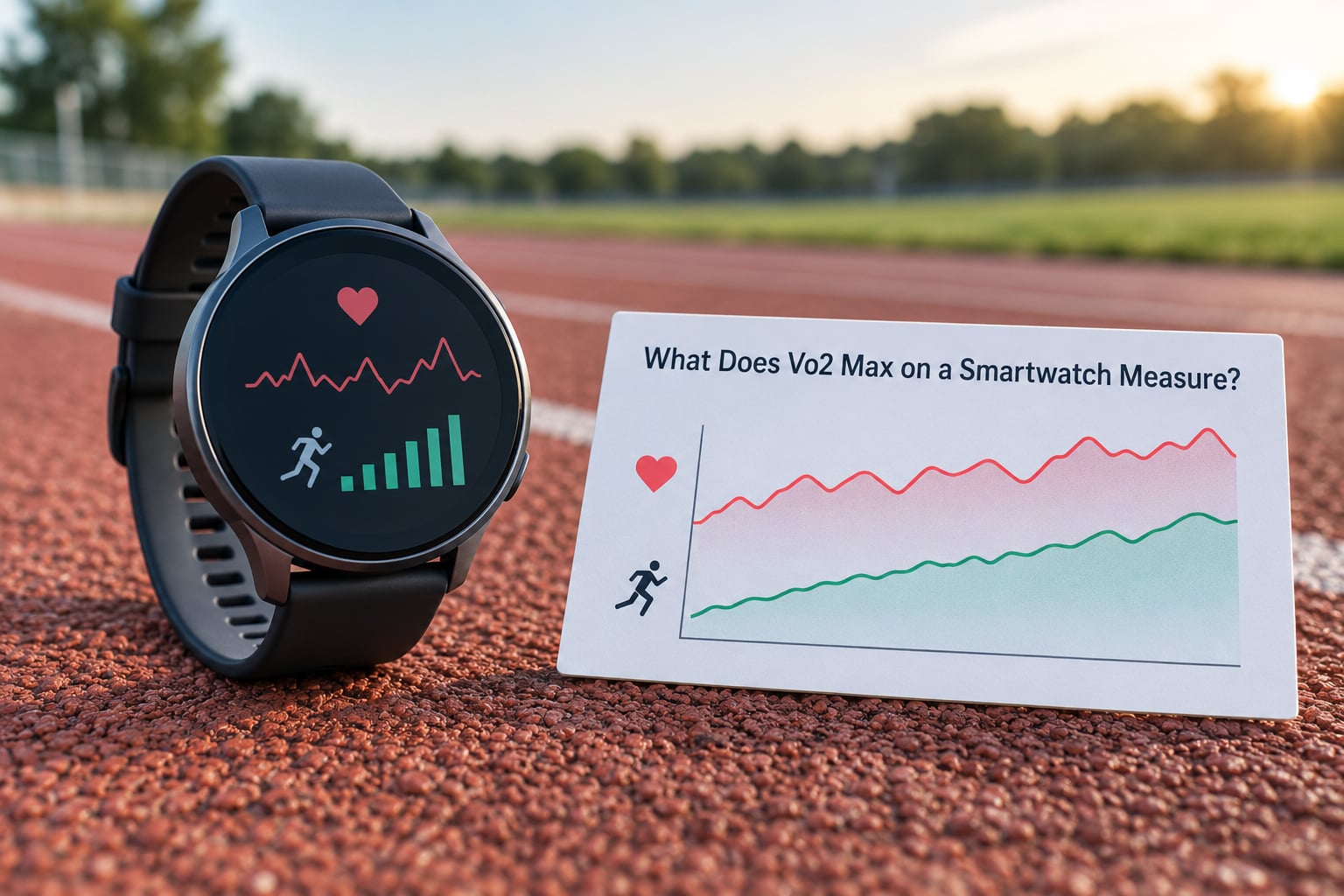
Wrist devices have no oxygen sensor. There is no mouthpiece, no treadmill, no mask. Every watch and ring estimate instead, and the estimate is really a prediction: the watch takes the heart rate it recorded, the speed it tracked with GPS, how long the workout lasted, and details from your profile such as age, sex, height and weight, then feeds those inputs into a physiological model of aerobic power.
Because it is a model output rather than a measurement, most brands require a qualifying session before they will produce a number at all. The usual rule is an outdoor walk or run of about 20 minutes or longer with steady pace and little elevation gain.
Three factors move the estimate around the most. Heart rate accuracy decides whether the model has a clean signal to work with. Whether you wore the watch snug and stayed still matters as much as the workout itself. And your profile inputs have to be right, because a stale weight quietly skews a figure that is divided by body weight.
What Is a Good Vo2 Max Score?
There is no universal good score. The number only means something against other people of a similar age and sex, and even then it describes aerobic fitness, not overall health. A 28-year-old and a 58-year-old reading the same 42 are describing very different bodies.
Fitness generally peaks in the early twenties and declines gradually from there, with the drop steepening later in life. Typical reference bands look like this.
| Age | Poor | Fair | Good | Very good | Excellent |
|---|---|---|---|---|---|
| Men | |||||
| 20-29 | Below 40 | 40-45 | 46-52 | 53-59 | 60 and above |
| 30-39 | Below 35 | 35-40 | 41-47 | 48-53 | 54 and above |
| 40-49 | Below 32 | 32-37 | 38-43 | 44-49 | 50 and above |
| 50-59 | Below 27 | 27-32 | 33-39 | 40-44 | 45 and above |
| 60-69 | Below 22 | 22-27 | 28-33 | 34-39 | 40 and above |
| Women | |||||
| 20-29 | Below 32 | 32-36 | 37-42 | 43-47 | 48 and above |
| 30-39 | Below 28 | 28-32 | 33-38 | 39-43 | 44 and above |
| 40-49 | Below 24 | 24-28 | 29-34 | 35-39 | 40 and above |
| 50-59 | Below 21 | 21-25 | 26-30 | 31-35 | 36 and above |
| 60-69 | Below 18 | 18-21 | 22-26 | 27-31 | 32 and above |
These bands come from published reference charts rather than from any single manufacturer, so treat them as a guide. Every company sets its own cut-offs, which is why Garmin will call a 33 fair while a general fitness chart labels the same number average.
One more distinction trips people up. Absolute VO2 max is total millilitres per minute. Relative VO2 max divides that by your body weight, and the number on your watch is the relative version. That is why two people with the same fitness level can show different scores, and why your score shifts when your weight changes.
How Do You Read a Vo2 Max Result on a Smartwatch?
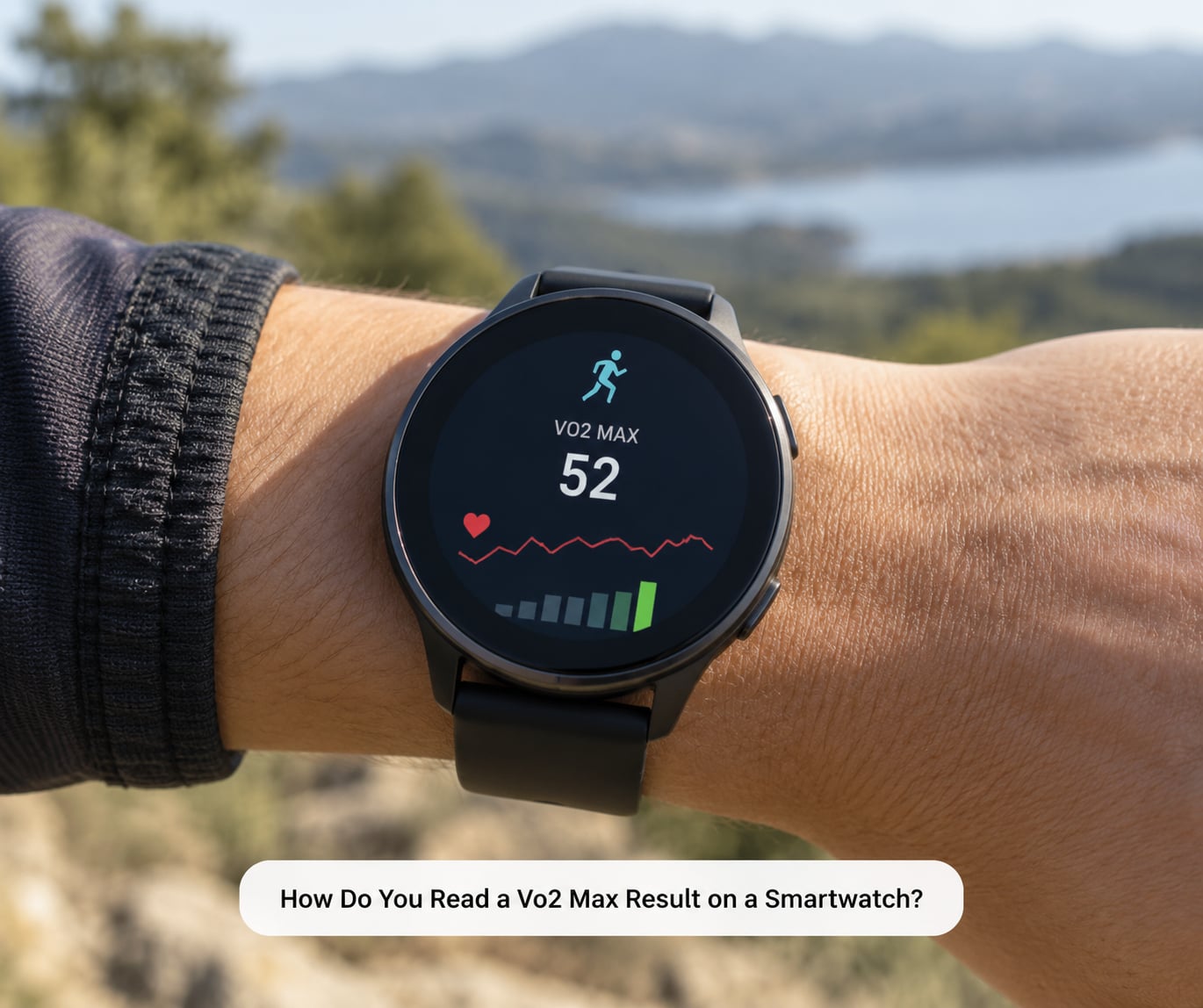
The score is usually buried in a summary screen rather than sitting on the main dashboard. Menu names shift between manufacturers and between app versions, so check your own app if these paths do not match.
On a Garmin watch with the Garmin Connect app
Open Garmin Connect, then go to Health and Performance Stats. Your current VO2 max sits near the top with a fitness age reading, and tapping the metric opens the full history graph. Long press the card on the watch face itself to jump straight to the page.
On a Wear OS watch with Samsung Health or Google Health
Open the health app, tap the dashboard or Steps card area, and look for Cardio or Heart Rate. On most Samsung Health builds the value appears under Health, then Heart, then Cardio Fitness or Vitals, where it is grouped with blood oxygen and heart rate readings. Google Health on the newest Pixel Watch builds places it in the Vitals section of the daily report.
On a Xiaomi or other Wear OS watch
The metric lives wherever the active health provider puts it. Open your health app, find the daily summary or Vitals tab, and look for cardio fitness or VO2 max. Xiaomi’s own fitness app on Mi Band and Redmi watches uses the label Cardio capacity for the same figure, and some builds show it as a percentage against an age range instead of a raw number.
On a Huawei watch with Huawei Health
Open Huawei Health, tap Device, then scroll to Heart rate and the health card list. The cardio capacity figure appears there alongside your stress and sleep summaries, and the trend view shows previous readings.
Whatever the path, look for two things: the current value and the history graph. The single number tells you almost nothing on its own.
How to Interpret Vo2 Max on a Smartwatch: The Trend Framework
Interpret the slope, not the value. Four checks matter more than the figure itself.
Start with direction over time. Open the history graph and ask whether the last three months trend up, flat or down. A number that drifts upward a point or two across a season of steady training is a good sign even if it never looks impressive in a single screenshot.
Next, compare it only with your own previous readings. Change is the meaningful unit here. A three-point rise in eight weeks means something real for your body. The same three points compared with a stranger tells you almost nothing.
Then check the conditions around each workout that produced an estimate. A session on a hot day, an unusually hilly route, a week of poor sleep or a workout where the watch slipped around your wrist will all read lower than the same effort in calm conditions.
Finally, treat the fitness label as a rough signpost rather than a verdict. Labels are useful because they compress a wide range into something glanceable. They are unhelpful when you compare them across brands, because every manufacturer draws its boundaries differently.
What Do the Fitness Labels and Numbers Mean?
Garmin is the most explicit of the major platforms, pairing the score with a band and an age-group percentile, so a reading of 33 can show as fair and sit in the lower half of the same age group. Apple tends to show cardio fitness level as a single number with its own reference curve. Samsung, Huawei and Xiaomi use label scales that differ again.
That variation is the whole problem with these labels. A number that one app frames as average can be framed as good by another, because the cut-off is set by the manufacturer, not by the research.
A useful habit is to record the raw number alongside the label every time you check. Labels can be re-tuned in a software update and change underneath you; the raw number usually does not.
How Can You Improve Your Vo2 Max?
VO2 max responds to aerobic work, and it responds slowly. These are general training principles rather than a plan built for you, so take any specific prescription to a coach or a doctor.
Consistency beats intensity for most people. Three to four aerobic sessions a week, spread across the week, produce a more durable rise than one hard effort followed by silence.
Mix your intensities. Steady work at a conversational pace builds the aerobic base, while short hard efforts raise the ceiling. Weekly guidelines commonly describe around 150 minutes of moderate activity, with some harder sessions on top.
Watch your heart rate zones rather than your pace. Zone 2 work, the kind where you can speak in sentences but not sing, is where most of the aerobic gain happens. A chest strap gives a more trustworthy zone reading than an optical wrist sensor if zone accuracy matters to you.
Recover properly. VO2 max adapts during rest, not during the session. Sleep, days off and reduced weeks are what let the adaptation stick.
Why Does My Smartwatch VO2 Max Change?
A sudden move is usually a measurement event rather than a fitness event. These are the common triggers.
A gap in training is the first suspect. Two weeks off will pull most estimates down, and that is a real change in fitness, not an error.
Illness, dehydration and heat all suppress performance, and the watch reads the suppressed performance. A hard week followed by a rest week often shows a dip that reverses on its own.
Elevation and terrain matter. A hilly run that feels much harder than your usual flat route can produce a lower estimate because the pace data is uneven.
Profile changes cause re-estimation. Updating your weight, height or age makes the device recalculate against new inputs, which can move the figure without any change in your fitness.
Software updates can shift things too. Sensor algorithms, heart rate processing and qualifying rules have all changed across firmware revisions, and a revised model will read your history differently.
Finally, watch fit and sensor contact. A loose strap, movement during the session or an optical sensor reading poorly will degrade the input the model depends on.
If a drop coincides with none of these and lasts more than a few weeks, treat it as information rather than a verdict, and see the last section below.
How to Measure VO2 Max Accurately on a Smartwatch
You cannot make an estimate into a measurement, but you can make it more repeatable. That is what matters for reading a trend.
Wear the watch where it belongs, snug enough that it does not slide, and check the sensor window is clean and dry before a session. Loose fit is the most common avoidable error.
Use a supported outdoor workout. Running or walking outdoors with clean GPS beats an indoor session, and most brands need roughly 20 minutes at a steady pace with minimal elevation.
Keep your routine fixed. Same workout type, similar time of day, similar weather. Comparing a hot-weather run against a cool-morning one produces noise, not data.
Pair a chest strap when you can. Optical wrist sensors drift more, especially at higher intensities where movement interferes with the reading.
Collect several readings before you conclude anything. Most estimates need a few weeks of qualifying workouts before the figure stops moving around, and the first one to appear is the least reliable.
Can You Compare VO2 Max Scores from Different Smartwatches?
Not directly. Each brand uses different sensor hardware, different qualifying rules and a different model, so the same runner can produce very different numbers on two devices.
One well-documented case on the COROS subreddit described a runner whose score fell from 48 on Garmin to 38 after switching, then took roughly 16 months of steady training on the new watch to climb back to 43. Nothing about his fitness changed that dramatically. The model did.
Before comparing anything, check these: whether both values are relative or absolute, whether your profile was entered the same way, whether the workout protocol matched, and whether the units are the same. If any of those differ, the comparison is meaningless.
Switching brands invalidates your historical trend. Keep old screenshots so you can rebuild a personal baseline rather than assuming continuity.
When Should You Stop Relying on a Smartwatch VO2 Max Reading?
Treat the metric as a wellness indicator and step away from it when symptoms are involved. Any chest pain, unusual breathlessness, dizziness or a sharp drop in exercise tolerance deserves a conversation with a doctor, regardless of what your watch shows.
Also seek advice if your score falls a long way and stays there without an obvious training explanation, or if it keeps contradicting what you feel during your sessions. Trust the sensation over the screen.
If you want a real number, a laboratory metabolic cart test measures oxygen uptake directly and is the only way to remove the modelling guesswork. It is worth doing when a medical decision depends on the result, and it is a useful reality check if your training is at a level where the extra detail pays off.
Frequently Asked Questions
What does VO2 max mean on a smartwatch?
It is the maximum amount of oxygen your body can take in, use and deliver to your muscles per minute per kilogram of body weight, expressed in ml/kg/min. It is the standard marker of cardiorespiratory fitness. Your watch does not measure oxygen directly; it estimates the figure from heart rate, pace and your profile data.
Is a higher smartwatch VO2 max score always better?
Higher generally indicates better aerobic fitness, which tends to track with endurance performance and recovery capacity. But a higher number is not automatically better for your training. Very high scores often come with training volume you cannot sustain, and the number says nothing about strength, mobility or overall health.
Does a smartwatch measure VO2 max accurately?
No wrist device measures oxygen, so every smartwatch produces an estimate from heart rate and movement data. Users comparing their watches with laboratory results report differences of several ml/kg/min between brands, with no clear winner across Garmin, Polar, COROS, Suunto and Apple. Use the trend from one device rather than any absolute value.
How often does a smartwatch update its VO2 max score?
Most platforms refresh the estimate after each qualifying workout, typically an outdoor walk or run of 20 minutes or more at steady pace with minimal elevation. The displayed figure may not move with every session, and it usually needs several weeks of consistent qualifying workouts before it settles. Short or indoor sessions generally do not count.
Can I compare VO2 max readings from different smartwatch brands?
Only with heavy caution, because each manufacturer uses different sensors, qualifying rules and models. A runner switching from one brand to another reported a drop from 48 to 38 that took about 16 months to partially recover, with no real change in fitness. Check that both readings are relative values, use the same units and come from the same workout protocol.
Should I be concerned if my smartwatch VO2 max suddenly drops?
Check for a trigger first: a training gap, illness, heat, dehydration, a hilly route, a loose strap or an updated profile in your app. Most short dips reverse once normal training resumes. If the drop is large, persistent and unexplained, or it comes with chest pain, breathlessness or dizziness, speak to a doctor rather than trusting the screen.
Conclusion: Focus on Your Own Trend
Write down today’s number and the date, then decide on one qualifying workout you will repeat consistently. Once you have a few weeks of that routine, stop checking daily and look at the graph every month or so instead.
The score is useful as a direction of travel for your aerobic fitness. It is not a diagnosis, not a competition, and not something to compare with the person next to you on the treadmill. Learning how to interpret Vo2 max on a smartwatch comes down to that: one device, one routine, and a trend you actually watch.