
Yes, for most people it is. Moving from built-in TV speakers to a soundbar is the single largest audio improvement you can make to a modern television, and it costs one box, one cable and about ten minutes. Whether the next step up to separate speakers is worth buying is a different question, and for many living rooms the answer is no.
This guide works through the whole decision so you can tell soundbar vs tv speakers is it worth upgrading for your situation rather than in the abstract. We look at what each option physically is, how big the jump between them really is, what changes for movies, television and games, and what a soundbar handles badly. No brand pushing, no affiliate links, just the reasoning.
If you are renting, living in a small flat, or already own a mid-range soundbar, skip to the sections that matter to you. Otherwise, read straight through — the verdict lands near the end.
Table of Contents
- Soundbar vs TV Speakers at a Glance
- What Is the Difference Between TV Speakers and a Soundbar?
- How Much Better Is a Soundbar Than TV Speakers?
- Sound Quality and Dialogue Clarity
- How Dialogue Clarity and Bass Control Differ
- Why Soundstage and Surround Immersion Matter
- Is a Soundbar Worth It for Movies, TV and Gaming?
- What About Music Listening?
- Price, Features and Setup Compared
- Which Option Fits Your Room and Budget?
- Which Should You Choose?
- Frequently Asked Questions
- Is it worth upgrading from built-in TV speakers?
- Do I need a soundbar with wireless rear speakers?
- Is a soundbar better than a TV plus separate speakers?
- How do I connect a soundbar to my Android TV?
- Can I use a soundbar for music as well as movies?
- Should I buy a soundbar or a home-theater speaker system?
- Conclusion
Soundbar vs TV Speakers at a Glance
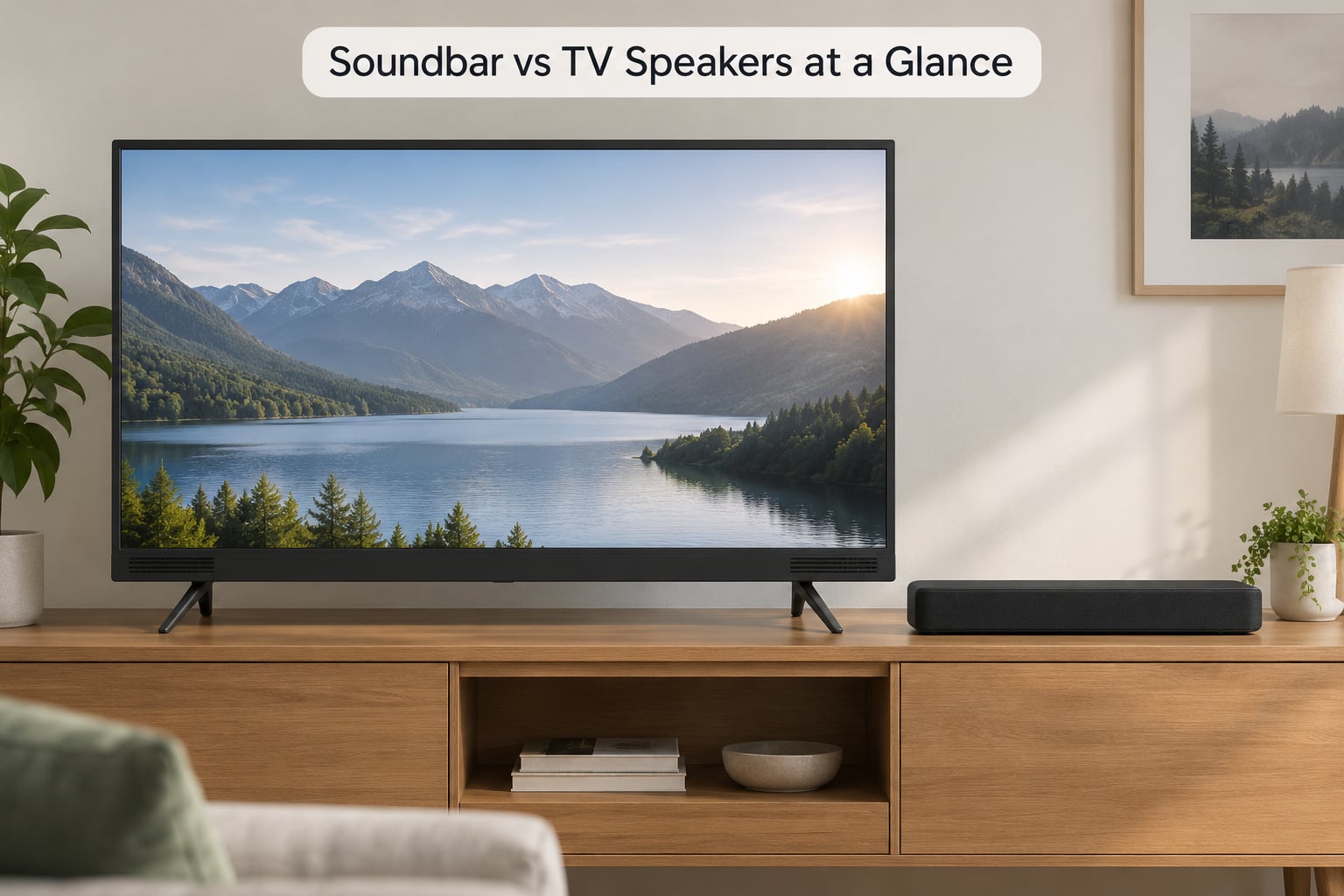
The table below is the whole comparison in one place. It covers the built-in TV speakers, a typical soundbar with an optional wireless bass module, and a full distributed speaker system, because most people end up choosing between the middle two.
| Criterion | Built-in TV speakers | Soundbar | Separate speaker system |
|---|---|---|---|
| Sound quality ceiling | Low; tuned to be acceptable at normal volume | Good to very good depending on the bar and bass module | Best; scales with the components you choose |
| Dialogue clarity | Often poor once music or effects kick in | Noticeably clearer, often the main reason people upgrade | Clearest, especially at low volume |
| Bass depth | Very limited; no real low end | Moderate; better with a wireless bass module | Deep and controlled with a dedicated subwoofer |
| Soundstage width | Narrow; everything comes from a point | Wide from a single enclosure, with limits | Widest and most natural, since drivers are physically spread |
| Surround separation | None | Virtual or simulated, improving with height drivers | Genuine surround channels behind and beside you |
| Physical space | Zero; already built in | One bar, optionally one bass module | Five or more boxes placed around the room |
| Cables needed | None | One HDMI or optical cable | Several runs, speaker wire, and often in-wall work |
| Setup time | None | About ten minutes | An afternoon or a professional install |
| Ongoing flexibility | None | Add wireless rears or a sub later | Mix and match channels and swap parts |
| Best for | News, casual viewing, small rooms, tight budgets | Most living rooms and renters | Dedicated rooms, music-first listening, dedicated cinema |
What Is the Difference Between TV Speakers and a Soundbar?
The difference starts with physics, and it explains almost everything else. Television makers sell thin, light, wall-mountable panels, and every gram and millimetre spent on a bigger speaker is a gram taken from the screen or the chassis. The result is typically two small drivers, sometimes downward-firing into the cabinet, with no room for a proper woofer.
A soundbar solves that by moving the problem. It is a single elongated enclosure that can be three to five times wider than the space the TV gave up, so it fits wider drivers and more of them. Add digital signal processing, and the bar can widen the apparent image, lift dialogue and simulate height channels that have no physical driver at all.
A separate speaker system does something a soundbar cannot: it puts each driver at a real point in your room. Front left and right sit either side of the screen, surrounds sit behind your seating, a subwoofer handles low frequencies somewhere out of the way. An AV receiver runs the channels and usually includes room correction to fix the problems that placement creates.
So the honest summary is this. A soundbar buys you bigger drivers and clever processing in one box. Separate speakers buy you physical separation and real surround channels, at the cost of space, cables and setup.
How Much Better Is a Soundbar Than TV Speakers?
This is the question that comes up most, and the most useful answer is a rough scale. Think of it as a 0 to 100 quality ladder, where 0 is what your TV ships with and 100 is a properly placed surround system with a real subwoofer in a treated room.
| System tier | Approximate score | What you actually get |
|---|---|---|
| Thin TV built-in speakers | 0 to 10 | Clear at low volume, thin and boxy when pushed |
| Entry soundbar, no sub | 40 to 50 | Cleaner voices, wider image, still shallow bass |
| Mid-range soundbar with wireless bass module | 55 to 70 | Dialogue stays audible, effects have weight and direction |
| Flagship bar with height drivers or wireless rears | 70 to 85 | Convincing overhead and rear effects, wide soundstage |
| Placed speaker system with a real subwoofer | 85 to 100 | Genuine channel separation, deep controlled bass, best for music |
Read those gaps carefully. The first jump, from 0 to roughly 50, is the biggest single step most people will ever take in their living room, and it arrives in one box. The second jump, from a good soundbar to a full system, is real but smaller — and it costs several times more and a weekend of your time.
The consensus across home theatre communities matches that shape. People who have owned both report that the jump from built-in TV speakers to a soundbar is noticeably larger than the jump from that soundbar to a full surround setup. Many also describe the first upgrade as transformative specifically for hearing dialogue.
Before you spend anything, run this quick diagnostic to confirm your TV speakers are genuinely the bottleneck:
- Turn on a dialogue-heavy film or a nature programme at your normal evening volume. If you strain to follow speech while effects are playing, the built-in speakers are failing you.
- Watch the same scene on a phone or tablet with headphones or decent earbuds. If that sounds dramatically better, your TV is the weak link, not the streaming quality or the content.
- Check your TV’s audio menu for any equaliser, dialogue boost or sound mode that is switched off or set to a flat preset. Enabling the right setting often buys you part of the improvement for nothing.
- Look at the TV’s speaker grille and check whether the drivers fire downward into a cabinet. If so, clear the space in front of and around the set and listen again.
- Play an Atmos or surround mix and listen for direction. TV speakers collapse everything to a single point in front of you, which is the giveaway that external audio is where the next gain is.
Sound Quality and Dialogue Clarity
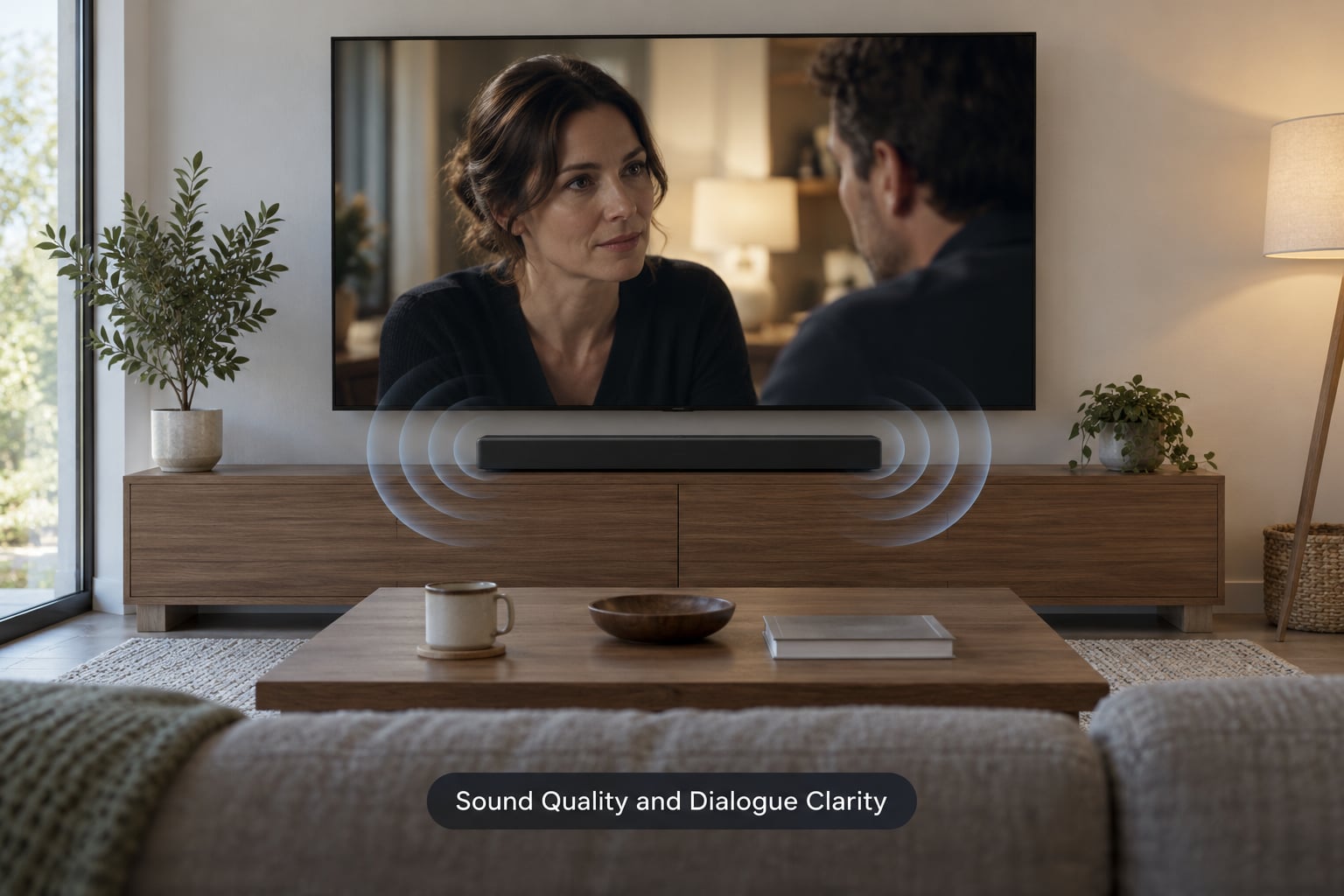
Three things change when you leave the TV’s built-in audio behind, and they matter in this order: how clearly you understand speech, how much weight sits under the picture, and how wide the sound feels around you. Everything else — app support, voice assistants, surround formats — is secondary to those three.
How Dialogue Clarity and Bass Control Differ
Small drivers cannot move much air at low frequencies, so they reproduce bass badly and, worse, that distortion eats into the midrange where voices live. Soundbar vs tv speakers is it worth upgrading comes down to this in most homes: the bar’s wider midrange drivers keep dialogue at the front of the mix instead of under it.
A word on the wireless bass module that ships with many bars. It is not the same thing as a proper subwoofer. It adds weight on film sound effects, which is a real improvement, but it will not produce the deep, clean low end that music and explosions need. If deep bass is your priority, budget for a real subwoofer rather than assuming the included module covers it.
Why Soundstage and Surround Immersion Matter
Soundstage is the sense that sound exists in space around you rather than coming out of a box. Physical driver spacing is what creates it, which is why separate speakers usually win here even when their placement is imperfect.
Soundbars approach the same effect differently. DSP widens the image by adjusting timing and level across the bar’s drivers, and upward-firing drivers bounce sound off the ceiling to fake height channels. Modern object-based processing, including Dolby Atmos, gets surprisingly convincing when a film uses those effects properly. But it stays a simulation: there is no separate speaker behind you, so a scene that should wrap around will always feel front-loaded. Worth knowing before you decide the extra money is wasted.
Is a Soundbar Worth It for Movies, TV and Gaming?
For films it is the clearest win. Action scenes get weight, quiet dialogue stays readable, and a soundbar with height drivers handles Atmos mixes better than any TV. The gap between a soundbar and a full system narrows fastest on films because the codecs are designed to be played through channels a soundbar can only approximate.
For everyday television the difference is smaller but still real. News and talk show the benefit mainly in voice clarity, and a dialogue or night mode is genuinely useful late at night. Talk shows, cooking shows and reality programming will not reveal the limits of any of this.
Sports is a specific case worth calling out, because it is the one most articles skip. Commentary stays audible over a roaring stadium crowd, which is exactly the complaint that drives people to upgrade in the first place. Fans using wireless rears for a bar can get crowd ambience behind them rather than smeared across the front, which makes live football feel less like a broadcast.
Gaming adds its own criteria. What matters is low-latency passthrough for sound and video, so the audio does not drift out of sync with fast movement, plus virtual surround processing that helps you place footsteps and gunfire. Many current bars also pass through high-resolution audio and Atmos from a console. Read the compatibility notes for your console before buying, because passthrough support is the one feature that genuinely varies.
What About Music Listening?
This is where the soundbar argument gets weaker, and it is the main reason experienced listeners buy speakers instead. Two small speakers placed a couple of metres apart produce a genuinely wide stereo image with real space between instruments. A single bar can widen its image, but the drivers still sit inches from each other, so the result is wider rather than properly spaced.
Tonal balance matters too. Music exposes extension problems in the low end and any harshness in the midrange far more directly than film does, because there are no dialogue cues to mask it. Speakers with proper midrange and bass drivers stay comfortable at volume in a way many bars do not.
So the practical rule is simple. If music is occasional background to watching, a soundbar handles it fine, and it can double as a Bluetooth speaker. If music is a regular part of your day, prioritise a good pair of bookshelf speakers with an amplifier, and let the TV use them as a front stage.
Price, Features and Setup Compared
Costs here are relative tiers rather than figures, since pricing changes constantly and varies by region. What matters is what each tier delivers.
- Entry soundbars are a single enclosure with two or three drivers and no wireless bass. They solve dialogue and add width. That is most of the upgrade, and it is a genuinely good value.
- Mid-range soundbars add a wireless bass module, more drivers, height channels and often room calibration. This is the tier where most buyers should stop and where the biggest single gain after the first jump sits.
- Flagship soundbars add more height drivers, tuning, HDMI switching and multi-room support. Past this point you are spending heavily for refinements that a movie reveals and music usually does not.
- Entry speaker systems give you real separation for less money than people expect, but you still need an amplifier or receiver, and ideally a subwoofer for film.
- Full surround systems are where cost climbs, with receiver, five speakers, subwoofer and cables. Add installation if you are not comfortable running wire.
Two hidden costs catch people out. First, the equipment shelf: a receiver and separate speakers need somewhere to live, and a soundbar needs almost nothing. Second, wall sockets. If your room has no convenient outlet behind the TV or beside the seating, a distributed system means running cable or hiring an installer, while a soundbar and wireless rears avoid the problem entirely.
Connectivity decides whether any of it works. The best connection is HDMI eARC from the TV to the bar, which carries surround formats including Atmos and needs a single cable. Most current TVs have at least HDMI ARC, which handles most surround audio but not the newest object-based formats. Optical audio out is the universal fallback and is still on many sets. Check the specifications for your TV model before buying, and if you can, count the HDMI ports marked for audio return.
The rest is housekeeping but still worth checking: remote coverage, so you are not juggling two remotes, Bluetooth and Wi-Fi for music, HDMI switching if you own a console as well as a disc player, and whether the manufacturer still issues firmware updates. A three-year-old bar that no longer receives updates will age badly.
Which Option Fits Your Room and Budget?
Room size matters more than most buyers expect, because it sets the ceiling on what extra speakers can achieve.
| Room size | Realistic choice | Why |
|---|---|---|
| Under about 10 square metres | Soundbar, or compact bookshelf speakers | Full surround has nowhere to separate channels; bass modes help neighbours more than you |
| 10 to 20 square metres | Mid-range soundbar with wireless rears, or a 3.1 speaker system | Enough room for separation, and rears start to earn their place |
| 20 square metres and up | Surround speaker system with a subwoofer | Distance between channels becomes an asset, and cinema processing pays off |
Measure before you buy, not after. For a soundbar, check the width of your media unit or wall mount and whether the bar will clear the bottom of the screen. For speakers, check where the front pair will actually sit, because that position determines soundstage and cannot be fixed later. Also clear the space in front of the bar and around it. A soundbar shoved inside a cabinet sounds worse than the TV speakers it replaced, which is the most common complaint people end up searching about.
There are also two situations where the sensible decision is to do nothing. If your TV sits in a bedroom or a small study and you mostly watch the news, built-in speakers are fine and any money is better spent on the picture. And if you already own a mid-range soundbar that you find satisfying, the second upgrade to separate speakers is a refinement rather than a rescue, so it is worth living with what you have first.
One last consideration: if your picture is genuinely weak on a large screen, the TV itself is now the biggest limitation, and better audio will only get you so far. Some people notice that after upgrading sound. Fix the problem the eye catches first, not the one you read about online.
Which Should You Choose?
The verdict depends on who you are rather than on the technology. Match yourself to one of these:
- Keep your TV speakers if you watch in a bedroom or small study, mostly watch news and talk shows, or your TV is under about 43 inches and sits on a stand away from your seat. Run the diagnostic above first; if you pass it, keep what you have.
- Buy a soundbar if you cannot hear dialogue comfortably, you rent, your room is small, or you want the largest improvement for one box and one cable. This is the best value upgrade for most living rooms, and it is the answer for most people reading this.
- Step up to a surround-capable system if you watch films most days, sit far from a large screen, and have the space, sockets and patience for a receiver, speakers and a subwoofer. Consider the soundbar-plus-wireless-rears path as a middle step that keeps the cable count down.
- Choose speakers for music-first listening if music is a daily habit rather than an occasional soundtrack. Bookshelf speakers with an amplifier will serve both the TV and music, and you can add a centre channel and subwoofer later.
- Do both, in stages if you are unsure. A soundbar now, and surrounds plus a proper subwoofer later, is the most common upgrade path and loses nothing at the first step.
Frequently Asked Questions
Is it worth upgrading from built-in TV speakers?
Yes, for most people this is the best value audio upgrade available. Thin TVs ship with small drivers that cannot produce bass or keep dialogue audible over effects, so moving to a soundbar fixes a real weakness rather than chasing marginal gains. If you strain to follow speech at normal volume, or sound effects smear into a single point in front of the screen, your TV’s speakers are the bottleneck.
Do I need a soundbar with wireless rear speakers?
Only if your room has space behind or beside your seating and you watch films and live sport most days. Wireless rears add ambience and directional effects that a single bar cannot fake, and they avoid running cables across the room. In a small flat or when neighbours matter, the front channels and a wireless bass module do most of the work for most of the benefit.
Is a soundbar better than a TV plus separate speakers?
Neither is better in general, they are better at different jobs. A soundbar gives a wide, clear soundstage with almost no effort and takes up one shelf. Separate speakers give genuine surround separation, better bass and a much better result for music, but need an amplifier or receiver, several boxes and cable routing. Choose on room size, music habits and how much effort you want, not on sound quality alone.
How do I connect a soundbar to my Android TV?
Use HDMI eARC if your TV has it: plug one end into a port marked eARC, ARC or eARC/ARC on the television, and the other into the bar’s matching HDMI input, then enable eARC or ARC in the TV’s sound settings. If the TV has no such port, use optical audio out or an older HDMI port and select the matching input on the bar. Name menus differ by brand, so check your model’s settings guide.
Can I use a soundbar for music as well as movies?
Yes, most current soundbars support Bluetooth and Wi-Fi streaming, and a bar with a wireless bass module handles pop, film scores and podcasts well. Stereo imaging is the compromise, since the drivers sit inches apart rather than across a room, so a wide but shallow soundstage is typical. If you listen to music daily, a pair of bookshelf speakers serves that better and can still be used as the TV’s front channels.
Should I buy a soundbar or a home-theater speaker system?
Buy a soundbar if you rent, have a small or awkward room, want one box and no wiring, or want the biggest gain for the least effort. Buy a home-theater speaker system if you have a dedicated room, can run cable or use wireless rears, sit far from a large screen, and want genuine surround channels with a real subwoofer. Add wireless rear speakers to a good soundbar later if you want to grow into the second option.
Conclusion
So, soundbar vs tv speakers is it worth upgrading? For most living rooms, yes, and the soundbar is where the value is. The jump from a thin TV’s built-in audio to a soundbar with a wireless bass module is the largest single improvement most people will ever make, and it costs one box and one cable. Move to separate speakers when music is a daily habit or you have a room that can genuinely separate channels.
Before spending, check four things: measure the shelf or wall space, run the dialogue test at your normal volume, confirm your TV has HDMI eARC or optical out, and decide whether you want the simpler life or the better music. Those four answers settle the question faster than any spec sheet.