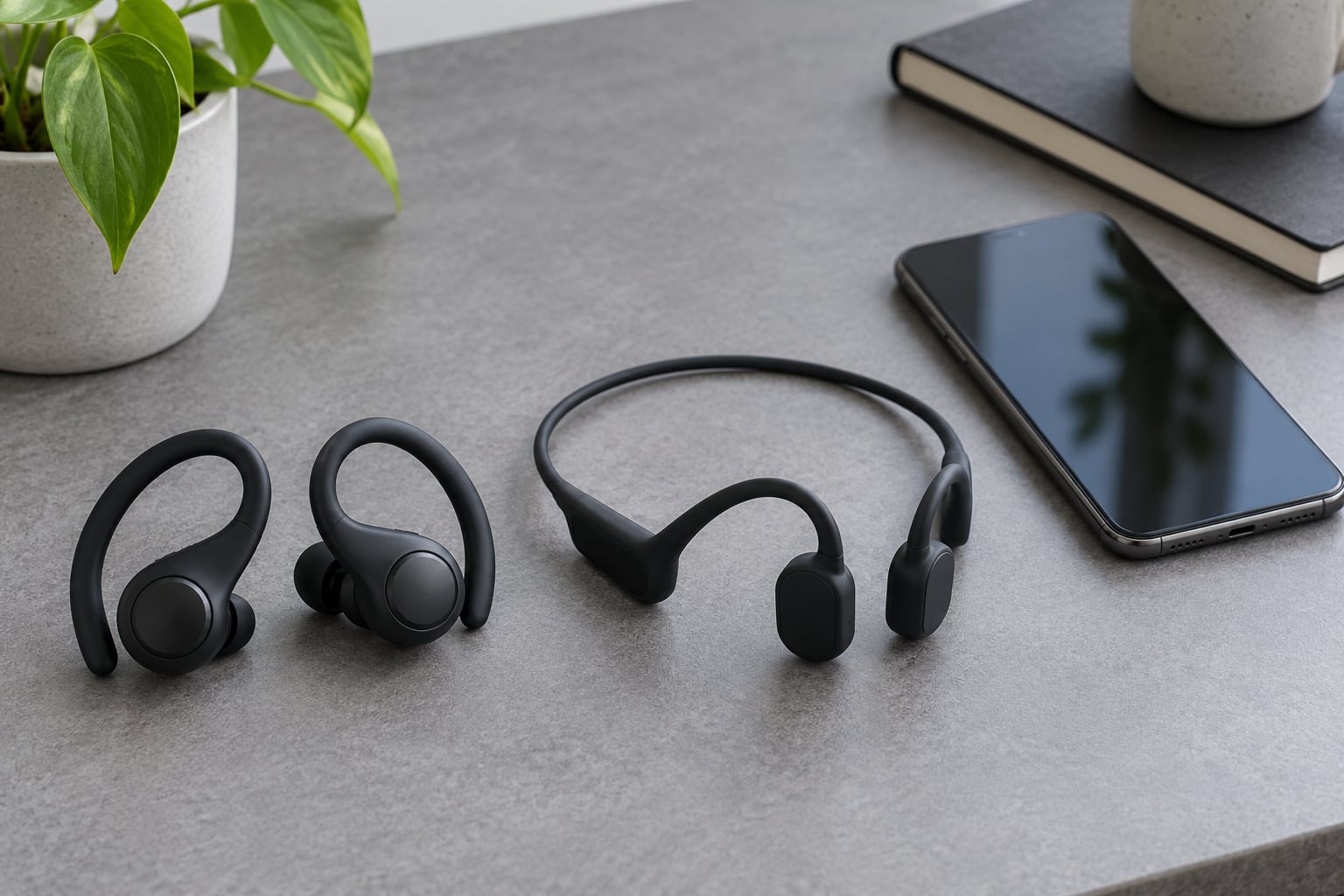
Open ear headphones vs bone conduction comes down to one thing: whether sound reaches you through the air or through your skull. Pick open ear if music quality and all-day comfort come first, and pick bone conduction if you swim, cycle in traffic, wear hearing aids or simply want your ears as free as possible.
Both types sit in the same shelf category, both are wireless, and neither blocks your ears. Beyond that they behave very differently, and most of the confusion comes from shoppers using “air conduction”, “open ear” and “bone conduction” as if they were interchangeable. They are not. Two of those three mean the same thing.
Switching between the two on runs, cycles and desk days tends to change the honest answer, because what matters depends on what you are doing when the music starts.
Disclosure: this site earns a commission from qualifying purchases. That never changes what we recommend.
Table of Contents
- Open Ear Headphones vs Bone Conduction at a Glance
- How Open Ear Headphones and Bone Conduction Work
- Sound Quality and Bass
- Open ear headphones vs bone conduction for bass and detail
- Where bone conduction still wins on sound
- Comfort, Fit, and Long Wear
- Open Ear Headphones vs Bone Conduction for Running and Outdoors
- Calls, Microphones, and Everyday Use
- Battery Life, Durability, and Price
- Which Should You Choose?
- Frequently Asked Questions
- Are bone-conduction headphones better for music than open-ear headphones?
- Which is better for running: open-ear or bone-conduction headphones?
- Can I wear open-ear headphones with prescription glasses?
- Do open-ear headphones protect my ears better than earbuds?
- Are bone-conduction headphones suitable for swimming?
- Which type is better for phone calls in a noisy place?
- Conclusion
Open Ear Headphones vs Bone Conduction at a Glance
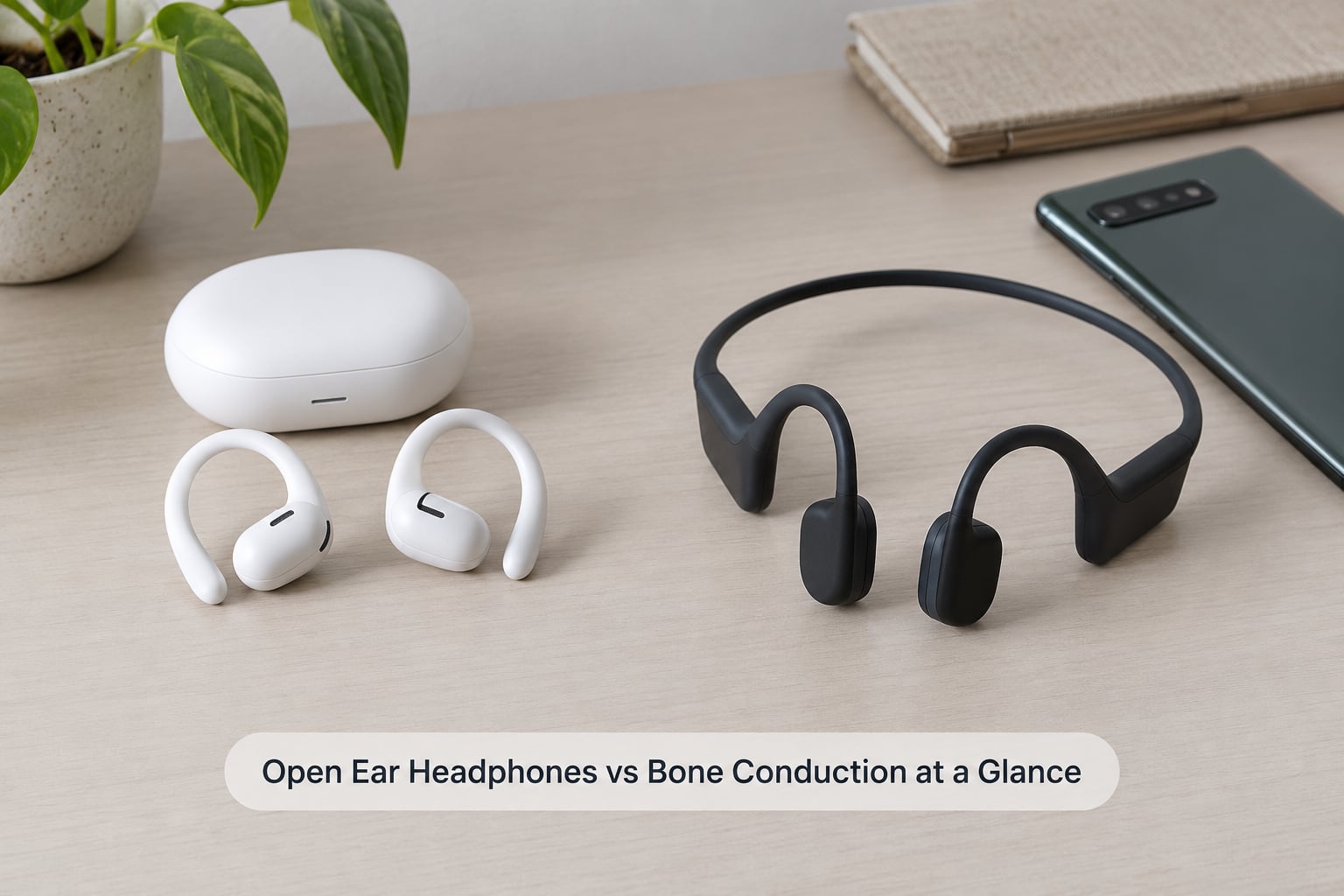
| Criterion | Open ear headphones (air conduction) | Bone conduction headphones |
|---|---|---|
| How sound reaches you | Small speakers aimed down an open ear canal | Vibration through the cheekbone and skull to the inner ear |
| Ear contact | Hangs on the outer ear or clips to the earlobe, canal stays clear | Rests on the cheekbone, canal stays clear |
| Bass and detail | Noticeably fuller, warmer, closer to normal earbuds | Thin and mid-heavy, best on voices |
| Perceived volume | Easy to reach a comfortable level | Often needs turning up, and leaks more when you do |
| Situational awareness | Good, though music masks some of it | Best available, nothing covers your ear |
| Sound leakage | Noticeable on a train, quiet near a desk at moderate volume | Very audible to people nearby, especially at volume |
| Comfort over three hours | Good if the fit is right, can rub or slip | Cheekbone pressure builds, band can feel tight |
| Glasses and helmet straps | Usually fine, depends on the hook shape | Straps and temple arms fight the headband |
| Hearing aid use | Works, sits away from the canal | Strongest option, clear of both ear and aid |
| Water resistance | Commonly sweat and rain rated | Commonly swim-capable on dedicated models |
| Best for | Music, podcasts, commuting, desk days | Swimming, running, cycling, hearing loss |
How Open Ear Headphones and Bone Conduction Work
Bone conduction headphones rest on your cheekbones and use a component called a transducer to turn audio into mechanical vibration. That vibration travels through the bone of your skull and reaches the cochlea, the inner-ear organ that converts movement into nerve signals. The eardrum and the ear canal are bypassed completely.
Open ear headphones skip none of that. They use ordinary speakers, the same kind that sit inside a normal earbud, but position them outside or just inside the opening of the ear and fire the sound down an unoccluded canal. Air carries the signal exactly as it always does. The only difference is the absence of a seal.
That is also why the two words get tangled. Open ear and air conduction describe the same technology from different angles: one names the physical design, the other names the mechanism. Bone conduction is the genuinely different approach.
The practical consequence follows directly from the physics. Bone conduction has to move a skull and a jaw, which are heavy and damped compared with air, so low frequencies lose energy on the way through. Skip the seal and nothing is lost, but the open canal leaks whatever you are playing back into the room.
Sound Quality and Bass
Open ear headphones win on sound quality, and it is not a close call. Speaker-based designs get bass and warmth that bone conduction simply cannot reproduce, because they still have an air column to push. Music has a sense of scale and a low end that feels present rather than implied.
Bone conduction designs are tuned the opposite way. Vocals and high-pitched sounds come through clearly, which is why podcasters and audiobook listeners gravitate to them, and why they work as training companions where spoken pace matters more than a bass line.
The word “volume” deserves its own note. Bone conduction feels quieter for the same setting, so users push the level up, and louder means more leakage. This is the single most common complaint in owner feedback and the reason strangers hear your music several metres away.
Open ear headphones vs bone conduction for bass and detail
Test both with something you know: a track with a kick drum, a podcast at low volume, and an audiobook while walking. Open ear will hold the kick and the strings. Bone conduction will hold the speech and lose the kick.
Sealed earbuds with a good transparency mode still beat both on isolation and on bass at low volume, which is worth remembering if music is your main reason to wear headphones at all.
Where bone conduction still wins on sound
On intelligibility under movement it holds its own. Speech stays legible while you run, and because nothing sits in the canal, there is no thumping occlusion effect when your foot lands, which is the artefact that makes ordinary earbuds unpleasant on a run.
Comfort, Fit, and Long Wear
Neither type pushes anything into your ear canal, so both avoid the pressure headaches of long in-ear sessions. What replaces it is a different set of complaints.
Open ear comfort depends entirely on shape. An earhook loops around the outer ear and needs a stable anchor; a clip-on cuff grips the lobe and is the least noticeable option; a battery pod design adds a lump behind the ear that some people dislike. All three can work with glasses, though a thick hook can push a temple arm out of place.
Bone conduction comfort is mostly about headband tension. Tight enough to stay put over a run, loose enough to forget, and the difference is only a few millimetres. Push past that and the cheekbone pads create a dull ache after two or three hours, which several owners describe as pressure fatigue. Hair matters too: a thick ponytail or a bun sits under the band and ruins the fit.
One group should weigh this carefully. If you wear earbuds as well and want both at once, bone conduction keeps the canals free. Open ear usually blocks an earbud unless the hook is very slim.
Open Ear Headphones vs Bone Conduction for Running and Outdoors
For running, both work and the deciding factor is what else is on your head. Bone conduction wins on total awareness and durability, and it is the safer choice beside busy roads or when you run in the dark. Nothing covers your ear, so an approaching car arrives as a full sound rather than a hint under music.
Open ear wins on enjoyment. If your run is on a quiet canal path or a treadmill, fuller sound matters more than awareness you will not use, and the fit of a well-designed earhook or cuff stays put through intervals that make a headband slip.
Wind is where both disappoint. Gusty noise rides along with music on both, and open ear tends to suffer more because the speaker is in the airflow. A foam mic windscreen helps calls, not playback. Neither gives you noise cancelling, so beside heavy traffic you are turning the volume up against masking, which is precisely the situation where you want your ears open.
For cycling, helmet straps are the deciding factor. Straps and earhooks compete for the same space above the ear, while a bone conduction band sits higher and clears most straps. Riders who wear a helmet every day usually end up with the headband.
Calls, Microphones, and Everyday Use
Microphone placement decides call quality. Bone conduction microphones sit at the end of the band near your mouth, so they pick up your voice cleanly but also pick up wind and street noise. Open ear microphones sit further out, and the hook itself can act as a small wind baffle. In practice, test calls in real street noise, because both camps handle wind differently.
For office use the two solve different problems. Open ear gives you music without blocking announcements, at the cost of your colleagues hearing it. Bone conduction gives you awareness of the room, which is more useful for short bursts and nothing at all if you want sustained focus.
One genuine limitation applies to both. You cannot easily hold a two-way conversation while wearing either type at a level you actually enjoy. Removing one ear or dropping to lower volume is the normal routine, and pretending otherwise is how people end up missing important information.
Battery-wise, the pod and case designs add bulk, and Bluetooth multipoint pairing has become common enough to expect. Check for USB-C charging and quick charge, since sport use drains these faster than commuting does.
Battery Life, Durability, and Price
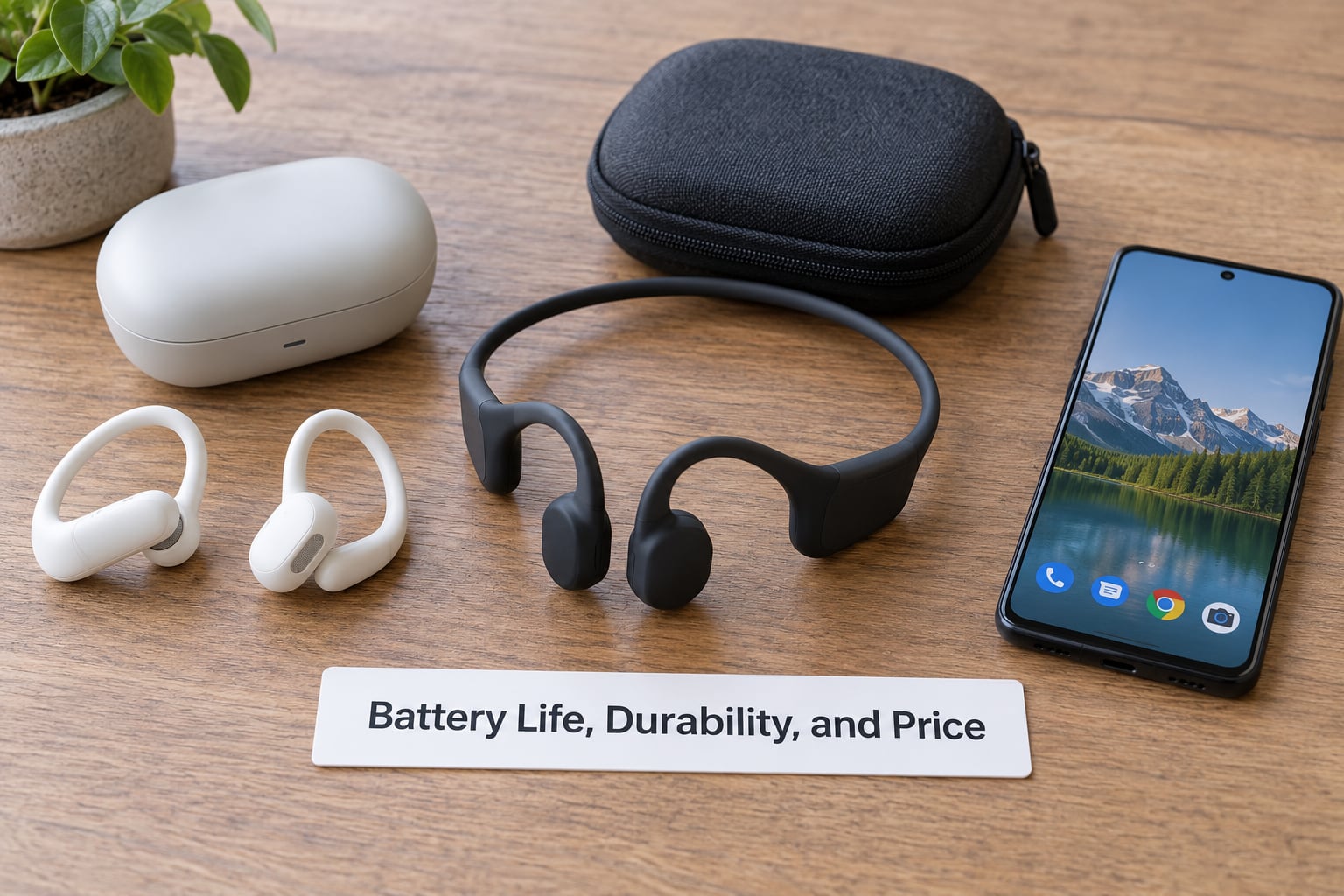
Battery expectations are similar in shape rather than in exact numbers. Both types run a working day of playback at moderate volume, several run longer with the case or pod included, and heavy volume cuts that sharply. Open ear designs with a battery pod often lose a little more per charge because the pod carries the cell and the amplifier.
Durability is the cleaner divider. Look at the IPX rating rather than the marketing. IPX4 handles sweat and rain, IPX5 handles sweat and splashing, and IPX7 handles immersion, which is the only tier that genuinely suits swimming. Bone conduction models dominate the top of that scale because the body of the device is a headband rather than a sealed earbud, and there are well-known swim-capable models from Shokz for that reason.
On price, both categories span cheap clip-on designs to flagship hardware, and bone conduction sits at the expensive end at the top. That gap is the real budget question, since a reader asking about value usually wants to know whether the bone conduction premium is worth paying at all.
It is worth it for swimmers, cyclists with a helmet and anyone with hearing loss, because those are cases where the other type genuinely struggles. For everyone else it buys a marginally more secure fit and slightly better awareness than a good clip-on design already provides.
Which Should You Choose?
- Music-first listening: open ear. Fuller sound, better bass, and you can wear sealed earbuds with transparency mode if isolation matters more.
- Running on roads or in traffic: bone conduction for total awareness, open ear for sound quality on quiet routes.
- Cycling with a helmet: bone conduction, since the band clears helmet straps.
- Swimming or pool work: bone conduction, and only an IPX7-rated model.
- Commuting and public transport: either. Open ear for podcasts, bone conduction if you want announcements without removing anything.
- Office and desk days: open ear at moderate volume, bone conduction if you need to hear the room rather than the music.
- Hearing loss or hearing aid use: bone conduction. It keeps both the ear and the aid unobstructed, and single-sided deafness still gets stereo.
- All-day wear with glasses: open ear clip-on or slim hook designs, tested with your actual frames.
Two groups should look elsewhere. If you care about isolation in a noisy place, neither type delivers it, and sealed earbuds with a transparency mode are a better tool. If you never wear headphones in the rain or a pool, the water-resistance advantage of bone conduction is not worth anything to you.
Frequently Asked Questions
Are bone-conduction headphones better for music than open-ear headphones?
No. Open ear headphones use ordinary speakers firing into an unoccluded ear canal, so they keep more of the bass, warmth and detail that music depends on. Bone conduction drives vibration through the skull, which loses low-frequency energy, so voices stay clear while kick drums and bass lines fall away. For podcasts and spoken-word training sessions the gap narrows considerably.
Which is better for running: open-ear or bone-conduction headphones?
Bone conduction is the safer choice near traffic and in poor light, because nothing covers your ear and approaching vehicles arrive as full sound. Open ear wins when sound quality matters more than awareness, such as on a quiet route or a treadmill. Fit decides more than technology: an earhook tuned for your ear outline beats a loose headband in either category.
Can I wear open-ear headphones with prescription glasses?
Usually yes, but the hook shape decides. A slim earhook that runs below the temple arm works fine with most frames, while a thicker hook can push glasses down or out of place on every stride. Clip-on cuffs avoid the problem entirely because they grip the earlobe and touch nothing above the ear. Try them with your usual frames before you commit.
Do open-ear headphones protect my ears better than earbuds?
They reduce one specific risk: nothing sits in the ear canal, so there is less irritation, less trapped moisture and no need to push tips deep for a seal. They do not protect against noise-induced hearing damage, which is driven by volume and duration rather than by the form factor. Keep the level moderate and take regular breaks with any type.
Are bone-conduction headphones suitable for swimming?
Only if the specific model is rated for it. Look for an IPX7 rating or a swim-focused model from a brand that makes one, since the headband form factor survives immersion far better than an earbud ever could. IPX4 and IPX5 cover sweat and rain only. Even swim-rated models usually mean pool use, not open water with salt or cold.
Which type is better for phone calls in a noisy place?
Neither is a winner in real street noise. Bone conduction microphones sit closer to your mouth, so your voice stays clearer, though the band picks up wind and traffic. Open ear mics sit further out, but the hook itself works as a small wind baffle. Run a test call in genuine noise before buying, and treat any wind screen included as a help rather than a fix.
Conclusion
Start with your priority rather than the technology. Better music and longer wear sessions point to open ear headphones, and the harder requirements, water, a helmet strap, hearing aids or maximum awareness, point to bone conduction. That is the whole of the open ear headphones vs bone conduction decision in practice.
If you are still undecided, hold one of each on your desk for a week and use them the way you actually live, because the difference stops being theoretical the moment you put them on. Last updated: October 2026.