What IP68 water resistance really means for phones is narrower than most spec sheets suggest: the device is dust-tight and certified to survive continuous immersion in fresh water under laboratory conditions. It is not waterproofing. The depth and the duration come from the manufacturer, not from the code itself, and plenty of everyday situations sit outside the test.
Most confusion comes from a single repeated line: that IP68 means 1.5 metres for 30 minutes. That figure belongs to one manufacturer’s specification, not to the rating system. Here is what IP68 actually covers, what it does not, and what to do the moment your phone gets wet.
Table of Contents
- What Does IP68 Water Resistance Really Mean for Phones?
- What Do the IP Numbers Mean?
- How Deep and for How Long Can an IP68 Phone Survive?
- Why the 8 in IP68 does not mean 1.5 metres
- What IP68 water resistance really means for your specific phone
- Can an IP68 Phone Survive Rain, the Sink or a Pool?
- Is an IP68 Phone Waterproof?
- What Can Damage an IP68 Phone?
- What Should You Do After Your Phone Gets Wet?
- How to Protect Your IP68 Phone Without Overprotecting It
- Frequently Asked Questions
- Can I swim with an IP68 phone or take photos underwater?
- Is IP68 really waterproof or just water resistant?
- How deep can an IP68 phone actually go?
- Can you fix a water damaged phone with rice?
- How long does water damage take to show up on a phone?
- Does IP68 still count after a screen or battery repair?
- The Bottom Line
What Does IP68 Water Resistance Really Mean for Phones?
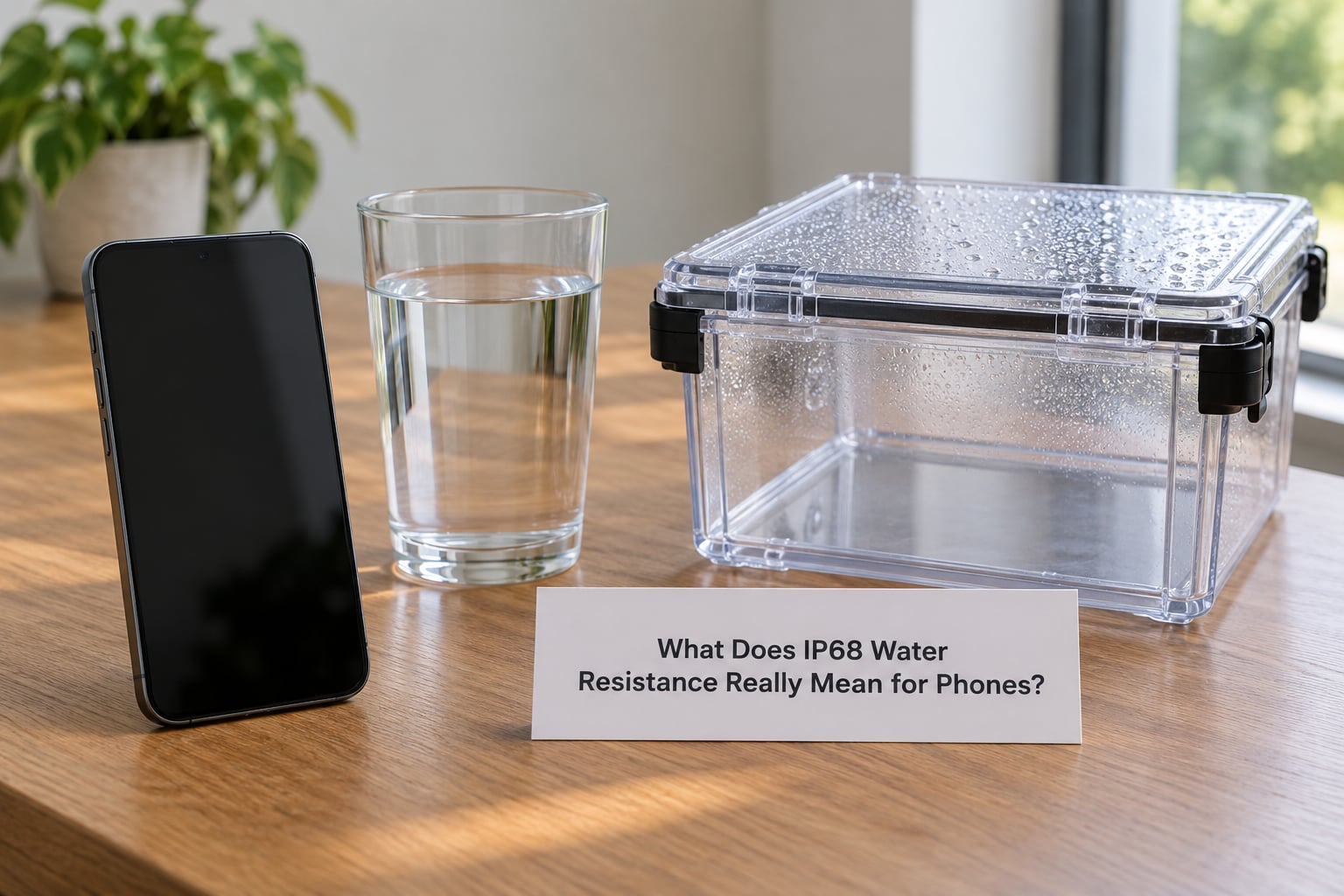
IP68 is an Ingress Protection code defined by the International Electrotechnical Commission under standard IEC 60529. The letters IP stand for ingress protection. The first digit, 6, means the enclosure is dust-tight, so no dust enters it. The second digit, 8, means the device is protected against the effects of continuous immersion in water.
Continuous immersion is the key phrase, and it is where most spec-sheet language oversells the rating. The 8 certifies the phone was tested in a lab tank, in still fresh water, at a depth and duration the manufacturer chooses and then publishes. A rating describes a result that happened to a test unit, not a promise about your phone in a real situation.
What IP68 does not mean is equally clear. It does not mean the phone is waterproof, that it can go in the sea or a chlorine pool, that it can be charged while wet, or that liquid damage will be repaired under warranty. Every one of those exclusions appears in the fine print of the manufacturers that print the number at all.
What Do the IP Numbers Mean?
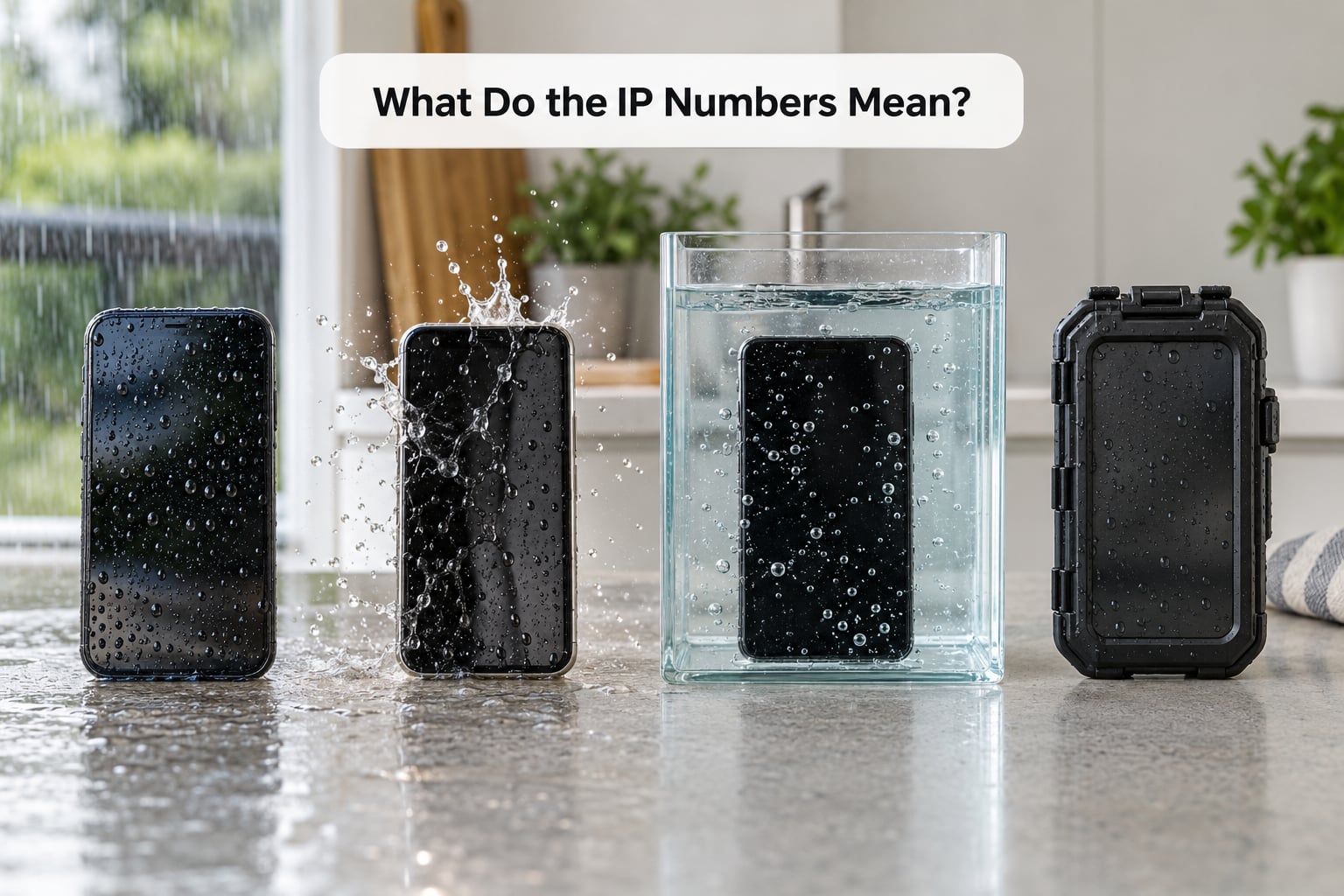
The IP code has always been two positions, and a letter can stand in for a digit that was never tested. IPX8, common on earbuds and smartwatches, means the dust level was not assessed while the water level was. That is a real difference, and it is why some wearables cannot be compared to a phone on the first digit.
The first digit, from 0 to 6, describes solid particle protection.
| First digit | Solid particle protection |
|---|---|
| 0 | No protection |
| 1 | Protected against objects over 50 mm |
| 2 | Protected against objects over 12.5 mm |
| 3 | Protected against objects over 2.5 mm |
| 4 | Protected against objects over 1 mm |
| 5 | Dust protected, not fully dust-tight |
| 6 | Dust-tight, no dust enters the enclosure |
The second digit, from 0 to 8, describes water protection. A 9 exists in the standard for high-pressure, high-temperature water jets, which is why you sometimes see the IP69K mark on rugged devices and washing-machine components.
| Second digit | Water protection | Test basis |
|---|---|---|
| 0 | No protection | None |
| 1 | Vertical drips | 10 minutes |
| 2 | Tilted drips | 10 minutes |
| 3 | Spraying water | Up to 60 minutes |
| 4 | Splashing water | From any direction |
| 5 | Water jets | Up to 1 minute |
| 6 | Powerful water jets | At least 3 minutes |
| 7 | Temporary immersion | Up to 1 m for 30 minutes |
| 8 | Continuous immersion | Over 1 m, depth and time set by the manufacturer |
Put the two together and you get the ratings phone buyers actually meet.
| Rating | What it means in plain terms |
|---|---|
| IP53 | Dust protected, survives spraying water |
| IP54 | Dust protected, survives splashing from any direction |
| IP67 | Dust-tight, survives immersion up to 1 m for 30 minutes |
| IP68 | Dust-tight, survives continuous immersion at a manufacturer-specified depth |
How Deep and for How Long Can an IP68 Phone Survive?
Here is the correction that matters most, and it is the line most ranking pages get wrong. The IEC requires the 8 test to exceed one metre of depth for at least 30 minutes. The standard sets that floor. It does not set 1.5 metres, and it does not set 6 metres. Each manufacturer tests, then publishes its own figure.
That is why two phones with identical IP68 badges behave differently in the sea, and why the answer to how deep your phone goes is sitting in a footnote on the manufacturer’s support page rather than in the code itself.
Why the 8 in IP68 does not mean 1.5 metres
People repeat 1.5 metres because a well-known Android maker publishes exactly that. Other brands test deeper and say so. Because both are IP68, and the standard only guarantees more than one metre for 30 minutes, the 1.5 metre figure is marketing copy that has been mistaken for a definition.
| Manufacturer | Published condition for IP68 |
|---|---|
| Apple | Up to 6 metres for 30 minutes |
| Samsung | Fresh water, up to 1.5 metres, for up to 30 minutes |
| Other brands | Varies. Some publish a figure, many publish only the code, so check the model-specific support page |
What IP68 water resistance really means for your specific phone
Look up your exact model number rather than the range. Regional variants of the same phone can carry different seals and different published conditions, and a case in the box can change what the ports are exposed to. If the manufacturer publishes no depth or time at all, treat the rating as spill insurance and not as permission to submerge.
Most flagship phones people compare in 2026 carry the same three-character badge while testing to quite different conditions. That gap between the code on the box and the footnote on the support page is the whole story of this rating.
Can an IP68 Phone Survive Rain, the Sink or a Pool?
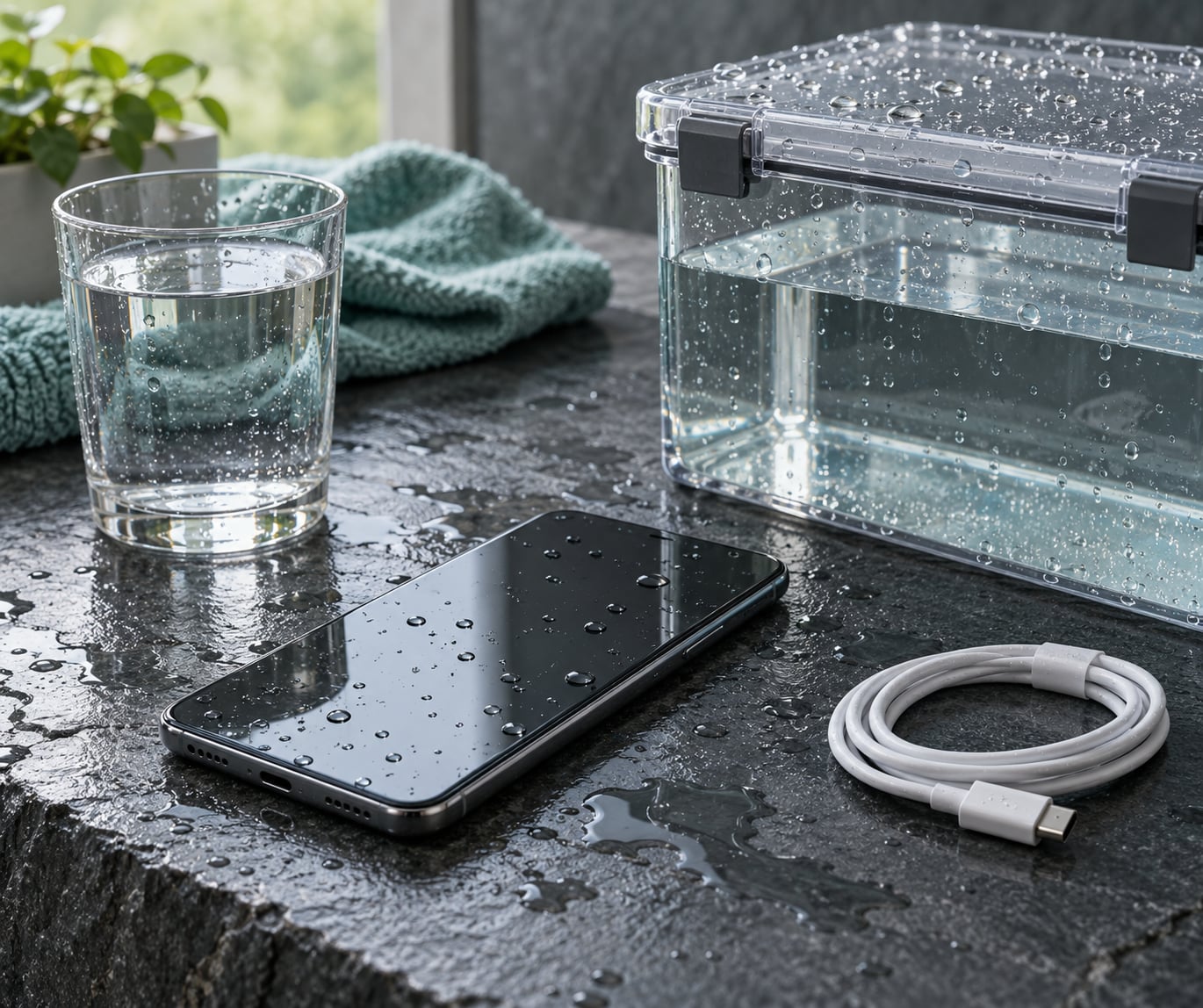
Rain is the easy case. An IP68 phone handles being caught in a downpour, and a quick rinse under a tap is a lower risk than most people assume, though the ports and any case seals still matter. A drop into a sink of still fresh water sits inside what the rating was designed to cover, which is exactly the scenario the test models.
Beyond that, the rating stops describing your situation. Running tap water is a moving-water scenario, not a still-water one, and it hits seals from more angles. Salt water attacks adhesives and leaves residue that keeps working after the phone is dry. Chlorinated pool water is a chemical exposure the lab test never covers.
Hot water and steam are a separate problem entirely. Heat changes the pressure inside the sealed enclosure and can push moisture past a gasket that would otherwise hold, and the vapour from a hot shower can condense inside. The same caution applies to dish soap, hand sanitiser and sunscreen, all of which leave a film that a nano water-repellent coating was never tested against.
Soapy water, swimming and taking photos underwater are the three areas where I would not rely on the rating at all. Forum threads on r/Smartphones reach the same conclusion repeatedly: IP68 is treated as a spill policy, not a swimming capability.
Is an IP68 Phone Waterproof?
No, and the industry knows it. IEC 60529 contains no waterproof rating. The standard measures ingress protection under test conditions, which is a narrower claim than waterproof and a more honest one. When a spec sheet says water resistant, that is the accurate word, and waterproof is a marketing substitution.
Water-resistant means a defined level of protection against a defined hazard under defined conditions. Waterproof means a promise of no water damage ever, which no mainstream phone maker can make and no warranty will honour. The gap between those two words is where most of the disappointment with IP68 lives.
The same caution shows up in the manufacturers’ own language. r/technews threads picked up Google’s warning that IP68 protection does not cover all conditions, which is a manufacturer conceding in public that the label has edges.
What Can Damage an IP68 Phone?
The rating describes a new, sealed device. Several things take that device outside the description.
- Charging while wet. Water in or near a charging port can arc, and this is the fastest route from a wet phone to a dead one.
- Salt, chlorine and cleaning products. These corrode and degrade seals rather than simply being repelled.
- Liquid sitting in the speaker mesh or earpiece grille, where it blocks sound and can linger.
- Heat and steam, which change pressure inside the enclosure and can force moisture past a gasket.
- Drops and impacts. Adhesive seals can shift, and a phone that has been dropped is no longer a tested unit.
- Screen or battery repairs, which mean opening the enclosure and disturbing the seals that the rating depends on.
- Liquid damage that arrived before you bought the phone, including on refurbished devices.
Delayed corrosion is the quiet one. A phone can work fine for hours or days after a soak, then fail later as residue continues to eat traces. Community threads on r/GalaxyS23 report exactly this pattern, with sea water damaging the protection permanently rather than temporarily.
Warranty is the other half of the disappointment. Liquid damage is excluded on IP68 devices, and users in Samsung and OnePlus community forums report losing claims after exposure that the marketing language implied was safe. The rating protects the phone from some accidents and does not protect your wallet from any of them.
What Should You Do After Your Phone Gets Wet?
Speed matters more than technique. The aim is to stop electricity meeting water and to let the device dry without pushing moisture deeper. Work in this order.
- Get it out of the water and move it away from any power source immediately.
- Power it down. If it will not shut off, leave it off rather than restarting it to check the screen.
- Disconnect every accessory, and stop using the phone entirely rather than testing what still works.
- Remove the case and the SIM tray, then shake the phone gently with the charging port facing down to shed surface water.
- Do not charge it, and do not put it in rice. Uncooked rice does not reliably draw moisture from inside a phone, and starch can lodge in ports. Air drying is the correct advice.
- Leave it on a dry, ventilated surface for 24 to 48 hours before attempting to power it on.
- Check the liquid contact indicator, usually a small white or red sticker inside the SIM tray area, and note the colour.
- Seek professional service if it will not start, if a display shows problems, or if the indicator has changed colour.
Do not use heat. Hair dryers, radiators, and warm ovens push moisture further into the enclosure and can warp adhesives or the display.
Short-term symptoms tend to be obvious: no power, a dim or blotchy display, no sound, or a charging port that only works at an angle. Long-term symptoms are quieter, appearing weeks later as corrosion finishes its work, which is why a phone that works right after a soak is not proof that nothing got in.
How to Protect Your IP68 Phone Without Overprotecting It
The useful habits are unglamorous. Check the rating for your exact model on the manufacturer’s support page, and read the condition line rather than the badge. Keep the case on around pools and soapy water, because a case is a cheap sacrificial layer that keeps residue out of the ports.
Skip the sea and hot tubs as a routine environment rather than an emergency, and treat pool water and beach sand as a reason to rinse with plain fresh water and dry the edges afterwards. Keep ports clear of lint and pocket grit, and let a wet phone dry fully before it goes near a charger.
Do not test the rating by submerging the phone on purpose. A single dip to prove a claim is the shortest route to corrosion you would have to pay for, and the forum consensus is that the rating holds up best when nobody is trying to prove it exists.
Frequently Asked Questions
Can I swim with an IP68 phone or take photos underwater?
Treat IP68 as spill insurance, not a swimming capability. The rating is tested in still fresh water at a manufacturer-specified depth, and swimming introduces moving water, chlorinated chemicals and repeated immersion that no test covers. If you want underwater photos, a purpose-built waterproof case is the honest option. The same goes for sea water, which degrades adhesives and leaves residue that keeps corroding after the phone looks dry.
Is IP68 really waterproof or just water resistant?
Water resistant, always. IEC 60529 defines no waterproof rating at all; it only defines ingress protection levels under test conditions. IP68 certifies dust-tight enclosure plus protection against continuous immersion in fresh water as tested in a lab. It does not cover salt water, chlorine, hot water, moving water, wet charging, or damage that results from a dropped or repaired phone.
How deep can an IP68 phone actually go?
That number comes from the manufacturer, not the code. The IEC requires the 8 test to exceed one metre for at least 30 minutes, and each brand publishes its own figure on top of that floor. Apple states up to 6 metres for 30 minutes, while Samsung states fresh water up to 1.5 metres for up to 30 minutes. Check the support page for your exact model, because regional variants can differ.
Can you fix a water damaged phone with rice?
No. Uncooked rice does not reliably draw moisture from inside a phone, and starch can lodge in ports and speaker mesh and cause problems of its own. Air drying is the better method: power the phone off, remove the case and SIM tray, shake out surface water with the port facing down, and leave it on a dry ventilated surface for 24 to 48 hours without charging it. Avoid heat sources entirely.
How long does water damage take to show up on a phone?
It varies, and that is what makes liquid damage tricky. Some phones lose power immediately, while others run normally for hours or days before failing as residual moisture corrodes internal traces. The liquid contact indicator inside the SIM tray area changes colour as soon as water reaches it, which gives you an early signal. If the phone misbehaves after a soak, treat it as damaged rather than testing it repeatedly.
Does IP68 still count after a screen or battery repair?
Not reliably. Opening the enclosure means disturbing the gaskets, adhesives and mesh membranes the rating depends on, and a repair centre may not reseal the phone to the original specification. Drop damage can also shift seals without any visible sign. Community users on Samsung and OnePlus forums report warranty rejections after water exposure, so treat an opened or dropped phone as having an unknown water-resistance level.
The Bottom Line
IP68 is a useful rating with a narrow reading: dust-tight, and tested for continuous immersion in still fresh water under conditions the manufacturer publishes. It covers the everyday accidents most buyers actually fear, such as rain, a spill, or a drop into a sink. It does not cover the sea, the pool, hot water, wet charging, or a phone that has been dropped or opened for repair.
Do one thing before your next trip to the water: find the published condition for your exact model on the manufacturer’s support page, and keep the fine print rather than the badge.