To pick a phone case for drop protection, match the case’s structure to your real drop risk: a soft TPU bumper with raised screen edges and reinforced corners handles everyday drops, a hard polycarbonate back handles scrapes and sliding, and a hybrid build covers both. Anything labelled “military grade” without a named standard and a drop height is just a sticker.
Most cracked screens are not caused by wild throws. They come from the ordinary slip: a phone sliding out of a back pocket, tumbling off a café table, landing screen-down on tile when someone bumps the table. That is good news, because the kind of case you need depends almost entirely on how and where your phone actually lands.
This guide walks through the whole decision, from confirming your exact model to reading a drop rating without falling for marketing. It takes about fifteen minutes to work through, and it works whether you buy from a brand’s own store, an electronics retailer or a marketplace listing.
Table of Contents
- What You Need
- How to Pick a Phone Case for Drop Protection
- What drop risk changes your case choice?
- Confirm the exact model and case fit
- Choose a protective material and structure
- Inspect corner, screen-edge and back coverage
- Test grip, buttons, ports and wireless charging
- Check evidence, warranty and seller quality
- Common Mistakes
- Frequently Asked Questions
- What is the best phone case for drop protection?
- Is a thicker phone case always better for preventing drops?
- Do wallet cases protect a phone better than slim cases?
- Should I buy a case with a raised camera edge?
- Are clear cases more likely to yellow or crack?
- How often should I replace a phone case after a hard drop?
- What to Do First
What You Need
Gather a few specifics before you compare anything, and shopping gets much faster. Without them, every case listing looks equally plausible.
- Your exact model, including the region variant. The same phone name covers different part numbers in different markets, and cases rarely cross over between them.
- Where your phone actually drops. Nightstand, back pocket, car seat, kitchen counter, worksite bench, hiking trail — the answer changes the case more than any other factor.
- Your protection level. There are three practical tiers: basic scratch plus short-drop coverage, everyday drop protection, and heavy-duty protection for work, kids or manual handling.
- Your accessory list. Wireless charging pads, magnetic wallets and car mounts, a screen protector, a lanyard loop, or a kickstand all constrain which cases fit.
- Your budget range and return terms. Know what you want to spend and whether the seller allows a no-fuss return, because fit is the one thing you cannot fully judge from photos.
- Your grip habits. If your phone regularly slides out of your hand or out of a pocket, texture matters as much as thickness.
How to Pick a Phone Case for Drop Protection
Here is the selection process in the order that saves the most money: work out your risk, confirm the fit, then judge materials and structure before you look at any brand name. Six checks cover it.
What drop risk changes your case choice?
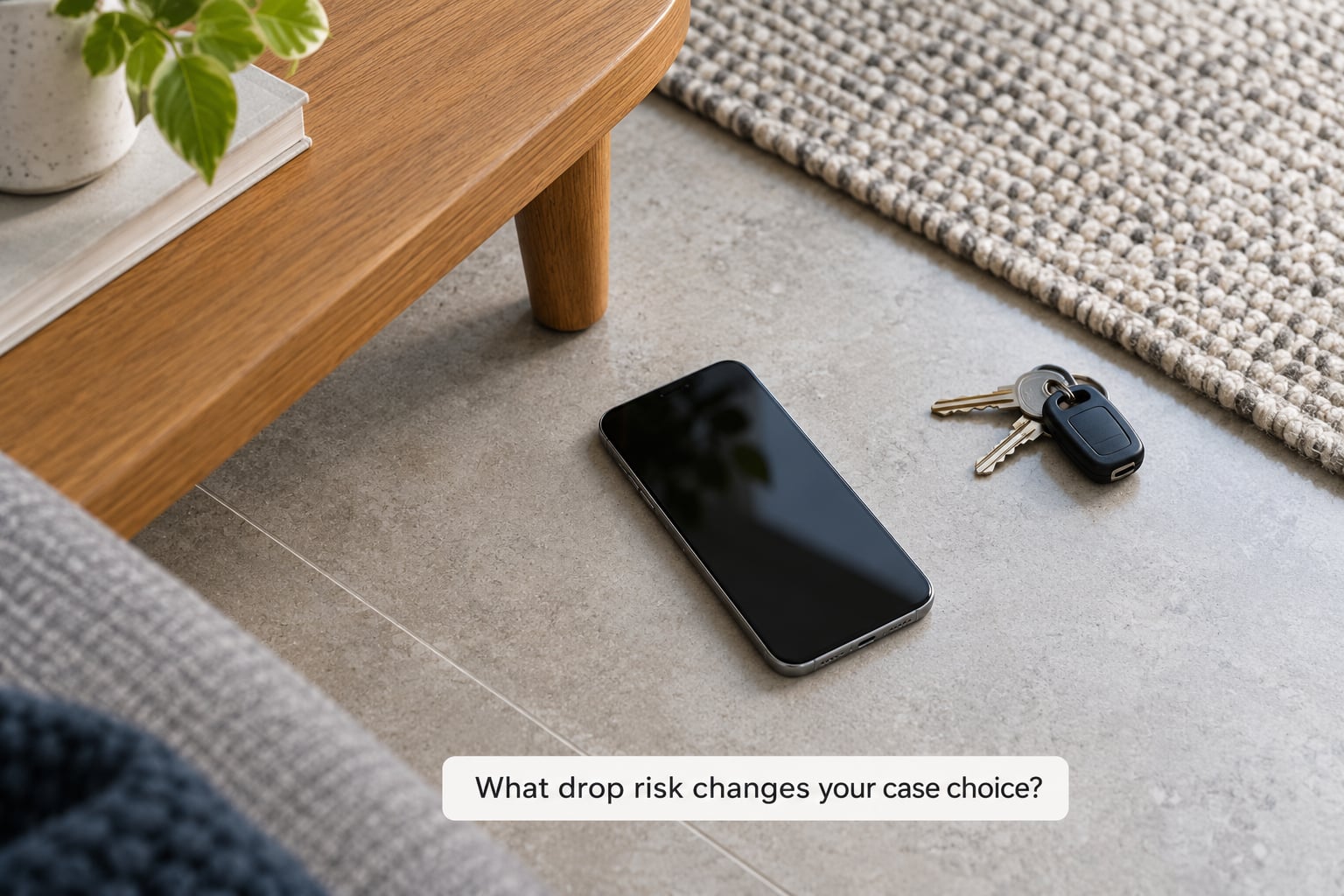
Your drop environment sets the protection tier you are shopping for. A case that handles a bedroom floor drop will often do nothing for a phone that spends its day on a scaffolding plank.
- Indoor and desk use: a slim case with a raised bezel is enough. Protection is mostly about keeping the screen off the surface when the phone lands face-down.
- Pocket and commuting: add a grippy side texture and a secure fit. Drops here are almost always corner-first onto pavement or a kerb, so corner cushioning matters more than total thickness.
- Outdoor use: look for a case with port covers you can actually operate with gloves on, a raised camera surround, and enough grip for damp hands. Water resistance on the case matters more here than shock absorption.
- Work environments: construction, warehouse, kitchen and workshop use calls for a thick multi-layer build with reinforced corners and replaceable parts. Expect a heavier, less pocket-friendly case.
- Frequent droppers, or homes with toddlers: go to the heaviest case you can genuinely live with. Phones get thrown, not dropped, and only bulk reliably survives that.
Write down your tier before you start scrolling. It turns an open-ended search into a filter.
Confirm the exact model and case fit
Fit is where most disappointing cases come from, and it costs nothing to verify. Find the model number in your phone’s settings, then check that the case listing names the same number rather than just the marketing name.
- Check settings first. The model number, storage variant and region suffix appear in the about-phone or device information screen. A case made for a Plus or Pro body will not seat properly on a standard model.
- Compare dimensions, not photos. Listings usually give length, width and thickness in millimetres. Compare those against your handset rather than trusting a product photo, since photography flatters gaps.
- Watch for lookalike variants. Cases for slightly different launch years of the same phone can share a name and a photo but differ in camera cutout size and button placement.
- Confirm cutout positions. Camera openings, speaker grilles and side buttons have to line up. If a listing shows no dimensions at all, that is a sign the seller sources from several factories.
A case that fits properly clicks in at the corners with no gaps, the buttons sit proud rather than recessed, and nothing has to be pried or forced. If a retailer has a return window, order the exact model first and check all of that in hand before keeping it.
Choose a protective material and structure
Material decides how a case absorbs impact, and each type fails in a different way. Understanding the trade-off matters more than any brand name on the box.
- Silicone: soft, quiet and grippy, and it absorbs low-level bumps well. It scuffs, picks up lint, and can stretch or tear at the corners after a real impact.
- TPU (thermoplastic polyurethane): a flexible plastic that compresses on impact and bounces back, with better scratch resistance than silicone. TPU is the workhorse of drop protection. Its known weakness is yellowing, which is mostly a UV issue, so a dark or opaque colour hides it entirely.
- Polycarbonate (PC): a hard, rigid plastic that spreads force across a wider area and resists scratches better than anything else here. On its own it transmits impact straight to the phone, because it does not absorb anything.
- Hybrid PC plus TPU: the standard answer for drop protection. The soft inner bumper takes the hit and the hard outer shell handles scuffs and sliding, so each material covers the other’s weakness.
The compromise to accept is thickness. Hybrids and hard-shelled cases are bulkier than a thin flexible skin, and that bulk is the protective structure, not waste. Where you can compromise is on feel: an opaque hybrid with a soft-touch bumper gives you most of the protection without looking like fieldwork gear.
Inspect corner, screen-edge and back coverage
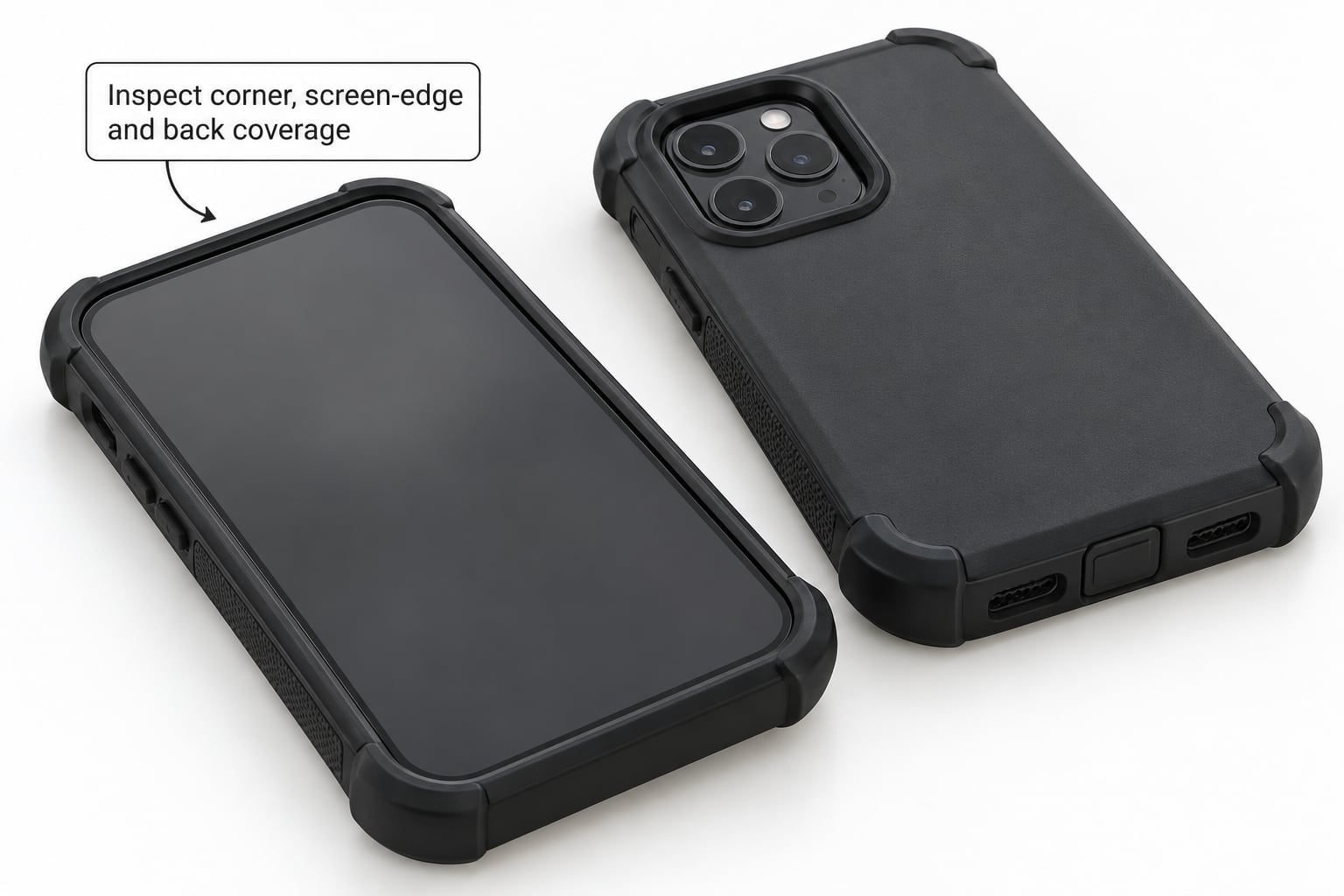
Corner cushioning and a raised screen edge do the real work in a drop, so inspect those two areas before anything else. Drop a phone and the impact concentrates at a corner first, then rolls across an edge.
- Reinforced corners: look for visibly thicker corner geometry, internal air pockets, or a bumper that extends past the phone’s corner. Cheap cases put decoration on the corners instead of cushioning.
- Raised screen edges: the case wall should stand above the glass so a face-down drop lands on the case, not the screen. On a curved-edge phone, check whether the lip touches the display when laid flat.
- Camera surround: a raised lip around the camera block stops the lens from resting on tile. Without it, one drop can cost you the whole module even when the screen survives.
- Back coverage: a thin unprotected back panel transfers a hard impact straight through. A raised or recessed back panel with an inner layer is better.
- Port access: covered ports stop grit and dust entering, but a flap you cannot open with one hand is a daily irritation. Check the latch type in photos.
Thickness on its own is a poor signal. A very thick case with flat, unreinforced corners will not outperform a slimmer hybrid with a proper bumper, and it will not fit in your pocket the way you will actually carry it.
Test grip, buttons, ports and wireless charging
A case you have to fight defeats the protection it provides, because you will take it off. Evaluate the parts you touch every day.
- Texture: look for a matte or textured side panel rather than a glossy one. Gloss surfaces are slippery when damp and show fingerprints.
- Edge grip: a slight lip or chamfer along the side wall helps a phone sit between your fingers instead of sliding down them.
- Buttons: covers should be distinct and clicky, not mushy. Recessed buttons that require a firm press are a common complaint in long-term owner reports.
- Ports and speakers: the charging cutout should be wide enough for a thick cable sleeve without the phone rocking. Speaker grilles need to be fully open, not partially covered.
- Camera clearance: hold the case next to your phone’s camera block to check that the lenses clear the opening when the phone is on a table.
- Charging and magnets: if you use wireless charging, confirm the case is listed as compatible. Thick hybrid builds can slow or block charging pads that need close alignment. Magnetic accessories need a case designed with an aligned magnet ring, otherwise the mount pulls harder than the case was rated for.
If you can, buy from a seller who lets you return it, then run through this list in hand within the return window. It is the only reliable way to catch a mushy button or a charging pad that will not seat.
Check evidence, warranty and seller quality
Drop claims range from meaningless to carefully measured, and you can tell the difference by asking what the number is based on.
- Look for a named standard. MIL-STD-810H is a US military standard for environmental testing, and method 516.8 covers drop testing onto a surface. When a brand cites it, they should also say the drop height, the surface used and the number of drops.
- Treat “military grade” on its own as decoration. The same phrase is used for cases with no test data at all. Claims like two or three times a military standard have no fixed meaning unless the manufacturer publishes the method behind them.
- Prefer feet or metres over adjectives. A specific drop height on a named surface is checkable. “Extreme shockproof” is not.
- Read long-term owner reports, not the top reviews. What matters is what a user says after six months: has the case yellowed, has the corner cushioning compressed, did the buttons loosen, did the screen protector lift at the edges.
- Check the warranty and returns. A multi-year warranty against material breakdown says something about how the maker expects the case to age. A short return window from a marketplace seller means you are the quality inspector.
Construction quality shows up in the small details: even seam lines, tight speaker cutouts, a screen lip that does not taper to nothing at the corners, and a back panel that does not flex when you press it.
Common Mistakes
Most bad outcomes trace back to one of these, and each has a straightforward fix.
- Buying by camera appearance. A matching camera cutout says nothing about protection. Fix: judge corner cushioning and the raised screen lip instead.
- Choosing a case with no raised edges. This is the single most common reason a cracked phone still had a case on it. Fix: check that the case wall stands above the glass before you buy.
- Trusting unsupported drop-test claims. Fix: look for a named standard, a drop height, a surface and a repeat count. If the listing gives none of those, treat the rating as marketing.
- Ignoring buttons and charging ports. A case you remove to charge is not protecting your phone. Fix: confirm button feel and charging cutout clearance.
- Buying without checking return terms. Fix: pick a seller with a return window so fit and charging can be tested at home.
- Oversizing for protection you do not need. Overbuilt cases are hard to use, so people take them off. Fix: match the tier to your drop environment instead of buying the heaviest option available.
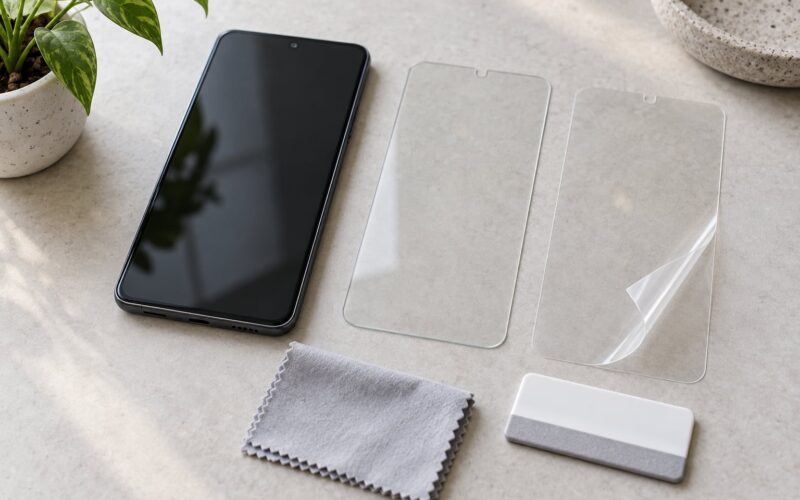
- Forgetting the screen protector. A raised bezel helps, but glass still chips if a corner lands directly on it. Fix: pair the case with a protector that fits inside the lip.
- Reusing a case that has already taken a hard hit. Compressed foam and stressed corners do not recover. Fix: replace it and treat the second drop as the one that matters.
Frequently Asked Questions
What is the best phone case for drop protection?
A hybrid case built from a flexible TPU bumper and a hard polycarbonate back shell. The TPU compresses on impact, the PC spreads the force, reinforced corners take the first hit, and a raised lip keeps the screen off the ground. Look for a named drop standard with a stated height and surface rather than a bare military grade claim.
Is a thicker phone case always better for preventing drops?
No. Thickness only helps when it comes from structure: corner cushioning, air pockets, a raised bezel and a rigid back panel. A thick case with flat corners transfers force straight into the phone, and it is heavy enough that you stop carrying it. A slim hybrid with a proper bumper usually beats a bulky case with none.
Do wallet cases protect a phone better than slim cases?
The folio cover helps when a phone lands face-up, because the closed flap takes the impact. It does very little for corner drops onto pavement, where the case body does the work. Wallet cases also add bulk and block wireless charging unless the shell is removable, so they suit people who value screen coverage over pocket comfort.
Should I buy a case with a raised camera edge?
Yes, if your phone rests on flat surfaces. The camera block is the first part to touch a table, so it takes scratches and direct impacts that a flat edge offers nothing against. A surround standing slightly proud of the lenses costs almost nothing in bulk and protects the most fragile module on the phone.
Are clear cases more likely to yellow or crack?
Clear cases are usually TPU, and TPU yellows with UV exposure, which is why transparent cases show it first. Silicone stays flexible but scuffs, and hard polycarbonate resists yellowing while eventually spider-web cracking from a hard hit. If appearance matters, an opaque or coloured hybrid avoids the issue entirely.
How often should I replace a phone case after a hard drop?
Replace it after any drop hard enough to visibly deform the corner cushioning, crack the back panel, leave the phone rocking on a flat surface, or loosen the buttons. The compressed structure has absorbed energy once and will not do it reliably again. Without visible damage, inspect it every few months, since rubber edges slowly stretch at the corners.
What to Do First
Start with the model number from your settings, then choose a protection tier based on where your phone actually lands. From there, confirm the fit dimensions, check for raised screen edges and reinforced corners, and read owner feedback from six months in rather than the top reviews. That sequence takes fifteen minutes and filters out nearly every bad purchase in this category. Once you know what to pick a phone case for drop protection in your own hands, the rest is just choosing between two cases you already trust.