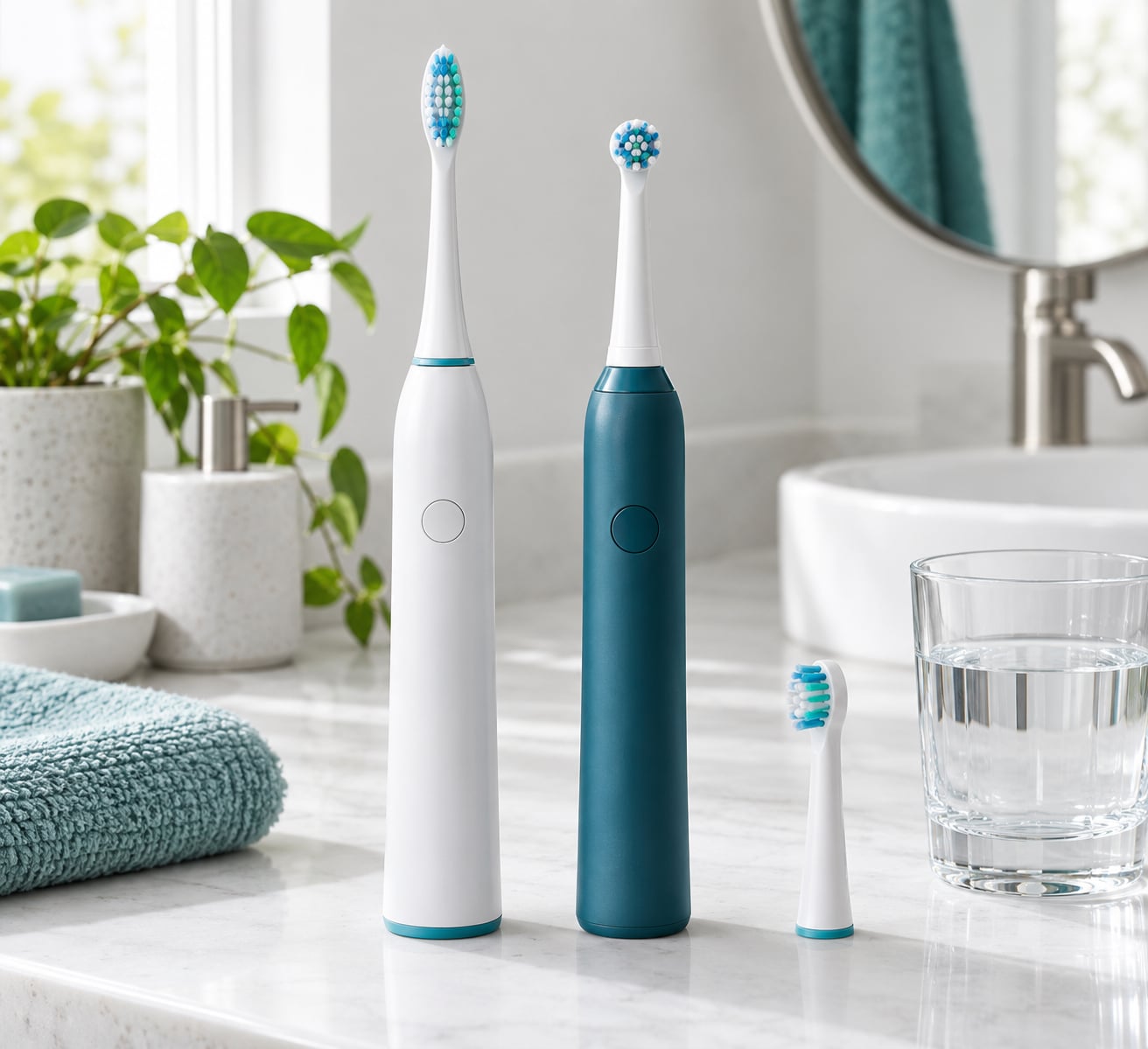
Both types beat a manual toothbrush, and the measured gap between them is small. If you have sensitive or receding gums, a sonic brush is usually the gentler feel. If you want the method with the least room for error and the lowest running cost, an oscillating-rotating brush usually wins.
That is the whole answer, honestly. Everything below explains why, and where the two types actually differ rather than just sounding different in a shop aisle.
Updated for 2026. This is general oral-care information, not dental advice. If your gums bleed every day, hurt, or have already receded, ask your dentist what to do before changing anything.
Table of Contents
- Sonic vs Oscillating Electric Toothbrush at a Glance
- How the Two Cleaning Technologies Work
- Which Removes More Plaque?
- Which Is Better for Sensitive Gums?
- Coverage and Cleaning Different Tooth Surfaces
- Pressure Sensors, Modes and Smart Features
- Comfort, Noise and Everyday Handling
- Cleaning and Maintenance Requirements
- Price and Value Comparison
- Which Should You Choose?
- Frequently Asked Questions
- Is a sonic electric toothbrush better than an oscillating one?
- Which electric toothbrush is gentler on sensitive gums?
- Are sonic and oscillating toothbrush replacement heads interchangeable?
- Do I need an electric toothbrush with pressure sensors?
- Can electric toothbrushes be used with braces or dental work?
- Conclusion
Sonic vs Oscillating Electric Toothbrush at a Glance
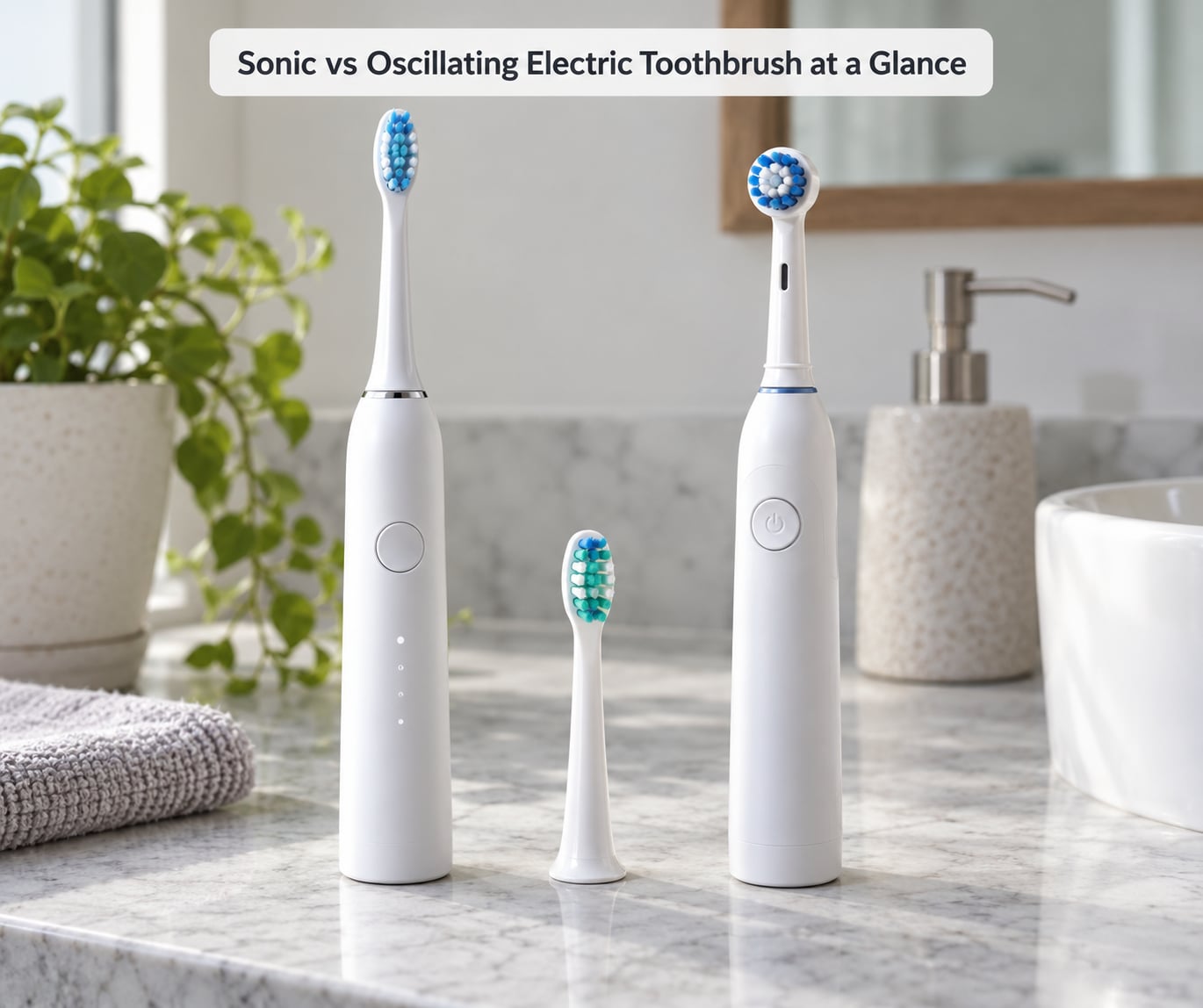
The fastest way to see the difference is to compare how the head moves and what you are expected to do with it.
| What to compare | Sonic electric toothbrush | Oscillating-rotating electric toothbrush |
|---|---|---|
| Cleaning motion | High-frequency side-to-side bristle movement | Small head rotates back and forth, and also pulses |
| Speed figure | About 20,000 to 62,000 strokes per minute | About 7,000 to 10,000 oscillations per minute |
| Head shape | Elongated, shaped like a manual brush head | Small round head |
| How you guide it | Glide slowly along the gumline and the tooth surfaces | Place on one tooth, wait a couple of seconds, move on |
| Cleaning mechanism | Bristle contact plus fluid movement reaching beyond the bristles | Direct mechanical scrubbing of each tooth, one tooth at a time |
| Plaque removal | Strong, slightly gentler overall | Very slightly ahead in most trials, easier to do correctly |
| Gum comfort | Often better, especially with soft bristles and sensitive mode | Fine for most people, but firm if you press hard |
| Pressure control | Sensor slows or warns; light pressure needed | Sensor slows or warns; round head punishes heavy pressure fast |
| Noise | Louder, higher-pitched hum | Lower-pitched, chattering whirr |
| Maintenance | Wide head, single replacement part per brand | Same, but round-head bundles are usually cheaper |
| Best for | Sensitive gums, braces, stain and coffee drinkers, manual switchers | First-time electric users, kids, heavy plaque formers, lower running cost |
How the Two Cleaning Technologies Work
A sonic toothbrush moves its bristles side to side at high frequency while the handle stays mostly still. You still move it yourself, slowly, the way you would move a manual brush.
An oscillating-rotating toothbrush spins a small round head through a limited arc while pulsing it in and out against the tooth. The idea is that you stop scrubbing and start placing.
That is the real structural difference in this comparison: one brush relies on your hand to cover the surfaces, the other relies on the motor’s geometry to wrap around a single tooth.
Why the speed numbers are not comparable
Strokes per minute and oscillations per minute describe different movements on different head shapes. A stroke is a side-to-side movement of the whole head. An oscillation is one direction change of a rotating head. Comparing them directly tells you nothing about cleaning power.
One thing the sonic figures do describe is fluid behaviour. The vibrations agitate the saliva, water and toothpaste around the bristles, and manufacturers claim the flow reaches several millimetres past the point of contact. Treat that as a real physical effect that helps along the gumline, not as a replacement for placing the bristles correctly.
Watch the wording in the aisle, by the way. Electric, sonic, ultrasonic, rotary, oscillating and sonic-rotary get used almost interchangeably on boxes. The two categories that matter in this article are the oscillating-rotating round head and the side-to-side vibrating elongated head. Everything else is usually one of those two wearing a different name.
Which Removes More Plaque?
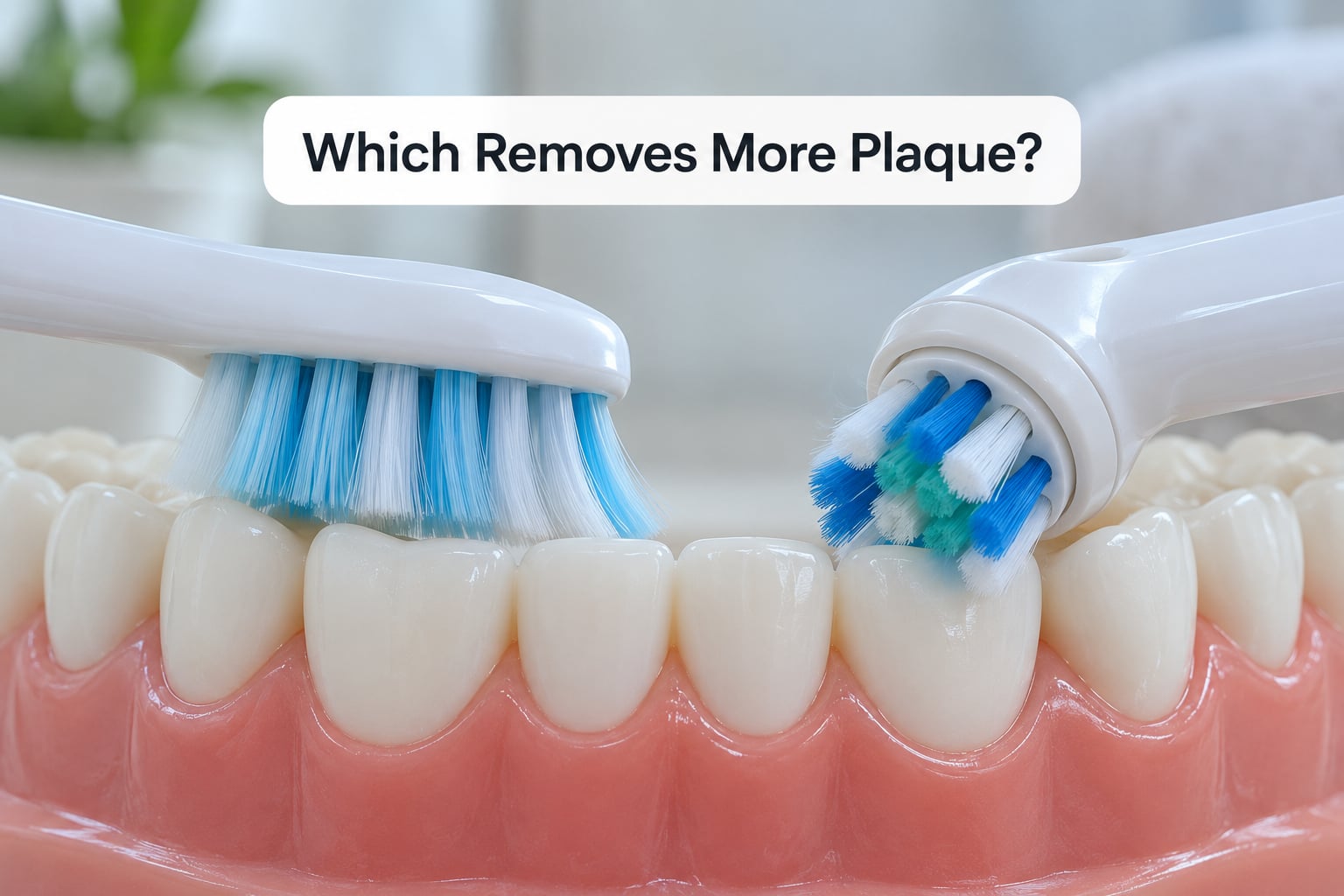
Oscillating-rotating brushes edge ahead on plaque removal, by a margin most dentists describe as small. What matters far more is that you use the brush at all, and for long enough.
What the reviews actually found
The widely cited Cochrane review of powered toothbrushes looked at 56 studies with more than 5,000 participants and found roughly 21% more plaque reduction and 11% more gingivitis reduction than manual brushing. It did not produce a clear winner between the two powered types.
Later network meta-analyses have been more pointed. One ranked oscillating-rotating brushes ahead of sonic brushes on plaque outcomes, with a SUCRA score of 89.2% against 72.4% for sonic. Another found 11.7% greater gingivitis reduction for the rotating type. Separate trials have reported things like 65.6% plaque reduction from baseline for oscillating against 60.7% for sonic.
Look at those numbers together and the honest reading is: rotating wins by a few percentage points, consistently, in trials that are usually short.
Who paid for the research
This is where a lot of online arguments come from. The brand that makes rotating brushes funds plenty of studies that favour rotating brushes, and the brand that makes sonic brushes funds plenty that favour sonic. Readers notice. One widely repeated claim on r/Dentistry that sonic brushes are roughly 30% less effective than rotating ones is not something the clinical literature supports; the gap it refers to is small.
Practical rule for reading any comparison study: check who funded it, how long it ran, and whether people in the study were brushing correctly. A short trial with coached brushing flatters whichever head makes technique errors easiest to correct.
Where technique matters more than technology
Two minutes, twice a day, with soft bristles, beats any motor. Short sessions are the most common reason a good brush underperforms, and both types punish them equally.
How to use a sonic brush
Set it to sensitive mode if you are new. Angle the head so the bristles meet the gumline at roughly 45 degrees. Glide along the outer surfaces, then the inner surfaces, then the chewing surfaces, spending a few seconds on each section rather than racing. Let the brush move; do not scrub. Start at the back of the mouth and work forward.
How to use an oscillating-rotating brush
Place the round head on a single tooth at the gumline. Wait two to three seconds, then move to the next tooth. Overlap slightly so you do not leave a seam. Use almost no downward pressure; the motor does the work. Work through the same order every time so you do not skip a quadrant.
The round head takes a few days to feel natural. That adjustment period is the main reason some people give up on it and blame the brush.
Which Is Better for Sensitive Gums?
For sensitive, inflamed or receding gums, the sonic brush usually feels gentler, mostly because the elongated head spreads pressure over several teeth and the vibrations replace pressing.
Oscillating brushes are not harsh by design. Used with light pressure, they are fine for most sore gums. The problem appears when someone pushes down, and a small round head concentrates that force into one spot, which is exactly the pattern behind recession in over-brushers.
What helps in either type
Soft or extra-soft bristles, a pressure sensor that actually slows or stops the motor, and a sensitive mode matter more than the label on the box. A pressure sensor is the single feature I would refuse to give up on if gums are involved, because it converts a habit you cannot feel into feedback you can.
If your gums bleed every single time you brush, or a tooth feels loose, or you have recession showing, book a dental visit first. No brush technology substitutes for scaling, a hygiene appointment, or treatment of active gum disease. A dentist may also advise a periodontal brush for the interdental areas, which no electric head replaces.
Coverage and Cleaning Different Tooth Surfaces
Round heads win on back molars and tight contacts. A small circle fits behind the last molar far more easily than a long head that has to be angled around the corner of the jaw.
Elongated heads win on long straight surfaces. One sweep covers the front teeth without eight separate placements, which is why many people coming from a manual brush find the transition painless.
Neither cleans between teeth. Both need floss or interdental brushes daily, and neither brush is built to remove hardened tartar. If tartar is forming, that is a professional cleaning job.
Pressure Sensors, Modes and Smart Features
Most of the difference in this section is marketing volume rather than cleaning power. Here is what tends to earn its place on a bathroom counter.
- Pressure sensor with motor cutoff. The useful ones change the motor, not just a light on the handle.
- Two-minute timer and a 30-second quadrant pacer. Free on almost every model, and the pacer is the feature that fixes short sessions.
- Soft bristles available in the brand’s own range. Check the head fits the handle before assuming any soft head will work.
- Battery life of two to four weeks. Anything that needs charging twice a week fails the travel test.
- Waterproofing and a sealed charging base. Baths are where brushes die.
- Bluetooth and an app. Useful for a few weeks while you correct your technique, then mostly noise. Skip it if you dislike handing app permissions to a toothbrush.
Cleaning modes beyond sensitive and daily clean add little. Whitening modes are polish at best and are no substitute for a professional clean.
Comfort, Noise and Everyday Handling
Comfort decides far more purchases than any specification sheet. A brush that feels unpleasant in the hand gets used twice a week, and twice a week is worthless.
Weight and diameter matter in a small bathroom and in a small mouth. A thick handle that collides with your cheek in the back means you will skip the back teeth, which is where plaque hides.
Noise is a real consideration for early mornings and shared bathrooms. Sonic brushes run louder and higher-pitched; rotating brushes are lower and more chattery. Neither is quiet, so if noise is a dealbreaker, try both in a shop with the packaging off.
On grip, both types benefit from a handle with a slight taper and a textured thumb pad. And neither has an advantage in the shower as long as it carries a proper waterproof rating.
Cleaning and Maintenance Requirements
Both types need the same routine: rinse the head after use, let it air-dry upright rather than in a sealed cup, and replace the head roughly every three months, sooner if the bristles flare.
The cost difference sits in the heads. Small round-head bundles are typically cheaper per head than the elongated heads used by the major sonic brands, and the per-head cost of any given brand is the number that actually adds up over five years.
That is the most repeated complaint in reader discussions about electric brushes, and the cheapest sonic brush is often not the cheapest brush to own. Check what a four-pack of replacement heads costs for your model before buying the handle.
Travel adds a wrinkle. A long handle plus a charging base is a bulky item in a bag, while a spare head is small. If you travel often, factor in how long the battery lasts between charges.
Price and Value Comparison
Both categories span entry-level to premium, so the technology alone does not decide what you pay. The entry oscillating brushes tend to be the cheapest way into powered brushing, and the premium tier is crowded on both sides.
Value in this comparison is closer to running cost than sticker price. Add up the handle, the replacement heads over five years, and the charging base, then ask whether you would rather spend that on a brush with a good pressure sensor or on more brushes. Fifteen replacement heads for a premium sonic handle can exceed the cost of a perfectly good mid-range oscillating setup.
Here is my read on value. If your main worry is the running cost, an oscillating brush is almost always the cheaper five-year option. If your main worry is comfort with sore gums, the sonic brush is worth the higher head cost, because a brush you tolerate is worth more than a cheaper brush you avoid.
Which Should You Choose?
Choose an oscillating-rotating electric toothbrush if you are a first-time electric user, buying for a child, brushing for someone with limited dexterity, or you mainly want the lowest running cost. It is also the better pick for heavy plaque formers who can handle firm feedback, and for small mouths where the round head reaches back molars more easily.
Choose a sonic electric toothbrush if your gums are sensitive, inflamed or receding, if you are switching from manual brushing and want a familiar head shape, if you wear braces and want long sweeping strokes along the wire, or if you drink coffee, tea or tobacco and care more about surface stain than pure plaque scores.
A third option exists in the hybrid sonic-rotary category, which pairs side-to-side movement with rotation. It is a reasonable compromise if you cannot decide, though it inherits the running cost of the premium tier.
If you are still torn after all this, run a two-week trial. Use one type for a week with your usual technique, then the other for a week, and judge on gum comfort and whether you looked forward to using it. That decides it faster than any specification.
Frequently Asked Questions
Is a sonic electric toothbrush better than an oscillating one?
Both beat manual brushing by a wide margin, and the measured gap between them is small. Oscillating-rotating brushes usually edge ahead on plaque removal in trials, while sonic brushes tend to feel gentler on gums. The brush you use twice a day for two minutes matters far more than the technology you pick, so comfort and your own technique should decide it.
Which electric toothbrush is gentler on sensitive gums?
A sonic electric toothbrush is usually the gentler option for sensitive or receding gums, because its elongated head spreads pressure over several teeth and its vibrations reduce the need to press. An oscillating brush works well too, provided you use almost no downward force. Whichever you pick, soft bristles and a pressure sensor that slows the motor are worth more than the label.
Are sonic and oscillating toothbrush replacement heads interchangeable?
No. Head shapes and connectors differ by brand and by type, so an elongated sonic head will not fit an oscillating-rotating handle or the reverse. Even within one brand, models often use different heads. Some manufacturers make heads removable so you can swap between types on one handle, which is worth checking before buying a second handle. Always confirm the exact model number.
Do I need an electric toothbrush with pressure sensors?
You do not strictly need one, but it is the feature most likely to protect your gums. Over-brushing is common, especially with people who had gum recession or bleeding. A sensor that slows or stops the motor turns force you cannot feel into feedback you can, which matters most if you already have sensitive gums. Soft bristles and light pressure remain the baseline either way.
Can electric toothbrushes be used with braces or dental work?
Yes, and either type works well if you use a brush head designed for orthodontic appliances, since it guides the bristles around brackets and along the wire. Watch for debris building up under the brackets and around the gum line, and clean it out daily with an interdental brush or floss threader. With crowns, implants or veneers, ask your dentist which head and pressure level they prefer.
Conclusion
Oscillating-rotating wins on slightly better plaque numbers and lower running cost. Sonic wins on comfort with sensitive gums, on long straight surfaces, and on stain removal.
Start by picking the brush you can hold comfortably and that has a pressure sensor you understand. Then get the technique right, two minutes twice a day, and replace the head on schedule. If your gums bleed or hurt every day, see a dentist rather than shopping for a different motor.