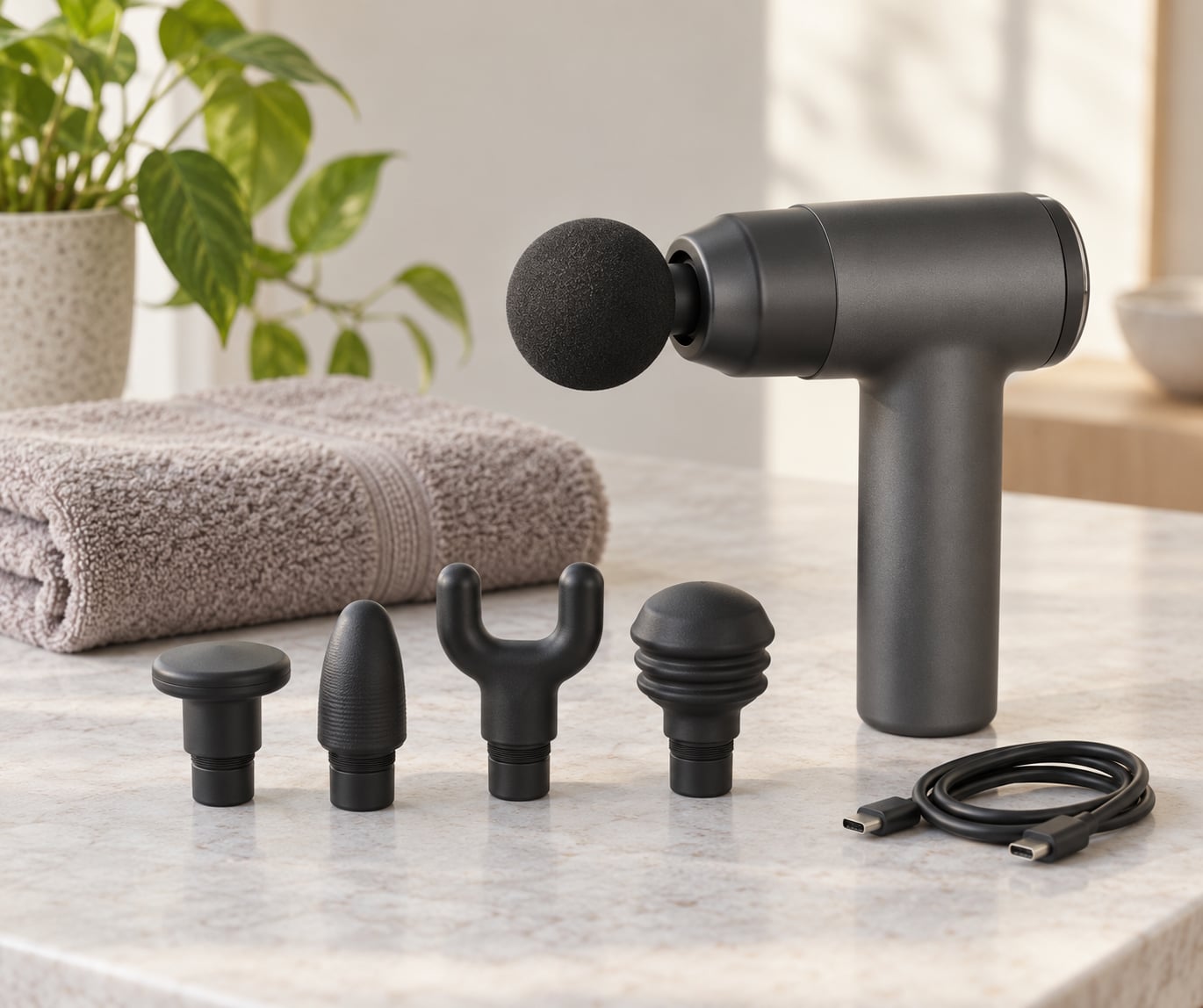
A massage gun is safe to use at home as long as you treat it like a tool for muscle tissue and nothing else. Start on the lowest speed setting, use short 30 to 60 second passes over big muscle groups, keep the head moving, and stay away from your neck, spine, joints and any bruised or swollen skin. Most problems people run into come from one of two habits: holding the gun in one spot too long, or angling it sideways instead of straight on.
It takes about ten minutes per session and no real skill. What it does not do is diagnose anything. If you have a fresh injury, swelling, or a health condition that affects blood flow or bone, check with a doctor before your first session.
Table of Contents
What You Need
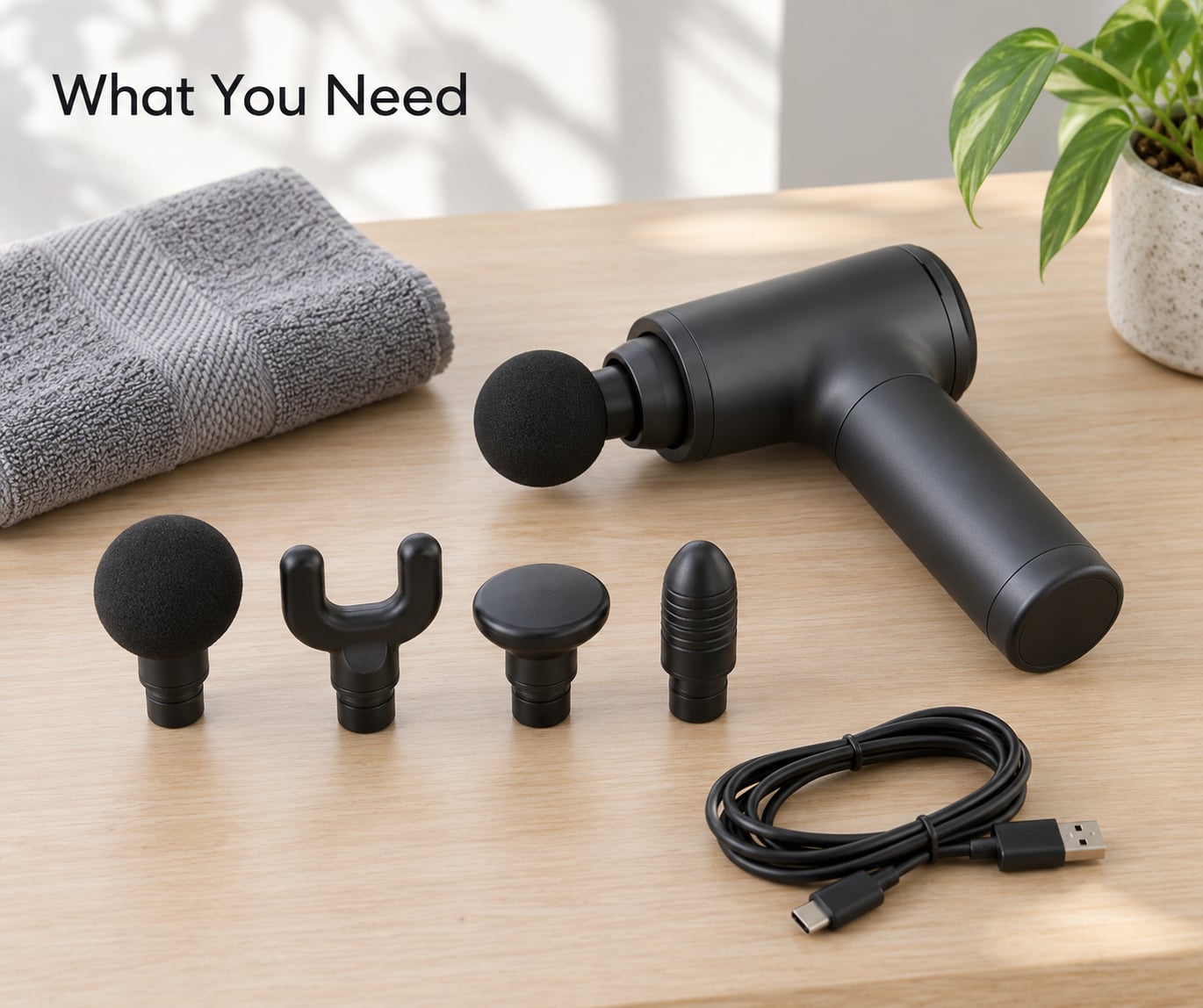
You need the device, its charger, one clean attachment head, a towel, water, the manufacturer’s instructions, and a flat surface that will not slide.
Before the first session, read the manual end to end. Manufacturers list approved body areas, which heads are meant for which regions, what the speed numbers actually mean, how long the battery indicator holds a charge, and how to clean the heads. Some models warn against specific areas that others allow, so the booklet in front of you beats any general article, including this one.
Then inspect the device. Look along the charging cable for cracks or exposed wire, check the casing and the head socket for splits, and press each speed button to confirm it responds. If anything looks damaged or the battery swells or gets hot while charging, stop and get it serviced or replaced.
Pick your head before you lie down, not after. A broad or rounded head suits large muscles like the calves and quads. A softer or narrower head belongs on smaller, tighter areas only where the manual permits it. Wash the head with soap and water, let it dry fully, and never share a head without cleaning it.
Step-by-Step: How to Use a Massage Gun Safely at Home
Read the Instructions and Check the Device
Find the section in the manual that lists approved body areas and supported attachments, then find the cleaning instructions. Check the battery indicator and the speed modes so you know which setting is the lowest one before your hand ever touches the trigger.
If the cable, casing, battery or controls show damage, stop using the device until it is repaired. A frayed cable or a loose head socket is not a minor issue, because the gun’s own weight pulls on exactly those points while it is running.
Prepare Your Body and the Massage Area
Pick a comfortable spot you can hold still in, such as a bed, a firm chair or a rug. Wear thin clothing or work over exposed skin so you can see what you are doing, and make sure the skin is clean and dry.
Move the device slowly over the muscle first with no pressure behind it. That warms the tissue and tells you where the guard is before anything is pulsing. Position yourself so your working arm and wrist stay relaxed, because a tense arm is what pushes the head into the wrong angle.
Test the Lowest Speed and Choose an Attachment
Turn the gun to its lowest speed and rest the broad head on a sturdy muscle area such as the top of your thigh. Give it three or four seconds. You should feel a light thump, not pain, and the skin under the head should stay the same colour.
Pick a broad or rounded head for large muscle groups and move up in size only as your tolerance allows. A narrower or pointed head concentrates the same force into a smaller spot, so it belongs on tight, smaller areas and never on the neck, spine or a joint.
Apply Light Pressure and Keep It Moving
Glide the gun over the muscle without pressing into it. Let the weight of the device do the work. An angled or sideways position drags the vibrating head across your skin, which is the direct cause of the friction burns people report on forums.
Make short passes of 10 to 15 seconds, three to five sweeps per area, and rest a few seconds between them. Increase the speed one setting at a time only if you stay comfortable. Skip bones, joints, the spine, the front and sides of the neck, and any area that is bruised, cut, swollen or recently injured.
Finish Slowly and Check Your Response
Drop the speed back to the lowest setting, then to zero, before you lift the device away. Lifting it while it is still running at speed is how people jolt a muscle right at the moment it relaxes.
Wipe the head clean with a damp cloth, let it dry, and put the charger somewhere flat and dry. Over the next day, watch for pain that sharpens, numbness, tingling, swelling, dizziness or unusual fatigue. If any of those show up, stop using the device and get medical advice.
Common Mistakes
Holding the gun at an angle. Tilt it so the head rakes across the skin instead of pressing straight in, and the moving head grinds rather than pulses. Keeping the head perpendicular to the muscle is the single change that most reliably stops those friction burns.
Sitting in one spot. One minute of static pulsing on a small area is the most common route to bruising and irritated tissue. Keep the head gliding and treat 30 to 60 seconds per spot, 1 to 2 minutes per area, as the ceiling rather than the target.
Turning the speed up to prove something. Intensity is not the measure of a good session. Start low, work up only while it stays comfortable, and drop back a setting the moment you catch yourself bracing or holding your breath.
Using it to treat an injury. A massage gun is for healthy soft tissue. Fresh strains, sprains, swelling, suspected fractures and post-surgery sites need a professional assessment, and percussion over them can worsen the damage.
Sharing heads without cleaning them. Wipe each head with soap and water after use and let it dry. Sharing an unclean head is a straightforward skin hygiene problem, and it takes ten seconds to avoid.
Ignoring warnings. The manual’s approved-area list and your own body’s signals outrank any video, influencer or article, including this one. Migraine-prone readers should skip neck work entirely and check with a clinician first, because percussion around the neck can set off a headache instead of settling one.
Frequently Asked Questions
Do massage guns break up muscle knots?
They reduce the sensation of a knot rather than removing it. The pulsing stimulates sensory nerve receptors in the skin and fascia, which interrupts the muscle’s contraction reflex and dampens the pain signal, while the mechanical action increases local blood flow to the area. A knot that keeps coming back is usually a training, posture or workload issue, not something a device can resolve.
Where not to massage with massage gun?
Stay off your neck, especially the front and sides, your spine and lower back’s bony centre, joints, kneecaps, ribs, collarbones, the inside of the arms and wrists, the armpits, and the groin. Also skip bruised, cut, swollen, numb or recently injured skin. Stick to thick muscle bellies: calves, hamstrings, glutes, quads, lats and the muscle beside the shoulder blade.
How long can you use a massage gun?
Use 30 to 60 seconds per spot, 1 to 2 minutes for a whole muscle area, and keep a session to about 10 to 15 minutes in total. Work in short passes of 10 to 15 seconds with rests between them rather than one continuous burst. Anything beyond that gives you more bruising than benefit, and soreness the next day is the usual sign you went too far.
Can you put a massage gun on your spine?
No. Never place the head directly over the spine or the bones of the lower back. Vertebrae are bone, not muscle, and the pulses can irritate nerves and blood vessels running alongside them. If you want to work the upper or lower back, reach the thick muscle to either side of the spine and angle across the muscle belly, never across the bone.
How often can you safely use a massage gun?
Two sessions a week per area is generally fine, and daily short bursts are common for athletes and desk-bound users. What matters is cumulative load rather than session count. If an area bruises easily, feels tender the morning after, or gets gradually more sore over a week, drop to every other day and keep sessions short.
Who should ask a doctor before using one?
Check with a doctor or physical therapist first if you take blood-thinning medication, have osteoporosis, a clotting disorder, a history of blood clots, diabetes, a bleeding disorder, an implanted device, or are pregnant. Same goes for anyone with a recent injury, surgery or swelling. Bring the device or its manual to the appointment so they can see exactly what you plan to use.
The Safe First Step
Open the manual, check the cable and battery, wash a broad attachment, and spend your first three minutes on a large muscle group at the lowest speed. That sequence takes longer to describe than to do, and it removes almost every problem people bring to a device like this.
A massage gun cannot tell you what an injury is. If you are dealing with sharp pain, swelling, numbness or a health condition that affects blood flow or bone, a doctor or physical therapist is the right first call, not a speed setting.