Tempered glass wins on hardness and face-down drops; film wins on thinness, curved-screen fit and touch feel. If you carry your phone in a pocket with keys and drop it often, glass is the safer bet. If your phone has a curved AMOLED edge, an in-display fingerprint sensor or you use a stylus, film is usually the better fit.
The honest answer is that the two materials protect against completely different problems. Glass is a rigid sacrificial sheet that cracks before your display does. Film is a flexible plastic skin that shrugs off scratches and keys but barely slows an impact.
I’ve swapped both materials onto the same phones more times than I’d like to admit, and the thing that decides it most often isn’t the material at all. It’s whether the protector is made for your exact model. A perfect glass sheet for the wrong phone will lift, chip or kill your fingerprint reader before it ever protects anything.
Table of Contents
- Tempered Glass vs Film Screen Protector at a Glance
- Drop and Scratch Protection
- Thickness and Day-to-Day Feel
- Touch Sensitivity, Clarity, and Fingerprints
- Installation and Reusability
- Price and Compatibility by Phone Type
- Tempered Glass vs Film Screen Protector: Which One Wins?
- Which Should You Choose?
- Frequently Asked Questions
- Does tempered glass stop a phone screen from cracking?
- Is a film screen protector better for touch sensitivity?
- Which protector works best with an under-display fingerprint sensor?
- Does a screen protector protect the camera lenses too?
- How do I choose the right size for my phone?
- Conclusion
Tempered Glass vs Film Screen Protector at a Glance
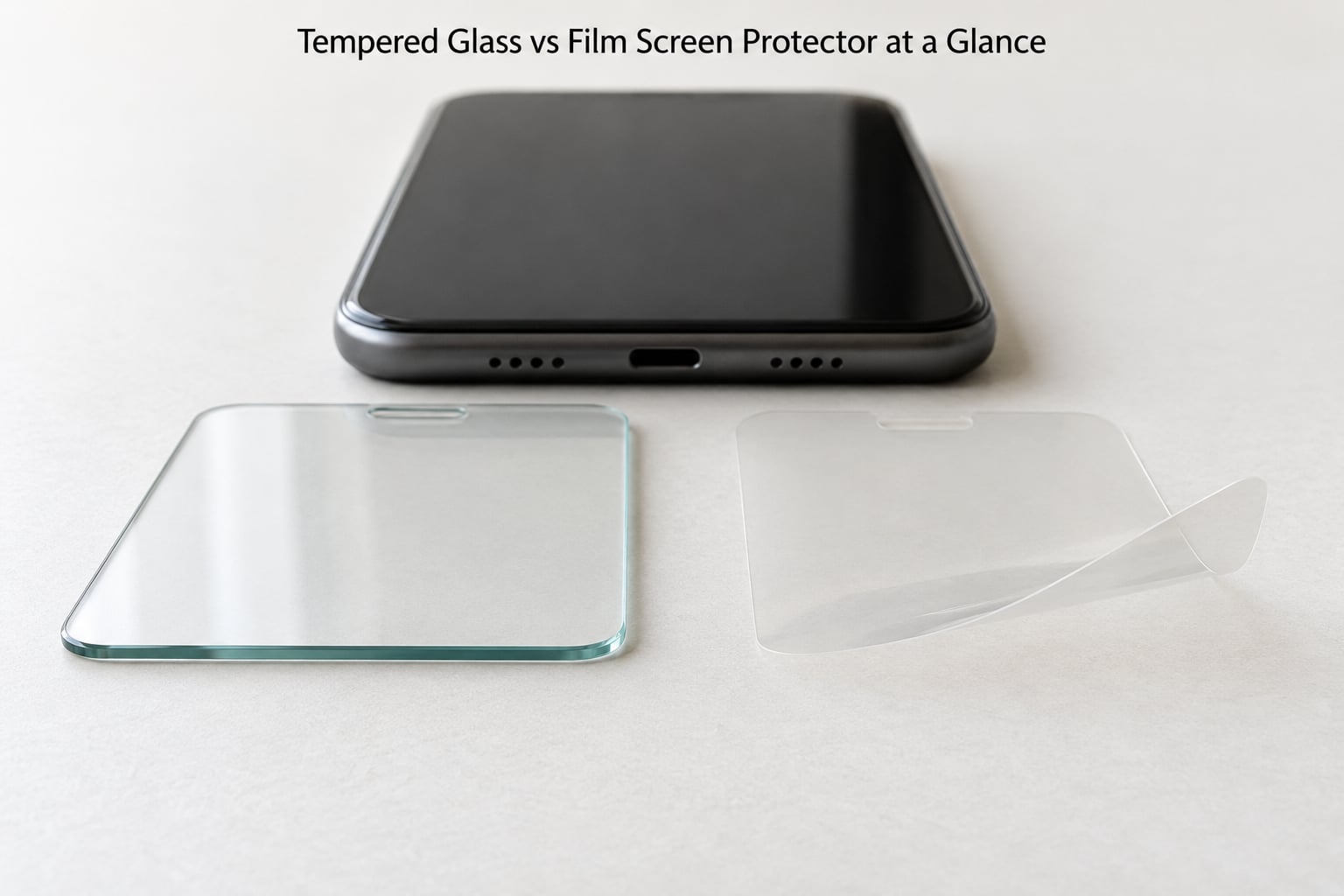
| Criterion | Tempered glass | Film (PET, TPU, hydrogel) |
|---|---|---|
| Main job | Absorbing face-down impact, blocking hard scratches | Blocking scratches, keys, dust abrasion |
| Typical thickness | 0.3mm to 0.5mm | Under 0.2mm |
| Hardness | Harder than the display glass, sold with a 9H scratch claim | Soft, flexible polymer; 9H claims are rare and unreliable |
| Edge coverage | Flat screens only; curved edges stay exposed | Wraps around curved edges, often full coverage |
| Touch feel | Firm, slightly glassy glide | Softer and smoother, closer to the bare screen |
| In-display fingerprint reader | Can slow or break it if too thick or wrongly sized | Usually works better, thinner light path |
| Case fit | Needs a case with a lip that clears the sheet | Thin enough for most snug cases |
| Installation | Frame tray, dust stickers, squeegee; no curing | Wet or dry install; some need UV lamp curing |
| When it fails | Chips at the edge, then spiderwebs across | Clouds, yellows, picks up scratches, loses matte finish |
| Best for | Frequent droppers, pocket-with-keys carriers | Curved screens, stylus users, budget multi-packs |
Drop and Scratch Protection
Glass protects by being a sacrificial layer. The sheet is chemically strengthened so its outer surface sits in compression, which makes it spread impact across the whole panel instead of letting a point hit concentrate on one spot. When it does fail, it fails outward, and the display below stays whole.
That is the single most common report from people who use glass. A protector sitting spiderwebbed across the screen with an intact panel underneath is the whole point of the product, not a malfunction.
Film works differently. A TPU or hydrogel sheet deforms on impact and absorbs a small amount of energy, then slowly pushes minor marks back out. It is genuinely good against the everyday damage that kills a film first: coins, keys, sand in a pocket, a cat claw near the bottom edge. Against a real drop onto concrete it does very little.
Neither material saves you from everything. Here is what a protector genuinely cannot do:
- Corner impacts. A phone landing on a corner drives force straight into the frame. The protector only covers the front glass, so it does nothing at all here.
- Pocket drops face-down onto keys. Glass helps a lot, but a concentrated point impact from a key can still reach the display.
- Bending damage. A phone sat on under load in a back pocket flexes the panel until it cracks. No surface protector touches that.
- Water and liquid damage. Both materials keep residue out of the seams, but neither stops liquid reaching the panel.
- Frame or back glass damage. Cracked back panels are a separate repair from a cracked display.
If corner impacts scare you, the case does more than the protector. A raised-edge case is what turns a cracked back panel into a scuffed bumper.
Thickness and Day-to-Day Feel
Thickness is where film quietly wins. Most quality glass sits between 0.3mm and 0.5mm, and film is usually under 0.2mm. On a flat phone you can see that extra material at the edges, and with a snug case it matters: the case lip presses on the glass sheet, which is the number one cause of lifted edges and lifted corners.
Film slides into a case without argument. You can often leave the case on while replacing a film sheet, which sounds minor until you have done it with glass in a hot car.
Weight is not really a factor. The difference is a fraction of a gram and you will not notice it in a pocket.
Then there is the glass on glass feel. A rigid sheet adds a faint double-tap sensation with a stylus and makes scrolling on a flat screen feel slightly heavier. Film glides closer to the bare panel. Neither is wrong, but people who switch from glass to film rarely go back, while the reverse is common too.
Touch Sensitivity, Clarity, and Fingerprints
Modern touch panels are capacitive, so they sense through anything non-conductive. Responsiveness rarely depends on the protector as long as it is not thick, warped or badly bonded. Where you do notice differences is latency on the edges and how confidently the system registers fast swipes and typing.
Clarity is another area where glass tends to look better. A good optical sheet is nearly invisible. Cheap films add a faint haze or a rainbow oil-slick effect at certain angles, and matte finishes deliberately trade sharpness for killing reflections.
Fingerprints are the real fight. Glass gets an oleophobic coating, the same chemistry as the display glass beneath it, and it smudges far less. Budget films often have a thinner version of that coating or none, so they turn greasy within a day. Matte paper-feel films hide smudges beautifully but blur text and dim contrast, which bothers people who read a lot.
Under-display fingerprint sensors deserve their own paragraph. The sensor fires light through the display and reads the pattern off your finger, so anything on top sits in the optical path. An over-thick or slightly oversized glass sheet can slow recognition or make it fail outright, and users on Galaxy-style phones have reported exactly that before moving to film. If your reader is slow, try a thinner or correctly cut protector before you blame the phone.
Installation and Reusability
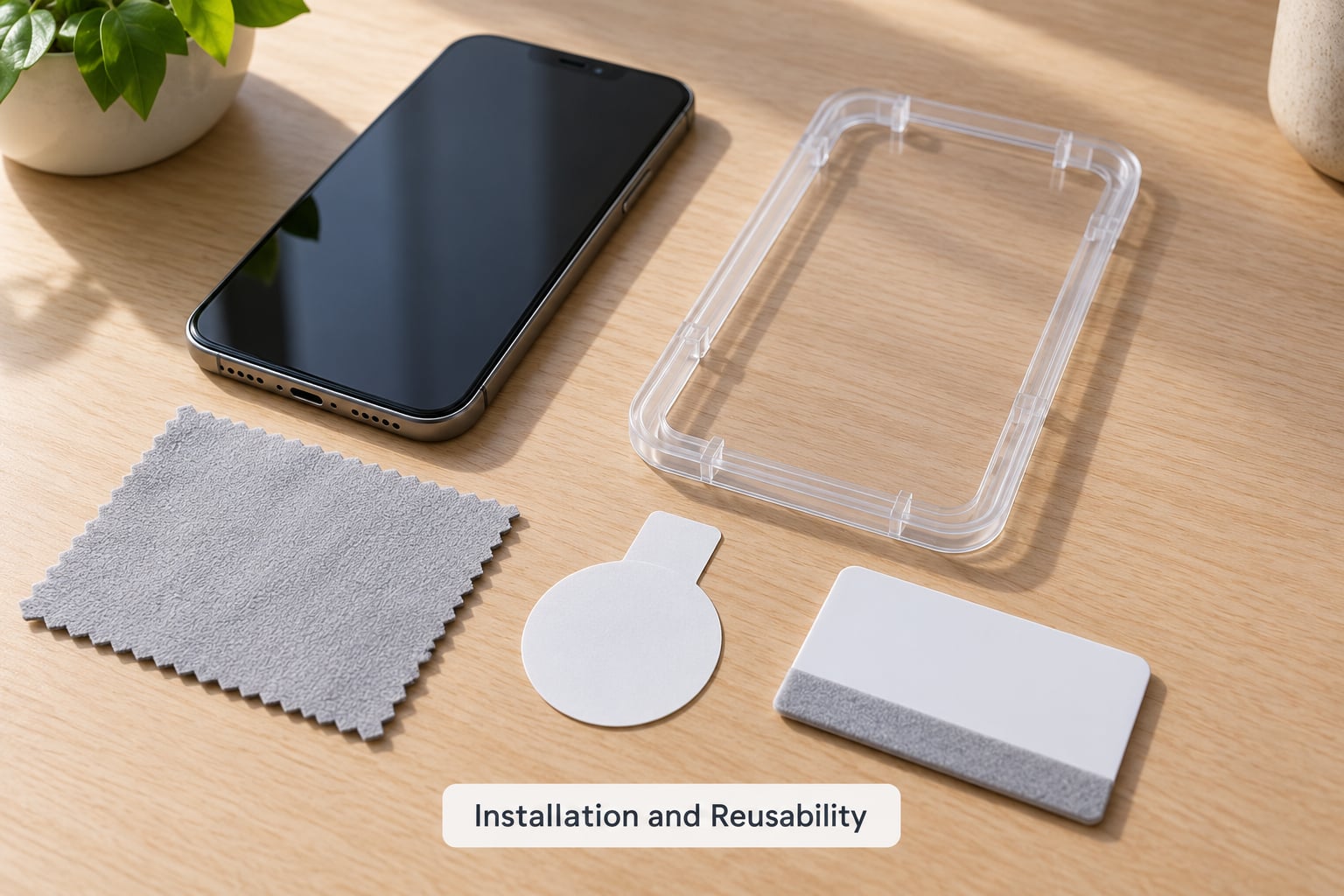
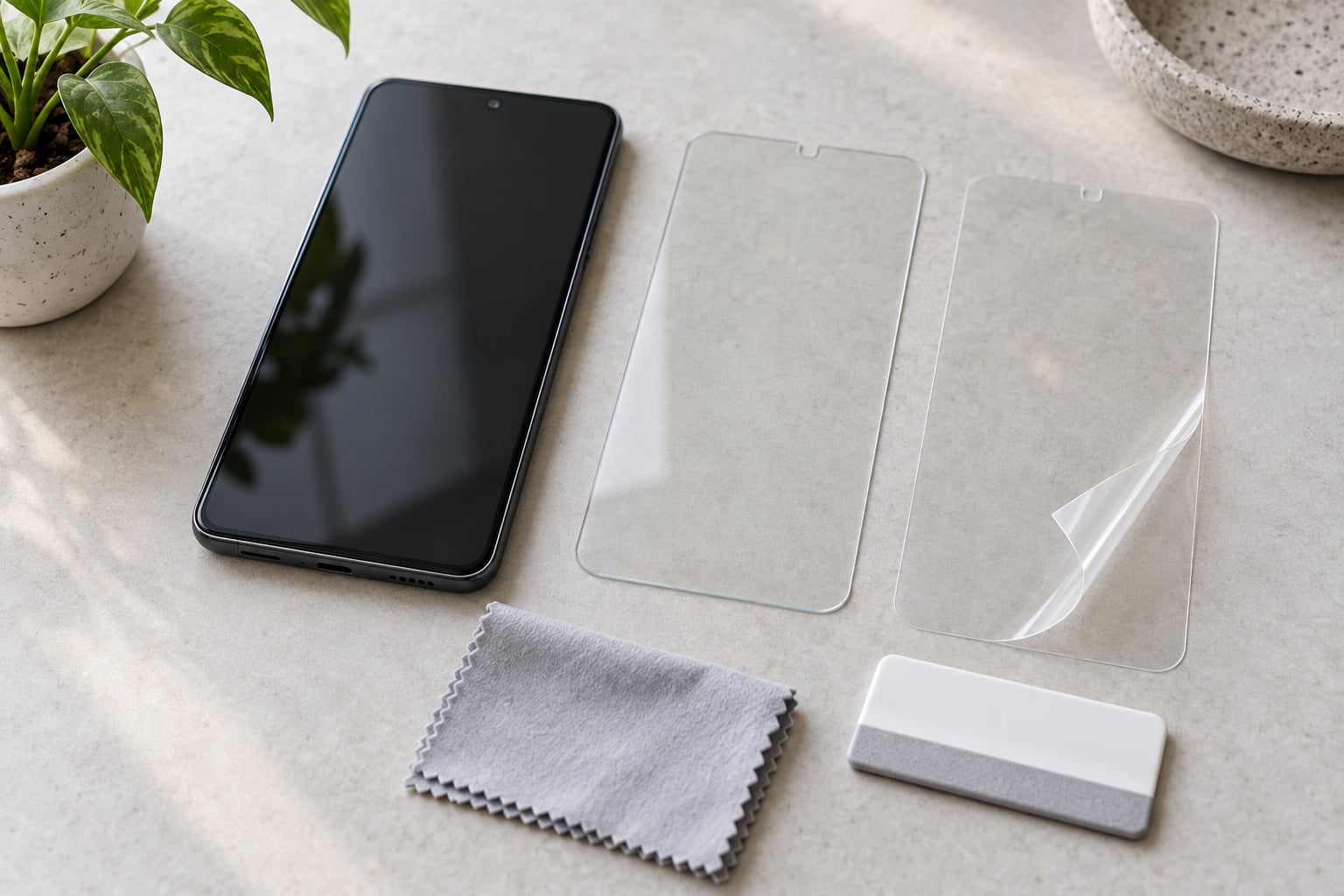
Glass is the easy install. Most sheets come in a tray with an alignment frame, so you drop it in, peel the film backing, lower it straight down and push out with a squeegee. It takes about five minutes and there is no curing time. The risk is dust and a chip from touching the edge with a bare finger, which is why the dust-removal stickers matter more than people expect.
Film has two routes. Dry-install PET or TPU sheets use a sticky backing and a squeegee, and the sheet is forgiving of small specks but hard to reposition once it sticks. Wet-install hydrogel uses a liquid layer with a UV lamp, which gives an almost invisible finish and better edge coverage, but it is unforgiving and one dust speck turns into a bubble you live with.
The steam trick comes up constantly in forums for a reason. Running the phone under a hot shower or hair dryer for a minute reduces static so dust does not jump onto the adhesive. It is one of those small fixes that works.
Neither protector should be removed and reapplied. Film lifts once and the adhesive is spent; glass either shatters or its adhesive layer stretches beyond saving. Treat both as replace-when-needed. Keep a spare sheet on hand, because the moment you notice a chip or a lifted corner is exactly when you will want one.
Replace glass when it chips or the touch near an edge goes strange. Replace film when it clouds, yellows or the edges start peeling up.
Price and Compatibility by Phone Type
Cost follows material in a predictable way. A single sheet of tempered glass is usually pricier than one film sheet, but film is sold in cheap multi-packs and hydrogel sells in pairs. For most people the total spent over the life of a phone still comes out ahead with film, because you replace it two or three times while the glass is still sitting there.
What tips the maths is repair cost rather than accessory cost. A display replacement on a mid-range phone costs a large multiple of what a film multi-pack does, so if your failure mode is drops rather than careful daily handling, spending more on the sheet that cracks first is the sensible trade. Budget buyers who accept replacement are better served by film; drop-prone owners are buying insurance.
Compatibility matters more than either of those. Curved and waterfall displays cannot be covered by a flat glass sheet, so if your phone has a curved edge, glass leaves a visible bare strip or you force an ill-fitting sheet that lifts immediately. Film is the only real option there.
Curved screens, narrow bezels and in-display fingerprint sensors all push toward film. Old budget phones with flat LCD panels, where you can order a case with a wide lip, lean toward glass. New flagships with Gorilla Glass generations already toughened at the surface are arguably fine with either, since the display is no longer the weak point. And on any phone shipped with a pre-applied or pre-boxed protector, the bundled film is usually there to stop shipping scuffs, not drops.
Tempered Glass vs Film Screen Protector: Which One Wins?
Glass wins on hardness, scratch resistance and face-down drop protection. It is a harder material with a rigid structure, and it is the only one of the two that regularly survives a real impact.
Film wins on thickness, flexibility, curved-screen fit, case compatibility and touch feel. It is also cheaper per replacement, which matters more than most people first assume.
Beyond that it is not a quality ranking, it is a fit ranking. The right protector is the one sized for your model and shaped for your screen.
Which Should You Choose?
- Frequent dropper, pockets full of keys: glass, paired with a raised-edge case. This is the one scenario where the extra spend pays off.
- Curved or waterfall display: film. Glass cannot reach the edge and will either leave a bare strip or lift within days.
- Stylus and note-taking: film, ideally a matte paper-feel TPU. It grips the nib better and a rigid sheet makes handwriting feel slippery.
- Slow or unreliable in-display fingerprint reader: film, and check the protector listing for sensor compatibility before buying.
- Gamer or fast scroller: film for glide and responsiveness, glass if you also drop the phone while gaming.
- Dusty outdoor work: film in a wet-install or full-glue build. Glass traps grit against the display and scratches faster than most people expect.
- Privacy on a commute: either material has a privacy variant. Film is thinner and lighter on brightness loss; glass keeps colour truer but narrows viewing angles harder.
- Resale-minded owner: film, replaced regularly, keeps the display free of chips and keeps resale value.
Whatever you choose, confirm the exact model number before you buy. A protector listed for a similar-looking phone will either not cover the sensor area or will fight your case.
Frequently Asked Questions
Does tempered glass stop a phone screen from cracking?
No. It reduces the odds on face-down drops by cracking first, which is exactly the point of a sacrificial sheet. It does nothing for corner impacts, bending damage or a phone squeezed in a back pocket. Pair glass with a raised-edge case, since the case handles the impacts the glass cannot reach.
Is a film screen protector better for touch sensitivity?
Usually yes for everyday use. A film under 0.2mm adds almost nothing between your finger and the touch panel, so swipes and typing register cleanly, and a matte finish can feel more responsive than glossy glass. Very thick glass can feel slightly heavier and introduce a small latency at the edges.
Which protector works best with an under-display fingerprint sensor?
A thin film is the safer choice. The sensor reads a reflected image through the display, so a thick or oversized glass sheet sits in the optical path and can slow recognition or break it. Check the product listing for fingerprint-sensor compatibility, and confirm the cutout matches your exact model before installing.
Does a screen protector protect the camera lenses too?
No. Screen protectors only cover the display glass. The camera lenses and the small flash area sit on the back of the phone and need a separate lens or camera-area protector. Many phone cases include a raised lip or built-in lens guard that covers this area.
How do I choose the right size for my phone?
Match the exact model number, not the marketing name, because screen sizes and bezels change between generations of the same phone. For curved or waterfall displays you need a film designed to wrap the edge, since flat glass cannot cover it. Check the listing for a cutout for the in-display fingerprint sensor and front camera.
Conclusion
Choose tempered glass if your main worry is drops, and pair it with a raised-edge case. Choose film if you want the thinnest, smoothest feel, a curved-screen fit or a protector you can replace every few months.
Before buying either one, confirm the exact model number so the cutouts, sensor area and case fit line up. That single check prevents more problems than the material choice ever will.